
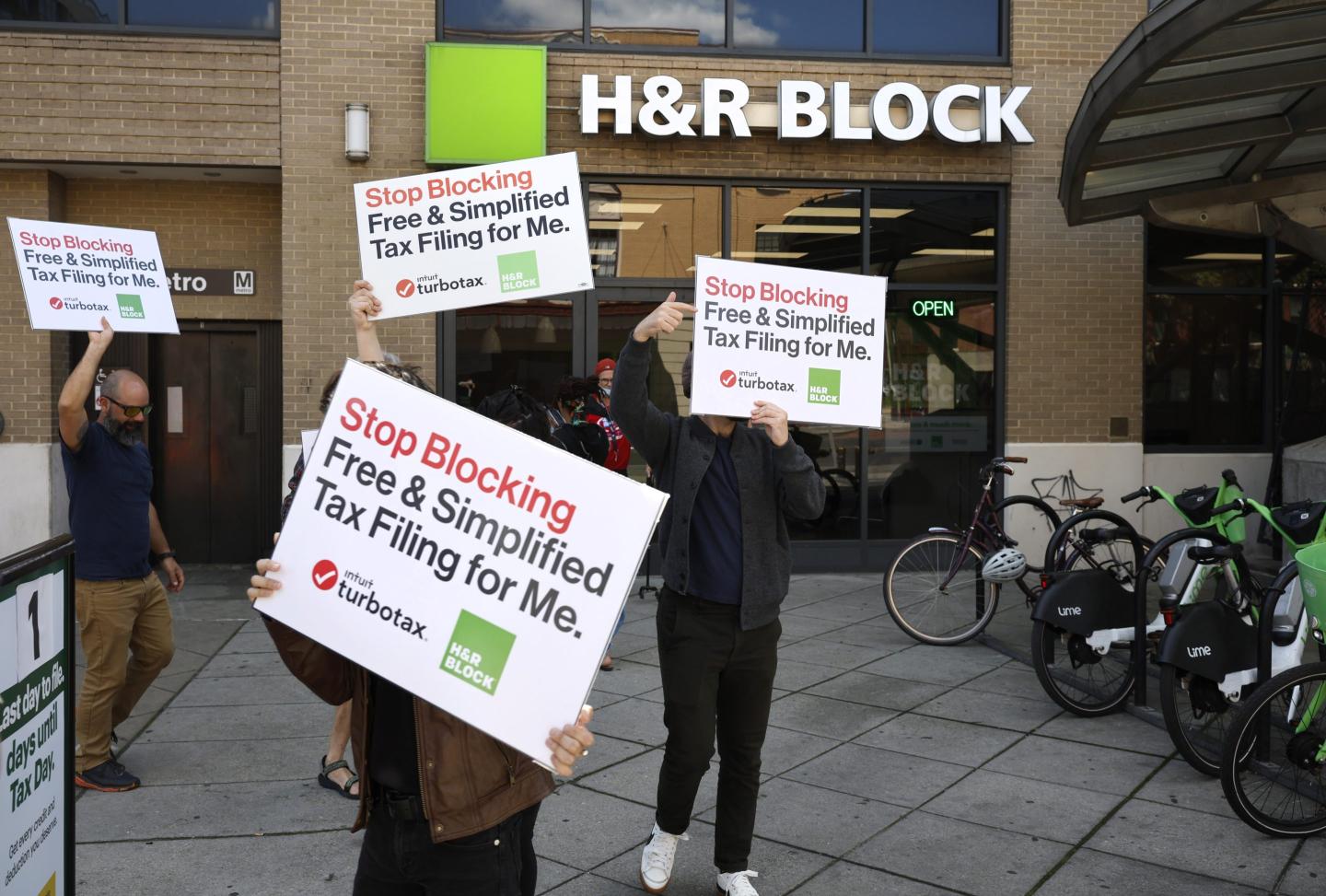
This 2026 tax season is the first in which Americans can’t use Direct File, a short-lived IRS initiative intended to save 30 million Americans time and money they would have otherwise spent getting their taxes done through a private tax preparer. The Direct File program prepared your taxes: listing exactly how much you made and owed, and all for free. But thanks to lobbying efforts from such tax giants like H&R Block and Intuit, that initiative is all but dead, and taxpayers once again are relegated to spending hours and untold amounts on filing their taxes.
The death knell of the Direct File program is in part thanks to more than $103 million in federal lobbying efforts from H&R Block and Intuit alone since 2003 ($20.8 million of which was spent in the past three years alone since Direct File came and went). And now marks the first year following the two-year program that saw an over 90% satisfaction rate from the average American taxpayer. Supporters of the program point to the lobbying efforts by those two tax giants alone as removing a public good to drive the bottom line, while the companies themselves point to the large number of people who use their services compared with the less than 1% of eligible Americans who used the IRS’s service. Whichever side you fall on, here’s a timeline of the past two decades that have culminated in today’s tax filing practices.
It started two decades ago
Between 2002 and 2003, the IRS flirted with building a free online filing system and then backed away, in part owing to private tax preparers that didn’t want to lose their grip on the process. Instead of launching its own tool, the IRS, under pressure to offer a no‑cost electronic filing service, entered into a public‑private partnership with tax prep companies, most prominently Intuit, maker of TurboTax, and H&R Block. In exchange for a promise that the IRS wouldn’t build a direct competitor, the companies agreed to offer certain low‑ and moderate‑income taxpayers free versions of their software through a “Free File” portal.
For the 2025 tax year, you’re eligible for the service if you made $89,000 or less in 2025—and if you are able to click through a series of seemingly never-ending obstacles that will eventually direct you to that free service. For everyone else, the IRS’s short-lived free Direct File program was the closest taxpayers came to having a free tax filing service—and, as experts say, posed such a threat to private tax preparers that the death of the service was inevitable.
“It’s such a clear‑cut example of a really common problem in our politics,” Brookings senior fellow Vanessa Williamson told Fortune. “What’s good for the many has a hard time succeeding in Congress against the narrow loss of a well‑funded small group.”
The public-private partnership, dubbed the Free File Alliance, created the Free File portal—which, since its inception in 2003, over 65 million Americans have used to successfully submit their tax returns. A 2019 ProPublica investigation revealed tax preparers, like the two tax giants among others, would deter people who otherwise qualified from accessing the free software.
“Again and again, we find the profit incentive driving away from quality services,” Williamson said. “You think you’ve clicked the free option, and then you go through the whole process filling out your taxes, and then at the end there’s actually a bill, because somewhere along the way you clicked the wrong button.” The result, she argues, is a “Rube Goldberg device” that embodies “predatory profit‑making at the expense of the public good.”
This caused intense public backlash. Sen. Elizabeth Warren and then-Rep. Katie Porter went on a public campaign against the lobbying efforts by tax preparers, specifically Intuit and H&R Block, and criticized them for effectively rendering the Free File portal unusable for most Americans who qualify for it. Following this publicity, H&R Block left the alliance in 2020, and Intuit shortly followed suit, leaving in 2021. (In a statement to Fortune, an Intuit spokesperson said that reporting didn’t point to the company’s internal data showing more people used its Free File offering in 2019 than the year before. The company says it left the Free File Alliance in 2021 because of limitations in the model, not to kill free filing.)
Neither Porter nor the IRS responded to Fortune’s request for comment. Senator Warren exclusively shared with Fortune remarks ahead of her address to Congress in her introduction of a bill to bring back Direct File.
“This story tells you all you need to know about why Republicans will block my bill today. This is all about money and power. It’s about letting big corporations donate to politicians, and then politicians letting those companies rip off American families,” Warren’s remarks will read later on Tax Day.
“To Republicans who say that it’s already free to file your taxes: Go talk to the millions of people who paid over a hundred bucks to file their taxes this year and ask them how free it was.”
She will also point to the cost of the Iran war, saying: “For just one day of bombing Iran, we could pay for 20 years of Direct File.”
The life and death of great American Direct File
This backlash led to the Biden administration creating an addendum on the Free File Alliance that lifted restrictions previously placed on the IRS that had blocked the agency from creating a competing direct file program when it first entered the alliance nearly two decades earlier. The administration then allocated $15 million to the IRS through the Inflation Reduction Act to study the feasibility of creating a direct free file program, and the study quickly returned positive results. Direct File was built in‑house at the IRS.
The tool launched as a pilot for the 2023 tax year in 12 states. More than 3.3 million people ran the eligibility checker; over 400,000 logged in; and 140,803 filed accepted returns. The Treasury later calculated that those filers claimed more than $90 million in refunds and avoided about $5.6 million in filing fees they otherwise would have paid to private providers. Roughly 90% of surveyed users rated the experience “excellent” or “above average,” and 86% said Direct File increased their trust in the IRS.
“Direct File really was an example of how good government can be,” Williamson said. “It was an example of what it would mean to put the public first in your interactions with government.” Before it launched, she added, the question hanging over return‑free filing was, “Can the government do it?” Afterward, “Yes, they can. And so now it’s just about the political will. It’s not a feasibility question. We know it works.”
That’s precisely what made it dangerous to those companies, said Matt Gardner, a senior fellow at the Institute on Taxation and Economic Policy. These tax preparers “have been fighting like hell for two decades to keep something like Direct File from being introduced,” not because it can’t work, but because “it threatens their market share.” What’s happened in the past year, he said, “is only the latest chapter of a long and really sorry tale of corporate lobbying.”
According to OpenSecrets, since 2003, both preparers spent roughly $103 million on federal lobbying, much of it touching Free File, IRS modernization, and proposals for prefilled returns. Individual years saw millions spent fighting proposed bills that would have allowed the IRS to send taxpayers ready‑made, prefilled returns—last year seeing a record-high combined spend of over $7.1 million from the two companies.
Following the pilot program, the Treasury declared Direct File a permanent option in 2024, and by October that year, officials said the tool would be available in 25 states for the tax year, with more than 30 million taxpayers eligible. In that second season, 296,531 returns were accepted through Direct File, less than 1% (0.7%) of eligible filers but double the first year’s volume.
Critics say that sub-1% figure is troubling. “Today, every American taxpayer can file their taxes completely free of charge, a reality that has existed for decades. Direct File is duplicative and represents an unnecessary use of more than $100 million in taxpayer dollars, re-creating services already available at no cost,” Intuit told Fortune in a statement. “We are proud to have helped more than 140 million Americans file their taxes for free, more than all other tax preparation software companies combined. And we will continue working with government and industry partners to increase awareness and adoption of existing free options, while advocating for meaningful simplification of the tax code to better serve taxpayers.”
Both Gardner and Williamson argue that’s the wrong comparison. Direct File was a deliberately narrow pilot, and success should be measured by user experience and long‑term potential.
“A pilot program is supposed to not be that big,” Williamson said. For Gardner, the Earned Income Tax Credit, which took years to reach the people it was designed to help, is one such example. “You look at some of the most effective anti‑poverty policies we’ve enacted—once people are aware of them, the take‑up really took off,” he said. “There’s every reason to think that, given time, the use of Direct File would go up as well. People just need to be more aware of it.”
He’s also skeptical that industry critics offer an honest read of the numbers. “These are the last people in the world you need to be looking to for an objective evaluation of how effective Direct File is,” Gardner said. “These are exactly the companies who can benefit most from its demise.”
In a statement to Fortune, H&R Block said its “lobbying expenditures have remained steady, reflecting our long-standing practice of responsible advocacy. As a year-round business serving customers in every season, we maintain consistent engagement with policymakers to ensure the voice of working Americans is heard in tax policy discussions and that lawmakers understand the practical effects of changes, big or small.”
Lobbying efforts
Part of the argument from critics is that Congress did not appropriate funds to the IRS to complete the Direct File program. The Center on Budget and Policy Priorities (CBPP) sent Fortune a list of funds allocated to the agency sourced by the Treasury Inspector General for Tax Administration for both the pilot and fiscal year 2025. Through the IRA, the agency received $1.4 million to modernize its system in fiscal year 2023, and received an additional $4.8 million the following year through the IRA. The IRA also allocated $5.8 million to the agency for operations support and taxpayer services. Still, critics argue, that was not approved by Congress.
A December 2024 letter from Rep. Adrian Smith and 28 other House Republicans urged then President‑elect Donald Trump to end Direct File “on day one,” calling it “government overreach” that would improperly “consolidate” the IRS’s roles as preparer, collector, and enforcer.
Gardner sees that rhetoric as lifted directly from industry talking points. “It’s not surprising that we’d see members of Congress basically copying the lobbying language,” he said, given that Intuit, H&R Block, and their peers have been “giving money directly to candidates to help them get elected and stay elected.”
“The IRS is always the one that is the final decider of how much taxes you owe. It doesn’t really matter if they fill in the boxes for you or not,” Williamson said. “If we’re going to talk about who has a conflict of interest, I think that is where I would look first—at for‑profit preparers. Preparers prepare taxes for profit. It’s in the name.”
By November 2025, the second Trump administration had suspended Direct File, and the IRS told states the tool “will not be available” in 2026. The switch that Williamson feared would be flipped was. “You can turn off Direct File,” she said, “but the fact that we could do it is something we all know now. There’s no way to put the genie back in the bottle in terms of the evidence that government can help people.”
For Gardner, that matters because the damage is reversible. “Killing Direct File is not irreversible,” he said. “The work has been done; the research work has been done to put the system in place. It can be brought back. It can be updated.” What can’t be undone easily is the lesson in who benefits from the current system. “We had this brief period when, incredibly, the IRS was given the tools they need to introduce this helpful tool,” he said. “Now, apparently, the Treasury Department and IRS will not have the option. It won’t get the chance to make life easier for millions of taxpayers.”