
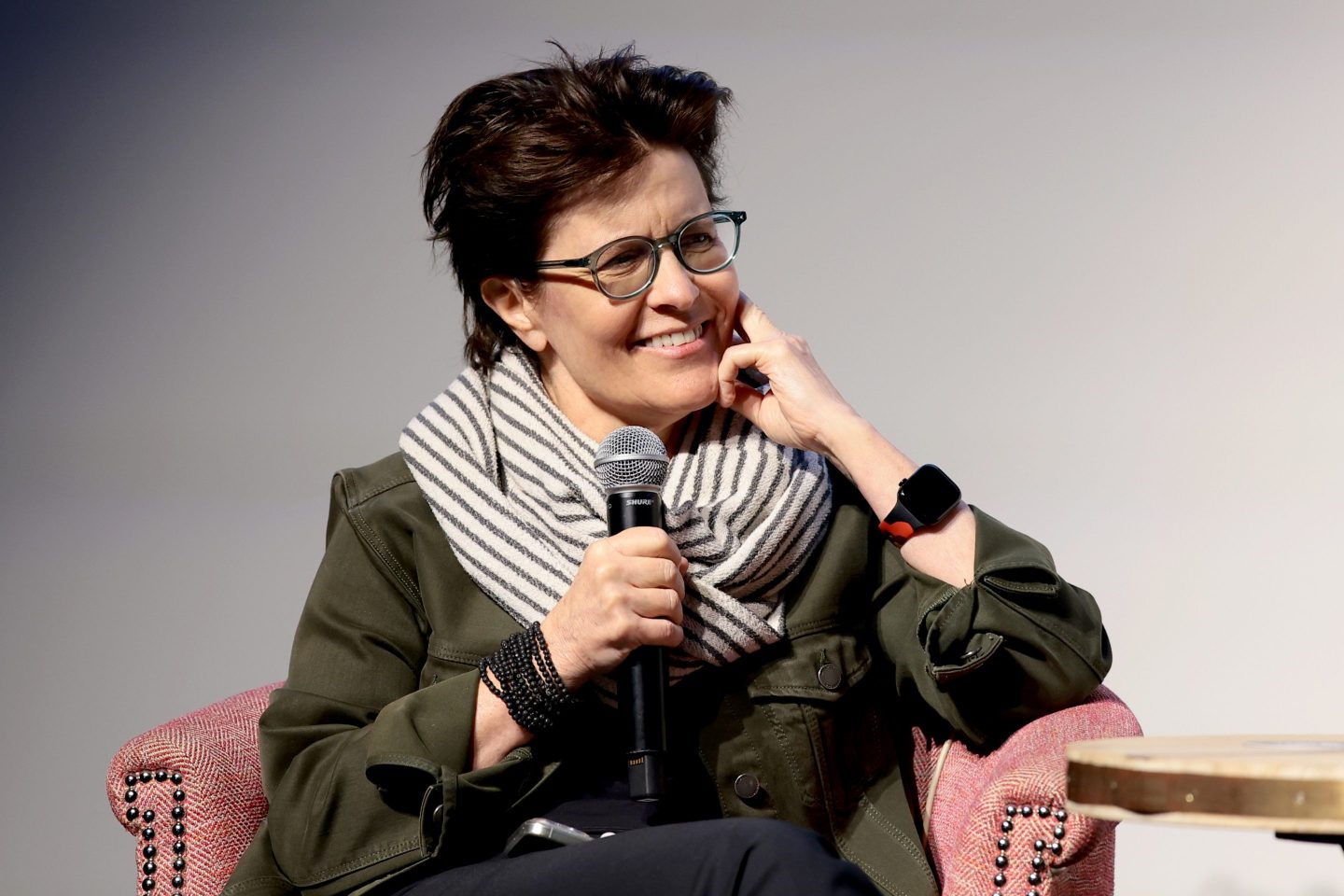
Artificial intelligence has quickly become the defining technology of the moment—promising breakthroughs from curing diseases to making space travel more routine, while also raising fears of widespread job disruption. But Kara Swisher isn’t convinced the technology will live up to the hype.
On a recent episode of her podcast, On With Kara Swisher, the veteran tech journalist argued that AI may be hitting a ceiling—not just because of technical limitations, but because of human resistance.
“Human beings don’t like it,” she bluntly explained.
“Ultimately, [AI] feels like a Twinkie. It tastes like a Twinkie. And I don’t know if they can ever make it taste like an apple, if that makes sense. I don’t know if they can.”
Gen Zers are souring on AI as they see through the ‘fake’ and ‘performative,’ according to Kara Swisher
The path forward for AI companies is already getting steeper as sentiment, particularly among young people, begins to sour. A new survey from the Walton Family Foundation found that just 18% of Gen Zers feel hopeful about using AI, down from 27% the year prior. Nearly one-third of respondents said the technology makes them feel angry.
“I think people are moving faster towards the genuine versus the fake and the performative. I know that with my kids, I can see it. I can see it in the culture,” Swisher added. “People are craving community and people and things like that.”
That skepticism isn’t just abstract. It’s increasingly colliding with the realities of the workplace, where AI is being deployed not only as a productivity tool, but also as a justification for restructuring—and in some cases, reducing headcount. For many younger workers, that shift has turned AI from a distant technological promise into something far more immediate: a threat to the careers they are eager to get off the ground.
In response, some young people have already begun pivoting toward more “AI-proof” career paths, including skilled trades jobs, that are less susceptible to automation. And the shift goes beyond careers: Young people are also pulling back on screen-heavy habits, trading doomscrolling and video games for board games, manual cars, and vinyl records as they seek out more tangible, offline experiences in an increasingly digital world.
As tech companies prepare to cut headcounts in the name of AI, Gen Z is taking note
Earlier this year, payments firm Block became a poster child for major layoffs in the name of AI—cutting its workforce nearly in half from over 10,000 to just under 6,000.
“We’re already seeing that the intelligence tools we’re creating and using, paired with smaller and flatter teams, are enabling a new way of working which fundamentally changes what it means to build and run a company,” Block CEO Jack Dorsey wrote on X.
At Amazon, CEO Andy Jassy similarly said last year that generative AI will likely reduce the need for certain roles.
“We will need fewer people doing some of the jobs that are being done today, and more people doing other types of jobs,” he wrote in a June 2025 letter to Amazon employees. “It’s hard to know exactly where this nets out over time, but in the next few years, we expect that this will reduce our total corporate workforce as we get efficiency gains from using AI extensively across the company.”
The company then went on to cut 14,000 employees in the fall, but Jassy cited the layoffs as a mismatched cultural fit, not “really AI-driven, not right now at least.”
The distinction may be beside the point for the workers affected. AI may not be the sole driver of layoffs, but paired with rising unemployment among young workers, the perception alone is reshaping how Gen Z thinks about the future. Nearly half (48%) say AI’s risks outweigh its benefits in the workplace—up from 37% just a year ago, according to the Walton Family Foundation survey.
The long-term irony could be stark. A workforce hollowed out by automation is also a consumer base hollowed out of their jobs—and resentful toward the technology. The companies racing to replace workers with AI may eventually find themselves with fewer people willing, or able, to buy what they’re selling.