• Home
  • Latest
  • Fortune 500
  • Finance
  • Tech
  • Leadership
  • Lifestyle
  • Rankings
  • Multimedia
EnvironmentWhite House

Newt Gingrich wants to drop a nuke on the Strait of Hormuz. America actually looked at the same thing in 1977 in Latin America

By
The Conversation
The Conversation
and
Christine Keiner
Christine Keiner
Down Arrow Button Icon
By
The Conversation
The Conversation
and
Christine Keiner
Christine Keiner
Down Arrow Button Icon
April 3, 2026, 10:39 AM ET
newt
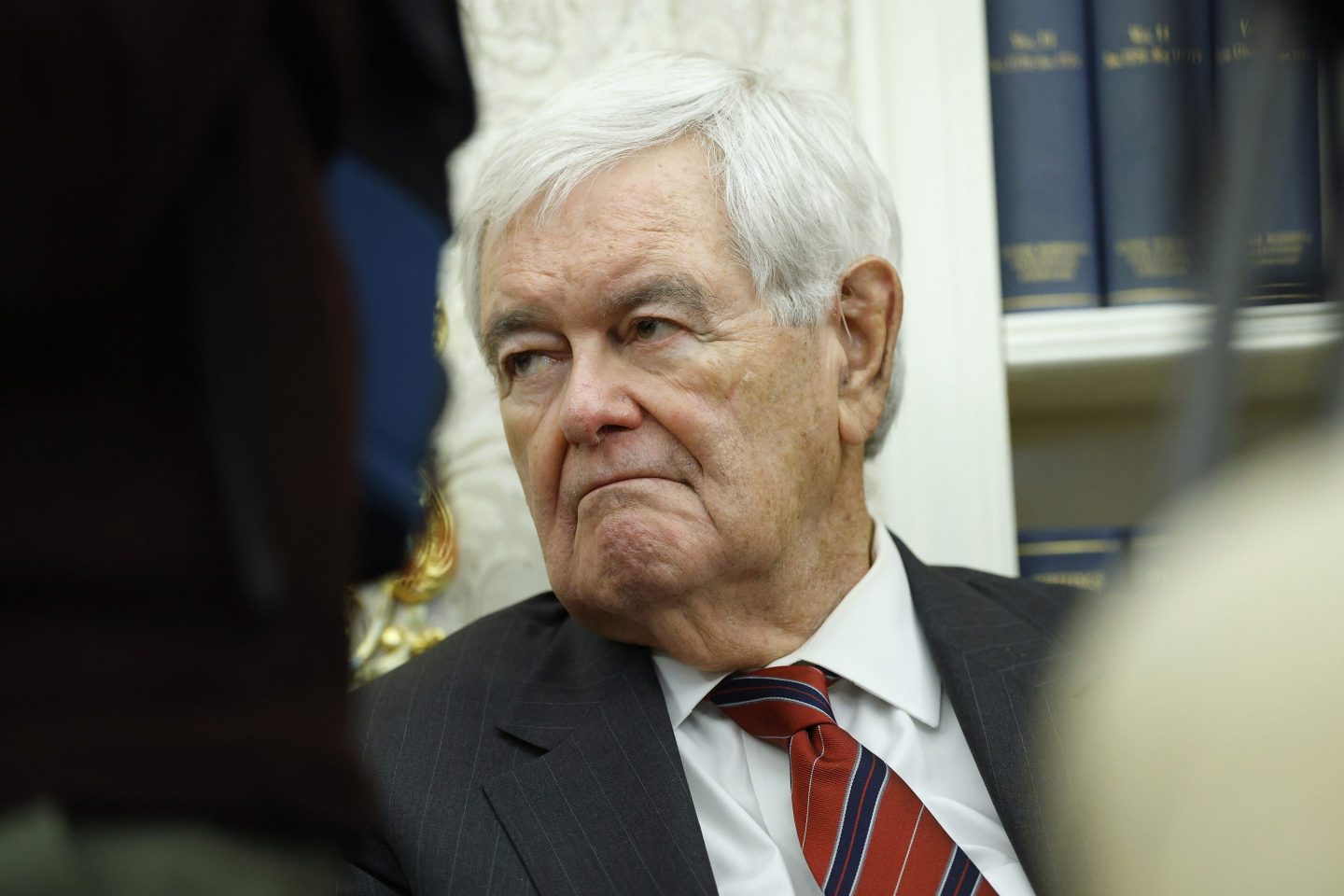
Former Speaker of the House Newt Gingrich during a press conference in the Oval Office of the White House, Oct. 15, 2025. Kevin Dietsch—Getty Images

With the world struggling to get oil supplies moving from the Middle East, former House Speaker Newt Gingrich raised eyebrows with a social media post highlighting a radical idea: Use nuclear bombs to cut a new channel along a route that would avoid Iranian threats in the Strait of Hormuz.

Recommended Video

Gingrich’s March 15, 2026, post linked to an article that labeled itself as satire. Gingrich has not clarified whether his endorsement was serious. But he is old enough to remember when ideas like this were not only taken seriously but actually pursued by the U.S. and Soviet governments.

As I discuss in my book, “Deep Cut: Science, Power, and the Unbuilt Interoceanic Canal,” the U.S. version of this project ended in 1977. At the time, Gingrich was launching his political career after working as a history and environmental studies professor.

Improving global trade and geopolitical influence

The idea for a new canal to move oil from the Middle East had emerged two decades earlier, in the context of another Middle East conflict, the Suez crisis. In 1956, Egypt seized the Suez Canal from British and French control. The canal’s prolonged closure caused the price of oil, tea and other commodities to spike for European consumers, who depended on the shipping shortcut for goods from Asia.

But what if nuclear energy could be harnessed to cut an alternative canal through “friendly territory”? That was the question asked by Edward Teller, the principal architect of the hydrogen bomb, and his fellow physicists at the Lawrence Radiation Laboratory in Livermore, California.

Partially sunken ships block a waterway.
Scuttled ships block one end of the Suez Canal in 1956, sparking an international outcry and conflict. Horace Tonge/NCJ Archive/Mirrorpix via Getty Images

President Dwight D. Eisenhower’s administration had already begun promoting atomic energy to generate electricity and to power submarines. After the Suez crisis, the U.S. government expanded plans to harness “atoms for peace.”

Project Plowshare advocates, led by Teller, sought to use what they called “peaceful nuclear explosions” to reduce the costs of large-scale earthmoving projects and to promote national security. They envisioned a world in which nuclear explosives could help extract natural gas from underground reservoirs and build new canals, harbors and mountainside roads, with minimal radioactive effects.

To kick-start the program, Teller wanted to create an instant harbor by burying, and then detonating, five thermonuclear bombs in an Indigenous village in coastal northwestern Alaska. The plan, known as Project Chariot, generated intense debate, as well as a pioneering environmental study of Arctic food webs.

Teller and the Livermore physicists also worked with the Army Corps of Engineers to study the possibility of using nuclear explosions to build another waterway in Panama. Fearing that the aging Panama Canal and its narrow locks would soon be rendered obsolete, U.S. officials had called for building a wider, deeper channel that wouldn’t require any locks to raise and lower the ships along its route.

A sea-level canal would not only fit bigger vessels; it would also be simpler to operate than the lock-based system, which required thousands of employees. Since the early 1900s, U.S. canal workers and their families had lived in the Canal Zone, a large strip of land surrounding the waterway. Panamanians increasingly resented having their country split in two by the racially segregated, colony-like zone.

A group of people holding hand tools stand next to a large pile of soil.
Building the Panama Canal involved backbreaking manual labor. Bettmann via Getty Images

Crossing Central America

Nuclear explosions appeared to make a new sea-level canal financially feasible. The greatest impetus for the so-called Panatomic Canal occurred in January 1964, when violent anti-U.S. protests erupted in Panama. President Lyndon B. Johnson responded to the crisis by agreeing to negotiate new political agreements with Panama.

Johnson appointed the Atlantic-Pacific Interoceanic Canal Study Commission to determine the best site to use nuclear explosions to blast a seaway between the two oceans. Funded by a $17.5 million congressional appropriation – the equivalent of around $185 million today – the five civilian commissioners focused on two routes: one in eastern Panama and the other in western Colombia.

The Panamanian route spanned forested river valleys of the Darién isthmus and reached 1,100 feet above sea level. To excavate this landscape, engineers proposed setting off 294 nuclear explosives along the route, in 14 separate detonations, using the explosive equivalent of 166.4 million tons of TNT.

This was a mind-blowing amount of energy: The most powerful nuclear weapon ever tested, the Soviet “Tsar Bomba” blast in 1961, released the energy equivalent to 50 million tons of TNT.

To avoid the radioactivity and ground shocks, planners estimated that approximately 30,000 people, half of them Indigenous, would have to be evacuated and resettled. The canal commission considered this a formidable but not impossible obstacle, writing in its final report, “The problems of public acceptance of nuclear canal excavation probably could be solved through diplomacy, public education, and compensating payments.” https://www.youtube.com/embed/YtCTzbh4mNQ?wmode=transparent&start=0 In 2020, the Russian government declassified this footage of the “Tsar Bomba” test blast from 1961.

A not-so-hot idea, in retrospect

As explored in my book, marine and evolutionary biologists of the late 1960s sought to study the project’s less obvious environmental effects. Among other potential catastrophes, scientists warned that a sea-level canal could unleash “mutual invasions of Atlantic and Pacific organisms” by joining the oceans on either side of the isthmus for the first time in 3 million years.

Plans for the nuclear waterway ended by the early 1970s, not over concerns about marine invasive species but rather due to other complex issues. These included the difficulties of testing nuclear explosions for peaceful purposes without violating the Limited Nuclear Test Ban Treaty of 1963 and the huge budget deficits caused by the Vietnam War.

Despite the geopolitical and financial constraints, the sea-level canal studies employed hundreds of researchers who increased knowledge of the isthmus and its human and nonhuman inhabitants. Ironically, the studies revealed that wet clay shale rocks along the Darién route meant nuclear explosives might not work well there.

The cover of a bound book.
The cover of the final report of a commission that studied blasting a canal across Central America with ‘peaceful nuclear explosions.’ Atlantic-Pacific Interoceanic Canal Study Commission via University of Florida

But for Project Plowshare’s biggest proponents, atomic excavation remained a worthwhile goal. In 1970, in their final report, the canal commissioners predicted that “someday nuclear explosions will be used in a wide variety of massive earth-moving projects.” Teller shared their commitment, as he explained near the end of his life in the 2000 documentary “Nuclear Dynamite.”

Today, given widespread awareness of the severe environmental and health effects of radioactive fallout, it is hard to envision a time when using nuclear bombs to build canals seemed reasonable. Even before Gingrich’s post sparked ridicule, press accounts described Project Plowshare using words like “wacky,” “insane” and “crazy.”

However, as societies struggle with disruptive new technologies such as generative AI and cryptocurrency, it is worth remembering that many ideas that ended up discredited once seemed not only sensible but inevitable.

As historians of science and technology point out, technological and scientific developments cannot be separated from their cultural contexts. Moreover, the technologies that become part of people’s daily lives often do so not because they are inherently superior, but because powerful interests champion them.

It makes me wonder: Which of the high-tech trends being promoted by influencers today will amuse, shock and horrify our descendants?

Christine Keiner, Chair of the Department of Science, Technology, and Society, Rochester Institute of Technology

This article is republished from The Conversation under a Creative Commons license. Read the original article.


The Conversation
The Fortune 500 Innovation Forum will convene Fortune 500 executives, U.S. policy officials, top founders, and thought leaders to help define what’s next for the American economy, Nov. 16-17 in Detroit. Apply here.
About the Authors
By The Conversation
See full bioRight Arrow Button Icon
By Christine Keiner
See full bioRight Arrow Button Icon

Latest in Environment

Finance
Lorem ipsum dolor sit amet, consectetur adipiscing elit, sed do eiusmod tempor incididunt ut labore et dolore magna aliqua. Ut enim ad minim veniam
By Fortune Editors
October 20, 2025
Finance
Lorem ipsum dolor sit amet, consectetur adipiscing elit, sed do eiusmod tempor incididunt ut labore et dolore magna aliqua. Ut enim ad minim veniam
By Fortune Editors
October 20, 2025
Finance
Lorem ipsum dolor sit amet, consectetur adipiscing elit, sed do eiusmod tempor incididunt ut labore et dolore magna aliqua. Ut enim ad minim veniam
By Fortune Editors
October 20, 2025
Finance
Lorem ipsum dolor sit amet, consectetur adipiscing elit, sed do eiusmod tempor incididunt ut labore et dolore magna aliqua. Ut enim ad minim veniam
By Fortune Editors
October 20, 2025
Finance
Lorem ipsum dolor sit amet, consectetur adipiscing elit, sed do eiusmod tempor incididunt ut labore et dolore magna aliqua. Ut enim ad minim veniam
By Fortune Editors
October 20, 2025
Finance
Lorem ipsum dolor sit amet, consectetur adipiscing elit, sed do eiusmod tempor incididunt ut labore et dolore magna aliqua. Ut enim ad minim veniam
By Fortune Editors
October 20, 2025

Most Popular

Finance
Lorem ipsum dolor sit amet, consectetur adipiscing elit, sed do eiusmod tempor incididunt ut labore et dolore magna aliqua. Ut enim ad minim veniam
By Fortune Editors
October 20, 2025
Finance
Lorem ipsum dolor sit amet, consectetur adipiscing elit, sed do eiusmod tempor incididunt ut labore et dolore magna aliqua. Ut enim ad minim veniam
By Fortune Editors
October 20, 2025
Finance
Lorem ipsum dolor sit amet, consectetur adipiscing elit, sed do eiusmod tempor incididunt ut labore et dolore magna aliqua. Ut enim ad minim veniam
By Fortune Editors
October 20, 2025
Finance
Lorem ipsum dolor sit amet, consectetur adipiscing elit, sed do eiusmod tempor incididunt ut labore et dolore magna aliqua. Ut enim ad minim veniam
By Fortune Editors
October 20, 2025
Finance
Lorem ipsum dolor sit amet, consectetur adipiscing elit, sed do eiusmod tempor incididunt ut labore et dolore magna aliqua. Ut enim ad minim veniam
By Fortune Editors
October 20, 2025
Finance
Lorem ipsum dolor sit amet, consectetur adipiscing elit, sed do eiusmod tempor incididunt ut labore et dolore magna aliqua. Ut enim ad minim veniam
By Fortune Editors
October 20, 2025
Fortune Secondary Logo
Rankings
  • 100 Best Companies
  • Fortune 500
  • Global 500
  • Fortune 500 Europe
  • Most Powerful Women
  • Future 50
  • World’s Most Admired Companies
  • See All Rankings
Sections
  • Finance
  • Fortune Crypto
  • Features
  • Leadership
  • Health
  • Commentary
  • Success
  • Retail
  • Mpw
  • Tech
  • Lifestyle
  • CEO Initiative
  • Asia
  • Politics
  • Conferences
  • Europe
  • Newsletters
  • Personal Finance
  • Environment
  • Magazine
  • Education
Customer Support
  • Frequently Asked Questions
  • Customer Service Portal
  • Privacy Policy
  • Terms Of Use
  • Single Issues For Purchase
  • International Print
Commercial Services
  • Advertising
  • Fortune Brand Studio
  • Fortune Analytics
  • Fortune Conferences
  • Business Development
  • Group Subscriptions
About Us
  • About Us
  • Editorial Calendar
  • Press Center
  • Work At Fortune
  • Diversity And Inclusion
  • Terms And Conditions
  • Site Map
  • About Us
  • Editorial Calendar
  • Press Center
  • Work At Fortune
  • Diversity And Inclusion
  • Terms And Conditions
  • Site Map
  • Facebook icon
  • Twitter icon
  • LinkedIn icon
  • Instagram icon
  • Pinterest icon

Latest in Environment

newt
EnvironmentWhite House
Newt Gingrich wants to drop a nuke on the Strait of Hormuz. America actually looked at the same thing in 1977 in Latin America
By The Conversation and Christine KeinerApril 3, 2026
3 hours ago
Workers on the production line of solar panels in China
EnergyRenewables
After renewable power’s record-smashing 2025, the Iran war could accelerate the shift as countries seek ‘structurally more resilient’ energy, UN says
By Tristan BoveApril 2, 2026
24 hours ago
china
AIChina
Meet China’s AI-powered recycling robot that sorts 220 pounds of clothes in 2 to 3 minutes
By Tian MacLeod Ji and The Associated PressApril 2, 2026
1 day ago
A chip research center site operations manager stands next to a window overlooking the facility.
EnvironmentData centers
Data centers are so hot their ‘heat island’ effect is raising temperatures up to 6 miles away and impacting 343 million people worldwide, study finds
By Sasha RogelbergApril 1, 2026
2 days ago
trump
CommentaryEPA
The EPA just valued a human life at $0. That’s not just a moral crisis — it’s a market crisis
By Andrew BeharApril 1, 2026
2 days ago
rice's whale
Environmentendangered species
Trump’s plan to drill for oil in the Gulf of Mexico could be foiled by just 50 survivors of a rare whale species
By Tammy Webber and The Associated PressMarch 31, 2026
3 days ago

Most Popular

Gen Z fled San Francisco for Texas and Florida. Now they’re turning ‘welcomer cities’ into the next big tech towns
Real Estate
Gen Z fled San Francisco for Texas and Florida. Now they’re turning ‘welcomer cities’ into the next big tech towns
By Fortune EditorsApril 2, 2026
1 day ago
Major 4-day workweek study suggests that when we work 5 days we spend one doing basically nothing
Success
Major 4-day workweek study suggests that when we work 5 days we spend one doing basically nothing
By Fortune EditorsApril 2, 2026
1 day ago
Current price of oil as of April 2, 2026
Personal Finance
Current price of oil as of April 2, 2026
By Fortune EditorsApril 2, 2026
1 day ago
Paul Krugman smacks down Trump speech with argument that $4 gas is ‘less than half’ of the Hormuz hit. Here’s what he’s talking about
Economy
Paul Krugman smacks down Trump speech with argument that $4 gas is ‘less than half’ of the Hormuz hit. Here’s what he’s talking about
By Fortune EditorsApril 2, 2026
22 hours ago
Current price of gold as of April 1, 2026
Personal Finance
Current price of gold as of April 1, 2026
By Fortune EditorsApril 1, 2026
2 days ago
Trump wants to add nearly $7 trillion to the $39 trillion national debt with his new military budget, watchdog warns
Economy
Trump wants to add nearly $7 trillion to the $39 trillion national debt with his new military budget, watchdog warns
By Fortune EditorsApril 2, 2026
21 hours ago

© 2026 Fortune Media IP Limited. All Rights Reserved. Use of this site constitutes acceptance of our Terms of Use and Privacy Policy | CA Notice at Collection and Privacy Notice | Do Not Sell/Share My Personal Information
FORTUNE is a trademark of Fortune Media IP Limited, registered in the U.S. and other countries. FORTUNE may receive compensation for some links to products and services on this website. Offers may be subject to change without notice.