• Home
  • Latest
  • Fortune 500
  • Finance
  • Tech
  • Leadership
  • Lifestyle
  • Rankings
  • Multimedia
EnergyAlternative energy
Asia

The Iran war is accelerating plans for Southeast Asia to go nuclear. Experts say it won’t be easy

Angelica Ang
By
Angelica Ang
Angelica Ang
Writer
Down Arrow Button Icon
Angelica Ang
By
Angelica Ang
Angelica Ang
Writer
Down Arrow Button Icon
April 1, 2026, 4:08 AM ET
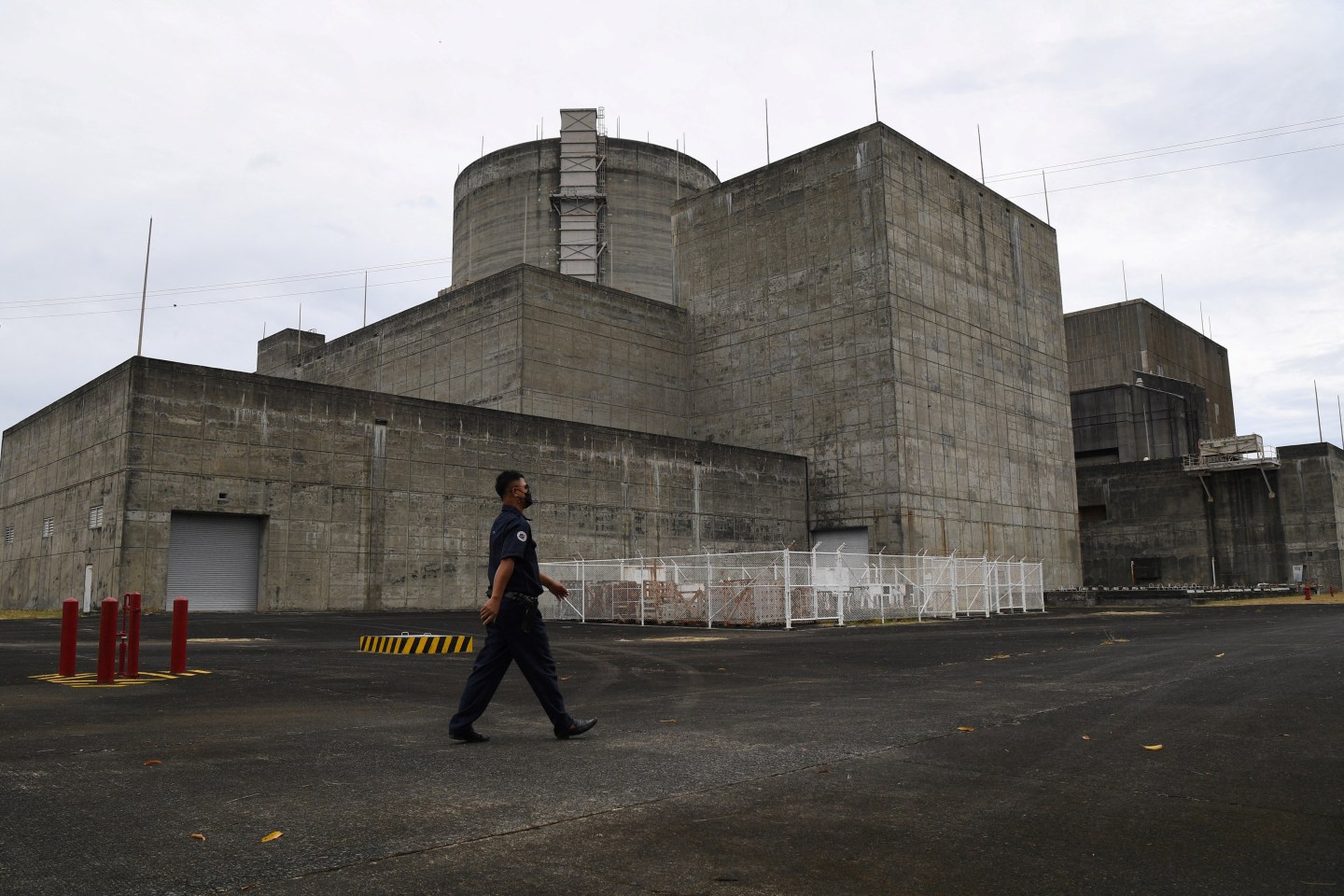
The region’s first attempt at nuclear power, the Bataan Nuclear Power Plant, was built in the Philippines in 1976. Ordered by President Ferdinand Marcos in the wake of the 1973 oil shock, the plant was completed in 1984 at a cost of roughly $2.2 billion. But the plant was never used, due to accusations of government corruption and waning public support for nuclear energy following the Chernobyl disaster in 1986.
The region’s first attempt at nuclear power, the Bataan Nuclear Power Plant, was built in the Philippines in 1976. Ordered by President Ferdinand Marcos in the wake of the 1973 oil shock, the plant was completed in 1984 at a cost of roughly $2.2 billion. But the plant was never used, due to accusations of government corruption and waning public support for nuclear energy following the Chernobyl disaster in 1986.TED ALJIBE VIA GETTY IMAGES

The last time an energy crisis pushed Southeast Asia to consider nuclear energy, it led to a $2.2 billion plant in the Philippines that never got switched on.

Half a century later, a new crisis is pressing the region to start thinking about nuclear again. Global oil and gas prices have surged since Iran closed the Strait of Hormuz, the world’s most critical energy chokepoint. Southeast Asia, comprised mainly of net energy importers, has been hit especially hard by rising energy prices, accelerating plans to drive down energy usage. 

Recommended Video

On March 23, Vietnam and Russia signed a deal to build a nuclear power plant in Vietnam’s Ninh Thuan province. The plant, set to come online in a decade, will be Southeast Asia’s first modern nuclear power plant. Malaysia, Indonesia, Thailand, and the Philippines have also signaled their intention to build nuclear capacity.

“Previously, the clean energy transition in the region was mainly driven by economic considerations—particularly the growing expectations from companies for access to low-carbon electricity,” Tan-Soo Jie Sheng, a professor at the Lee Kuan Yew School of Public Policy in the National University of Singapore (NUS), tells Fortune. “However, geopolitical shocks like the Iran war bring the energy security dimension back into sharper focus.”

Southeast Asia’s previous attempt to go nuclear

The region’s first attempt at nuclear power, the Bataan Nuclear Power Plant, was built in the Philippines in 1976. Commissioned by President Ferdinand Marcos in the wake of the 1973 oil shock, the plant was completed in 1984 at a cost of roughly $2.2 billion. But the plant was never used, due to accusations of government corruption and waning public support for nuclear energy following the Chernobyl disaster in 1986. 

“Marcos’ successor said that the plant was corruption-tainted—which is true—and claimed it was substandard and too dangerous to operate,” says Julius Cesar I. Trajano, a research fellow at Singapore’s Nanyang Technological University.

In recent years, rising energy demand, spurred in part by an explosion of AI data centers, is pushing several Southeast Asian nations to start reconsidering nuclear energy. In 2024, data centers consumed 415TWh, or 1.5% of the world’s electricity, according to the International Energy Agency; the organization also noted power usage had risen by 12% annually over the past five years.

“Unlike weather-dependent renewables like solar and wind energy, nuclear gives round-the-clock low-carbon electricity,” explains Tan-Soo of NUS. “That matters in Southeast Asia because electricity demand is rising fast, grids are uneven and governments want cleaner power without sacrificing reliability.”

Indonesia added nuclear power to its energy plan last year, with hopes to build two small modular reactors (SMRs) by 2034. Thailand wants to add 600 MW of nuclear generating capacity by 2037. 

Advances in nuclear technology, like SMRs, have made modern nuclear plants safer, according to Alvin Chew, a senior research fellow at NTU. SMRs are reactors of up to 300 MW per unit, which are about one third the size of conventional large reactors. SMRs could be better suited to Southeast Asia, as they can be added to remote areas like islands and be connected to smaller or less-developed grids.

Major challenges

Yet experts caution against being too optimistic about nuclear power, due to gaps in technological and institutional development.

Many SMR designs are still in the early stages of commercialization, so “there is no guarantee they will be cheaper, more mobile and safer,” Ian Storey, a principal fellow from Singapore’s ISEAS-Yusof Ishak Institute, explains. “There are only two experimental SMRs in operation, one in China and one in Russia. The rest exist only on paper.”

Others, like Joshua Kurlantzick, a senior fellow at the Council on Foreign Relations, point to low public acceptance for nuclear. “In most of Southeast Asia, except the Philippines where there is very strong support for nuclear energy, members of the public remain cautious about it, especially in countries like Indonesia which have a history of earthquakes and tsunamis,” he explains.

A 2021 survey from NTU reported low support for nuclear energy among the region’s population. Indonesia was the most receptive to nuclear, with 39% support; Thailand had the lowest share of support, at just 3%.

Public concerns may rise once nuclear projects get started. “The public’s rating of the risks of nuclear energy will likely change dramatically when presented with an imminent reality closer to home,” suggests Catherine Wong, an environmental sociologist from the University of Amsterdam.

Nuclear plants are also capital-intensive and time-consuming to build. “Nuclear is hard to do well,” explains Tan-Soo. “It requires a capable regulator, long-term political continuity, strong utilities, grid readiness, emergency planning, waste arrangements, and financing discipline. For many countries, those institutional requirements are often more difficult than the technology itself.”

Finally, there’s the security dimension. “The 21st century era of drone and cyber warfare makes nuclear power even harder to secure,” Wong suggests. That’s in contrast to more decentralized renewable energy: “You can take out five or even fifty wind turbines, and there will still be hundreds more spread across the country supplying electricity to the population.”

The Fortune 500 Innovation Forum will convene Fortune 500 executives, U.S. policy officials, top founders, and thought leaders to help define what’s next for the American economy, Nov. 16-17 in Detroit. Apply here.
About the Author
Angelica Ang
By Angelica AngWriter

Angelica Ang is a Singapore-based journalist who covers the Asia-Pacific region.

See full bioRight Arrow Button Icon

Latest in Energy

Finance
Lorem ipsum dolor sit amet, consectetur adipiscing elit, sed do eiusmod tempor incididunt ut labore et dolore magna aliqua. Ut enim ad minim veniam
By Fortune Editors
October 20, 2025
Finance
Lorem ipsum dolor sit amet, consectetur adipiscing elit, sed do eiusmod tempor incididunt ut labore et dolore magna aliqua. Ut enim ad minim veniam
By Fortune Editors
October 20, 2025
Finance
Lorem ipsum dolor sit amet, consectetur adipiscing elit, sed do eiusmod tempor incididunt ut labore et dolore magna aliqua. Ut enim ad minim veniam
By Fortune Editors
October 20, 2025
Finance
Lorem ipsum dolor sit amet, consectetur adipiscing elit, sed do eiusmod tempor incididunt ut labore et dolore magna aliqua. Ut enim ad minim veniam
By Fortune Editors
October 20, 2025
Finance
Lorem ipsum dolor sit amet, consectetur adipiscing elit, sed do eiusmod tempor incididunt ut labore et dolore magna aliqua. Ut enim ad minim veniam
By Fortune Editors
October 20, 2025
Finance
Lorem ipsum dolor sit amet, consectetur adipiscing elit, sed do eiusmod tempor incididunt ut labore et dolore magna aliqua. Ut enim ad minim veniam
By Fortune Editors
October 20, 2025

Most Popular

Finance
Lorem ipsum dolor sit amet, consectetur adipiscing elit, sed do eiusmod tempor incididunt ut labore et dolore magna aliqua. Ut enim ad minim veniam
By Fortune Editors
October 20, 2025
Finance
Lorem ipsum dolor sit amet, consectetur adipiscing elit, sed do eiusmod tempor incididunt ut labore et dolore magna aliqua. Ut enim ad minim veniam
By Fortune Editors
October 20, 2025
Finance
Lorem ipsum dolor sit amet, consectetur adipiscing elit, sed do eiusmod tempor incididunt ut labore et dolore magna aliqua. Ut enim ad minim veniam
By Fortune Editors
October 20, 2025
Finance
Lorem ipsum dolor sit amet, consectetur adipiscing elit, sed do eiusmod tempor incididunt ut labore et dolore magna aliqua. Ut enim ad minim veniam
By Fortune Editors
October 20, 2025
Finance
Lorem ipsum dolor sit amet, consectetur adipiscing elit, sed do eiusmod tempor incididunt ut labore et dolore magna aliqua. Ut enim ad minim veniam
By Fortune Editors
October 20, 2025
Finance
Lorem ipsum dolor sit amet, consectetur adipiscing elit, sed do eiusmod tempor incididunt ut labore et dolore magna aliqua. Ut enim ad minim veniam
By Fortune Editors
October 20, 2025
Fortune Secondary Logo
Rankings
  • 100 Best Companies
  • Fortune 500
  • Global 500
  • Fortune 500 Europe
  • Most Powerful Women
  • Future 50
  • World’s Most Admired Companies
  • See All Rankings
Sections
  • Finance
  • Fortune Crypto
  • Features
  • Leadership
  • Health
  • Commentary
  • Success
  • Retail
  • Mpw
  • Tech
  • Lifestyle
  • CEO Initiative
  • Asia
  • Politics
  • Conferences
  • Europe
  • Newsletters
  • Personal Finance
  • Environment
  • Magazine
  • Education
Customer Support
  • Frequently Asked Questions
  • Customer Service Portal
  • Privacy Policy
  • Terms Of Use
  • Single Issues For Purchase
  • International Print
Commercial Services
  • Advertising
  • Fortune Brand Studio
  • Fortune Analytics
  • Fortune Conferences
  • Business Development
  • Group Subscriptions
About Us
  • About Us
  • Editorial Calendar
  • Press Center
  • Work At Fortune
  • Diversity And Inclusion
  • Terms And Conditions
  • Site Map
  • About Us
  • Editorial Calendar
  • Press Center
  • Work At Fortune
  • Diversity And Inclusion
  • Terms And Conditions
  • Site Map
  • Facebook icon
  • Twitter icon
  • LinkedIn icon
  • Instagram icon
  • Pinterest icon

Latest in Energy

Photo: Donald and Melania Trump.
PoliticsMarkets
Trump has no good options in Iran—here are 5 of them ahead of his speech to the nation tonight
By Jim EdwardsApril 1, 2026
58 minutes ago
The Iran war is accelerating plans for Southeast Asia to go nuclear. Experts say it won’t be easy
EnergyAlternative energy
The Iran war is accelerating plans for Southeast Asia to go nuclear. Experts say it won’t be easy
By Angelica AngApril 1, 2026
3 hours ago
MUSCAT, OMAN - MARCH 22: The Albina Bulk carrier sits anchored on March 22, 2026 at Sultan Qaboos Port in Muscat, Oman.President Donald Trump had threatened to attack Iran's energy infrastructure if it did not end its de facto blockade of the Strait of Hormuz by just before midnight GMT of March 23. A subsequent statement from President Trump said the U.S. and Iran had held "very good and productive conversations regarding a complete and total resolution of our hostilities in the Middle East," and that he would postpone any attacks on Iranian energy infrastructure for five days. Maritime traffic through the strait, which conveys about 20% of the world's oil and gas, has mostly come to a halt after the joint U.S.-Israeli war with Iran that began on February 28.
EnergyIran
Trump has a labyrinth of bad options in the Strait of Hormuz. Here’s why some warn that walking away could transcend ‘our defeat in Vietnam’
By Jordan BlumMarch 31, 2026
13 hours ago
Bernard Looney, CEO of Prometheus Hyperscale
EnergyBP
Former BP CEO takes over Wyoming data center developer, as first woman leader of Big Oil giant becomes new BP chief
By Jordan BlumMarch 31, 2026
13 hours ago
hegseth
EnergyWhite House
‘Go get your own oil’: Trump’s message to allies who haven’t backed war in Iran
By Jon Gambrell, Mike Corder, Darlene Superville and The Associated PressMarch 31, 2026
14 hours ago
houthi
EnergyIran
The Strait of Hormuz crisis is drawing eyes to another point nearby: ‘the Gate of Tears’
By Flavio Macau and The ConversationMarch 31, 2026
16 hours ago

Most Popular

Jerome Powell says the $39 trillion national debt is ‘not unsustainable,’ but warns the trajectory ‘will not end well’
Economy
Jerome Powell says the $39 trillion national debt is ‘not unsustainable,’ but warns the trajectory ‘will not end well’
By Fortune EditorsMarch 30, 2026
2 days ago
A man used AI to call 3,000 Irish bartenders to track the cost of Guinness. Now pubs are lowering their prices to compete
AI
A man used AI to call 3,000 Irish bartenders to track the cost of Guinness. Now pubs are lowering their prices to compete
By Fortune EditorsMarch 30, 2026
2 days ago
Markets cheer as Trump threatens to abandon Iran war, but Jamie Dimon sides with allies: ‘Win this thing and clean up the straits’
Energy
Markets cheer as Trump threatens to abandon Iran war, but Jamie Dimon sides with allies: ‘Win this thing and clean up the straits’
By Fortune EditorsMarch 31, 2026
20 hours ago
The federal government shed 385,000 employees last year. Now the Trump administration is on a blitz to hire Gen Z workers
Politics
The federal government shed 385,000 employees last year. Now the Trump administration is on a blitz to hire Gen Z workers
By Fortune EditorsMarch 31, 2026
1 day ago
A CEO trying to reindustrialize America says blue-collar pay is headed for 'massive hyperinflation' and kids should skip college to become welders
Success
A CEO trying to reindustrialize America says blue-collar pay is headed for 'massive hyperinflation' and kids should skip college to become welders
By Fortune EditorsMarch 30, 2026
2 days ago
Kevin O'Leary says if you earn $68,000 a year and follow this rule, you'll retire a millionaire
Personal Finance
Kevin O'Leary says if you earn $68,000 a year and follow this rule, you'll retire a millionaire
By Fortune EditorsMarch 31, 2026
19 hours ago

© 2026 Fortune Media IP Limited. All Rights Reserved. Use of this site constitutes acceptance of our Terms of Use and Privacy Policy | CA Notice at Collection and Privacy Notice | Do Not Sell/Share My Personal Information
FORTUNE is a trademark of Fortune Media IP Limited, registered in the U.S. and other countries. FORTUNE may receive compensation for some links to products and services on this website. Offers may be subject to change without notice.