

• Home
  • Latest
  • Fortune 500
  • Finance
  • Tech
  • Leadership
  • Lifestyle
  • Rankings
  • Multimedia

Trendingnow

1

Farm groups saved Bayer in court over RoundUp cancer claims. Five days later, Bayer called for tariffs on the ingredient farmers rely on

2

Billionaire MacKenzie Scott just donated $20 million to support America’s youth mental health, as a fifth of teens struggle with suicidal thoughts

3

Self-made multimillionaire says Canadians 'give no money away' compared with Americans—research shows U.S. giving is more than twice as high

1

Farm groups saved Bayer in court over RoundUp cancer claims. Five days later, Bayer called for tariffs on the ingredient farmers rely on

2

Billionaire MacKenzie Scott just donated $20 million to support America’s youth mental health, as a fifth of teens struggle with suicidal thoughts

3

Self-made multimillionaire says Canadians 'give no money away' compared with Americans—research shows U.S. giving is more than twice as high
Economydisruption

Deutsche Bank asked AI if it’s true that AI will solve the economy’s inflation problems. The robots answered

Nick Lichtenberg
By
Nick Lichtenberg
Nick Lichtenberg
Business Editor
Down Arrow Button Icon
Nick Lichtenberg
By
Nick Lichtenberg
Nick Lichtenberg
Business Editor
Down Arrow Button Icon
April 1, 2026, 3:38 PM ET
Frederic J. Brown / AFP
Add Fortune on Google for similar content.

For the better part of two years, a powerful consensus has taken hold: Artificial intelligence is the great disinflationary force of our time. The logic, touted by billionaire investors like Marc Andreessen and Vinod Khosla, is seductive and seemingly airtight. AI substitutes cheap technology for expensive human labor. It supercharges productivity. It lowers barriers to entry, spawning legions of scrappy startups that compete on price and margins. The result, the thinking goes, is a secular decline in inflation that will keep interest rates low for years and give the Federal Reserve room to breathe.

Recommended Video

There’s just one problem. When Deutsche Bank’s economists decided to test that consensus—by asking the AI tools themselves—the machines disagreed.

“Does AI agree with this consensus?” the bank’s research team, led by chief U.S. economist Matthew Luzzetti, wrote in a note published March 30. “Surprisingly not.”

The experiment

The exercise was simple in design but striking in its implications. Luzzetti’s team posed a structured probability question to three leading AI systems: Deutsche Bank’s own proprietary tool, dbLumina; OpenAI’s ChatGPT-5.2; and Anthropic’s Claude Opus 4.6. The prompt asked each model to assign probabilities to four outcomes for U.S. inflation—that AI raises it, leaves it roughly unchanged, slightly reduces it, or meaningfully reduces it—over both a one-year and five-year horizon.

The answer landed with a thud. At the one-year horizon, all three tools agreed that the most likely outcome is minimal impact. But more striking: Every model rated AI raising inflation as more probable than AI meaningfully reducing it; dbLumina put the odds of AI lifting inflation at 40%, versus just 5% for a meaningful decline. Claude: 25% vs. 5%. ChatGPT: 20% vs. 5%.

The culprit cited consistently across all three models is the AI investment boom itself. Data centers are multiplying. Semiconductor demand has surged. Electricity consumption from AI workloads is rising sharply. That kind of demand-pull pressure doesn’t lower prices. It raises them. Even at the five-year horizon—where the models do shift more toward disinflationary outcomes—the dramatic deflationary collapse that some have forecasted remains firmly in tail-risk territory.

That’s a notably more cautious picture than the one sketched by some of the most provocative voices in financial analysis. James van Geelen’s Citrini Research, the top finance Substack, rattled markets in February with the scenario of a coming “white-collar recession,” arguing that AI won’t just ease prices—it will destroy the consumer base that sustains them. In a viral “thought experiment” written as a dispatch from 2028, Citrini described “ghost GDP”: a scenario in which AI inflates the national accounts while mass layoffs hollow out household incomes and “machines spend zero dollars on discretionary goods.” The result, in his scenario, is a negative feedback loop—corporate AI adoption triggers unemployment, which in turn triggers more AI adoption—culminating in a 10.2% unemployment rate and a 38% S&P 500 crash.

A March 2026 Anthropic study found that AI tools like Claude are theoretically capable of automating the vast majority of tasks in high-paying white-collar fields: 94% of computer and math work; 90% of office and administrative roles—yet actual adoption is only a fraction of that potential. If and when AI closes that gap, the downward pressure on wages and service costs could be significant, though the researchers note no systematic rise in unemployment has occurred yet.
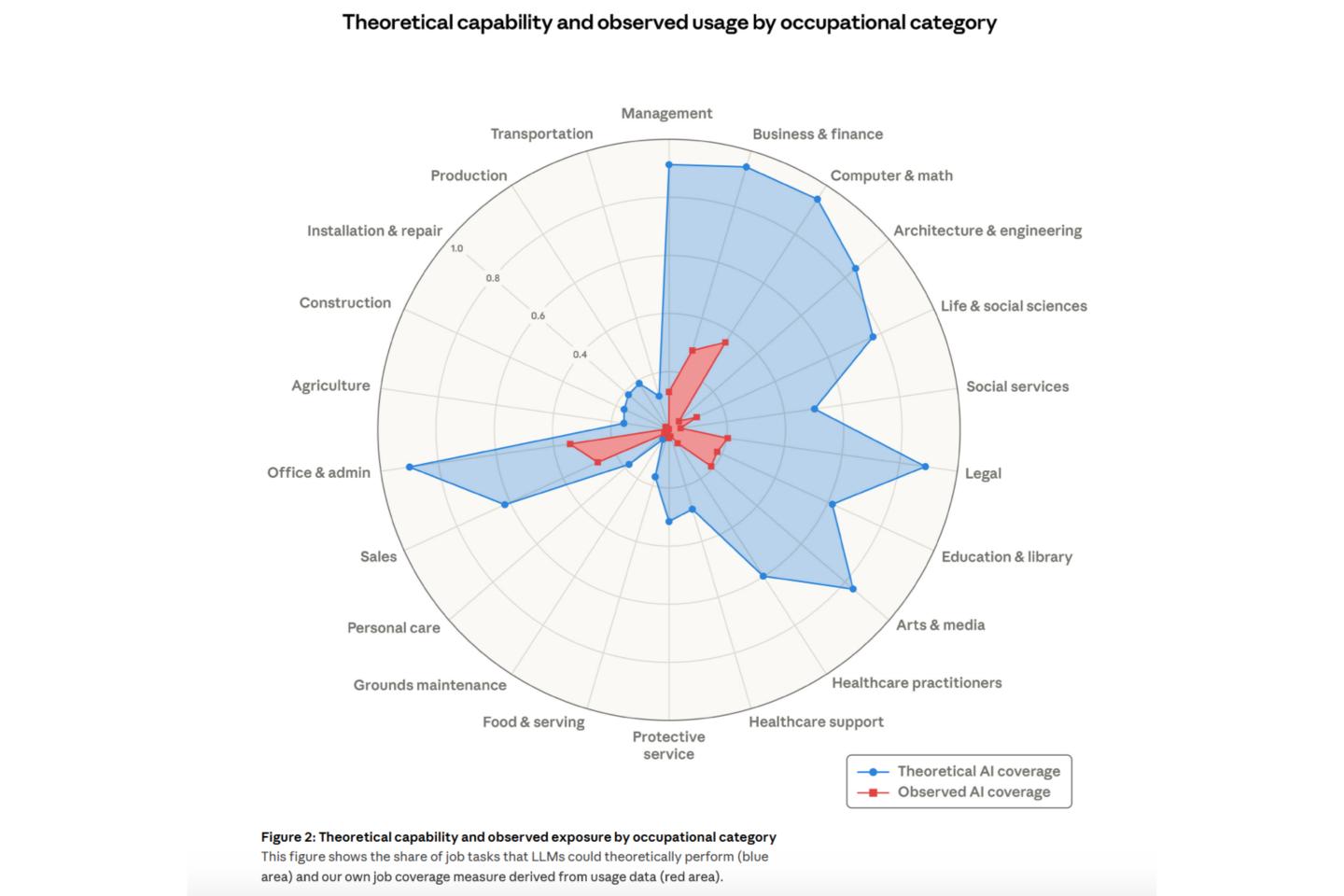
anthropic research chart
Anthropic researchers found that actual AI adoption is a fraction of what AI tools are capable of performing.
Anthropic: “Labor market impacts of AI: A new measure and early evidence”

What could happen next?

The Deutsche Bank AI tools don’t go nearly that far. Their collective message is more measured: The disinflationary promise is real but overstated; the timeline is longer than markets assume; and the near-term investment surge could cut the other way entirely.

Deutsche Bank’s economists leave the philosophical punch line hanging. If AI is wrong about its own inflationary impact, they note, perhaps we should “rethink our assessment of how transformative it is likely to be for complex knowledge work like forecasting, at least in its current form.” And if it’s right, markets may be pricing in AI-driven disinflation ahead of what’s actually happening.

Annoyingly, depending on your perspective, AI may be a little bit too much like the economists who programmed it. “A middle ground is that AI is taking a sensible approach by assigning relatively flat probabilities across outcomes in a highly uncertain environment with longer time horizons,” Luzzetti’s team wrote. “Having been trained on a corpus of text from economists, AI is simply acting as the proverbially two-handed economist, hedging its views against an unknowable backdrop.”

Either way, the machines were asked a direct question about their own economic legacy.

Their answer was, it’s complicated.

For this story, Fortune journalists used generative AI as a research tool. An editor verified the accuracy of the information before publishing.

Subscribe to Fortune Gulf Brief. Every Tuesday, this new newsletter delivers clear-eyed, authoritative intelligence on the deals, decisions, policies, and power shifts shaping one of the world’s most consequential regions, written for the people who need to act on it. Sign up here.
About the Author
Nick Lichtenberg
By Nick LichtenbergBusiness Editor
LinkedIn icon

Nick Lichtenberg is business editor and was formerly Fortune's executive editor of global news.

See full bioRight Arrow Button Icon
Add Fortune on Google for similar content.

Latest in Economy

Finance
Lorem ipsum dolor sit amet, consectetur adipiscing elit, sed do eiusmod tempor incididunt ut labore et dolore magna aliqua. Ut enim ad minim veniam
By Fortune Editors
October 20, 2025
Finance
Lorem ipsum dolor sit amet, consectetur adipiscing elit, sed do eiusmod tempor incididunt ut labore et dolore magna aliqua. Ut enim ad minim veniam
By Fortune Editors
October 20, 2025
Finance
Lorem ipsum dolor sit amet, consectetur adipiscing elit, sed do eiusmod tempor incididunt ut labore et dolore magna aliqua. Ut enim ad minim veniam
By Fortune Editors
October 20, 2025
Finance
Lorem ipsum dolor sit amet, consectetur adipiscing elit, sed do eiusmod tempor incididunt ut labore et dolore magna aliqua. Ut enim ad minim veniam
By Fortune Editors
October 20, 2025
Finance
Lorem ipsum dolor sit amet, consectetur adipiscing elit, sed do eiusmod tempor incididunt ut labore et dolore magna aliqua. Ut enim ad minim veniam
By Fortune Editors
October 20, 2025
Finance
Lorem ipsum dolor sit amet, consectetur adipiscing elit, sed do eiusmod tempor incididunt ut labore et dolore magna aliqua. Ut enim ad minim veniam
By Fortune Editors
October 20, 2025

Most Popular

Finance
Lorem ipsum dolor sit amet, consectetur adipiscing elit, sed do eiusmod tempor incididunt ut labore et dolore magna aliqua. Ut enim ad minim veniam
By Fortune Editors
October 20, 2025
Finance
Lorem ipsum dolor sit amet, consectetur adipiscing elit, sed do eiusmod tempor incididunt ut labore et dolore magna aliqua. Ut enim ad minim veniam
By Fortune Editors
October 20, 2025
Finance
Lorem ipsum dolor sit amet, consectetur adipiscing elit, sed do eiusmod tempor incididunt ut labore et dolore magna aliqua. Ut enim ad minim veniam
By Fortune Editors
October 20, 2025
Finance
Lorem ipsum dolor sit amet, consectetur adipiscing elit, sed do eiusmod tempor incididunt ut labore et dolore magna aliqua. Ut enim ad minim veniam
By Fortune Editors
October 20, 2025
Finance
Lorem ipsum dolor sit amet, consectetur adipiscing elit, sed do eiusmod tempor incididunt ut labore et dolore magna aliqua. Ut enim ad minim veniam
By Fortune Editors
October 20, 2025
Finance
Lorem ipsum dolor sit amet, consectetur adipiscing elit, sed do eiusmod tempor incididunt ut labore et dolore magna aliqua. Ut enim ad minim veniam
By Fortune Editors
October 20, 2025
Fortune Secondary Logo
Rankings
  • 100 Best Companies
  • Fortune 500
  • Global 500
  • Fortune 500 Europe
  • Most Powerful Women
  • World's Most Admired Companies
  • See All Rankings
  • Lists Calendar
Sections
  • Finance
  • Fortune Crypto
  • Features
  • Leadership
  • Health
  • Commentary
  • Success
  • Retail
  • Mpw
  • Tech
  • Lifestyle
  • CEO Initiative
  • Asia
  • Politics
  • Conferences
  • Europe
  • Newsletters
  • Personal Finance
  • Environment
  • Magazine
  • Education
Customer Support
  • Frequently Asked Questions
  • Customer Service Portal
  • Privacy Policy
  • Terms Of Use
  • Single Issues For Purchase
  • International Print
Commercial Services
  • Advertising
  • Fortune Brand Studio
  • Fortune Analytics
  • Fortune Conferences
  • Business Development
  • Group Subscriptions
About Us
  • About Us
  • Press Center
  • Work At Fortune
  • Terms And Conditions
  • Site Map
  • About Us
  • Press Center
  • Work At Fortune
  • Terms And Conditions
  • Site Map
  • Facebook icon
  • Twitter icon
  • LinkedIn icon
  • Instagram icon
  • Pinterest icon

Latest in Economy

49% of young adults live at home, up 12 points since 2019. An economist says the fallout will reshape marriage, kids, and home-buying
Economybehavioral economics
49% of young adults live at home, up 12 points since 2019. An economist says the fallout will reshape marriage, kids, and home-buying
By Catherina GioinoJuly 9, 2026
12 hours ago
Farm groups saved Bayer in court over RoundUp cancer claims. Five days later, Bayer called for tariffs on the ingredient farmers rely on
EconomyMonsanto
Farm groups saved Bayer in court over RoundUp cancer claims. Five days later, Bayer called for tariffs on the ingredient farmers rely on
By Mia OsmonbekovJuly 9, 2026
16 hours ago
Fed’s Williams says AI is now his main inflation concern
EconomyFederal Reserve
Fed’s Williams says AI is now his main inflation concern
By Maria Eloisa Capurro and BloombergJuly 9, 2026
16 hours ago
Businessman flying private jet using smartphone
SuccessWealth
Self-made multimillionaire says Canadians ‘give no money away’ compared with Americans—research shows U.S. giving is more than twice as high
By Preston ForeJuly 9, 2026
16 hours ago
This year’s El Niño is not ‘run-of-the-mill’—and it could rival one that killed 23,000
EnvironmentWeather and forecasting
This year’s El Niño is not ‘run-of-the-mill’—and it could rival one that killed 23,000
By Seth Borenstein and The Associated PressJuly 9, 2026
18 hours ago
Current price of Bitcoin for July 9, 2026
Personal FinanceCryptocurrency
Current price of Bitcoin for July 9, 2026
By Joseph HostetlerJuly 9, 2026
19 hours ago

Most Popular

Farm groups saved Bayer in court over RoundUp cancer claims. Five days later, Bayer called for tariffs on the ingredient farmers rely on
Economy
Farm groups saved Bayer in court over RoundUp cancer claims. Five days later, Bayer called for tariffs on the ingredient farmers rely on
By Mia OsmonbekovJuly 9, 2026
16 hours ago
Billionaire MacKenzie Scott just donated $20 million to support America’s youth mental health, as a fifth of teens struggle with suicidal thoughts
Success
Billionaire MacKenzie Scott just donated $20 million to support America’s youth mental health, as a fifth of teens struggle with suicidal thoughts
By Emma BurleighJuly 9, 2026
16 hours ago
Self-made multimillionaire says Canadians 'give no money away' compared with Americans—research shows U.S. giving is more than twice as high
Success
Self-made multimillionaire says Canadians 'give no money away' compared with Americans—research shows U.S. giving is more than twice as high
By Preston ForeJuly 9, 2026
16 hours ago
Current price of oil as of July 9, 2026
Personal Finance
Current price of oil as of July 9, 2026
By Joseph HostetlerJuly 9, 2026
19 hours ago
Ex-PepsiCo CEO Indra Nooyi worked from midnight until 5 a.m. as a receptionist to pay for her Yale degree—and she says ‘respect went up’ because of it
Success
Ex-PepsiCo CEO Indra Nooyi worked from midnight until 5 a.m. as a receptionist to pay for her Yale degree—and she says ‘respect went up’ because of it
By Preston ForeJuly 6, 2026
4 days ago
Current price of gold as of July 8, 2026
Personal Finance
Current price of gold as of July 8, 2026
By Danny BakstJuly 8, 2026
2 days ago

© 2026 Fortune Media IP Limited. All Rights Reserved. Use of this site constitutes acceptance of our Terms of Use and Privacy Policy | CA Notice at Collection and Privacy Notice | Do Not Sell/Share My Personal Information
FORTUNE is a trademark of Fortune Media IP Limited, registered in the U.S. and other countries. FORTUNE may receive compensation for some links to products and services on this website. Offers may be subject to change without notice.