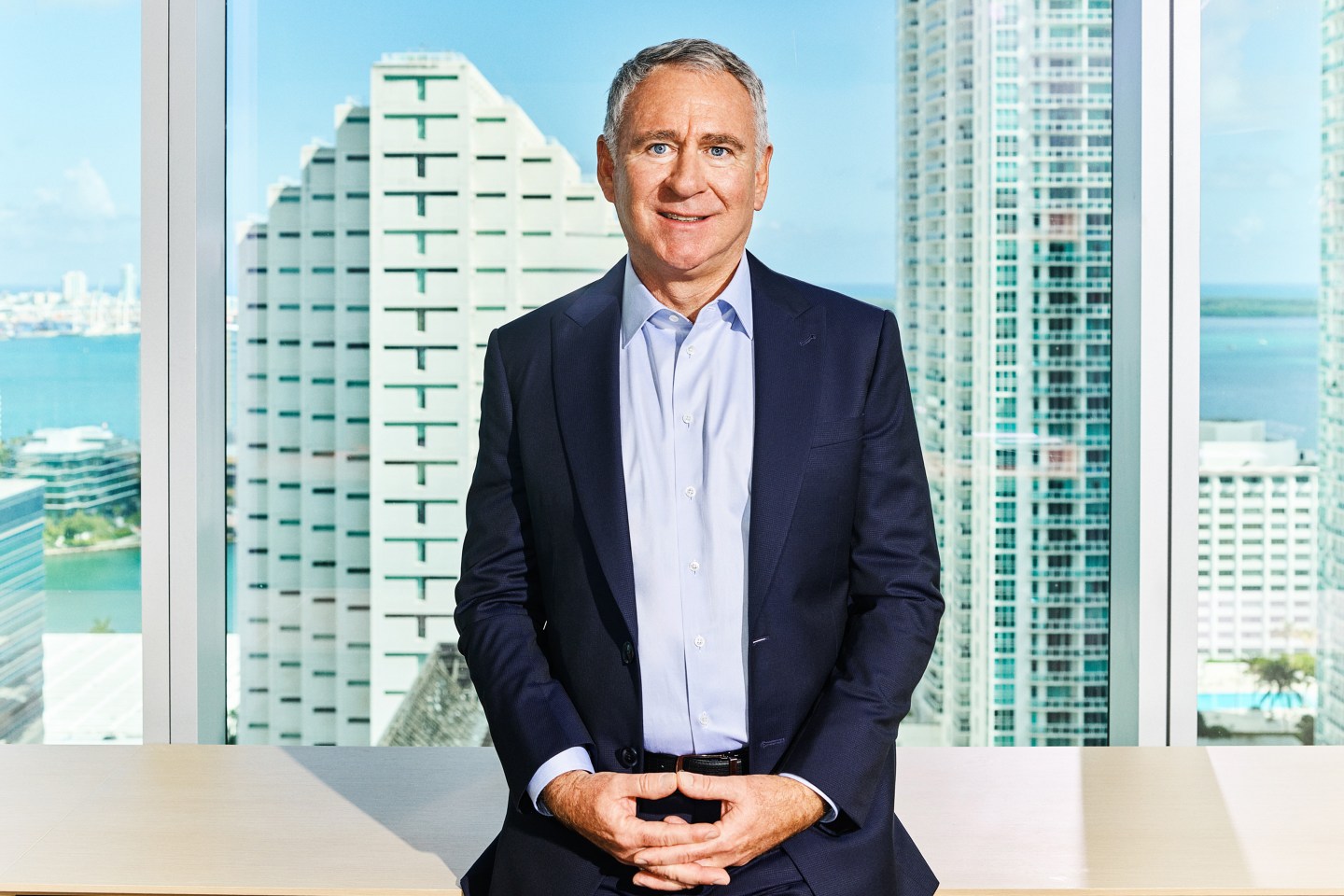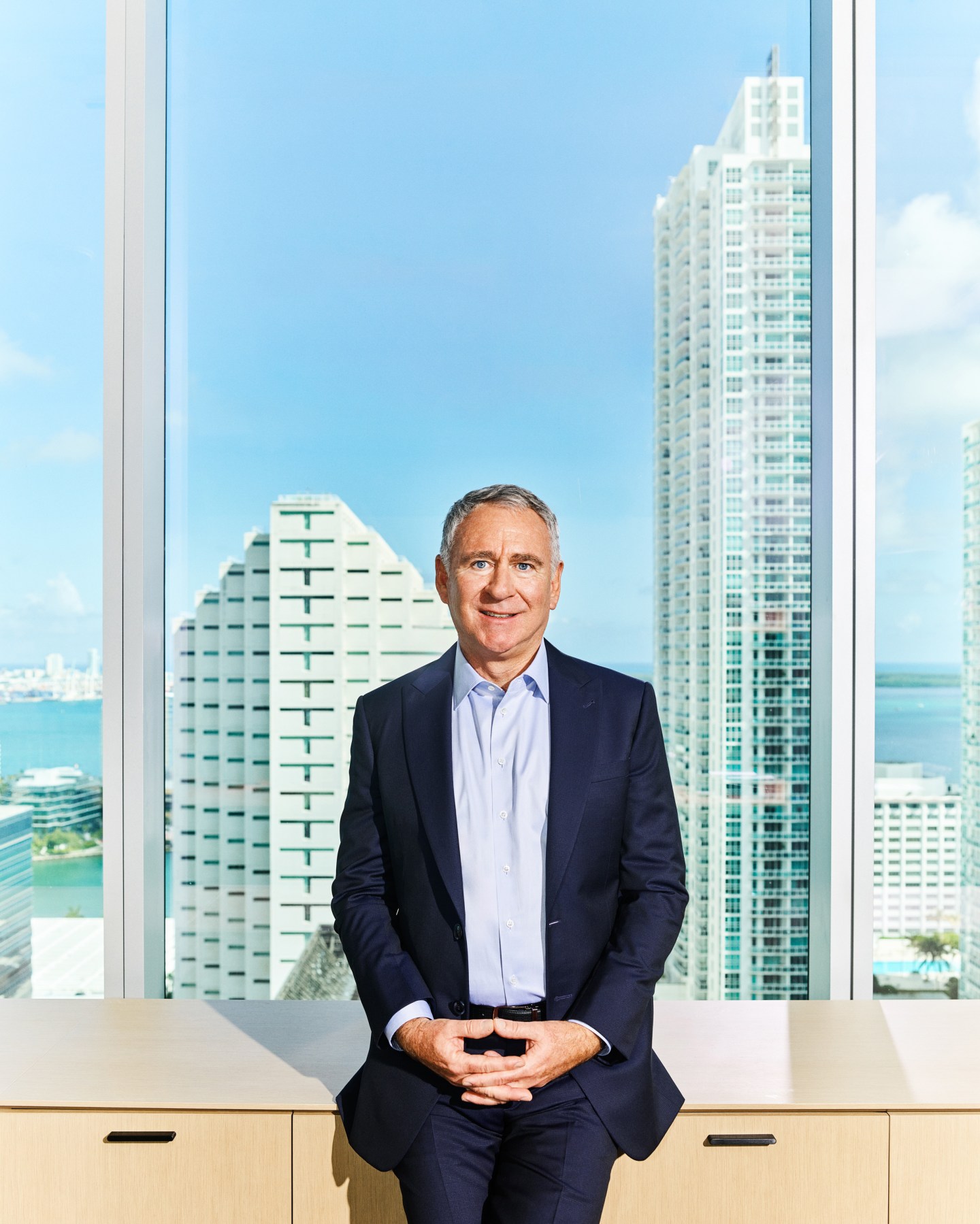

Ken Griffin is pointing an outstretched arm toward his field of dreams. On this Wednesday afternoon in early February, the CEO of Citadel, one of the world’s largest and most profitable hedge funds, is holding court, attired in his signature blue suit and saddle shoes, sans jacket for the moment. With Biscayne Bay glittering a vivid turquoise in the distance, he stands framed by floor-to-ceiling windows on the 27th floor of a skyscraper where he has temporarily parked Citadel’s offices, while he awaits completion of the crown-jewel headquarters, a gracefully tapered, 54-story Norman Foster design, slated for completion in 2030 at a cost recently estimated at $2.5 billion. Extols Griffin, “We’re constructing an iconic office building for this century, right here in Miami, in the free state of Florida, on the water. And people from some of the biggest tech companies in the world who’ve seen the design are saying, ‘We want to be there!’ ”
He is adamant about one thing: This could not have happened in Chicago, or New York, or maybe anywhere but here. Griffin’s tone grows rhapsodic as he describes how Miami authorities coordinated like a Navy SEALs team to fast-track his vision on Biscayne Bay. The dynamic is what Griffin lauds as Miami hustle. The city and county leadership, under a Republican and Democrat, respectively, share a “we’re open for business” mindset. Miami-Dade County designated the Citadel site as part of a rapid transit zone, special areas where the authorities greatly expedite the zoning approval process. Citadel won approval in around 18 months—for a megaproject that would have taken years to be green-lighted in virtually any other major metro.
For Griffin, the 1,049-foot-high billboard represents a dual ascension: of Miami as a major business capital, and his own growing prominence as a leader. He has established himself as one of the biggest financial power players—if not the biggest—in modern Republican politics. With a net worth estimated at roughly $50 billion, over the past decade he has donated almost a quarter of a billion dollars to candidates ranging from Florida Gov. Ron DeSantis to Senators Tim Sheehy (R-Mont.) and Dave McCormick (R-Pa.), supporting causes close to his heart. And a little more than one year into the second term of Trump—a Republican he has never donated to—Griffin has been the rare business voice that has grown louder and more critical of what he sees as the president’s wrong turns. Though he supports some of the president’s policies (more on that later) it galls him that so many fellow CEOs are forced to curry favor at the White House. He feels the regime of tariffs “encourages crony capitalism,” he asserts. “CEOs have to stomach going to D.C. and sucking up to one administration after another.”
Griffin instead is looking beyond MAGA, to the next chapter of Republican politics. His ideal vision weaves together classic conservative policies (lower taxes, free trade, fewer regulations, school choice, pro-growth policies in cities) with things he simply believes are essential to a booming economy (immigration, an end to cronyism, keeping government out of picking winners and losers). And, in fact, that ideal mix is pretty close to what he’s found in South Florida.
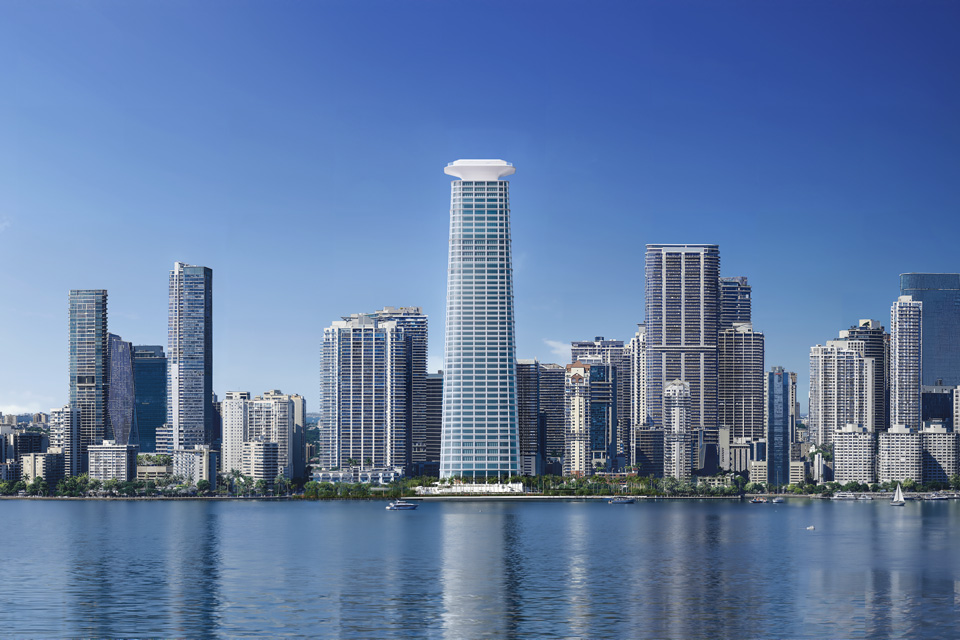
“The fight in America is all about protecting the cultures in places like Miami or Silicon Valley, and keeping us a nation of entrepreneurs. That’s really important because small enterprises will hire anyone who’s talented and willing to work hard whether you went to college or not,” he says. There is an optimism in his voice that is rare these days. Indeed, while many are “shorting” America’s prospects, Griffin is buying. And this certainly isn’t the first time one of his contrarian bets has paid off. He built Citadel not by hiring the typical cast of MBAs but engaging the likes of mathematicians, statisticians, and physicists who boasted great quant skills and learned finance fast. In mid-2022, fed up with Chicago’s failing schools, crime, and politicians, he moved Citadel’s base to Miami in what was arguably the most stunning corporate relocation in decades.
Griffin is rich, and he’s fearless, that much is not in doubt. And given his incredible wealth and potential influence going forward, it’s worth understanding where Griffin came from and how he developed a set of beliefs about society and the economy. Because if Ken Griffin believes there’s a path to remaking American capitalism—based on what he sees working in Miami—he might be one of the few people on the planet with the money and influence to make it happen.
In the past, Miami, and Florida overall, haven’t ranked as major business centers. The economy of Miami long depended primarily on tourism, wealth management, and residential construction. Miami wasn’t a place like Silicon Valley, Dallas, Minneapolis, or New York where entrepreneurs flocked to build startups into major players in tech, health care, or financial services. To this day, the largest Fortune 500 members in Miami-Dade are energy supplier World Kinect (No. 106), and homebuilder Lennar (No. 129). Florida isn’t home to any of the nation’s top 50 banks, measured by deposits.
But that’s changing. Post-pandemic, ServiceNow, Wells Fargo’s wealth management division, Palantir, Thoma Bravo, and Peter Thiel’s Thiel Capital are just a few of the companies that have shifted significant resources to South Florida. McKinsey’s Miami outpost now ranks as one of its fastest-growing offices in North America—its Miami headcount has grown fourfold to several hundred in the past four years—and Spanish Banco Santander is raising a 41-story tower in the city’s Brickell neighborhood.
“The fight in America is all about protecting the cultures in places like Miami or Silicon Valley, and keeping us a nation of entrepreneurs.”
Ken Griffin, Founder and CEO, Citadel
Griffin himself towers as a leading pioneer in not one but two distinct realms of finance. The $69 billion hedge fund, his original creation, forged a new model in an industry once dominated by superstar, individual golden-gut traders. By contrast, Citadel “atomized” the business by nurturing myriad teams to invest—and centrally managing them with a scientific approach to risk management and diversification.
The second sector: the market maker, Citadel Securities. Hardly a surprise that it’s nicknamed “the Amazon of financial services.” It’s the market leader in equity retail trades and handles one in four total transactions in the U.S. Griffin greatly aided the democratization of markets that grew our shareholder society. When you pay zero commissions selling from your account at Fidelity or Charles Schwab, the probability is high that the Citadel machine found the buyer in nanoseconds. Overall, the firm generates over $10 billion in annual net revenues.
Citadel’s journey to Florida happened almost by accident. It was March 2020 and Griffin, who had for 30-some years been based in Chicago, was deeply worried that with big cities going into COVID lockdown, Citadel Securities would be unable to run its giant trading operation. So in a flurry of activity he clinched a deal to rent the entire 207-room oceanfront Four Seasons Resort in Palm Beach. He and his team sprung into action to relocate its trading floor to the tropics; the campaign was dubbed “Operation Gator.”
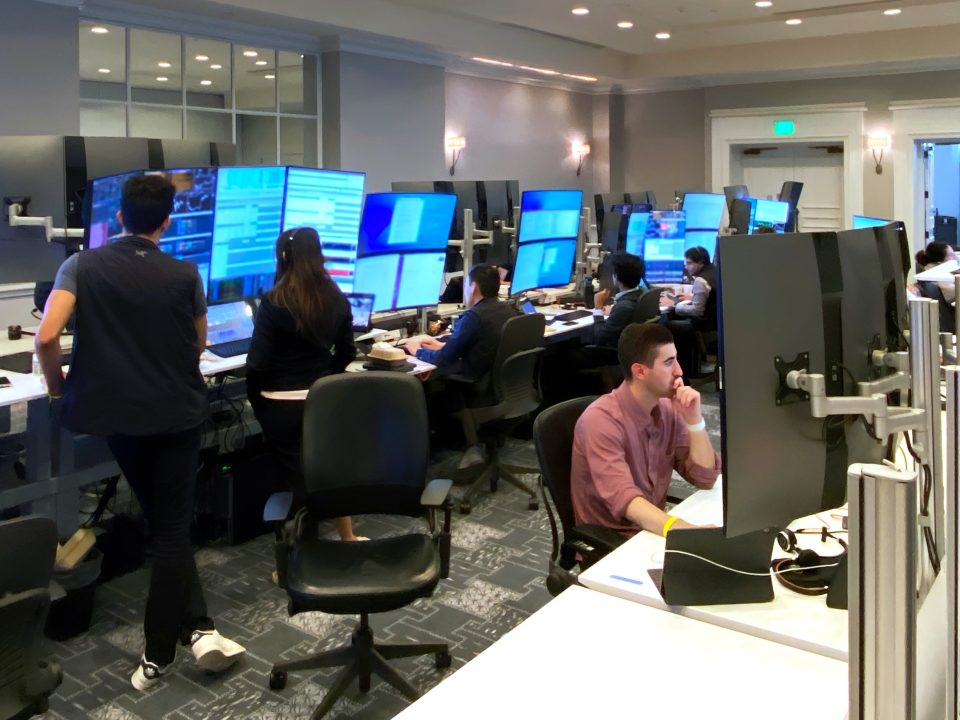
The city and state governments proved highly cooperative in seeking creative solutions to make the mass replanting happen. A City of Miami spokesman confirmed that the town treated “the property like a private residence, where people inside can work as they would at home.” A convoy of three tractor trailers working 24/7 over several days transported everything from desks to monitors to the Four Seasons. Fifty local workers dug trenches in the streets to run network cable to the hotel and installed lines running 70,000 feet. A semitruck pulled up to unload a giant generator that got planted in the parking lot. In just five days, Citadel Securities established 60 trading stations in the ballroom, installing enough capacity to handle its whole business, including supporting its market position in equities and options, for a full year.
During that year, 60 traders lived on-site in three-month shifts, with their spouses and kids, for whom the firm provided dedicated spaces so they could participate in their schools’ remote-learning programs, as well as music lessons. Fifty Four Seasons housekeepers, chefs, and other staff, who otherwise would have been unemployed, occupied a separate part of the hotel. While on-site, they couldn’t take so much as a stroll outside of what the firm dubbed “the bubble.” Jeff Maurone, COO of technology at Citadel Securities, recalls that Griffin stopped by from his residence in Palm Beach to check on the construction phase, attired in a polo shirt and shorts, accompanied by his son. “Ken said that he wanted his son to see the project because it exemplified the American spirit,” notes Maurone. Griffin expressed his wonder at how the Florida authorities, undeterred by COVID, moved so fast. “It would have taken months in a Northern city,” he says.
It was a giant leap for the firm. But for Griffin, it was also something of a homecoming. He was born in Daytona Beach; his dad worked at Cape Canaveral as a General Electric project manager on the NASA space program. In the early 1980s, after stints in Minneapolis and Midland, Texas (“What a great place for a kid to roam the great outdoors. Have you ever seen Landman?” he raves), the family settled in Boca Raton, where Ken’s father took a senior management position at a manufacturer of concrete roof tile. Griffin spent the full four years at Boca Raton Community High School—and greatly benefited from a highly intellectual, tech-savvy environment in an area best known for attracting beach-loving tourists and retirees. IBM developed its first PCs at its lab in Boca, and was manufacturing them in town when Ken started high school.
“Most people don’t appreciate that Boca in the ’80s had an incredibly rich community of engineers and computer scientists,” Griffin said. “Their children went to the public schools, including Boca High.” According to his math teacher Jim Graziose, the IBM parents coached their kids in programming. To match the progeny of the pros, ambitious kids like Ken had to work extra hard.
“In the best thing I ever did was move to Miami for my kids.” The attitude of their teachers in Chicago was damagingly woke.
Griffin, on one of the many things he appreciates about Miami
Griffin’s four-person computer club won the Miami-Dade County championship, and according to coach Graziose, the group generated as much mirth as elegant algorithms. The team harbored a zany obsession over nicknaming one another for heavy-metal stars and other teen music idols. To make money, they published a magazine, mysteriously called Kumquat, illustrated with cartoon images of the crew drawn by a free spirit who went on to design video games for Nintendo. Griffin was “Metal Nerd,” though the only heavy-metal sound that enticed him was the humming of mainframes.
Graziose kept a photo of the quartet in which Griffin looks reed-thin and sports bangs in the ruling Beatles style. He recalls that Griffin was a brilliant student but declined to do any and all homework. “That forced me to give him B’s instead of A’s,” says Graziose. Griffin didn’t take it personally. He wrote in Graziose’s yearbook, “Thanks for always taking my homework! [signed] Metal Nerd.” (Years later, after Graziose’s wife died of the autoimmune condition scleroderma, Griffin made a large contribution to a foundation researching cures for the disease.)
Even then, Griffin was civic-minded. His classmate Nate Adams recalls that he and Griffin joined a group that visited out-of-state companies in an effort to encourage them to move to South Florida. One sojourn took the students as far as Los Angeles, where they lobbied a satellite maker. Unfortunately, as Adams acknowledges, their pitch was about 30 years too early.
Griffin overcame the B’s to shine as the only one in his class admitted to Harvard. In Cambridge, he studied economics, but his real passion had long been parsing and playing the stock market. “In the third grade, I wrote a paper that set forth that I wanted to learn how the stock market worked,” he remembers. In his freshman year, Griffin found a highly negative story on Home Shopping Network, a seller of baubles on TV, so convincing that he shorted the shares, banking around $5,000. As a returning sophomore in September 1987, he hung a satellite dish from the third-floor window of his dorm room in ivy-covered, turn-of-the-century Cabot House, not to watch football games but to trade equities. From an “office” consisting of two phone lines, a futon bed, and the saucer, Griffin went short big-time, and cleaned up when the famed Black Monday crash struck in mid-October.
In 1990, backed by a veteran Chicago hedge fund manager who recognized his talent, Griffin raised $18 million to launch Citadel’s first fund, which was designed to exploit mispricing in convertible bonds. He quickly diversified into equities, and four years later was running a team of 60 that managed a portfolio of $200 million. The firm entered a vast new field in 2002 when Griffin launched its market-making arm, Citadel Securities. Today, Citadel is a leader in both domains and employs around 5,000 worldwide, divided into hundreds of teams of six to 10 members that cover virtually every flavor of investments from options to commodities to fixed income, and on the hedge fund side, quantitative trading.

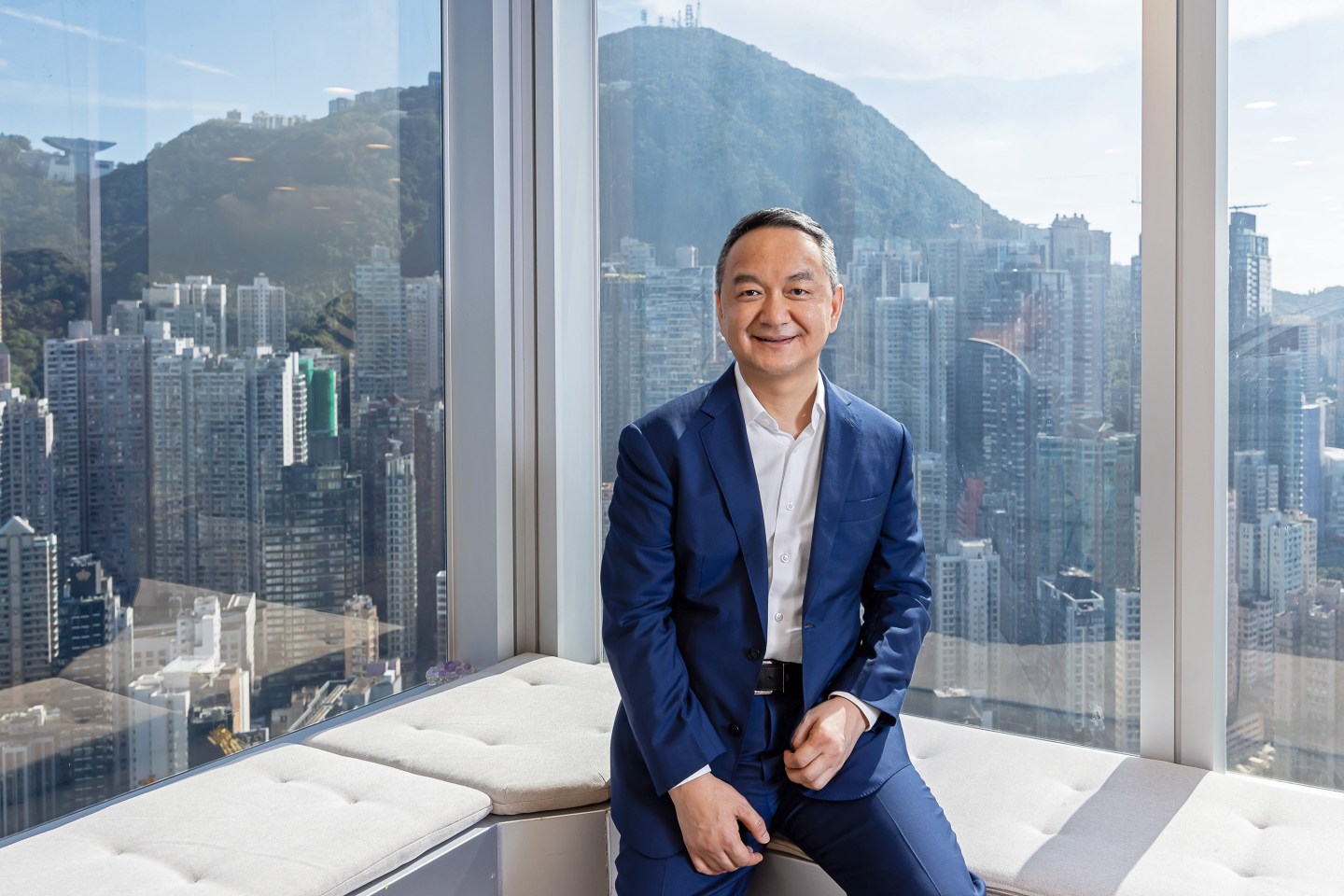
Still, it took a post-COVID appeal from the folks who had hunkered down in Palm Beach to clinch his exodus from Chicago. The CEO of Citadel Securities, Peng Zhao, made a pivotal call to action. “Peng walks into my office, and says, ‘Why did we leave Florida for Chicago?’ And I said, ‘We kind of left Chicago for Florida,’ ” reprises Griffin. Zhao responded, “We’d like to go back.” After asking, “Who’s we?” Griffin got the decisive answer from his market-making boss: “Pretty much the whole management team of Citadel Securities. Life is a lot better in Florida.” The go-getter approach of then-Mayor Francis Suarez also helped. Knowing the bubble’s success and Griffin’s warnings on Chicago’s decline, he paid a sales call to Griffin, showing the CEO empty properties via the Google Maps on his iPhone that he lauded as great locations for a new Citadel headquarters.
“The best thing I ever did was move to Miami for my kids,” swears Griffin. The attitude of their teachers in Chicago, he told the reporter, was damagingly woke. “It took a little time for my kids to adjust [to the stricter Miami schools], but before long, they would just come home with smiles on their faces.”
Griffin feels “optimism in the air here,” he avows. “In Northern cities awash in red tape, people talk about crime and how bleak the future is. It’s just much harder to say, ‘I’ll risk it all and join the startup down the street.’ It’s much easier for people to take the risk of joining a startup in a city with faith in the future.”
Citadel now employs around 500 in Miami; the crew includes such top brass as Zhao and Jim Esposito, respectively CEO and president of Citadel Securities; Sebastian Barrack, who for a decade has run the commodities trading franchise; and Griffin himself. Though New York and London are bigger, measured in personnel, Miami is the fastest-growing outpost by far.
Though he’s embraced Miami’s sunshine, almost everyone who meets Griffin (or works for him) comes away with the same impression: He’s incredibly intense. He greets people with a hammer handshake and a piercing blue-eyed stare. He follows what one source who knows him calls “the broken windows theory of management,” referring to the policing method pursued by New York Mayor Rudy Giuliani in the early 1990s, which involved cracking down on petty crimes. Griffin is renowned for getting extremely cross over what appear to be minor mistakes—don’t hand him a sloppily written memo, for example.
“Some people think he’s intense for the sake of being intense, and that he gets fixated on small issues,” says this person. “But it’s all about his lack of tolerance for complacency that can lead to more, bigger gaffes.” When asked if this characterization is correct, Griffin effectively answered yes, in a circuitous fashion. “I want everybody here to care deeply, and I make sure they do. That’s my job.”
And Griffin has another pet peeve: Managers who “won’t break glass,” meaning make extremely hard calls. “If a fixed-income team is 10th in Europe, and the guy who’s running the business thinks that’s fine, Ken will say, ‘That’s not fine. You need to win, you need to be number one,’ ” says another source who’s observed Griffin’s management style. “Ken is all about winning in every domain.”
Sebastian Barrack has for a decade run the legendarily profitable commodities trading franchise. He still marvels at his boss’s ability to identify overlooked forces that can drive prices, a talent enhanced by rare creativity.
As an example, Griffin once asked Barrack to examine how changes in outside temperatures translate into shifts in heating demand—and the subtle timing effects that influence when that demand shows up in energy markets. Asks Barrack, “Who on earth but Ken thinks at that level of granularity?”
Griffin prefers Q&A sessions to giving speeches. That’s because he’s such a details guy that he keeps paring the text looking for perfection. In interviews, he doesn’t try to be charming; Griffin sees himself as a truth-teller. He can even show deadpan humor. When asked at one event in West Palm Beach where he’d park “a suitcase full of cash” in the markets, Griffin quipped, “This sounds like an AML [anti-money-laundering] question, like I gotta call the FBI.”
Says Barrack of his boss, “He’s the fairest human being I have ever met in my life. That fairness can mean he will be brutally honest with me because I haven’t done very well, which doesn’t happen often, fortunately. He’ll also give praise, when it’s deserved, but after the praise he’s back at you with, ‘Now what’s next?’”
What’s next for Griffin himself is a topic that comes up a lot these days. Certainly the road to fashioning Miami into a global business leader will be long and arduous—and Griffin knows it. The Miami-Dade population has ballooned by over 300,000, or 11%, in just three years. Result: The housing supply has hugely lagged. Median home prices have doubled to $675,000 since the summer of 2019, and rents have risen comparably.
Plus, even lovers of low taxes will concede that Miami’s mass-transit network is extremely underdeveloped compared with New York or Chicago. Commuters to downtown, for example, can spend well over an hour in traffic when making the 15-mile trip from Doral to Brickell. “Miami is suffering from disjointed development where infrastructure isn’t keeping up with population growth,” notes Ned Murray of the Jorge M. Pérez Metropolitan Center at Florida International University.
The city and county will have to tackle traffic, but Griffin is leading a philanthropic campaign beating anything the city, or almost any other metro, has witnessed in recent decades. To date, he’s donated $350 million to an array of causes advancing health care, education, public safety, the arts, and more. Griffin also gives employees who serve on nonprofit boards as part of Citadel’s community leaders program up to $20,000 to contribute to those organizations.
That’s still left plenty of room for his personal real estate projects: He’s spent a total of $270 million on properties in Coconut Grove and Star Island. But his epic project is a stupendous, oceanfront complex in Palm Beach. At 27 acres, it occupies more property than the “winter White House,” 23-acre Mar-a-Lago, a quarter-mile down the street.
But billionaires haven’t always had the easiest time “connecting” in the political realm. Griffin cuts a particularly interesting figure at the moment because his beliefs don’t match up neatly with either party—starting with free trade. “The concerns about U.S. competitiveness and the resiliency of the supply chain that the administration is trying to address are real,” says Griffin. “But tariffs are the wrong tool. They function as a regressive tax—essentially a sales tax on the American people that will hit those working to make ends meet the hardest.”
Griffin has said that the Trump administration has made significant progress securing the southern border. At the same time, he’s stressed that the U.S. should continue to welcome talented people from around the world. “The southern border was the source of people willing to do tough jobs for modest wages—building houses, washing dishes, picking crops,” he says. “Reducing immigration will bring higher prices for groceries, housing, and food. We’ve rolled back the welcome mat too much.” He states that any foreign student graduating from a U.S. college or graduate school “should get a [work] visa stamped to their degree.”
Griffin believes that the current restrictions limit America’s access to the world’s best minds. He notes that immigrants or children of immigrants launched most of the successful Silicon Valley startups, including in AI. Griffin hammers the point by noting that his co-chief investment officer hails from Ecuador; the head of the trading unit from mainland China; the commodities chief from Australia; and Citadel’s most successful equity fund manager from the U.K. For Griffin, his hometown’s success is a tribute to the power of immigration: 54% of Miami-Dade County’s residents were born abroad.
“Reducing immigration will bring higher prices for groceries, housing, and food. We’ve rolled back the welcome mat too much.”
Ken Griffin, Citadel
It’s important to note, however, that Griffin praises a number of the president’s policies. A winner, he says, is scotching the four-year “regulatory onslaught” under President Biden. “That’s the biggest sea change,” he intones. “You cannot imagine how painful it was every day under the Biden administration to look at what crazy new proposal was being put in place. [Under Trump] it’s a giant sigh of relief that I can go on building my business instead of having a second job dealing with regulations that accomplish nothing.”
If pressed on his biggest worry, the man who knows more about the U.S. Treasury market than perhaps any other human cites the spiraling budget deficit. “In financial markets, no brand can compare to the brand of U.S. Treasuries,” he maintains. Their creditworthiness gives the U.S. extraordinary access to credit. But our gigantic budget deficits and debt at 6% and well over 100% of GDP respectively have put the U.S. “in a more fiscally precarious position than we’ve been in decades.”
Griffin doesn’t limit his views to U.S. economic policy, far from it. He eagerly tackles questions on broad international issues: “America’s relationships with its historical allies are extremely important, especially as competition with China increasingly shapes the global landscape. Allowing those ties to fray would be a mistake.” Europe must “embrace a radically new set of policies” that promote entrepreneurship “to accelerate economic growth, support its aging population, and strengthen its military capacity,” he says.
All of which leads one to wonder, what is Griffin really envisioning for his final act? At the close of the meeting in his Brickell conference room, the reporter asked Griffin if he’d consider stepping forward as a political candidate. “Not today,” he responded. “I would never say never. I’m 57 years old. I have another 25 or 30 years, I hope, of working hard and giving back to society.” Asked if he’d accept an offer to be secretary of the Treasury, Griffin said, “I’m not trying to be coy. There will be something after Citadel. Hank Paulson served as secretary of the Treasury and did a great job. It would be great if there was a chapter in my life that looked like what he did. That chapter is not to be written right here, right now.”
Nate Adams, Griffin’s old friend from Boca High who worked as a top advisor to former Florida Gov. Jeb Bush, views Griffin as a great future candidate for high office, and friends rate him as presidential timber. “I’m one of the ones promoting [a possible run for office],” Adams says. But those close to Griffin believe he won’t embrace retail politics and go on a ballot. Glad-handing in New Hampshire at diners and churches isn’t likely to excite him. But one thing’s for sure: Griffin is going long on his vision for America’s economy. And as many have learned the hard way in the financial markets, he’s a dangerous trader to bet against.
This article appears in the April/May 2026 issue of Fortune with the headline “Ken Griffin’s biggest bet.”