
• Home
  • Latest
  • Fortune 500
  • Finance
  • Tech
  • Leadership
  • Lifestyle
  • Rankings
  • Multimedia

Trendingnow

1

Despite having a $165 million net worth, Scarlett Johansson says work-life balance doesn’t exist—and the first step to success is admitting that

2

The Bezos family just donated $100 million to help achieve one of Mayor Zohran Mamdani’s top campaign promises

3

Current price of oil as of May 15, 2026

1

Despite having a $165 million net worth, Scarlett Johansson says work-life balance doesn’t exist—and the first step to success is admitting that

2

The Bezos family just donated $100 million to help achieve one of Mayor Zohran Mamdani’s top campaign promises

3

Current price of oil as of May 15, 2026
Economynational debt

Jerome Powell says the $39 trillion national debt is ‘not unsustainable,’ but warns the trajectory ‘will not end well’

Nick Lichtenberg
By
Nick Lichtenberg
Nick Lichtenberg
Business Editor
Down Arrow Button Icon
Nick Lichtenberg
By
Nick Lichtenberg
Nick Lichtenberg
Business Editor
Down Arrow Button Icon
March 30, 2026, 4:53 PM ET
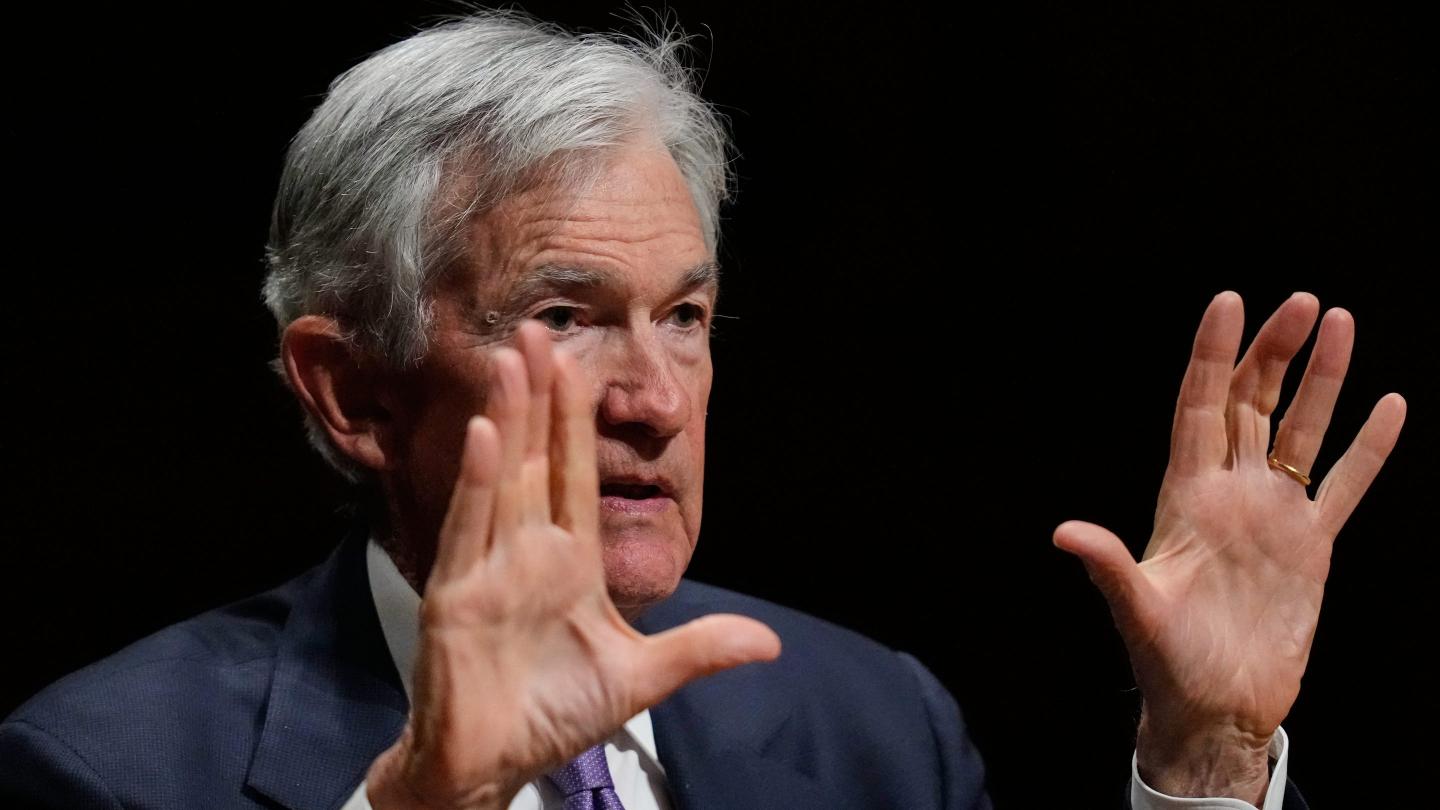
Photo of Jerome Powell
Federal Reserve Chair Jerome Powell at Harvard University, March 30, 2026, in Cambridge, Mass. Charles Krupa—AP Photo

Federal Reserve Chair Jerome Powell offered a sobering assessment of America’s fiscal health on Monday, telling a Harvard economics class that while the nation’s $39 trillion debt load is not immediately dangerous, the path the country is on demands urgent attention from lawmakers.

Recommended Video

“The level of the debt is not unsustainable,” Powell said during a wide-ranging conversation before roughly 400 students, “but the path is not sustainable. It will not end well if we don’t do something fairly soon.”

The remarks extend a consistent warning Powell has sounded for years, that while the debt level is manageable in the short term, the fiscal trajectory is absolutely not. His comments also came as the average national gas price neared $4 per gallon amid a war in Iran that shows no signs of resolving soon, despite President Trump’s remarks about a potential end to hostilities.

Powell was careful to draw a distinction between the stock of debt and its trajectory, noting that the U.S., as the world’s reserve currency issuer and home to the deepest capital markets on earth, can sustain a large debt load in ways smaller economies cannot.

The remarks came in response to a student asking at what point the size of the U.S. debt breaks “the point of natural systems of repayment.” Powell acknowledged that no one knows exactly where that breaking point lies—pointing to Japan as a country carrying a far higher debt-to-GDP ratio than the U.S.—but said the direction of travel was unambiguous.

“What’s clear is that our debt is growing much faster; the federal government debt is growing substantially faster than our economy,” Powell said. “And that ratio is going up. And in the long run, that’s kind of the definition of unsustainable.”

Net interest payments on the national debt are now projected to exceed $1 trillion in fiscal year 2026—nearly triple the $345 billion the government paid in 2020. In the first three months of the current fiscal year alone, interest payments reached $270 billion, already surpassing the nation’s defense spending for the same period. Those are real constraints on real budget choices. But they are constraints, not collapse—and conflating the two distorts the policy conversation. Debt held by the public is projected to surge from 101% of GDP today to 120% of GDP by 2036, eclipsing the post–World War II record, according to projections by the Congressional Budget Office.

Seeking balance

However, Powell did not call for paying down the debt outright. The fix, he suggested, is more modest—and more achievable, if there is political will. “We don’t have to pay the debt down,” he said. “We just need to have primary balance and begin to have the economy actually growing more quickly than the debt.”

The Fed chair was careful to note that fiscal policy is explicitly not within his jurisdiction. “This is not the Fed’s job, of course,” he said, and acknowledged with a touch of dry humor that his warnings tend to fall on deaf ears in Washington. “I pretty much limit myself to those high-level points, which essentially everyone ignores.”

To be sure, Powell is not wrong that America’s debt trajectory is unsustainable on paper. But that has been the verdict for decades—and the sky has stubbornly refused to fall. Also, his preferred solution of achieving primary balance, so the economy grows faster than the debt, will be difficult, to say the least. In practice, closing a structural primary deficit of the U.S. government’s current size means either raising revenues significantly; cutting spending in politically explosive areas like Medicare and Social Security; or banking on growth rates that history suggests are optimistic. But as Powell noted, the Fed chair is explicitly not responsible for solving the problem.

The broader context of Powell’s remarks made clear the stakes for the central bank. Powell has spent his tenure fiercely defending the Fed’s political independence, insisting throughout the conversation that the Fed must “stick to our knitting” and resist pressure to deploy its tools for purposes beyond maximum employment and price stability. A fiscal crisis that forced the Fed’s hand would represent exactly the kind of mission creep he has warned against.

Powell made those boundaries explicit when describing his philosophy of Fed governance. “There’s always a time when an administration looks and says, ‘It would be good to use that tool for something else,’” he said. “It happens all the time. And we just have to be in a situation where we’re not trying to work against any politician or any administration, but we have to be careful to stick to what we’re doing.”

There’s also an irony in Powell warning about debt sustainability while leading an institution whose own policies made cheap borrowing the path of least resistance for years. As J.P. Morgan warned in its 2026 outlook, there could be “a less straightforward path to reduce the U.S. government’s debt load”—in part because of the interplay between Fed policy and Treasury financing needs. Bridgewater’s Ray Dalio has described one possible endgame as an economic “heart attack,” with government investment crowded out by debt service obligations. That’s a serious concern, but that’s an argument for smart fiscal reform, not for treating Powell’s Harvard remarks as a five-alarm fire.

Former Fed Chair Janet Yellen struck a similar tone in January, warning that the ballooning debt could reduce the Fed’s ability to address unemployment and inflation, while noting that legislators were not “adequately acknowledging the risks.” The chorus of credible voices is real. So is the risk of that chorus becoming cover for cuts that disproportionately hurt the Americans least able to absorb them—a tradeoff Powell’s remarks, however honest, did not address.

The debt deserves serious attention. But serious attention means an honest accounting of tradeoffs, not just a clean sound bite from Cambridge telling lawmakers to act “fairly soon,” with no guidance on how, and no acknowledgment that acting too aggressively could be just as destabilizing as the debt itself.

Powell’s term as Fed chair expires in May 2026. His fiscal warning, which was offered not from a podium in Washington but to a room of Harvard students, may prove to be among the clearest statements of his tenure: The debt level is survivable, but only if the trajectory changes. “It will not end well,” he said, “if we don’t do something fairly soon.”

For this story, Fortune journalists used generative AI as a research tool. An editor verified the accuracy of the information before publishing.

Subscribe to Fortune Gulf Brief. Every Tuesday, this new newsletter will deliver clear-eyed, authoritative intelligence on the deals, decisions, policies, and power shifts shaping one of the world’s most consequential regions, written for the people who need to act on it. Sign up here.
About the Author
Nick Lichtenberg
By Nick LichtenbergBusiness Editor
LinkedIn icon

Nick Lichtenberg is business editor and was formerly Fortune's executive editor of global news.

See full bioRight Arrow Button Icon

Latest in Economy

Finance
Lorem ipsum dolor sit amet, consectetur adipiscing elit, sed do eiusmod tempor incididunt ut labore et dolore magna aliqua. Ut enim ad minim veniam
By Fortune Editors
October 20, 2025
Finance
Lorem ipsum dolor sit amet, consectetur adipiscing elit, sed do eiusmod tempor incididunt ut labore et dolore magna aliqua. Ut enim ad minim veniam
By Fortune Editors
October 20, 2025
Finance
Lorem ipsum dolor sit amet, consectetur adipiscing elit, sed do eiusmod tempor incididunt ut labore et dolore magna aliqua. Ut enim ad minim veniam
By Fortune Editors
October 20, 2025
Finance
Lorem ipsum dolor sit amet, consectetur adipiscing elit, sed do eiusmod tempor incididunt ut labore et dolore magna aliqua. Ut enim ad minim veniam
By Fortune Editors
October 20, 2025
Finance
Lorem ipsum dolor sit amet, consectetur adipiscing elit, sed do eiusmod tempor incididunt ut labore et dolore magna aliqua. Ut enim ad minim veniam
By Fortune Editors
October 20, 2025
Finance
Lorem ipsum dolor sit amet, consectetur adipiscing elit, sed do eiusmod tempor incididunt ut labore et dolore magna aliqua. Ut enim ad minim veniam
By Fortune Editors
October 20, 2025

Most Popular

Finance
Lorem ipsum dolor sit amet, consectetur adipiscing elit, sed do eiusmod tempor incididunt ut labore et dolore magna aliqua. Ut enim ad minim veniam
By Fortune Editors
October 20, 2025
Finance
Lorem ipsum dolor sit amet, consectetur adipiscing elit, sed do eiusmod tempor incididunt ut labore et dolore magna aliqua. Ut enim ad minim veniam
By Fortune Editors
October 20, 2025
Finance
Lorem ipsum dolor sit amet, consectetur adipiscing elit, sed do eiusmod tempor incididunt ut labore et dolore magna aliqua. Ut enim ad minim veniam
By Fortune Editors
October 20, 2025
Finance
Lorem ipsum dolor sit amet, consectetur adipiscing elit, sed do eiusmod tempor incididunt ut labore et dolore magna aliqua. Ut enim ad minim veniam
By Fortune Editors
October 20, 2025
Finance
Lorem ipsum dolor sit amet, consectetur adipiscing elit, sed do eiusmod tempor incididunt ut labore et dolore magna aliqua. Ut enim ad minim veniam
By Fortune Editors
October 20, 2025
Finance
Lorem ipsum dolor sit amet, consectetur adipiscing elit, sed do eiusmod tempor incididunt ut labore et dolore magna aliqua. Ut enim ad minim veniam
By Fortune Editors
October 20, 2025
Fortune Secondary Logo
Rankings
  • 100 Best Companies
  • Fortune 500
  • Global 500
  • Fortune 500 Europe
  • Most Powerful Women
  • World's Most Admired Companies
  • See All Rankings
  • Lists Calendar
Sections
  • Finance
  • Fortune Crypto
  • Features
  • Leadership
  • Health
  • Commentary
  • Success
  • Retail
  • Mpw
  • Tech
  • Lifestyle
  • CEO Initiative
  • Asia
  • Politics
  • Conferences
  • Europe
  • Newsletters
  • Personal Finance
  • Environment
  • Magazine
  • Education
Customer Support
  • Frequently Asked Questions
  • Customer Service Portal
  • Privacy Policy
  • Terms Of Use
  • Single Issues For Purchase
  • International Print
Commercial Services
  • Advertising
  • Fortune Brand Studio
  • Fortune Analytics
  • Fortune Conferences
  • Business Development
  • Group Subscriptions
About Us
  • About Us
  • Press Center
  • Work At Fortune
  • Terms And Conditions
  • Site Map
  • About Us
  • Press Center
  • Work At Fortune
  • Terms And Conditions
  • Site Map
  • Facebook icon
  • Twitter icon
  • LinkedIn icon
  • Instagram icon
  • Pinterest icon

Latest in Economy

lirr
EconomyRailroads
Spring Hamptons traffic nightmare as Long Island Rail Road workers go on strike
By Philip Marcelo, Nick Lichtenberg and The Associated PressMay 16, 2026
8 minutes ago
delivery
Retailecommerce
Walmart’s upper hand over Amazon in the $1 trillion e-commerce race: 90% of Americans live within 10 miles of a superstore
By Anne D'Innocenzio and The Associated PressMay 16, 2026
12 minutes ago
milei
North AmericaInflation
Argentinians wage inflation strike on red meat sending beef consumption to 20-year low
By Clara Preve and The Associated PressMay 16, 2026
23 minutes ago
bhaskar
Economydisruption
The prophet of the ‘Wired Belt’ says capitalism is finally eating itself
By Bhaskar ChakravortiMay 16, 2026
4 hours ago
cyborg
Future of WorkProductivity
AI’s cyborg problem: you have to embrace it to really succeed but 90% of people can’t or don’t want to
By Nick LichtenbergMay 16, 2026
5 hours ago
America’s productivity boom started before AI, and a Stanford economist who decoded the Great Resignation says working from home is the reason why
Future of Workremote work
America’s productivity boom started before AI, and a Stanford economist who decoded the Great Resignation says working from home is the reason why
By Marco Quiroz-GutierrezMay 15, 2026
18 hours ago

Most Popular

Despite having a $165 million net worth, Scarlett Johansson says work-life balance doesn’t exist—and the first step to success is admitting that
Success
Despite having a $165 million net worth, Scarlett Johansson says work-life balance doesn’t exist—and the first step to success is admitting that
By Preston ForeMay 13, 2026
3 days ago
The Bezos family just donated $100 million to help achieve one of Mayor Zohran Mamdani’s top campaign promises
Politics
The Bezos family just donated $100 million to help achieve one of Mayor Zohran Mamdani’s top campaign promises
By Jake AngeloMay 12, 2026
4 days ago
Current price of oil as of May 15, 2026
Personal Finance
Current price of oil as of May 15, 2026
By Joseph HostetlerMay 15, 2026
1 day ago
Nearly 50,000 Lake Tahoe residents have to find a new power source after their energy source looks to redirect lines to data centers
Travel & Leisure
Nearly 50,000 Lake Tahoe residents have to find a new power source after their energy source looks to redirect lines to data centers
By Catherina GioinoMay 12, 2026
4 days ago
The airplane fuel shortage is a myth propagated by airlines who want to cancel unprofitable flights, says private jet CEO
Energy
The airplane fuel shortage is a myth propagated by airlines who want to cancel unprofitable flights, says private jet CEO
By Jim EdwardsMay 14, 2026
2 days ago
Debbie Gibson, Geezer Butler of Black Sabbath want you to adopt a beagle rescued from an experimental lab in Wisconsin
North America
Debbie Gibson, Geezer Butler of Black Sabbath want you to adopt a beagle rescued from an experimental lab in Wisconsin
By Scott Bauer and The Associated PressMay 13, 2026
3 days ago

© 2026 Fortune Media IP Limited. All Rights Reserved. Use of this site constitutes acceptance of our Terms of Use and Privacy Policy | CA Notice at Collection and Privacy Notice | Do Not Sell/Share My Personal Information
FORTUNE is a trademark of Fortune Media IP Limited, registered in the U.S. and other countries. FORTUNE may receive compensation for some links to products and services on this website. Offers may be subject to change without notice.