Good morning. On Fortune‘s radar today:
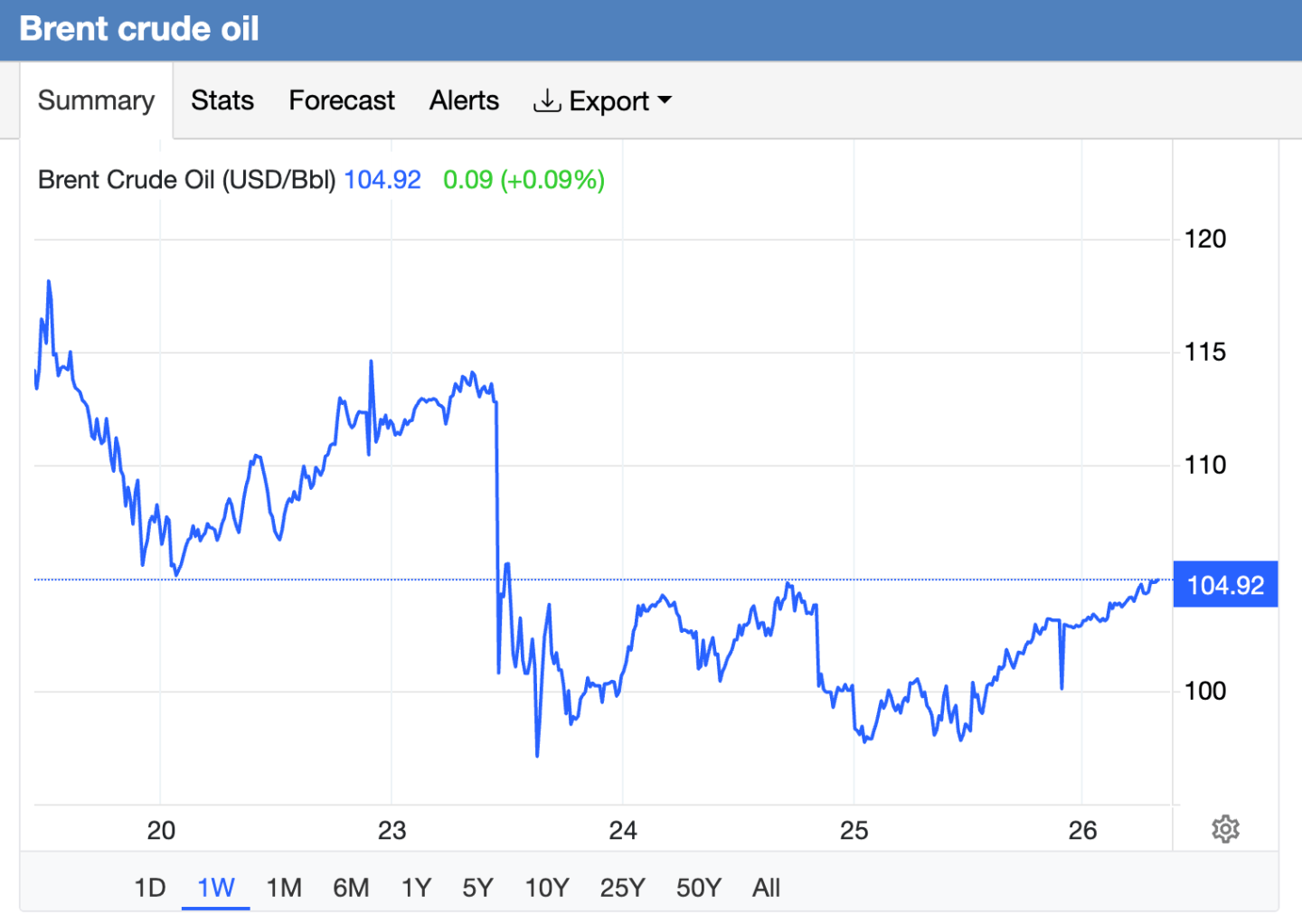
- Oil is back above $100 a barrel.
- President Trump wants the Iran conflict done in four to six weeks.
- The war is tearing NATO apart.
- Yes, the apps on your phone are deliberately addictive, a jury rules.
- It’s weird that the markets aren’t fully pricing in a sustained oil shock.
THE MARKETS
Oil goes up, stocks go down
S&P 500 futures were down 0.72% this morning after oil rose again to nearly $105 per barrel. The index closed up 0.54% yesterday. Stocks sold off in Asia and Europe this morning. In early trading, Stoxx Europe 600 was down 1.11%, and the U.K.’s FTSE 100 was down 1.25%. Japan’s Nikkei 225 closed down 0.27%. South Korea’s highly volatile KOSPI lost 3.22%.
- Labubu boo-hoo: Pop Mart International stock is on track to lose the entire last year's worth of gains, Fortune’s Nicholas Gordon tells me. It's down 55% from its all-time high last summer.
- It takes 28 days to ship gas from the U.S. to Asia, which is a problem because Asia’s usual supply has gone offline in the bombing of Qatar, reports Fortune’s Jordan Blum.
ONE BIG THING
Big tech’s tobacco moment
A Los Angeles jury decided in a landmark case—in which Mark Zuckerberg took the witness stand—that a young woman known as “Kaley” suffered $3 million in damages from serious mental health problems caused by the “addictive design” of Instagram, Facebook, and YouTube. The closely watched bellwether case against the platforms’ parents, Alphabet’s Google and Meta, could set a precedent in thousands of similar lawsuits and force Silicon Valley to rethink the features that keep users endlessly scrolling.
The multimillion-dollar verdict will grow, Fortune’s Kristin Stoller reports, after the jury decides whether the companies acted with malice or fraud, and consider punitive damages. TikTok and Snap settled before the trial began.
What should be done? Policymakers are floating answers, from state-level warning labels and restrictions on personalized feeds for minors to outright bans on teen social media in some countries. Platforms have rolled out an array of opt-in safeguards, teen modes, and screen-time nudges.
- Exclusive: Inside the Seattle clinic that treats tech addiction like heroin, and clients detox for up to 16 weeks, by Kristin Stoller
- Meta’s $27 billion AI data center is causing chaos in small town Louisiana, by Sharon Goldman
IRAN
‘Unbridgeable,’ but Trump wants it over soon
President Trump told White House insiders he wants the war to end within his four-to-six week timeframe, according to the Wall Street Journal. We are currently one-month into the war.
Iran responded to the U.S.’s proposed 15-point plan (which includes a demand for an end to Iran’s nuclear ambitions) with a five-point set of demands of its own, per the BBC. They are:
- A complete halt to "aggression and assassinations."
- A guarantee that the war will not restart.
- The payment of war damages and reparations.
- An end to the war via proxies and “resistance” groups.
- Assertion of Iran's right to control the Strait of Hormuz
The U.S. and Iran are far apart. “Unbridgeable” is the word Macquarie’s analysts have been using recently. Iran’s last demand over the strait is especially unlikely to be acceptable to the White House. Iranian officials are publicly insisting that no negotiations are taking place.
Trump yesterday said the Iranians "are negotiating" but "they're afraid to say it because they figure they'll be killed by their own people…They're also afraid they'll be killed by us."
- Yikes: A gallon of gas in California is now heading toward $9.
- Russia is actively supplying Iran with drones, the Financial Times reports.
What will they do when they get there?
Meanwhile, the Marines are en route to the Middle East and strikes from Israel, the U.S., and Iran continued across the region today. Analysts are gaming out the next steps: Putting boots on the ground would change the nature of the war radically, and risk extending it well beyond Trump’s timeframe.
Kharg Island: One option would be for the Marines to take Kharg Island, the vast offshore terminal through which 90% of Iran’s oil exports flow. The advantage would be that it’s a discrete objective that chokes off the Iranian economy but does not actually require an invasion of the mainland itself. The disadvantage is that the Marines would have to hold the island under constant fire from Iran, the Financial Times says.
Are the troops leverage or real? CNBC points out that sending ground war troops puts pressure on Iran to talk, but doesn’t necessarily mean that they’ll be used.
NATO: A 77-year-old alliance, one executive order away from collapse
Europe continues to tie itself in knots over the war. Although NATO chief Mark Rutte supports the U.S., NATO itself has not sent the ships Trump has asked for. The leaders of Germany, Spain, and Italy have straightforwardly said they want no part in the conflict.
It would be remarkably easy for the U.S. to ditch NATO, according to Christopher Hodge, chief economist for the U.S. at Natixis CIB. In a note to clients titled “End of NATO?” he wrote: “Trump is now openly contemplating leaving NATO—bringing up the same gripes he has expressed over the last decade. Now, Congress did pass a law requiring two-thirds Senate approval and congressional authorization to leave NATO, but practically speaking, it is Trump’s call. He is the commander-in-chief and can direct troops around the globe, so even if legally still part of NATO, providing support to an ally in the event of an attack would be at his discretion. There is no clear way to dispute that in the Courts either. The Courts will view this as a political question, not a legal one, and would be inclined to not even hear the case.”
CHART OF THE DAY
So far, so bad—as far as the market is concerned
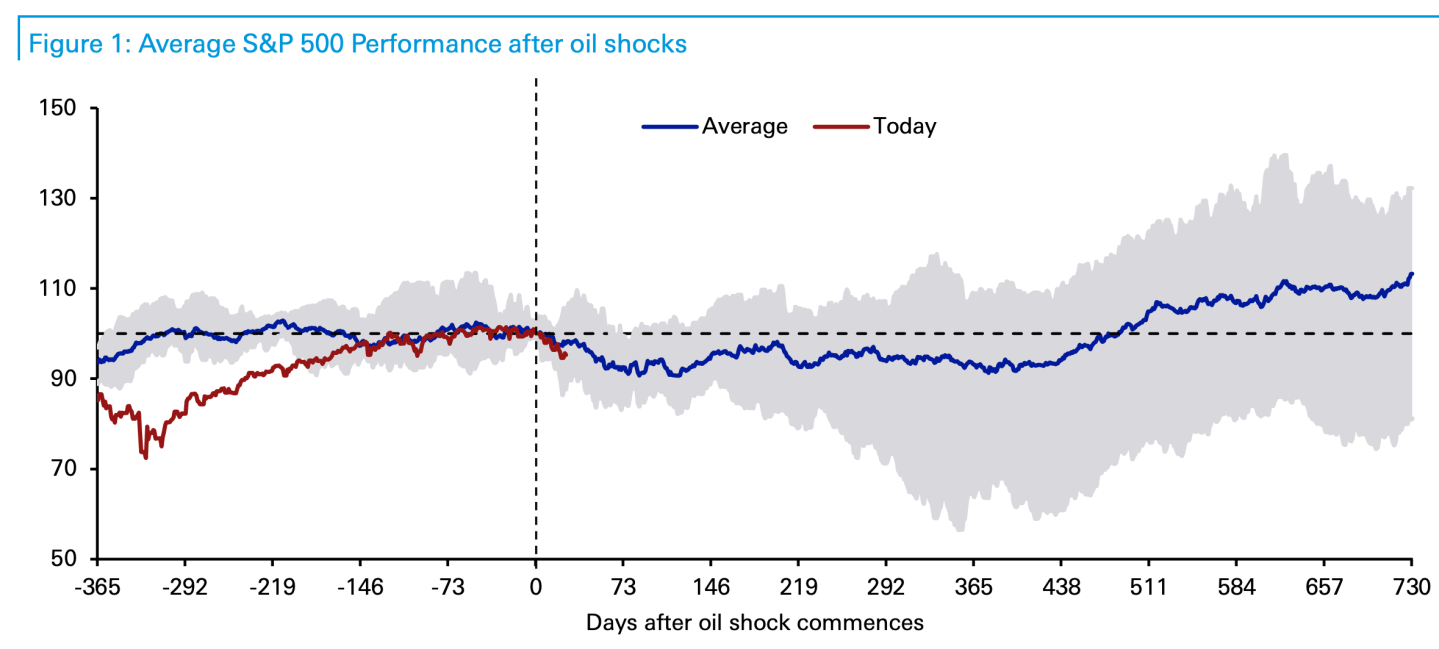
Why isn’t it worse? Deutsche Bank’s Henry Allen asked in a recent research paper: “Why doesn’t the scale of the losses [in stocks] compare to previous oil shocks?" He looked at the oil shocks of 1973, 1979, 1990, and 2022 and found that “on average, the S&P 500 falls into correction territory (-10%) within 3 months.” Basically, the “markets aren’t pricing in a sustained shock…[because] markets still expect a pullback in oil prices from current levels," he said.
NUMBER OF THE DAY
$8.2 billion
That was the size of the “outflow” from the S&P 500 last week as traders sold stocks in reaction to the war. It was the fourth-largest outflow since 2008, according to Jill Carey Hall of Bank of America.
MORE FROM FORTUNE
Washington and Silicon Valley have found their common enemy: China, by Jacqueline Munis
Social Security insolvency: How a ‘six figure cap’ to flatten benefits for the ultra-wealthy could buy the program 7 critical years, by Shawn Tully
The world’s consumers are ready for robotaxis. James Peng of Pony AI wants to make sure they’re riding in his, by Nicholas Gordon
The White House snubs Elon Musk’s offer to cover TSA salaries as airport miseries hit record levels, By Eva Roytburg
Vail Resorts’ CEO says it’s time to think beyond the $1,000 ski pass that helped build the empire, by Phil Wahba
Enter Melania Trump, escorted by humanoid robot: ‘I’m Figure 03, a humanoid built for the United States of America,’ by the Associated Press
THE FRONT PAGES TODAY
Prosecutor admits government lacks evidence of misconduct by Fed chair - Washington Post
Trump Says the Energy Shock Will Be Short-Lived. CEOs Paint a Scarier Picture - WSJ
Trump Team Examines What Oil as High as $200 a Barrel Would Mean - Bloomberg
Meta Lays Off 700 Employees, While Rewarding Top Executives - NYT
ONE MORE THING
AI is the cause of, and solution to, your cybersecurity fears
Dan Ives—the Wedbush analyst who is the most bullish of all the tech bulls—recently got back from a trip to the RSAC security conference. Doomsters worry that AI will be weaponised by hackers at scale, but Ives isn't one of them. “AI is...the most significant demand catalyst the industry has ever seen,” he said in a recent note.
“The increased use of AI has dramatically lowered the cost, skill, and time required to execute sophisticated attacks while massively elevating their scale/precision. AI agents and autonomous workflows dramatically increase the attack surface further, with more APIs, more machine identities, more lateral movement risk, and more cloud-native workloads creating entirely new vectors that legacy point solutions were never designed to address. Critically, AI does not reduce the need for endpoint, identity, cloud, and SOC automation; it multiplies it as more enterprises deploy LLM-powered agents...cyber becomes the enforcement layer of AI, not a casualty of it.”