Welcome to Eye on AI, with AI reporter Sharon Goldman. In this edition: With AI focus, Meta lays Off 700 while rewarding top executives…Google’s memory breakthrough deepens chip selloff...Outgoing CEOs of major companies are citing AI as a factor in their decisions to step down.
Reporting on the ground in northeast Louisiana last month, where Meta is building its massive Hyperion AI data center on over 2,250 acres of former farmland, I was struck by a street sign just minutes from soybean fields, grain silos, and grazing cows.
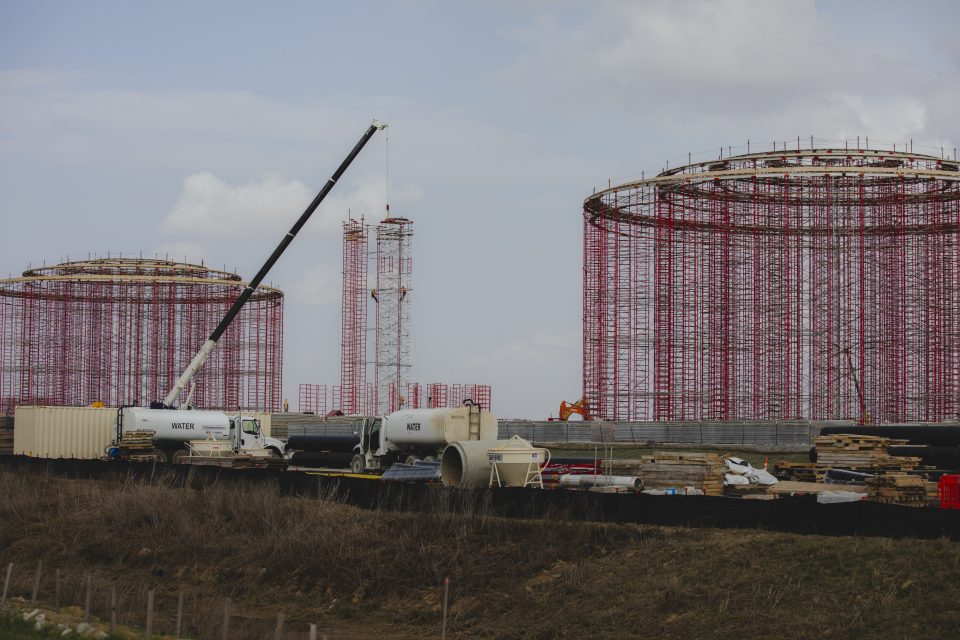
The sign, marking a newly-built road leading into the construction site, carries an appropriate name: Far Far Away Lane. The nod to Star Wars hints at a new frontier, but the Meta site is so disorientingly vast that what’s happening there feels less like sci-fi and more like the early stages of a city rising from the dirt. The site is five miles long and a mile wide at some points, steel frames jut from the ground, heavy machinery operates around the clock, and an endless stream of trucks pours in before sunrise, feeding a project where thousands of workers in hardhats and neon vests swarm. Residents complain about damage to their vehicles from rocks kicked up by the trucks hurtling to and from the Meta site.
Something enormous and unfamiliar has landed in rural Richland Parish, and it represents not just Meta’s stratospheric AI ambitions, but the financial, energy-hungry reality of building the infrastructure that underpins the AI boom.
I hope you’ll check out the second article in my series on the effects of the AI data center boom on local communities (the first was a December story on a data center developer’s designs on a vast desert site outside of Phoenix). Meta’s Hyperion arrives at a moment when data centers are no longer just an infrastructure issue—they’re becoming a political one. Just this week, Bernie Sanders and Alexandria Ocasio-Cortez proposed a moratorium on new data center development, citing concerns about energy use, environmental impact, and strain on local communities. And Sen. Mark Warner (D-VA) just floated taxing AI data centers to fund support for workers displaced by automation—a sign that policymakers are starting to connect the infrastructure buildout directly to labor disruption.
But in northeast Louisiana, the impact is hyperlocal. Meta’s project is transforming Richland Parish into a chaotic boomtown almost overnight, with attendant winners and losers. Some businesses are seeing a surge in demand from construction crews, while some residents are being pushed out as housing costs climb and landlords look to capitalize on the influx of higher-paying workers.
Supporters of the project argue that the Meta investment represents a once-in-a-generation opportunity for a region that has struggled with poverty, job loss, and population decline for decades. But for some Richland Parish residents, the experience is less one of opportunity than of spectatorship: watching the bustle of progress unfold nearby—and suffering through its accompanying headaches—without being able to participate or share in its rewards.
It remains to be seen how this unprecedented AI data center spending spree will play out. Collectively, the biggest tech hyperscalers are projected to invest roughly $630 billion to $700 billion in 2026 alone, a 62% jump from 2025, with total AI-related data-center capital expenditures expected to reach $5.2 trillion by 2030, driven largely by GPUs and energy infrastructure. Across tech, finance, and policy circles, there’s a growing question: is this a lasting buildout, or the kind of spending surge that precedes a correction?
Meanwhile, Meta’s Hyperion is just an example of something that is becoming more familiar across the country: mega-scale data center projects, providing the computing power underpinning the AI boom and the U.S. race against China to dominate the sector, are changing landscapes, straining energy grids and water tables, and reshaping the economy.
Because Hyperion is among the furthest along of today’s mega AI data center projects, it may offer one of the first glimpses of how this boom plays out—and the rest of the country is watching. Read the full story here.
With that, here’s more AI news.
Sharon Goldman
sharon.goldman@fortune.com
@sharongoldman
FORTUNE ON AI
Should you trust AI to manage your money? The finance industry is betting you will – by Jeff John Roberts
Exclusive: Blossom Health raises $20 million to bring an AI ‘copilot’ to psychiatry – by Lily Mae Lazarus
Trump taps Zuckerberg, Huang, Ellison for tech advisory council—but excludes Musk and Altman – by Sharon Goldman
Exclusive: Normal Computing raises $50M from Samsung Catalyst to tackle soaring AI chip costs and power demands – by Sharon Goldman
Wall Street is convinced AI will kill SaaS. History and economics say something else—by Jeremy Kahn
The AI era has a message for every CEO: Adapt or die—by Beatrice Nolan
AI IN THE NEWS
With AI focus, Meta lays Off 700 while rewarding top executives. Meta laid off roughly 700 employees, the New York Times reported yesterday, largely in its metaverse and virtual- and augmented-reality division Reality Labs and other non-core areas, just as it rolled out a massive new stock compensation plan for top executives that could be worth up to $921 million each if aggressive growth targets are met. The juxtaposition highlights how quickly AI is reshaping priorities inside Meta. CEO Mark Zuckerberg is doubling down on building “superintelligence,” while shifting resources away from legacy bets like the metaverse. The company plans to spend at least $115 billion this year, much of it on AI infrastructure, including data centers. Zuckerberg has suggested advances in AI tools could allow smaller teams to do work that once required many more people, accelerating both hiring at the top end (elite AI talent, leadership) and cuts elsewhere.
Google's memory breakthrough deepens chip selloff. Bloomberg reported that memory chip stocks fell sharply after Google highlighted a new algorithm, TurboQuant, that can reduce the memory needed to run large AI models by up to sixfold. It has raised investor concerns that one of the biggest bottlenecks in the AI boom could ease, potentially softening demand for high-priced memory. The selloff hit major players like Samsung Electronics, SK Hynix, and Micron Technology, which had surged amid an AI-driven supply crunch. But analysts say the longer-term impact may be a classic case of Jevons Paradox: By lowering the cost of running AI systems, efficiency gains could actually accelerate adoption, meaning demand for memory and infrastructure could ultimately grow rather than shrink.
Major outgoing CEOs are citing AI as a factor in their decisions to step down. Two major CEOs told CNBC in recent months that they departed their companies due to the rise of AI, underscoring how seriously corporate leaders are treating the shift. James Quincey said his decision to step down from Coca-Cola after eight years was driven in part by the need for new leadership to navigate what he described as a “huge new shift” in the AI era, arguing that the next phase of transformation requires different energy and capabilities. He will be succeeded by COO Henrique Braun. His remarks mirror December comments from Douglas McMillon at Walmart, suggesting that AI is forcing a generational rethink of leadership itself, with boards and CEOs increasingly viewing the transition as significant enough to warrant new leaders for the next phase.
EYE ON AI NUMBERS
67%
That's how many middle and high school students say they are concerned that using AI for schoolwork is eroding their critical thinking skills, according to a new RAND study.
Yet the study also found that 62% of U.S. students now use AI to help with homework, up from 48% just seven months earlier. The findings, from a March 2026 survey of more than 1,200 students, highlight a fast-moving shift: AI is rapidly becoming embedded in everyday workflows, even as a majority of users worry about its cognitive tradeoffs.
AI CALENDAR
April 6-9: HumanX, San Francisco.
June 8-10: Fortune Brainstorm Tech, Aspen, Colorado. Apply to attend here.
July 7-10: AI for Good Summit, Geneva, Switzerland.
August 4-6: Ai4, Las Vegas, Nevada
AI Playbook: The future of software development

Will software developers become obsolete? AI is increasingly competent at writing code, allowing non-coders to enter the software game and rendering some junior coders obsolete. But as Fortune AI Editor Jeremy Kahn explains, AI still hallucinates and makes mistakes, making experienced coders essential for quality control and reliability. Watch the playbook.