
• Home
  • Latest
  • Fortune 500
  • Finance
  • Tech
  • Leadership
  • Lifestyle
  • Rankings
  • Multimedia
C-Suitechief executive officer (CEO)

The AI era is turning Corporate America into a CEO churn machine

Claire Zillman
By
Claire Zillman
Claire Zillman
Editor, Leadership
Down Arrow Button Icon
Claire Zillman
By
Claire Zillman
Claire Zillman
Editor, Leadership
Down Arrow Button Icon
March 19, 2026, 9:24 AM ET
Shantanu Narayen, who stepped down from his role as CEO of Adobe Systems recently, will have a lot more time for golfing now.
Shantanu Narayen, who stepped down from his role as CEO of Adobe Systems recently, will have a lot more time for golfing now. Richard Heathcote/Getty Images

Adobe’s longtime CEO Shantanu Narayen announced he was stepping down last week, a move caused, at least in part, by investors’ impatience with the software company’s AI transition. Abode’s stock has been crushed in the “SaaSpocalypse” market selloff that has hit companies whose per-seat software tools are especially vulnerable to automation. Shares are down 25% year-to-date, and investors weren’t impressed with Adobe’s AI-driven quarterly revenue. 

Recommended Video

Narayen’s exit is a stark reminder that, after years of hyping the technology, CEOs now must turn their AI rhetoric into results—or risk being shown the door. The make-or-break moment for CEOs is contributing to an era of rapid turnover among chief executives. Last year, companies in the S&P 1500 named 168 new CEOs, the highest total in more than 15 years, according to Spencer Stuart, a global executive search and leadership advisory firm. Already this year, the CEOs of several companies including Lululemon, Disney, Target, and Walmart, have left their roles. 

CEO tenures are getting shorter and fewer incoming chief executives have prior CEO experience, the data shows, making the two-time CEO exceedingly rare. All told, corporate America has turned into a CEO meat-grinder; it’s chewing up and spitting out leaders at a pace not seen in a decade and a half.

“What we’re seeing right now is clearly a sign of stress,” says Dirk Jenter, professor of finance at the London School of Economics and Political Science. AI is only one part of the reason why.

AI hype is becoming a career hazard for corporate leaders

CEOs have been quick to blame recent layoffs of rank-and-file employees on AI, but their own departures are rarely explained so simply. Still, there’s little doubt that expectations around AI are factoring into chief executives’ more frequent departures in one way or another. 

There are circumstances like Narayen’s in which shareholders are displeased with a CEO’s ability to deliver on an AI vision. “Investors are not necessarily super patient,” Jenter says. “They see billions being spent on AI investments, and they see sort of very little in short-term return on investment, and that puts a lot of pressure on company leadership.”

But investors are also expecting CEOs to achieve overall growth on par with the extraordinary gains recorded at companies at the center of the AI revolution, the so-called “Magnificent 7.” 

“There’s increasing pressure on all CEOs to be growing at similar kinds of rates,” says Anthony Nyberg, a management professor at the University of South Carolina’s Darla Moore School of Business. “[It’s] not actually sustainable or manageable for those companies.”

A surge in shareholder activism is another sign of investors’ growing impatience. Activist campaigns hit an all-time high of 255 last year, surpassing the 2018 record, according to Barclays. U.S. campaigns rose 23%. 

Activists are increasingly targeting CEOs. “Five or ten years ago, activism was largely about corporate policies,” Jenter says. “Now they’re going directly after the top leadership of companies.” Thirty-two U.S. CEOs resigned within a year of an activist campaign, a 38% increase over the four-year average, Barclays’ data shows. 

And then there are instances in which boards tap fresh (often younger) blood to guide companies through the AI transition. Doug McMillon, Walmart’s highly-respected former CEO who, by all accounts, left on his own terms, cited AI in explaining his decision to step down in January. He said his successor, John Furner, was “uniquely capable of leading the company through this next AI‑driven transformation.”

Another force behind the churn: Today’s board directors are less likely to be current or former CEOs than in the past, studies show. Nyberg argues that these less CEO‑centric boards tend to be less sympathetic to sitting chiefs—and perhaps less attuned to the full scope of the job—making them more inclined to support a leadership change.

Experts also argue that CEO turnover is catching up after a backlog from the COVID era, during which boards favored continuity. 

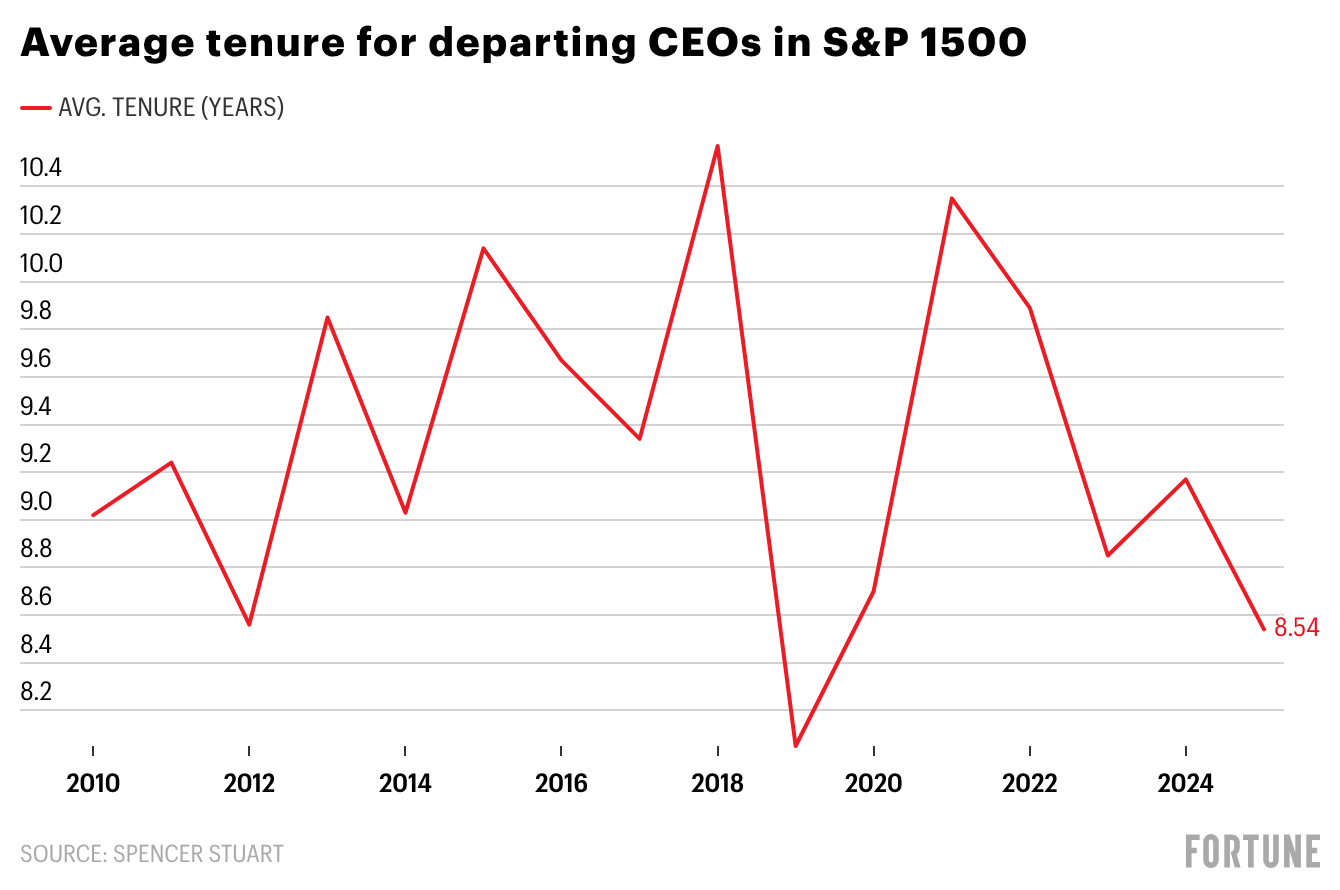
All told, CEOs are getting less time to deliver on their visions. The average tenure for S&P 1500 CEOs hit 8.5 years last year, down from 9.2 years in 2024—and the shortest since 2019. 
The broader CEO churn trend 

The rapid turnover is requiring boards to fulfill their succession planning responsibilities, and they’re increasingly dipping into their companies’ own ranks to replace chief executives. 

The share of externally hired CEOs hit 60% in 2025, up from 57%, a historic low, in 2024. But there are signs that boards have been caught off-guard by the pace of CEO turnover. Nineteen new CEOs were appointed from their company’s board last year, the most since 2020, according to Spencer Stuart, “suggesting that some companies are not ready for succession.” 

Almost always, internal CEO hires lack prior chief executive experience, a trait that shows up in the data. In 2025, 84% of newly appointed S&P 1500 CEOs in 2025 were serving in their first enterprise CEO role, reversing a multiyear trend toward CEOs with prior public-company experience.

Boards often view experienced CEOs as a safer bet, but Spencer Stuart research shows that, compared to veteran chief executives, rookies led their companies to higher market-adjusted total shareholder returns, with less volatility in the stock price.

As the number of first-time CEOs has increased, the age of new CEOs has dropped, hitting 54.4 in 2025, down from 55.8 in 2024. The share of incoming CEOs 60 and above fell to 18%, after hovering near 30% for the past two years.

Even with higher stakes and higher turnover, today’s CEOs are unlikely to garner much sympathy from the wider public. Median chief executive compensation hit $16.5 million in the S&P 500, according to 2025 proxy filings. (Exorbitant pay may actually be one reason two-time CEOs are so rare; few need the money.) 

Still, rapid CEO churn should raise alarm bells outside the boardroom. CEOs who hold onto the job past year ten beat the S&P 500 over the course of their time in the job, more than those in any other length of tenure, Spencer Stuart research shows. “That’s where the greatest shareholder value creation comes in,” says Jim Citrin, chair of the firm’s global CEO practice. “Longer is better.”
Join us for a virtual Fortune 500 Europe C-suite conversation, in partnership with Syndio, on mastering workforce decisions and pay transparency in the age of AI. Built for global and regional HR leaders, this session, moderated by Fortune editor Francesca Cassidy, will take place Wednesday, March 25, at 2:30 p.m. GMT (10:30 a.m. EDT) and feature senior HR leaders from Hilton and Syndio. Together we'll explore how CHROs are using AI to drive smarter pay decisions, manage regulatory risk, and strengthen workforce trust. Register now.
About the Author
Claire Zillman
By Claire ZillmanEditor, Leadership
LinkedIn iconTwitter icon

Claire Zillman is a senior editor at Fortune, overseeing leadership stories. 

See full bioRight Arrow Button Icon

Latest in C-Suite

Finance
Lorem ipsum dolor sit amet, consectetur adipiscing elit, sed do eiusmod tempor incididunt ut labore et dolore magna aliqua. Ut enim ad minim veniam
By Fortune Editors
October 20, 2025
Finance
Lorem ipsum dolor sit amet, consectetur adipiscing elit, sed do eiusmod tempor incididunt ut labore et dolore magna aliqua. Ut enim ad minim veniam
By Fortune Editors
October 20, 2025
Finance
Lorem ipsum dolor sit amet, consectetur adipiscing elit, sed do eiusmod tempor incididunt ut labore et dolore magna aliqua. Ut enim ad minim veniam
By Fortune Editors
October 20, 2025
Finance
Lorem ipsum dolor sit amet, consectetur adipiscing elit, sed do eiusmod tempor incididunt ut labore et dolore magna aliqua. Ut enim ad minim veniam
By Fortune Editors
October 20, 2025
Finance
Lorem ipsum dolor sit amet, consectetur adipiscing elit, sed do eiusmod tempor incididunt ut labore et dolore magna aliqua. Ut enim ad minim veniam
By Fortune Editors
October 20, 2025
Finance
Lorem ipsum dolor sit amet, consectetur adipiscing elit, sed do eiusmod tempor incididunt ut labore et dolore magna aliqua. Ut enim ad minim veniam
By Fortune Editors
October 20, 2025

Most Popular

Finance
Lorem ipsum dolor sit amet, consectetur adipiscing elit, sed do eiusmod tempor incididunt ut labore et dolore magna aliqua. Ut enim ad minim veniam
By Fortune Editors
October 20, 2025
Finance
Lorem ipsum dolor sit amet, consectetur adipiscing elit, sed do eiusmod tempor incididunt ut labore et dolore magna aliqua. Ut enim ad minim veniam
By Fortune Editors
October 20, 2025
Finance
Lorem ipsum dolor sit amet, consectetur adipiscing elit, sed do eiusmod tempor incididunt ut labore et dolore magna aliqua. Ut enim ad minim veniam
By Fortune Editors
October 20, 2025
Finance
Lorem ipsum dolor sit amet, consectetur adipiscing elit, sed do eiusmod tempor incididunt ut labore et dolore magna aliqua. Ut enim ad minim veniam
By Fortune Editors
October 20, 2025
Finance
Lorem ipsum dolor sit amet, consectetur adipiscing elit, sed do eiusmod tempor incididunt ut labore et dolore magna aliqua. Ut enim ad minim veniam
By Fortune Editors
October 20, 2025
Finance
Lorem ipsum dolor sit amet, consectetur adipiscing elit, sed do eiusmod tempor incididunt ut labore et dolore magna aliqua. Ut enim ad minim veniam
By Fortune Editors
October 20, 2025
Fortune Secondary Logo
Rankings
  • 100 Best Companies
  • Fortune 500
  • Global 500
  • Fortune 500 Europe
  • Most Powerful Women
  • Future 50
  • World’s Most Admired Companies
  • See All Rankings
Sections
  • Finance
  • Fortune Crypto
  • Features
  • Leadership
  • Health
  • Commentary
  • Success
  • Retail
  • Mpw
  • Tech
  • Lifestyle
  • CEO Initiative
  • Asia
  • Politics
  • Conferences
  • Europe
  • Newsletters
  • Personal Finance
  • Environment
  • Magazine
  • Education
Customer Support
  • Frequently Asked Questions
  • Customer Service Portal
  • Privacy Policy
  • Terms Of Use
  • Single Issues For Purchase
  • International Print
Commercial Services
  • Advertising
  • Fortune Brand Studio
  • Fortune Analytics
  • Fortune Conferences
  • Business Development
  • Group Subscriptions
About Us
  • About Us
  • Editorial Calendar
  • Press Center
  • Work At Fortune
  • Diversity And Inclusion
  • Terms And Conditions
  • Site Map
  • About Us
  • Editorial Calendar
  • Press Center
  • Work At Fortune
  • Diversity And Inclusion
  • Terms And Conditions
  • Site Map
  • Facebook icon
  • Twitter icon
  • LinkedIn icon
  • Instagram icon
  • Pinterest icon

Latest in C-Suite

C-Suitegeopolitics
‘We’ve become like Europe’: Jamie Dimon warns China is beating the U.S. as he says Iran war means a ‘better chance’ of permanent Middle East peace
By Marco Quiroz-GutierrezMarch 25, 2026
3 hours ago
Magazinechief executive officer (CEO)
The AI era has a message for every CEO: Adapt or die
By Beatrice NolanMarch 25, 2026
3 hours ago
Origin cofounders Chris Bruce (left) and Pete Craghill.
Startups & VentureVenture Capital
Exclusive: AI-powered benefits platform Origin raises $30 million in fresh funding to bring CHROs visibility into benefits usage and spend
By Jeremy KahnMarch 25, 2026
3 hours ago
Middle EastLetter from London
As war continues to rage, the World Economic Forum is the latest to postpone Gulf conference in Saudi 
By Kamal AhmedMarch 24, 2026
19 hours ago
SuccessNCAA March Madness
From 12 hours of video games a day to Big Ten Player of the Year: The unlikely rise of Yaxel Lendeborg
By Sydney LakeMarch 24, 2026
19 hours ago
onlyfans
LawBillionaires
Billionaire OnlyFans founder Leonid Radvinsky dies of cancer at 43
By Kaitlyn Huamani and The Associated PressMarch 24, 2026
20 hours ago

Most Popular

Commentary
The Treasury just declared the U.S. insolvent. The media missed it
By Fortune EditorsMarch 23, 2026
2 days ago
Magazine
The youngest-ever female CEO of a Fortune 500 company is fighting Trump's cuts to keep Medicaid strong
By Fortune EditorsMarch 24, 2026
1 day ago
Economy
It took 200 years for national debt to hit $1 trillion. Annual interest alone now exceeds that—a 'crushing legacy we must reverse,' says budget chair
By Fortune EditorsMarch 23, 2026
2 days ago
Energy
Nobel laureate Paul Krugman calls it 'treason': $580 million in suspicious oil futures traded minutes before Trump's Iran reversal
By Fortune EditorsMarch 24, 2026
16 hours ago
Success
Palantir’s billionaire CEO says only two kinds of people will succeed in the AI era: trade workers — ‘or you’re neurodivergent’
By Fortune EditorsMarch 24, 2026
19 hours ago
Personal Finance
Current price of oil as of March 24, 2026
By Fortune EditorsMarch 24, 2026
22 hours ago

© 2026 Fortune Media IP Limited. All Rights Reserved. Use of this site constitutes acceptance of our Terms of Use and Privacy Policy | CA Notice at Collection and Privacy Notice | Do Not Sell/Share My Personal Information
FORTUNE is a trademark of Fortune Media IP Limited, registered in the U.S. and other countries. FORTUNE may receive compensation for some links to products and services on this website. Offers may be subject to change without notice.