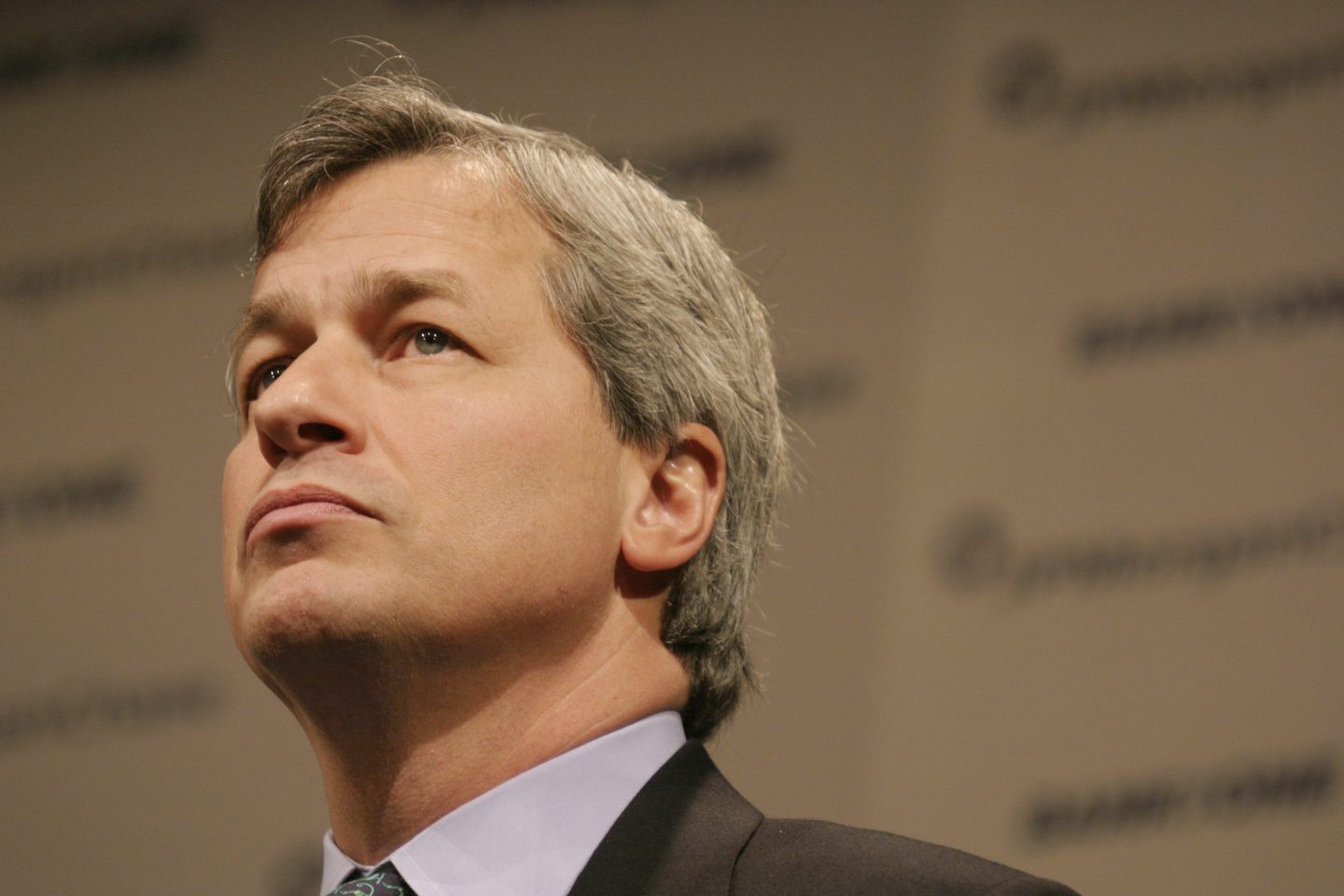
It was Jamie Dimon’s 70th birthday on March 13, a great excuse to look back at Shawn Tully’s 2006 Fortune cover story, “The Contender”—a profile of the man who had recently taken the reins at JPMorgan Chase and was “taking a shot at the title of world’s most important banker.”
He has now held that moniker for so long that it is taken for granted on Wall Street. Dimon led JPMorgan Chase to the No. 1 position among global investment banks by both revenue and fee share, and has held it there for nearly 20 years—almost exactly since Tully wrote those words.
The stories about the man were already legendary then. The moment he arrived at JPMorgan Chase, Dimon had shut down the corporate gyms and pulled the fresh flowers. At a retirement party for outgoing CFO Dina Dublon, Tully wrote, he stepped to the podium, praised her service, then stuck in the knife: “But if you paid one dollar for Texas Commerce Bank,” he declared, referring to the $1.2 billion purchase in 1987, “you paid a dollar too much.” “The room, studded with Texas Commerce alumni and executives who had championed the deal, went dead silent,” Tully wrote.
When Dimon discovered that regional J.P. Morgan managers were earning $2 million, five times what their Bank One counterparts made, he slashed hundreds of comp packages by 20% to 50%. “I’d tell people they were way overpaid,” he told Tully. “And guess what? They already knew it.”
Heidi Miller, then chief of treasury services, captured the paradox best: “He can be a total pain, overdemanding—but you’d trust your life to him.”
Trust in Dimon and his judgment has only grown. His annual shareholder letters now read like a head of state’s address. He has been floated for Treasury Secretary by both Republican and Democratic administrations and, as recently as January 2026, said he would take the job if asked (while ruling out the Fed chair role entirely). He has effectively been doing parts of it already: coordinating with Hank Paulson during the 2008 financial crisis; joining a Wall Street rescue committee during the 2023 SVB collapse; and in late 2025 launching a $1.5 trillion American Resiliency Initiative, recruiting Jeff Bezos, Michael Dell, Condoleezza Rice, and Jim Farley to marshal private capital toward national security goals.
In 2006, Tully wrote that Dimon believed you only “earn the right to do a deal” once the fundamentals are fixed. Twenty years later, the fundamentals are fortress-strong, and the contender has been a champion for a generation.