

• Home
  • Latest
  • Fortune 500
  • Finance
  • Tech
  • Leadership
  • Lifestyle
  • Rankings
  • Multimedia

Trendingnow

1

As Big Tech showers employees with perks to win the talent war, Nvidia built a nearly $5 trillion company by making people pay for their own lunch

2

Mark Zuckerberg feeds his cows macadamia nuts and beer to create the 'highest-quality beef in the world' on his $300 million estate in Hawaii

3

Today, Emily Blunt is worth $80 million thanks to her Hollywood career—but she actually wanted to be a UN Spanish translator on $80K

1

As Big Tech showers employees with perks to win the talent war, Nvidia built a nearly $5 trillion company by making people pay for their own lunch

2

Mark Zuckerberg feeds his cows macadamia nuts and beer to create the 'highest-quality beef in the world' on his $300 million estate in Hawaii

3

Today, Emily Blunt is worth $80 million thanks to her Hollywood career—but she actually wanted to be a UN Spanish translator on $80K
Future of WorkBipartisan

‘I don’t know if we’re ready’: Governors from each party appalled at 100-year-old federal workforce strategy

Catherina Gioino
By
Catherina Gioino
Catherina Gioino
News Editor
Down Arrow Button Icon
Catherina Gioino
By
Catherina Gioino
Catherina Gioino
News Editor
Down Arrow Button Icon
March 12, 2026, 10:32 AM ET
Former Tennessee Gov. Bill Haslam holding up his fingers.
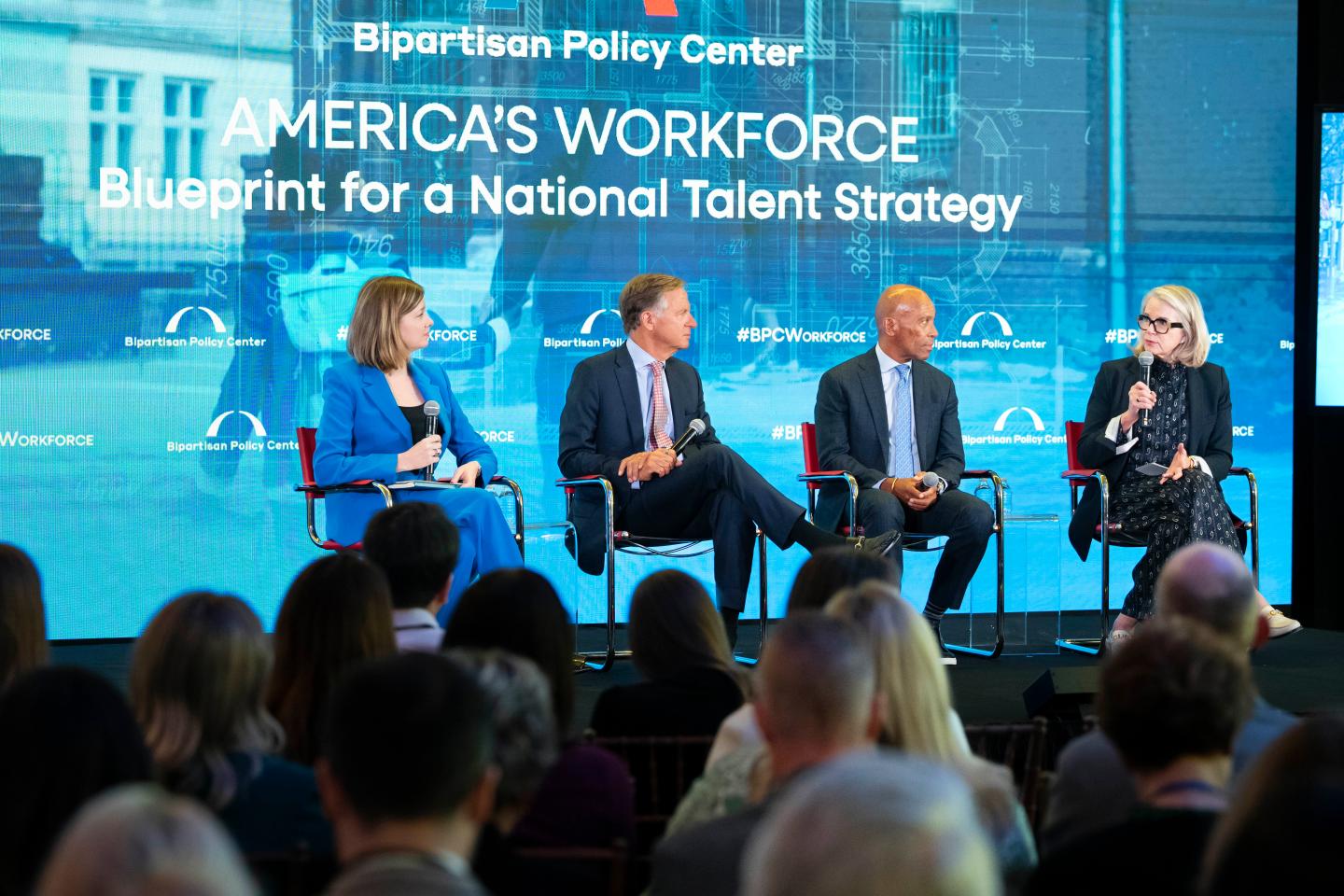
Former Governors Deval Patrick (D-MA) and Bill Haslam (R-TN) spoke with former U.S. Secretary of Education and president of the Bipartisan Policy Center Margaret Spellings at the Bipartisan Policy Center summit on Wednesday, March 11.Chip Somodevilla/Getty Images
Add Fortune on Google for similar content.

On Wednesday, some of the most prominent names in American education and workforce policy gathered in Washington to deliver a blunt message: the United States is failing its workers, its students, and its economy — and the window to fix it is closing fast.

Recommended Video

The Bipartisan Policy Center, a group of bipartisan national and state policymakers, business leaders, and education experts, released a sweeping report produced by a 24-member commission that spent more than a year examining the country’s broken education and workforce pipeline. The report, entitled “A Nation at Risk to a Nation at Work: The Case for a National Talent Strategy,” told a sombering story of a nation headed towards severe economic instability as an unready workforce becomes all the more unprepared in the midst of rising AI technologies in the workplace.

The numbers are alarming

By late 2025, estimates showed that 57% of current U.S. work hours could be automated with technology that already exists—nearly double McKinsey’s projection from just two years prior. Half of college graduates from the last decade were underemployed a year after graduation, and nearly three-quarters stayed that way for a decade. Some 37.6 million American adults under 65 have some college credits and no credential to show for it. 

“The world’s changed”

Former Tennessee Gov. Bill Haslam and former Massachusetts Gov. Deval Patrick, who co-chaired the effort and were joined on Wednesday by former U.S. Secretary of Education and BPC President Margaret Spellings and former Commerce Secretary Gina Raimondo. The two governors spoke to Fortune about the need to update our laws for the current dire situation. 
The key laws governing how Americans pay for college and access job training—the Higher Education Act and the Workforce Innovation and Opportunity Act—were last updated in 2008 and 2014, respectively, predating the rise of generative AI, the gig economy, and widespread remote work.​

“This is not just about AI,” Haslam told Fortune. “This is about making certain that we have a workforce training system that was designed 100 years ago for a very different economy than we have now. It’s about having a system that lets people know, hey, the world’s changed — here’s the skill sets that you are probably going to need going forward, and here’s how to get them.”​

According to the Bipartisan Policy Center, the trend reveals that “the U.S. workforce system is not fully aligned with the demands of an AI-driven economy,” with a growing skills mismatch leaving many employers unable to find qualified workers even as unemployment fluctuates. Education systems, the report notes, “remain largely built around traditional college-only pathways, while the modern labor market increasingly requires a wider range of options such as apprenticeships, technical credentials, short-term training programs, and opportunities for lifelong learning.” What makes the current moment different from past technological disruptions, the BPC argues, is its pace: “Previous tech waves automated routine tasks, while this disruption is different—changing in real time.”

Who gets left behind

Patrick, who served two terms as Massachusetts’ governor before leading Bain Capital Double Impact and later joining the Harvard Kennedy School faculty, was clear that the report’s ambitions stretch well beyond the AI debate. “We’re at a period of rapid change in the workforce, in our economy that comes from a lot of different places, but it affects all of us—workers, learners, employers.”

Central to the commission’s diagnosis is the question of who gets left behind. Patrick invoked the research of Stanford economist Raj Chetty to illustrate the stakes. “Raj Chetty’s work on ‘lost Einsteins’ shows us that genius, creativity, and innovation exist equally across zip codes and income levels,” Patrick said. “Yet too many talented young people from low-income and working-class communities never get the chance to develop their gifts because they lack access to great schools, mentorship, and career pathways,” he said. 

“We’re leaving untapped talent on the sidelines. If we’re serious about strengthening America’s competitiveness and expanding opportunity for everyone, we have to be equally serious about ensuring that every child can discover and develop their talents. That’s not charity — that’s smart policy and moral imperative.”

A model from Tennessee

Haslam brought his own track record to the table. As governor of Tennessee, he launched Tennessee Promise, making community college and technical school free for all high school graduates—a program the report holds up as a model for what aligned state-level policy can achieve. “When Tennessee made community college and technical school free for all high school graduates, we weren’t just opening doors—we were transforming the entire state’s economic trajectory,” Haslam said. 

“Employers had a deeper talent pipeline. Communities saw young people stay and build careers at home instead of leaving for opportunity elsewhere,” he continued. “Combined with our investments in K-12 and our commitment to employer partnerships, free community college became a linchpin of a statewide talent ecosystem. That’s what happens when you align education policy with workforce and economic development.”

The fix: a national talent strategy

The report’s central structural fix is the creation of a Talent Advisory Council within the Executive Office of the President—modeled on the National Security Council — that would coordinate education and workforce policy across more than a dozen federal agencies that currently spend over $230 billion annually across 150+ programs with no cohesive strategy. “What we have experienced is a system that is very fragmented, that is hard to access—that you kind of have to know about in your little corner of the economy to take advantage of,” Patrick said. “We need a strategy, and that strategy needs to be national in scope. Because the challenge is national in scope.”

“This feels like—different parts of the country, different political parties—but this feels like an issue that has some increasing national urgency, and it needs some leadership to address it,” said Haslam.

The report arrives at a fraught political moment, with the current administration cutting federal education spending and Congress showing little appetite for sweeping reform. But Patrick rejected the idea that funding battles would doom the effort. “Washington will act on this if the people are mobilized,” he said. “Funding always matters. I don’t want to downplay that. But this is not solely an issue about funding. This is about how you allocate the resources and assets to properly train the next generation workforce. If we get stuck in a funding conversation, that does evolve into the old battle. This is about how do we think differently.”​

That cross-partisan determination is the summit’s animating spirit. “There are a lot of things that are just immediately polarized in today’s world,” Patrick said. “This is one of those that everybody, I think, understands: the future is going to look a lot different. And I don’t know if we’re ready for it.”​

The Fortune 500 Innovation Forum will convene Fortune 500 executives, U.S. policy officials, top founders, and thought leaders to help define what’s next for the American economy, Nov. 16-17 in Detroit. Apply here.
About the Author
Catherina Gioino
By Catherina GioinoNews Editor
Instagram iconLinkedIn iconTwitter icon

Catherina covers markets, the economy, energy, tech, and AI.

See full bioRight Arrow Button Icon
Add Fortune on Google for similar content.

Latest in Future of Work

Finance
Lorem ipsum dolor sit amet, consectetur adipiscing elit, sed do eiusmod tempor incididunt ut labore et dolore magna aliqua. Ut enim ad minim veniam
By Fortune Editors
October 20, 2025
Finance
Lorem ipsum dolor sit amet, consectetur adipiscing elit, sed do eiusmod tempor incididunt ut labore et dolore magna aliqua. Ut enim ad minim veniam
By Fortune Editors
October 20, 2025
Finance
Lorem ipsum dolor sit amet, consectetur adipiscing elit, sed do eiusmod tempor incididunt ut labore et dolore magna aliqua. Ut enim ad minim veniam
By Fortune Editors
October 20, 2025
Finance
Lorem ipsum dolor sit amet, consectetur adipiscing elit, sed do eiusmod tempor incididunt ut labore et dolore magna aliqua. Ut enim ad minim veniam
By Fortune Editors
October 20, 2025
Finance
Lorem ipsum dolor sit amet, consectetur adipiscing elit, sed do eiusmod tempor incididunt ut labore et dolore magna aliqua. Ut enim ad minim veniam
By Fortune Editors
October 20, 2025
Finance
Lorem ipsum dolor sit amet, consectetur adipiscing elit, sed do eiusmod tempor incididunt ut labore et dolore magna aliqua. Ut enim ad minim veniam
By Fortune Editors
October 20, 2025

Most Popular

Finance
Lorem ipsum dolor sit amet, consectetur adipiscing elit, sed do eiusmod tempor incididunt ut labore et dolore magna aliqua. Ut enim ad minim veniam
By Fortune Editors
October 20, 2025
Finance
Lorem ipsum dolor sit amet, consectetur adipiscing elit, sed do eiusmod tempor incididunt ut labore et dolore magna aliqua. Ut enim ad minim veniam
By Fortune Editors
October 20, 2025
Finance
Lorem ipsum dolor sit amet, consectetur adipiscing elit, sed do eiusmod tempor incididunt ut labore et dolore magna aliqua. Ut enim ad minim veniam
By Fortune Editors
October 20, 2025
Finance
Lorem ipsum dolor sit amet, consectetur adipiscing elit, sed do eiusmod tempor incididunt ut labore et dolore magna aliqua. Ut enim ad minim veniam
By Fortune Editors
October 20, 2025
Finance
Lorem ipsum dolor sit amet, consectetur adipiscing elit, sed do eiusmod tempor incididunt ut labore et dolore magna aliqua. Ut enim ad minim veniam
By Fortune Editors
October 20, 2025
Finance
Lorem ipsum dolor sit amet, consectetur adipiscing elit, sed do eiusmod tempor incididunt ut labore et dolore magna aliqua. Ut enim ad minim veniam
By Fortune Editors
October 20, 2025
Fortune Secondary Logo
Rankings
  • 100 Best Companies
  • Fortune 500
  • Global 500
  • Fortune 500 Europe
  • Most Powerful Women
  • World's Most Admired Companies
  • See All Rankings
  • Lists Calendar
Sections
  • Finance
  • Fortune Crypto
  • Features
  • Leadership
  • Health
  • Commentary
  • Success
  • Retail
  • Mpw
  • Tech
  • Lifestyle
  • CEO Initiative
  • Asia
  • Politics
  • Conferences
  • Europe
  • Newsletters
  • Personal Finance
  • Environment
  • Magazine
  • Education
Customer Support
  • Frequently Asked Questions
  • Customer Service Portal
  • Privacy Policy
  • Terms Of Use
  • Single Issues For Purchase
  • International Print
Commercial Services
  • Advertising
  • Fortune Brand Studio
  • Fortune Analytics
  • Fortune Conferences
  • Business Development
  • Group Subscriptions
About Us
  • About Us
  • Press Center
  • Work At Fortune
  • Terms And Conditions
  • Site Map
  • About Us
  • Press Center
  • Work At Fortune
  • Terms And Conditions
  • Site Map
  • Facebook icon
  • Twitter icon
  • LinkedIn icon
  • Instagram icon
  • Pinterest icon

Latest in Future of Work

z
AIdisruption
Meet the Zillennials: The luckiest micro-generation in the workforce, born between 1993 and 1998
By Nick LichtenbergJuly 3, 2026
1 hour ago
U.S. Treasury Secretary Scott Bessent
EconomyDebt
AI’s $2.2 trillion deficit fix is already half fake, economists say
By Tristan BoveJuly 2, 2026
14 hours ago
Jason Lemkin
Successwork-life balance
This investor won’t back startups unless staff are in the office 6 days a week: ‘Not because I don’t have empathy, because they’re going to fail’
By Preston ForeJuly 2, 2026
17 hours ago
Today, Emily Blunt is worth $80 million thanks to her Hollywood career—but she actually wanted to be a UN Spanish translator on $80K
SuccessCareers
Today, Emily Blunt is worth $80 million thanks to her Hollywood career—but she actually wanted to be a UN Spanish translator on $80K
By Orianna Rosa RoyleJuly 2, 2026
1 day ago
Nikesh Arora, chief executive officer at Palo Alto Networks
SuccessJobs
CEO of $248 billion cybersecurity company says workers are about to face a ‘Darwinian moment’ thanks to AI: Evolve or get cut
By Emma BurleighJuly 1, 2026
2 days ago
Young worker at desk
SuccessGen Z
Remote-first fintech giant Revolut is making the office compulsory for new Gen Z grads—and they’ll earn flexibility like their peers after one year
By Emma BurleighJune 30, 2026
3 days ago

Most Popular

As Big Tech showers employees with perks to win the talent war, Nvidia built a nearly $5 trillion company by making people pay for their own lunch
Big Tech
As Big Tech showers employees with perks to win the talent war, Nvidia built a nearly $5 trillion company by making people pay for their own lunch
By Marco Quiroz-GutierrezJuly 1, 2026
2 days ago
Mark Zuckerberg feeds his cows macadamia nuts and beer to create the 'highest-quality beef in the world' on his $300 million estate in Hawaii
Success
Mark Zuckerberg feeds his cows macadamia nuts and beer to create the 'highest-quality beef in the world' on his $300 million estate in Hawaii
By Sasha RogelbergJuly 2, 2026
15 hours ago
Today, Emily Blunt is worth $80 million thanks to her Hollywood career—but she actually wanted to be a UN Spanish translator on $80K
Success
Today, Emily Blunt is worth $80 million thanks to her Hollywood career—but she actually wanted to be a UN Spanish translator on $80K
By Orianna Rosa RoyleJuly 2, 2026
1 day ago
Americans are escaping the U.S. for New Zealand where house prices have hit a new low—but only wealthy Americans with $3 million spare can invest
Success
Americans are escaping the U.S. for New Zealand where house prices have hit a new low—but only wealthy Americans with $3 million spare can invest
By Emma BurleighJuly 2, 2026
17 hours ago
Current price of oil as of July 2, 2026
Personal Finance
Current price of oil as of July 2, 2026
By Joseph HostetlerJuly 2, 2026
19 hours ago
MacKenzie Scott alone accounted for one-third of America's $19.2 billion in megagifts last year
Success
MacKenzie Scott alone accounted for one-third of America's $19.2 billion in megagifts last year
By Sydney LakeJune 25, 2026
8 days ago

© 2026 Fortune Media IP Limited. All Rights Reserved. Use of this site constitutes acceptance of our Terms of Use and Privacy Policy | CA Notice at Collection and Privacy Notice | Do Not Sell/Share My Personal Information
FORTUNE is a trademark of Fortune Media IP Limited, registered in the U.S. and other countries. FORTUNE may receive compensation for some links to products and services on this website. Offers may be subject to change without notice.