S&P 500 futures were down 0.32% this morning prior to the opening bell in New York, after the index fell 0.54% yesterday, suggesting that investors hate U.S. equities right now.
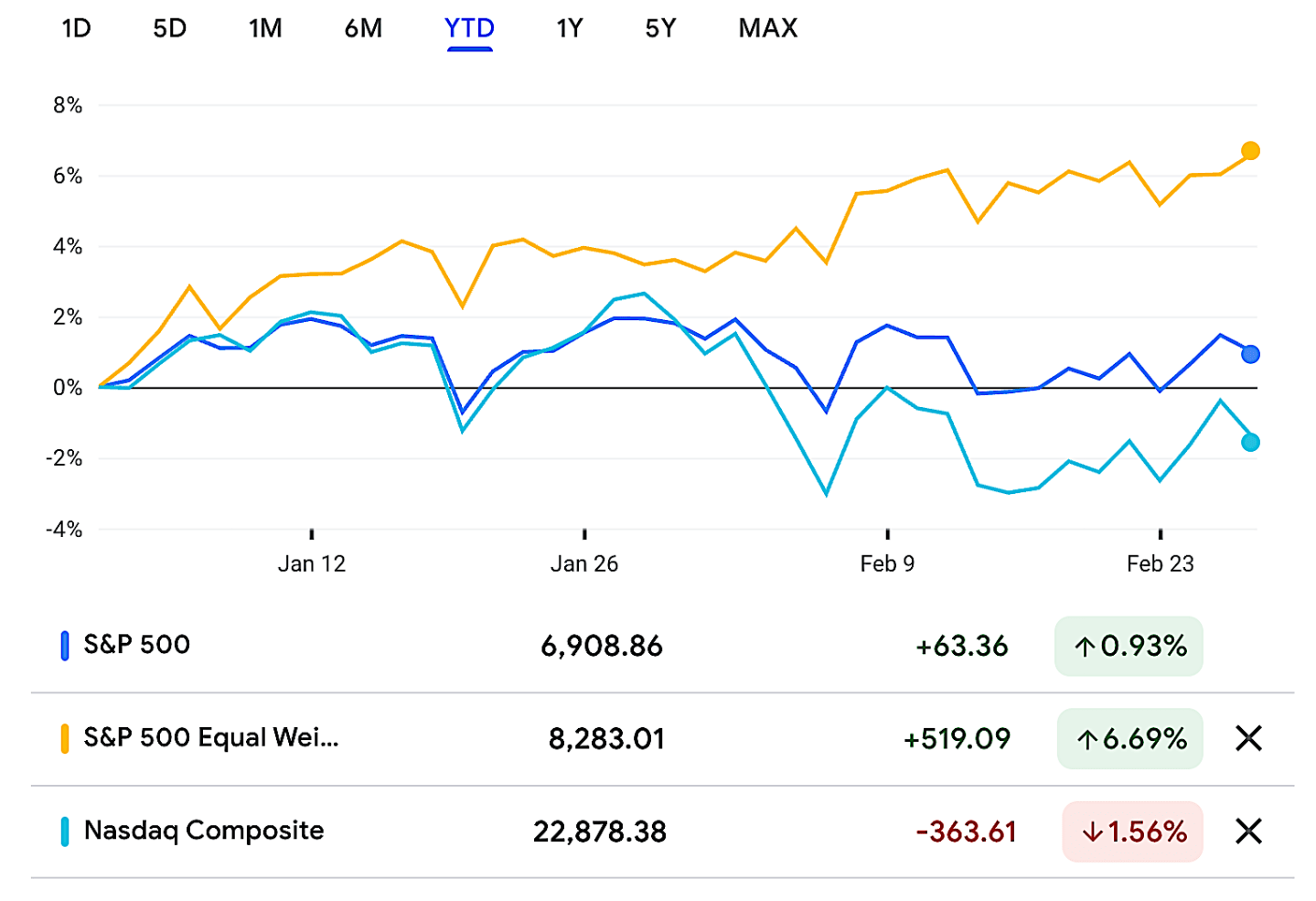
The index is up 0.93% year to date, a feeble performance compared with foreign stocks. The U.K.’s FTSE 100 is up nearly 10% over the same period. The STOXX Europe 600 is up 6.53% and sits at an all-time high. Japan’s Nikkei 225 is up nearly 14%. South Korea’s KOSPI is up an astonishing 45%.
Growth is everywhere, except in the U.S.
Why?
It’s “AI derangement syndrome,” according to an email sent by Yardeni Research to its clients.
Investors have become so skittish of stocks linked to AI that it’s dragging down the entire U.S. market. Exhibit A: Nvidia, the AI chipmaker that is the largest company on planet earth by market cap. Nvidia’s performance as a business has been unambiguously excellent. Its Q4 2025 earnings call was another blowout, expectations-beating, record performance.
But no good deed goes unpunished in the S&P 500, and Nvidia’s stock fell 5.46% yesterday. It is down 0.86% year to date. “Out of 13 total quarterly reports, [Nvidia] has reported 10 triple plays (beat earnings per share, beat sales, raised guidance) … Following its last seven reports, though, shares have averaged a decline of -3%,” Bespoke Investment Group said. (Bespoke tracks a custom “AI-doom basket” of stocks, which gives you an idea of how negatively AI is viewed by traders right now.)
AI-linked tech stocks are, in fact, dragging down the S&P as a whole. The equal-weight S&P 500—a notional index that ignores the market cap of each stock in favor of counting them all equally—is up 6.7% year to date, suggesting that the U.S. market would be better off without the tech stocks that dominate it. The tech-heavy Nasdaq, by contrast, is down 1.56% for the year.
“The main driver [of the market’s recent decline] was a serious slump for semiconductor stocks,” Jim Reid and his colleagues at Deutsche Bank told clients this morning.
AI is now regarded as a liability, not a benefit, according to some analysts. “If AI continues to disrupt, if not destroy, more and more business models, won’t that cause a recession?” asked Ed Yardeni of Yardeni Research in a recent email.
“It might if it triggers lots of white-collar layoffs, which in turn lead to blue-collar job losses. Alternatively, it might cause a credit crunch in the private credit markets. UBS Group AG has raised its private-credit default forecast, with its strategists warning that losses could reach as high as 15% in a worst-case scenario, up from 13% just weeks ago,” he said, citing Bloomberg.
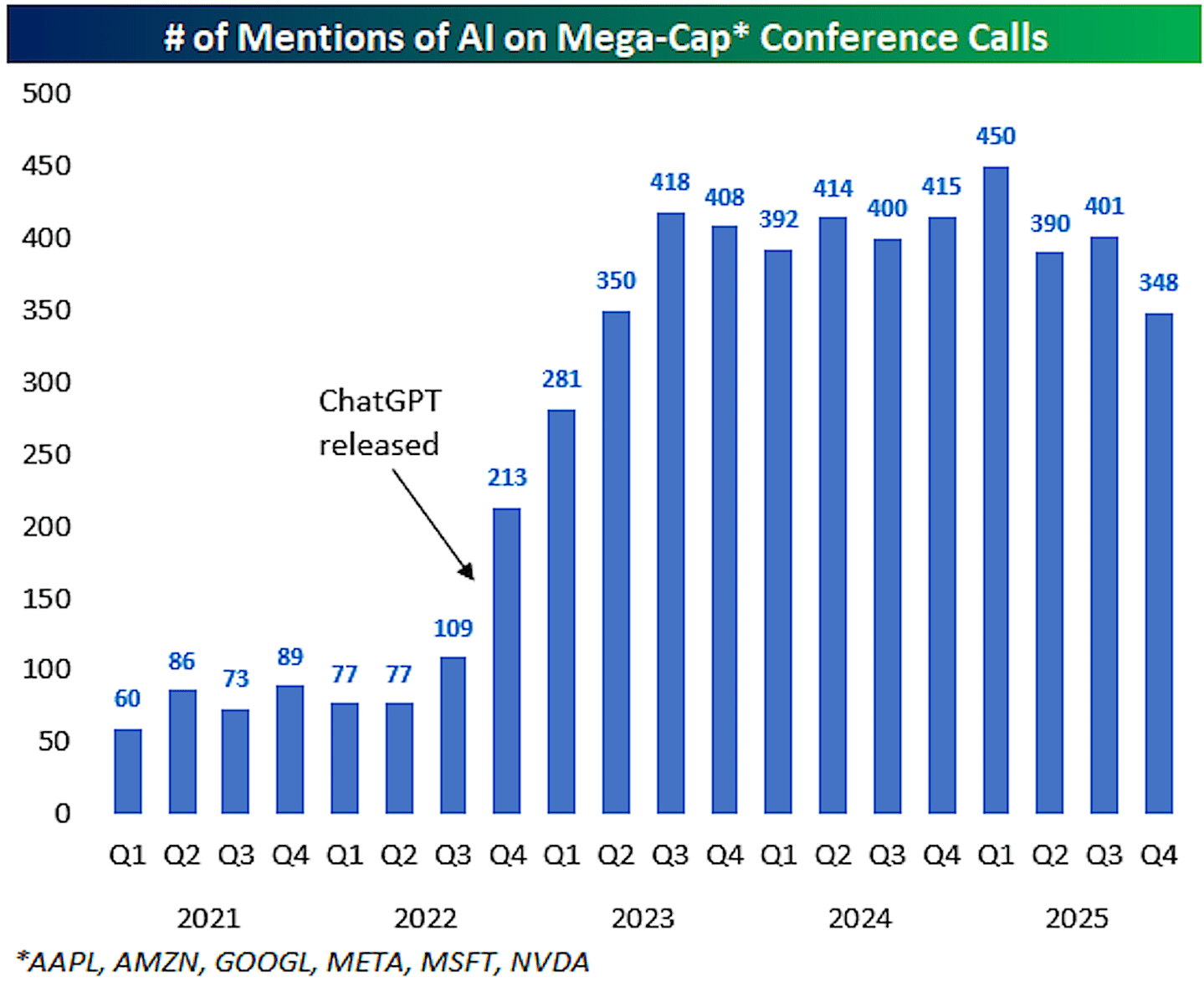
Corporate America appears to be slowly waking up to the fact that banging on about AI all the time is hurting, not helping. Bespoke tracked the mentions of AI in conference calls by Apple, Amazon, Alphabet (Google), Meta, Microsoft, and Nvidia, and discovered that chief executives are dialing down their mentions of AI.
“‘AI’ was mentioned 348 times this quarter. As shown below, that’s down quite a bit from the 401 ‘AI’ mentions last quarter, and it’s 102 fewer than peak ‘AI’ reached during the Q1 2025 earnings season,” the group said.
Here’s a snapshot of the markets this morning prior to the opening bell in New York:
- S&P 500 futures were down 0.32% this morning. The index closed down 0.54% in its last session.
- The STOXX Europe 600 was up 0.22% in early trading.
- The U.K.’s FTSE 100 was up 0.4% in early trading.
- Japan’s Nikkei 225 was up 0.16%.
- China’s CSI 300 is down 0.34%.
- The South Korea KOSPI was down 1%.
- India’s Nifty 50 was down 1.25%.
- Bitcoin declined to $66.8K.