

• Home
  • Latest
  • Fortune 500
  • Finance
  • Tech
  • Leadership
  • Lifestyle
  • Rankings
  • Multimedia
AIMarkets

Morgan Stanley predicts AI won’t let you retire early: Instead, you’ll have to train for jobs that don’t exist yet

Nick Lichtenberg
By
Nick Lichtenberg
Nick Lichtenberg
Business Editor
Down Arrow Button Icon
Nick Lichtenberg
By
Nick Lichtenberg
Nick Lichtenberg
Business Editor
Down Arrow Button Icon
February 26, 2026, 2:30 AM ET
Getty Images

Tech titans and stock market investors are increasingly unified in their forecast that artificial intelligence will permanently eliminate millions of white-collar jobs and render traditional employment obsolete.

Recommended Video

Software and services stocks have taken a beating, with software multiples pulling back by roughly 33% since late 2025 as investors fret over AI’s potential to automate vast swaths of knowledge work. Earlier this year, Elon Musk predicted that AI and humanoid robots will make work completely “optional” within the next 10 to 20 years, ushering in a post-scarcity economy where money itself becomes irrelevant. He joins a growing chorus of tech executives issuing stark warnings about human obsolescence; OpenAI CEO Sam Altman recently cautioned that superintelligence could soon outperform even top corporate executives, while Microsoft AI chief Mustafa Suleyman and Anthropic CEO Dario Amodei have projected that sweeping white-collar automation could arrive in one to five years. Economists remain skeptical of the timeline, noting that the apocalyptic narrative may be as much a tool to justify astronomical tech valuations as it is an impending economic reality.

But a new, cross-asset research report from Morgan Stanley offers a remarkably grounding message for anxious employees and jittery markets: Most of you won’t be permanently unemployed; you are just going to find new jobs, many or most of which don’t exist yet.

Addressing the widespread concern that AI will “replace millions of jobs and increase unemployment by an equivalent amount,” a large team of Morgan Stanley analysts pointed directly to history. Over the past 150 years, sweeping technological shifts—from electrification and the tractor to the computer and the internet—have fundamentally altered the labor force, but they “did not replace labor.”

When the spreadsheet was popularized in the 1980s, for example, it automated tedious financial modeling and reduced the need for certain bookkeeping clerks. However, it simultaneously freed up analysts’ time to do more complex work and birthed entirely new financial professions. Similarly, the firm argues, AI will merely change “job types, occupations, and needed skills.”

“While some roles may be automated, others will see enhancement through AI augmentation, and other, entirely new roles will be created,” the report said. Rather than a mass extinction event for the white-collar worker, the bank sees the corporate landscape simply preparing for an evolution.

The jobs to come?

So, what will these new jobs look like? Morgan Stanley outlines several emerging professions that it predicts will soon become corporate staples. As AI becomes central to business strategy, companies are expected to hire executive-level “chief AI officers” to guide technology adoption across departments. There will also be a massive surge in AI governance roles focused on data compliance, policy oversight, and information security, particularly in sensitive sectors like health care.

The tech sector could see the rise of blended roles, such as the product manager/engineer hybrid. Empowered by natural language coding tools, product managers will increasingly engage in “vibe coding”—prototyping and iterating concepts themselves before handing them off to engineers for deployment.

Highly specialized roles could also emerge across various industries. In the consumer sector, “AI personalization strategists” and “AI supply-chain analysts” will blend data science with customer experience. In industrials, we will see “predictive maintenance engineers” and “smart grid analysts,” while health care will demand “computational geneticists” and specialists dedicated to AI diagnostic oversight.

For financial markets, the current panic over AI disruption appears premature, if not entirely misplaced, in the bank’s view. Morgan Stanley notes that the services and cyclical industries that have recently seen outsize underperformance owing to disruption fears make up only about 13% of the S&P 500’s market cap.

Fortune previously reported on a similar finding from other Wall Street economists: The market appears to be talking itself into a panic that the fundamentals don’t justify, a trend likely exacerbated by the increasing number of retail investors in the equities market. Apollo Global Management chief economist Torsten Slok warned on Wednesday that the “entire market [is] exposed to a big move,” reasoning that the share of S&P 500 names moving more than 10% in a single day has increased, while options activity remains “extremely elevated, consistent with heavy retail speculation and leverage-like exposure.” This leaves the market structure “more fragile and more vulnerable to an abrupt, outsized move.”

But what if this time is different?

The Morgan Stanley report offers welcome reassurance—but it may be telling a comforting story that doesn’t fit the technological and economic realities of 2026. While it’s true that past waves of automation created as many jobs as they destroyed, AI may represent a qualitatively different shift, targeting cognitive, creative, and decision-making tasks once thought immune to automation.

In a new paper released the same day, two Nobel-winning economists (Daron Acemoglu and Simon Johnson) and another, massively influential one (David Autor, known for his work on “The China Shock”) argued that this time really could be different. In “Building Pro-Worker Artificial Intelligence,” published by the Hamilton Project, they warned that “pure automation technologies” do the opposite of collaborating with workers: “They commodify human expertise, rendering it less valuable and potentially superfluous.” The specific stock of specialized, human expertise could become “obsolete” with wide deployment of such technology.

While the Morgan Stanley thesis reflects historical optimism, history’s lessons may not apply cleanly in a situation with a shift from tools that amplify labor to systems that replace cognition. As warned in the speculative essay by Citrini Research, AI could produce productivity gains that decouple corporate profits from employment even more than in the computing era. If firms can scale output with largely automated workforces, they would have little incentive to rehire at historic rates.

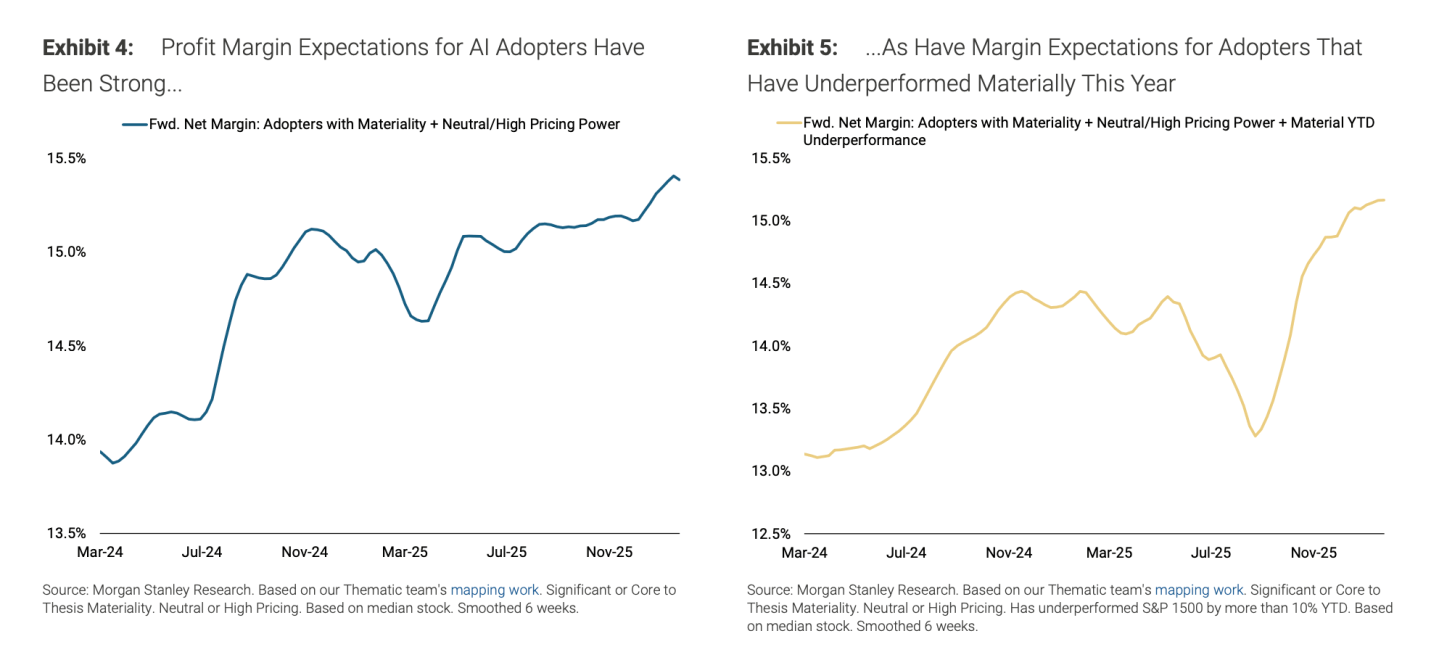
Morgan Stanley cites evidence that corporate America is already reaping tangible rewards from AI adoption. By the fourth quarter of 2025, 30% of companies identified as AI “adopters” reported quantifiable financial or productivity benefits from the technology, up from just 16% a year prior. As a result, forward profit margin expectations are actively accelerating for companies successfully utilizing AI. How those margins continue to increase, and how many new jobs those companies create as a result, will bear out whether Morgan Stanley’s prediction is right.
For this story, Fortune journalists used generative AI as a research tool. An editor verified the accuracy of the information before publishing.


In 2001, Fortune first convened “The Smartest People We Know,” bringing together CEOs and founders, builders and investors, thinkers and doers. Since then, Fortune Brainstorm Tech has been the place where bold ideas collide. From June 8–10, we will return to Aspen—where it all began—to mark 25 years of Brainstorm. Register now.
About the Author
Nick Lichtenberg
By Nick LichtenbergBusiness Editor
LinkedIn icon

Nick Lichtenberg is business editor and was formerly Fortune's executive editor of global news.

See full bioRight Arrow Button Icon

Latest in AI

Finance
Lorem ipsum dolor sit amet, consectetur adipiscing elit, sed do eiusmod tempor incididunt ut labore et dolore magna aliqua. Ut enim ad minim veniam
By Fortune Editors
October 20, 2025
Finance
Lorem ipsum dolor sit amet, consectetur adipiscing elit, sed do eiusmod tempor incididunt ut labore et dolore magna aliqua. Ut enim ad minim veniam
By Fortune Editors
October 20, 2025
Finance
Lorem ipsum dolor sit amet, consectetur adipiscing elit, sed do eiusmod tempor incididunt ut labore et dolore magna aliqua. Ut enim ad minim veniam
By Fortune Editors
October 20, 2025
Finance
Lorem ipsum dolor sit amet, consectetur adipiscing elit, sed do eiusmod tempor incididunt ut labore et dolore magna aliqua. Ut enim ad minim veniam
By Fortune Editors
October 20, 2025
Finance
Lorem ipsum dolor sit amet, consectetur adipiscing elit, sed do eiusmod tempor incididunt ut labore et dolore magna aliqua. Ut enim ad minim veniam
By Fortune Editors
October 20, 2025
Finance
Lorem ipsum dolor sit amet, consectetur adipiscing elit, sed do eiusmod tempor incididunt ut labore et dolore magna aliqua. Ut enim ad minim veniam
By Fortune Editors
October 20, 2025

Most Popular

Finance
Lorem ipsum dolor sit amet, consectetur adipiscing elit, sed do eiusmod tempor incididunt ut labore et dolore magna aliqua. Ut enim ad minim veniam
By Fortune Editors
October 20, 2025
Finance
Lorem ipsum dolor sit amet, consectetur adipiscing elit, sed do eiusmod tempor incididunt ut labore et dolore magna aliqua. Ut enim ad minim veniam
By Fortune Editors
October 20, 2025
Finance
Lorem ipsum dolor sit amet, consectetur adipiscing elit, sed do eiusmod tempor incididunt ut labore et dolore magna aliqua. Ut enim ad minim veniam
By Fortune Editors
October 20, 2025
Finance
Lorem ipsum dolor sit amet, consectetur adipiscing elit, sed do eiusmod tempor incididunt ut labore et dolore magna aliqua. Ut enim ad minim veniam
By Fortune Editors
October 20, 2025
Finance
Lorem ipsum dolor sit amet, consectetur adipiscing elit, sed do eiusmod tempor incididunt ut labore et dolore magna aliqua. Ut enim ad minim veniam
By Fortune Editors
October 20, 2025
Finance
Lorem ipsum dolor sit amet, consectetur adipiscing elit, sed do eiusmod tempor incididunt ut labore et dolore magna aliqua. Ut enim ad minim veniam
By Fortune Editors
October 20, 2025
Fortune Secondary Logo
Rankings
  • 100 Best Companies
  • Fortune 500
  • Global 500
  • Fortune 500 Europe
  • Most Powerful Women
  • Future 50
  • World’s Most Admired Companies
  • See All Rankings
Sections
  • Finance
  • Fortune Crypto
  • Features
  • Leadership
  • Health
  • Commentary
  • Success
  • Retail
  • Mpw
  • Tech
  • Lifestyle
  • CEO Initiative
  • Asia
  • Politics
  • Conferences
  • Europe
  • Newsletters
  • Personal Finance
  • Environment
  • Magazine
  • Education
Customer Support
  • Frequently Asked Questions
  • Customer Service Portal
  • Privacy Policy
  • Terms Of Use
  • Single Issues For Purchase
  • International Print
Commercial Services
  • Advertising
  • Fortune Brand Studio
  • Fortune Analytics
  • Fortune Conferences
  • Business Development
  • Group Subscriptions
About Us
  • About Us
  • Editorial Calendar
  • Press Center
  • Work At Fortune
  • Diversity And Inclusion
  • Terms And Conditions
  • Site Map
  • About Us
  • Editorial Calendar
  • Press Center
  • Work At Fortune
  • Diversity And Inclusion
  • Terms And Conditions
  • Site Map
  • Facebook icon
  • Twitter icon
  • LinkedIn icon
  • Instagram icon
  • Pinterest icon

Latest in AI

MagazineSoftware
Wall Street is convinced AI will kill SaaS. History and economics say something else
By Jeremy KahnMarch 25, 2026
2 hours ago
AsiaChina
China could be the ‘big winner’ in the AI race, thanks to abundant power, cheap manufacturing, and an open-source craze
By Nicholas GordonMarch 25, 2026
3 hours ago
Magazinechief executive officer (CEO)
The AI era has a message for every CEO: Adapt or die
By Beatrice NolanMarch 25, 2026
3 hours ago
Origin cofounders Chris Bruce (left) and Pete Craghill.
Startups & VentureVenture Capital
Exclusive: AI-powered benefits platform Origin raises $30 million in fresh funding to bring CHROs visibility into benefits usage and spend
By Jeremy KahnMarch 25, 2026
3 hours ago
Man with glasses wearing a black collared shirt
LawDonald Trump
‘Attempted corporate murder’: Judge calls on Anthropic and Department of War to explain dispute over supply chain risk 
By Amanda GerutMarch 24, 2026
8 hours ago
Woman holding a yellow umbrella that has become inverted in the wind.
NewslettersEye on AI
AI agents are getting more capable, but reliability is lagging—and that’s a problem
By Jeremy KahnMarch 24, 2026
13 hours ago

Most Popular

Commentary
The Treasury just declared the U.S. insolvent. The media missed it
By Fortune EditorsMarch 23, 2026
2 days ago
Magazine
The youngest-ever female CEO of a Fortune 500 company is fighting Trump's cuts to keep Medicaid strong
By Fortune EditorsMarch 24, 2026
1 day ago
Economy
It took 200 years for national debt to hit $1 trillion. Annual interest alone now exceeds that—a 'crushing legacy we must reverse,' says budget chair
By Fortune EditorsMarch 23, 2026
2 days ago
Energy
Nobel laureate Paul Krugman calls it 'treason': $580 million in suspicious oil futures traded minutes before Trump's Iran reversal
By Fortune EditorsMarch 24, 2026
15 hours ago
Success
Palantir’s billionaire CEO says only two kinds of people will succeed in the AI era: trade workers — ‘or you’re neurodivergent’
By Fortune EditorsMarch 24, 2026
18 hours ago
Personal Finance
Current price of oil as of March 24, 2026
By Fortune EditorsMarch 24, 2026
21 hours ago

© 2026 Fortune Media IP Limited. All Rights Reserved. Use of this site constitutes acceptance of our Terms of Use and Privacy Policy | CA Notice at Collection and Privacy Notice | Do Not Sell/Share My Personal Information
FORTUNE is a trademark of Fortune Media IP Limited, registered in the U.S. and other countries. FORTUNE may receive compensation for some links to products and services on this website. Offers may be subject to change without notice.