• Home
  • Latest
  • Fortune 500
  • Finance
  • Tech
  • Leadership
  • Lifestyle
  • Rankings
  • Multimedia
EconomyU.S. economy

America’s $901 billion trade deficit is like ‘chronically high cholesterol,’ top economist says, and Trump’s 150-day tariffs are the wrong medicine

By
Tristan Bove
Tristan Bove
Contributing Reporter
Down Arrow Button Icon
By
Tristan Bove
Tristan Bove
Contributing Reporter
Down Arrow Button Icon
February 25, 2026, 12:59 PM ET
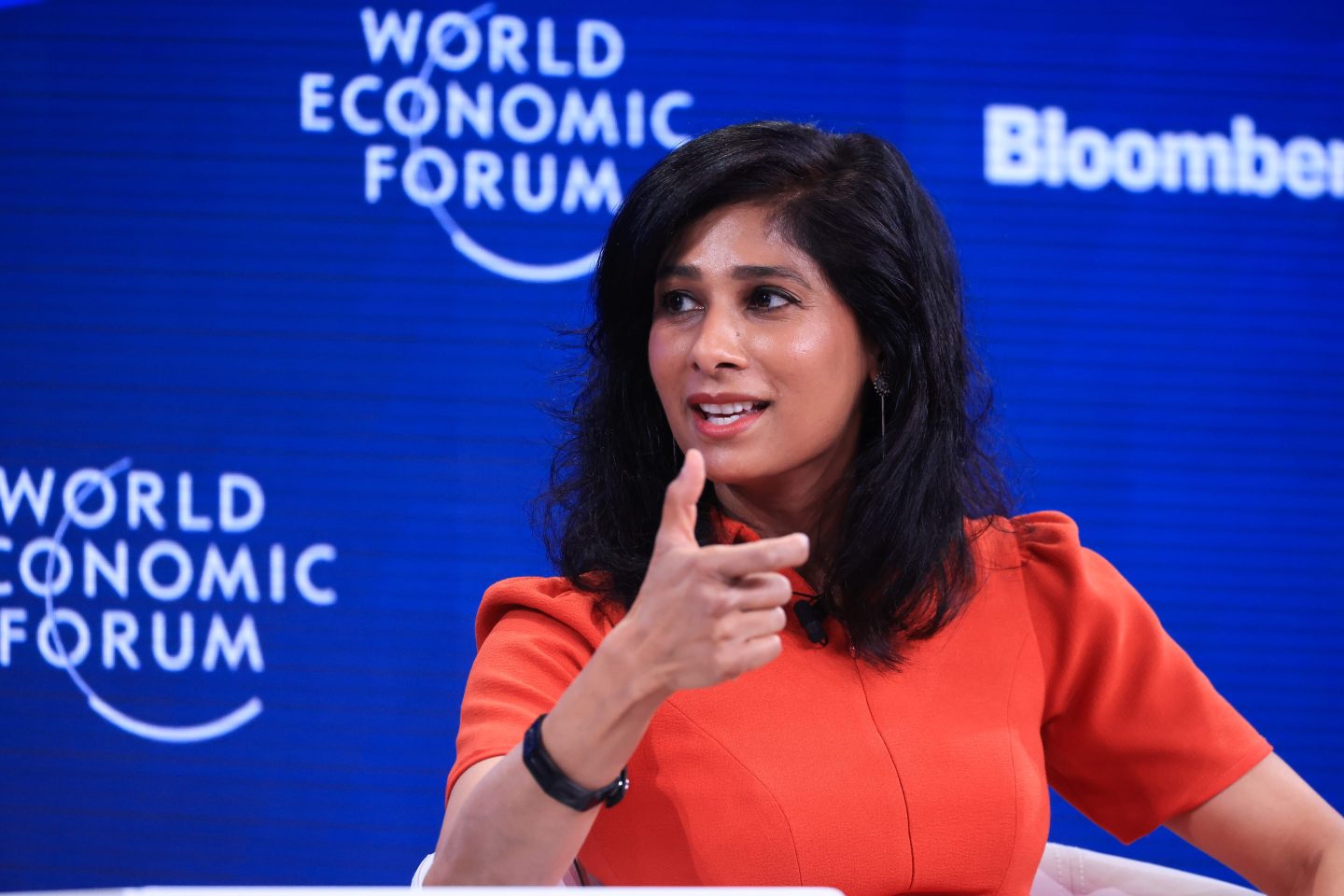
Gita Gopinath pictured during a Davos panel
Gita Gopinath, former first deputy managing director and chief economist of the IMF.Krisztian Bocsi—Bloomberg/Getty Images

President Donald Trump has framed the U.S. trade deficit as a “national emergency” and a threat to Americans’ “way of life” throughout his second term. It was why he invoked the International Emergency Economic Powers Act in April 2025 to announce “Liberation Day” and reciprocal tariffs around most of the world (the Supreme Court didn’t agree that it was quite the emergency that he claimed).

Recommended Video

As Trump scrambles to reassemble his signature policy, resuming his decades-long obsession with trade, some observers argue that he has conflated America’s trade problems with a very different kind of crisis.

The U.S. trade deficit—a measure of how much more value a country imports rather than exports—stood at around $901 billion last year, meaning that the U.S. is effectively spending much more than it is earning when it comes to trade. But it’s only a crisis if you can’t afford to pay, according to Gita Gopinath, former chief economist at the International Monetary Fund.

“U.S. trade deficits are large and need to be brought down. Reducing U.S. fiscal deficits is important. At the same time, there is no doubt in the U.S. ability to pay the world and therefore no crisis,” Gopinath, now a Harvard professor, wrote in an X thread Tuesday.

The wrong treatment

To balance the books with the rest of the world, America’s trade shortfalls have to be matched by foreign investment into U.S. assets. The U.S. has run a trade deficit for most of the past 50 years, but has never had a fiscal crisis related to this imbalance because international investors have kept buying up U.S. assets throughout that period, from government debt to real estate to equities. 

If the U.S. were to lose investor confidence abroad, then foreign exchange reserves might run dry and the country would no longer be able to service its international debt. That outcome, known as a balance-of-payments crisis, would be an enormously more challenging problem than a long-running trade deficit, Gopinath said.

“The difference is similar to suffering from chronically high cholesterol versus having a heart attack,” she wrote, adding that right now, the U.S. is dealing with “high cholesterol but not a heart attack.”

The last time the U.S. had such a “heart attack” was in the early 1970s, when President Richard Nixon took the U.S. off the gold standard. Since the Bretton Woods’ monetary system came into place following the Second World War, the U.S. dollar had been the world’s reserve currency, but its value had remained pegged to gold, which was convertible to dollars at a fixed rate. Throughout the 1960s, the foreign-held supply of dollars had eclipsed the supply of U.S.-held gold, making the country vulnerable to a gold run and a loss of investor confidence. Efforts to patch up the system proved unsuccessful, and Nixon eventually announced the end of dollar convertibility to gold in 1971.

Trump doubles down

Since the Supreme Court ruled the bulk of Trump’s tariffs illegal, his administration has reframed the country’s trade deficit as a balance-of-payments crisis. Hours after the justices announced their decision, Trump hit back and promised to install up to 15% tariffs across the board, authorized under Section 122 of the 1974 Trade Act, a provision that allows presidents to invoke tariffs for 150 days in response to “fundamental international payments problems,” which Trump explicitly referred to in his announcement of the new temporary tariffs.

Several commentators, including Gopinath and the libertarian-leaning Cato Institute, have argued that the current trade deficit in the U.S. does not equate to a balance-of-payments crisis. Or, to extend Gopinath’s metaphor, the U.S. is showing up to the proverbial doctor’s office, claiming symptoms of a heart attack, when it really just needs to change its diet and maybe go on a statin.

Even Trump’s own lawyers have seemed to agree that this crisis isn’t one of balance of payments. Last year, when the president’s emergency tariffs were first being litigated in court, the Justice Department justified their use in part because Section 122 tariffs would not apply, they argued.

Another prominent economic voice, hedge fund billionaire Ray Dalio, the founder of Bridgewater Associates, has been fond of the “economic heart attack” metaphor for years. In September, he predicted that the U.S. will face one in the next two to three years, but not from trade. Instead, he sees the national debt inducing cardiac arrest, brought on by Trump’s policies of cutting taxes to a greater extent than any tariff revenue being produced (notwithstanding anything that Trump has to refund as a result of the Supreme Court ruling).

Even if Trump is able to keep tariffs in place, economists are skeptical that his strict trade regimen will do much to reduce the deficit. Nobel Prize winner Paul Krugman and researchers at the Peterson Institute for International Economics have all argued that any tariff-driven decline in imports is usually accompanied by fewer exports as well. That is because the increased need for domestic production tends to draw resources away from exports. 

Both argue that a trade deficit is normally best addressed through domestic fiscal mechanisms rather than trade policy, specifically by cutting spending or raising taxes to balance the national deficit. This would raise savings at home and reduce reliance on capital flows from abroad. But it looks unlikely that Trump will be any more successful than previous presidents in reducing the national debt. His signature One Big Beautiful Bill policy package last year might add anywhere from $19 trillion to $32 trillion to the deficit over the next 30 years, making a debt heart attack as prophesied by Dalio all the more likely.

Despite Trump’s bombastic claims about the positive effect of tariffs—recently claiming they had reduced the deficit by 78%—official evidence during his first year back in office suggest a negligible impact. The trade deficit last year was $2.1 billion smaller than in 2024, or 0.2%, the Bureau of Economic Analysis announced last week. As Gopinath suggested on X, it is unclear whether his new replacement tariffs will have a different effect.

“A 150-day tariff cannot reduce persistent trade deficits, and the U.S. is not having a heart attack,” she wrote.
The Fortune 500 Innovation Forum will convene Fortune 500 executives, U.S. policy officials, top founders, and thought leaders to help define what’s next for the American economy, Nov. 16-17 in Detroit. Apply here.
About the Author
By Tristan BoveContributing Reporter
LinkedIn iconTwitter icon
See full bioRight Arrow Button Icon

Latest in Economy

Finance
Lorem ipsum dolor sit amet, consectetur adipiscing elit, sed do eiusmod tempor incididunt ut labore et dolore magna aliqua. Ut enim ad minim veniam
By Fortune Editors
October 20, 2025
Finance
Lorem ipsum dolor sit amet, consectetur adipiscing elit, sed do eiusmod tempor incididunt ut labore et dolore magna aliqua. Ut enim ad minim veniam
By Fortune Editors
October 20, 2025
Finance
Lorem ipsum dolor sit amet, consectetur adipiscing elit, sed do eiusmod tempor incididunt ut labore et dolore magna aliqua. Ut enim ad minim veniam
By Fortune Editors
October 20, 2025
Finance
Lorem ipsum dolor sit amet, consectetur adipiscing elit, sed do eiusmod tempor incididunt ut labore et dolore magna aliqua. Ut enim ad minim veniam
By Fortune Editors
October 20, 2025
Finance
Lorem ipsum dolor sit amet, consectetur adipiscing elit, sed do eiusmod tempor incididunt ut labore et dolore magna aliqua. Ut enim ad minim veniam
By Fortune Editors
October 20, 2025
Finance
Lorem ipsum dolor sit amet, consectetur adipiscing elit, sed do eiusmod tempor incididunt ut labore et dolore magna aliqua. Ut enim ad minim veniam
By Fortune Editors
October 20, 2025

Most Popular

Finance
Lorem ipsum dolor sit amet, consectetur adipiscing elit, sed do eiusmod tempor incididunt ut labore et dolore magna aliqua. Ut enim ad minim veniam
By Fortune Editors
October 20, 2025
Finance
Lorem ipsum dolor sit amet, consectetur adipiscing elit, sed do eiusmod tempor incididunt ut labore et dolore magna aliqua. Ut enim ad minim veniam
By Fortune Editors
October 20, 2025
Finance
Lorem ipsum dolor sit amet, consectetur adipiscing elit, sed do eiusmod tempor incididunt ut labore et dolore magna aliqua. Ut enim ad minim veniam
By Fortune Editors
October 20, 2025
Finance
Lorem ipsum dolor sit amet, consectetur adipiscing elit, sed do eiusmod tempor incididunt ut labore et dolore magna aliqua. Ut enim ad minim veniam
By Fortune Editors
October 20, 2025
Finance
Lorem ipsum dolor sit amet, consectetur adipiscing elit, sed do eiusmod tempor incididunt ut labore et dolore magna aliqua. Ut enim ad minim veniam
By Fortune Editors
October 20, 2025
Finance
Lorem ipsum dolor sit amet, consectetur adipiscing elit, sed do eiusmod tempor incididunt ut labore et dolore magna aliqua. Ut enim ad minim veniam
By Fortune Editors
October 20, 2025
Fortune Secondary Logo
Rankings
  • 100 Best Companies
  • Fortune 500
  • Global 500
  • Fortune 500 Europe
  • Most Powerful Women
  • Future 50
  • World’s Most Admired Companies
  • See All Rankings
Sections
  • Finance
  • Fortune Crypto
  • Features
  • Leadership
  • Health
  • Commentary
  • Success
  • Retail
  • Mpw
  • Tech
  • Lifestyle
  • CEO Initiative
  • Asia
  • Politics
  • Conferences
  • Europe
  • Newsletters
  • Personal Finance
  • Environment
  • Magazine
  • Education
Customer Support
  • Frequently Asked Questions
  • Customer Service Portal
  • Privacy Policy
  • Terms Of Use
  • Single Issues For Purchase
  • International Print
Commercial Services
  • Advertising
  • Fortune Brand Studio
  • Fortune Analytics
  • Fortune Conferences
  • Business Development
  • Group Subscriptions
About Us
  • About Us
  • Editorial Calendar
  • Press Center
  • Work At Fortune
  • Diversity And Inclusion
  • Terms And Conditions
  • Site Map
  • About Us
  • Editorial Calendar
  • Press Center
  • Work At Fortune
  • Diversity And Inclusion
  • Terms And Conditions
  • Site Map
  • Facebook icon
  • Twitter icon
  • LinkedIn icon
  • Instagram icon
  • Pinterest icon

Latest in Economy

trump
Energynational debt
Iran, the $39 trillion national debt and dedollarization: How Trump exposed America’s Achilles Heel in Hormuz
By Nick LichtenbergMarch 24, 2026
7 hours ago
A man in a green ERO vest walks through an airport terminal.
Politicsgovernment shutdown
ICE agents can make twice the salary of TSA employees—and economists warn their pay is more ‘shutdown proof’ than other government jobs
By Sasha RogelbergMarch 24, 2026
8 hours ago
Farmer standing in front a soybean farm
Economyfertilizer
Soaring fertilizer prices could pressure a U.S. agricultural industry that supports 50 million jobs and over $10 trillion in output
By Tristan BoveMarch 24, 2026
9 hours ago
gen z
Real EstateInflation
Gen Z finally had room to breathe. Now Trump’s 26% gas price hike has them suffocating
By Nick LichtenbergMarch 24, 2026
9 hours ago
Two People Faces Talking Discussion Communication Stock Market Insider 3d Illustration
EnergyIran
Nobel laureate Paul Krugman calls it ‘treason’: $580 million in suspicious oil futures traded minutes before Trump’s Iran reversal
By Eva RoytburgMarch 24, 2026
10 hours ago
BlackRock CEO Larry Fink
EconomyInequality
Billionaire Larry Fink says you’re wrong to think that AI stealing your job is the big problem—it’s really about what it’s doing for his class
By Tristan BoveMarch 24, 2026
11 hours ago

Most Popular

Commentary
The Treasury just declared the U.S. insolvent. The media missed it
By Fortune EditorsMarch 23, 2026
2 days ago
Magazine
The youngest-ever female CEO of a Fortune 500 company is fighting Trump's cuts to keep Medicaid strong
By Fortune EditorsMarch 24, 2026
20 hours ago
Economy
It took 200 years for national debt to hit $1 trillion. Annual interest alone now exceeds that—a 'crushing legacy we must reverse,' says budget chair
By Fortune EditorsMarch 23, 2026
2 days ago
Personal Finance
Current price of gold as of March 23, 2026
By Fortune EditorsMarch 23, 2026
2 days ago
Energy
Nobel laureate Paul Krugman calls it 'treason': $580 million in suspicious oil futures traded minutes before Trump's Iran reversal
By Fortune EditorsMarch 24, 2026
10 hours ago
Personal Finance
Current price of oil as of March 24, 2026
By Fortune EditorsMarch 24, 2026
16 hours ago

© 2026 Fortune Media IP Limited. All Rights Reserved. Use of this site constitutes acceptance of our Terms of Use and Privacy Policy | CA Notice at Collection and Privacy Notice | Do Not Sell/Share My Personal Information
FORTUNE is a trademark of Fortune Media IP Limited, registered in the U.S. and other countries. FORTUNE may receive compensation for some links to products and services on this website. Offers may be subject to change without notice.