

• Home
  • Latest
  • Fortune 500
  • Finance
  • Tech
  • Leadership
  • Lifestyle
  • Rankings
  • Multimedia
Economynational debt

$56 trillion national debt leading to a spiraling crisis: Budget watchdog warns the U.S. is walking a crumbling path

Nick Lichtenberg
By
Nick Lichtenberg
Nick Lichtenberg
Business Editor
Down Arrow Button Icon
Nick Lichtenberg
By
Nick Lichtenberg
Nick Lichtenberg
Business Editor
Down Arrow Button Icon
February 17, 2026, 12:24 PM ET
Photo of Donald Trump
Donald Trump is putting the economy on a “sugar high,” the CRFB says.Nathan Howard/Getty Images

The United States is rapidly accelerating toward a definitive tipping point in its financial history, the Committee for a Responsible Federal Budget (CRFB) wrote in response to the latest 10-year outlook from the Congressional Budget Office. The nonpartisan budget watchdog issued a stark assessment: The current trajectory of borrowing, which is running at double the 50-year historical average, is simply mathematically unsustainable.

Recommended Video

The CRFB cautioned that without immediate legislative intervention, the federal government faces a future defined by exploding interest costs, insolvent trust funds, and a national debt burden that will shatter post–World War II records within four years.

It amounts to a report card for the Trump administration’s first year back in office—potentially its last truly impactful year of President Donald Trump’s term, if midterm elections swing either or both of the House and Senate to Democrats. The CBO updated its projections to account for the One Big Beautiful Bill Act (OBBBA), Trump’s tariff regime, changes in immigration, and other factors. “With debt approaching record levels, interest costs exploding, trust funds approaching insolvency, and deficits expected to remain more than twice as large as the oft-discussed 3% of GDP target,” the CRFB argued, “lawmakers should come together to enact significant deficit reduction.”

The numbers: breaking records and breaking the bank

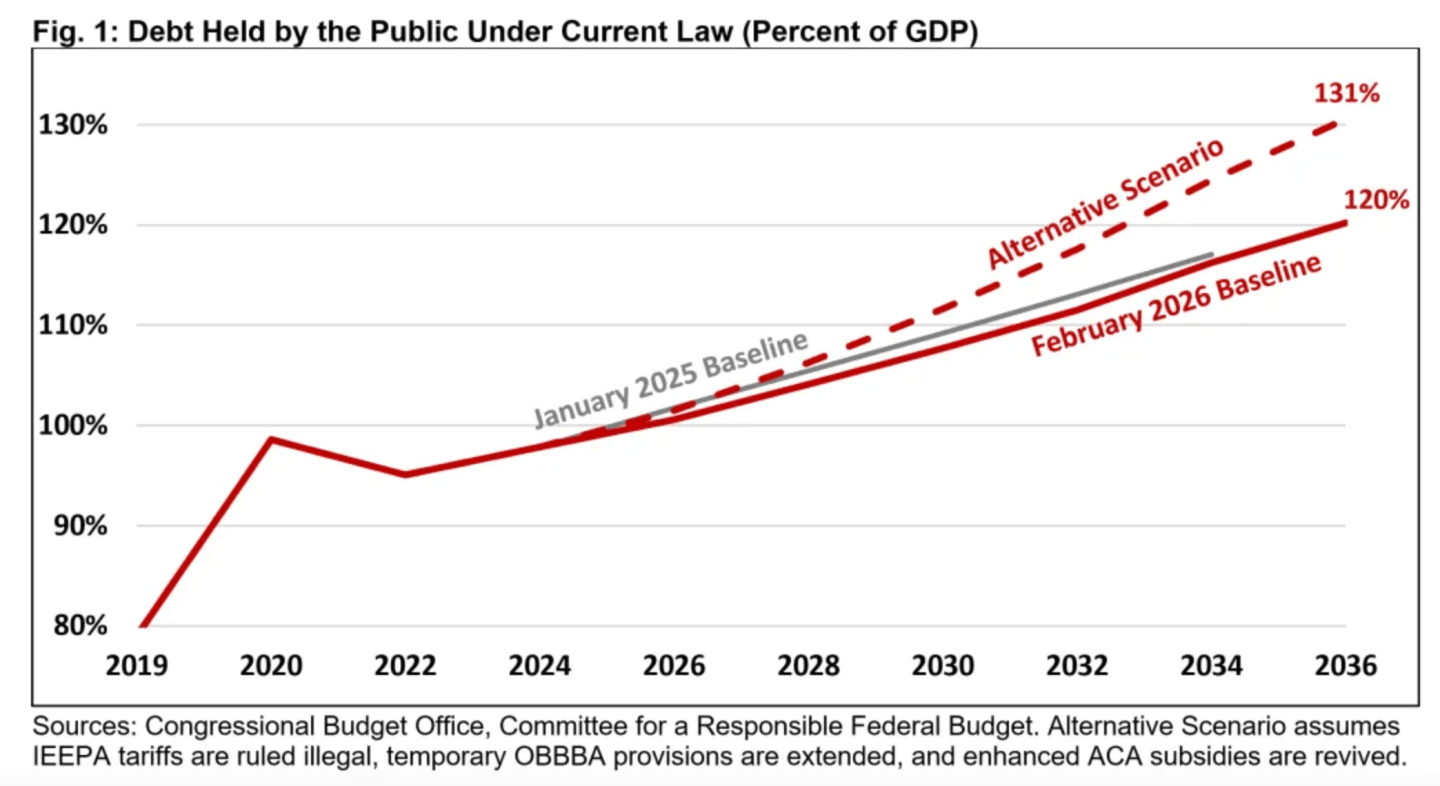
According to the new CBO projections, the federal debt held by the public is on track to reach a record 120% of gross domestic product (GDP) by 2036. In sheer dollar terms, the pile of money owed by the government is projected under the CBO’s baseline scenario to balloon from nearly $31 trillion today to a staggering $56 trillion over the next decade.

The speed of this accumulation is unprecedented in peacetime. The CRFB notes that debt held by the public currently hovers around 100% of GDP, which is already roughly double the 50-year historical average. Under the current baseline, federal debt is set to surpass the all-time record of 106% of GDP—set in the aftermath of World War II—by fiscal year 2030.

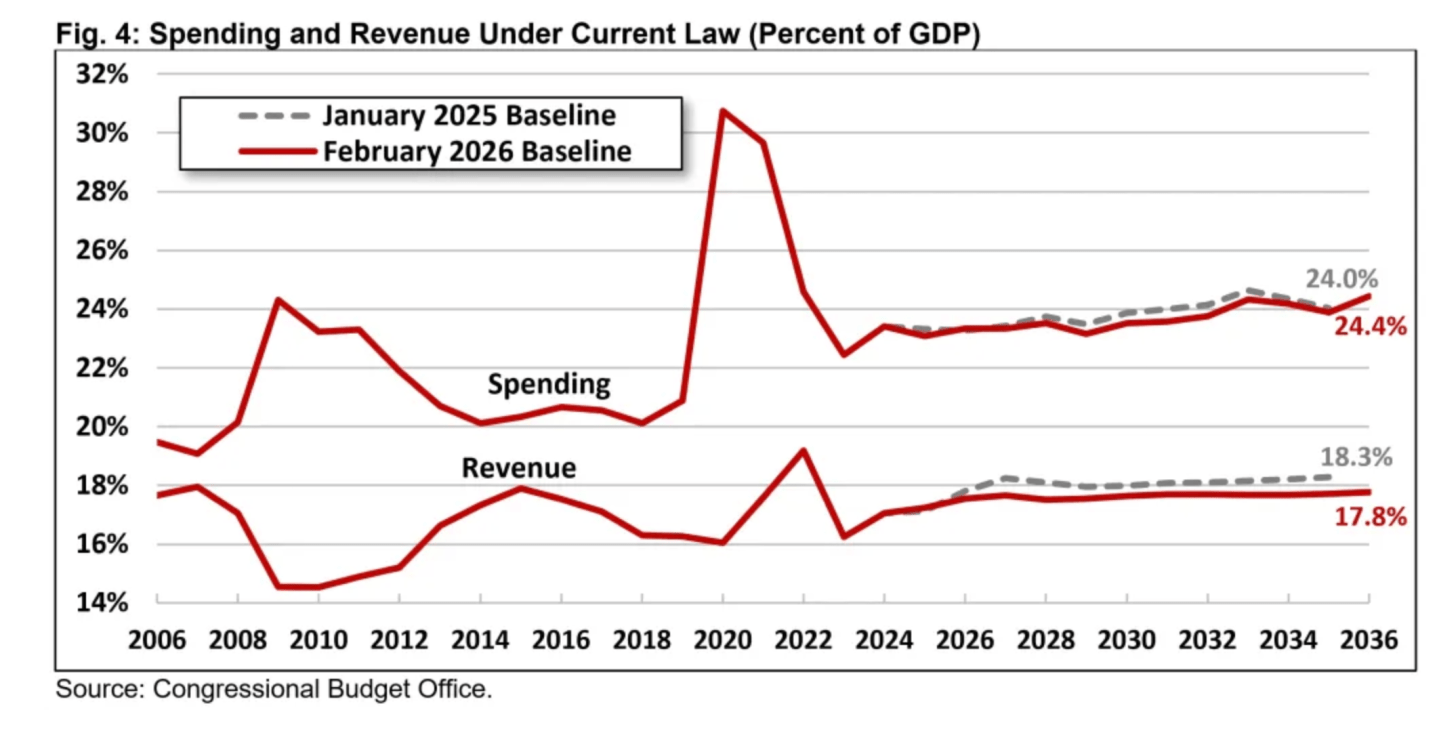
The driving force behind this surge is a structural mismatch between what the government spends and what it collects. Spending is projected to grow from 23.1% of GDP in 2025 to 24.4% by 2036. In contrast, revenue is trailing significantly, rising only marginally from 17.2% of GDP to 17.8% over the same period.

Consequently, the U.S. is facing a decade of massive deficits. The CBO projects annual budget deficits will total $24.4 trillion over the coming decade, exceeding $3 trillion annually by 2036. As a share of the economy, these deficits are expected to average 6.1% of GDP—more than twice the 3% target that economists and the CRFB suggest is necessary to place the national debt on a sustainable path.

It could easily get worse, too. If the Supreme Court strikes down much of Trump’s tariff regime, as expected, and if lawmakers make temporary previsions in the OBBBA permanent while reviving the Affordable Care Act health insurance subsidies, a core Democratic promise, the CRFB estimates debt spiking to 131% of GDP by 2036, rather than 120%. Under these conditions, the deficit would reach $3.8 trillion in 2036, and the risk of a full-blown fiscal crisis would grow exponentially.
The looming debt spiral

The most alarming aspect of the new outlook is the compounding danger of high interest rates interacting with high debt—the mechanics of what the CRFB calls a “debt spiral.” The CRFB warns that later in the decade, the average interest rate on all federal debt is projected to exceed the rate of nominal economic growth. Economists refer to this dynamic as “R>G” (rate > growth). When the cost of servicing past debt grows faster than the economy that supports it, debt accumulation becomes self-perpetuating, making a fiscal crisis increasingly likely.

Interest costs are already set to “explode” under current law. Nominal interest payments on the debt will more than double, jumping from $970 billion in 2025 to $2.1 trillion by 2036. As a share of the total economy, interest costs will rise from a record 3.2% of GDP in 2025 to 4.6% by 2036. This diversion of resources means that nearly $1 out of every $5 of federal revenue will eventually be consumed just to service the debt, crowding out investment in other national priorities.
Policy choices and the ‘sugar high’

The deterioration of the fiscal outlook is partially the result of recent aggressive policy changes. The CRFB analysis points specifically to OBBBA, which the CBO estimates will add $4.7 trillion to the debt through 2035 when accounting for interest and economic effects. While the CBO projects that new tariffs will subtract $3 trillion from the deficit, the net result of recent legislative, administrative, and economic changes has been to add roughly $1.4 trillion to borrowing projections between 2026 and 2035 compared to estimates made just a year prior.

These policies are expected to produce a temporary economic “sugar high.” The CBO projects real GDP will surge by 2.2% in 2026, driven by stimulus from the OBBBA, before slowing to a sustained rate of 1.8% per year thereafter. Inflation is expected to follow a similar trajectory, with the personal consumption expenditure (PCE) price index rising to 2.7% in 2026 before settling back toward the Federal Reserve’s 2.0% target by 2030.

However, the stimulus comes at the cost of higher interest rates. The CBO expects the 10-year Treasury yield to climb from 4.1% in 2026 to 4.4% by 2031, driven in large part by the federal government’s insatiable need to borrow capital.

Trust funds on the brink

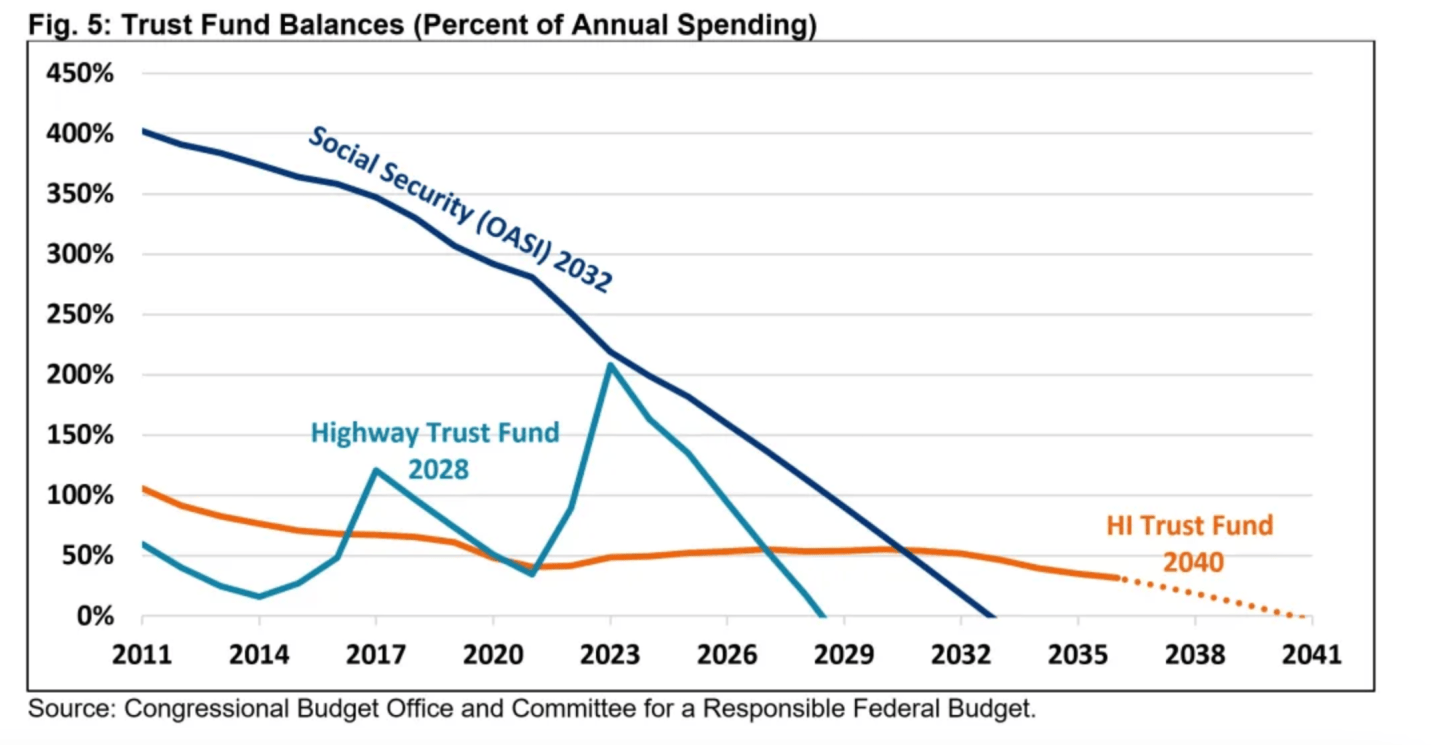
Beyond the headline debt numbers, the report highlights an imminent liquidity crisis for the safety net programs relied upon by millions of Americans. Several major government trust funds are approaching insolvency, meaning they will soon lack the reserves to pay full benefits.

The Highway Trust Fund is projected to deplete its reserves by fiscal year 2028, followed closely by the Social Security retirement trust fund in 2032. Upon insolvency, federal law mandates that spending be cut to match incoming revenue. The CRFB estimates this would result in an immediate 40% cut to highway spending and a devastating 28% across-the-board cut to Social Security retirement and survivor benefits.

To visualize the impact, the watchdog group calculates that a typical couple age 60 today, who retire at the moment of insolvency, would face an $18,400 annual cut in benefits.
The path forward

In their concluding assessment, the CRFB urged lawmakers to abandon the recent trend of adding to the debt and instead work to stabilize the nation’s finances. With debt approaching record levels and deficits remaining more than twice the size of the “oft-discussed 3% of GDP target,” the group argues that significant deficit reduction is no longer optional.

The group suggests the necessary adjustments to spending and revenue could be achieved through regular legislative order or a bipartisan fiscal commission. However, the window for gradual adjustment is closing. As the CBO data indicates, with the arrival of “R>G” and the looming exhaustion of trust funds, the U.S. is running out of time to avert a fiscal collision that has been decades in the making.

For this story, Fortune journalists used generative AI as a research tool. An editor verified the accuracy of the information before publishing.

The Fortune 500 Innovation Forum will convene Fortune 500 executives, U.S. policy officials, top founders, and thought leaders to help define what’s next for the American economy, Nov. 16-17 in Detroit. Apply here.
About the Author
Nick Lichtenberg
By Nick LichtenbergBusiness Editor
LinkedIn icon

Nick Lichtenberg is business editor and was formerly Fortune's executive editor of global news.

See full bioRight Arrow Button Icon

Latest in Economy

Finance
Lorem ipsum dolor sit amet, consectetur adipiscing elit, sed do eiusmod tempor incididunt ut labore et dolore magna aliqua. Ut enim ad minim veniam
By Fortune Editors
October 20, 2025
Finance
Lorem ipsum dolor sit amet, consectetur adipiscing elit, sed do eiusmod tempor incididunt ut labore et dolore magna aliqua. Ut enim ad minim veniam
By Fortune Editors
October 20, 2025
Finance
Lorem ipsum dolor sit amet, consectetur adipiscing elit, sed do eiusmod tempor incididunt ut labore et dolore magna aliqua. Ut enim ad minim veniam
By Fortune Editors
October 20, 2025
Finance
Lorem ipsum dolor sit amet, consectetur adipiscing elit, sed do eiusmod tempor incididunt ut labore et dolore magna aliqua. Ut enim ad minim veniam
By Fortune Editors
October 20, 2025
Finance
Lorem ipsum dolor sit amet, consectetur adipiscing elit, sed do eiusmod tempor incididunt ut labore et dolore magna aliqua. Ut enim ad minim veniam
By Fortune Editors
October 20, 2025
Finance
Lorem ipsum dolor sit amet, consectetur adipiscing elit, sed do eiusmod tempor incididunt ut labore et dolore magna aliqua. Ut enim ad minim veniam
By Fortune Editors
October 20, 2025

Most Popular

Finance
Lorem ipsum dolor sit amet, consectetur adipiscing elit, sed do eiusmod tempor incididunt ut labore et dolore magna aliqua. Ut enim ad minim veniam
By Fortune Editors
October 20, 2025
Finance
Lorem ipsum dolor sit amet, consectetur adipiscing elit, sed do eiusmod tempor incididunt ut labore et dolore magna aliqua. Ut enim ad minim veniam
By Fortune Editors
October 20, 2025
Finance
Lorem ipsum dolor sit amet, consectetur adipiscing elit, sed do eiusmod tempor incididunt ut labore et dolore magna aliqua. Ut enim ad minim veniam
By Fortune Editors
October 20, 2025
Finance
Lorem ipsum dolor sit amet, consectetur adipiscing elit, sed do eiusmod tempor incididunt ut labore et dolore magna aliqua. Ut enim ad minim veniam
By Fortune Editors
October 20, 2025
Finance
Lorem ipsum dolor sit amet, consectetur adipiscing elit, sed do eiusmod tempor incididunt ut labore et dolore magna aliqua. Ut enim ad minim veniam
By Fortune Editors
October 20, 2025
Finance
Lorem ipsum dolor sit amet, consectetur adipiscing elit, sed do eiusmod tempor incididunt ut labore et dolore magna aliqua. Ut enim ad minim veniam
By Fortune Editors
October 20, 2025
Fortune Secondary Logo
Rankings
  • 100 Best Companies
  • Fortune 500
  • Global 500
  • Fortune 500 Europe
  • Most Powerful Women
  • Future 50
  • World’s Most Admired Companies
  • See All Rankings
Sections
  • Finance
  • Fortune Crypto
  • Features
  • Leadership
  • Health
  • Commentary
  • Success
  • Retail
  • Mpw
  • Tech
  • Lifestyle
  • CEO Initiative
  • Asia
  • Politics
  • Conferences
  • Europe
  • Newsletters
  • Personal Finance
  • Environment
  • Magazine
  • Education
Customer Support
  • Frequently Asked Questions
  • Customer Service Portal
  • Privacy Policy
  • Terms Of Use
  • Single Issues For Purchase
  • International Print
Commercial Services
  • Advertising
  • Fortune Brand Studio
  • Fortune Analytics
  • Fortune Conferences
  • Business Development
  • Group Subscriptions
About Us
  • About Us
  • Editorial Calendar
  • Press Center
  • Work At Fortune
  • Diversity And Inclusion
  • Terms And Conditions
  • Site Map
  • About Us
  • Editorial Calendar
  • Press Center
  • Work At Fortune
  • Diversity And Inclusion
  • Terms And Conditions
  • Site Map
  • Facebook icon
  • Twitter icon
  • LinkedIn icon
  • Instagram icon
  • Pinterest icon

Latest in Economy

raikes
CommentaryMicrosoft
Jeff Raikes: AI is capturing cognition — and most companies are building a talent debt they don’t see yet
By Jeff RaikesApril 15, 2026
22 minutes ago
meat
PoliticsMinnesota
Polarized Minnesota politicians find something to agree on: the meat raffle
By Steve Karnowski, Mark Vancleave and The Associated PressApril 15, 2026
59 minutes ago
hampshire
LawEducation
Hampshire College closes, the latest in a string of small schools to fold under demographic, financial pressure
By Michael Casey, Leah Willingham and The Associated PressApril 15, 2026
1 hour ago
snap
LawLayoffs
Snap to cut about 1,000 jobs, or 16% of its global workforce
By The Associated PressApril 15, 2026
1 hour ago
lebanon
PoliticsIran
Iran, U.S. close to agreeing cease-fire extension, officials say
By Samy Magdy, Sam Metz, Munir Ahmed and The Associated PressApril 15, 2026
1 hour ago
clinton
Commentarydisruption
I was a government official in the 1990s and watched the economy get turned upside-down. It’s happening again
By Maria FlynnApril 15, 2026
2 hours ago

Most Popular

Billionaire philanthropist MacKenzie Scott has donated again—a week after gifting millions to a college, she's just given $70 million to Meals on Wheels America
Success
Billionaire philanthropist MacKenzie Scott has donated again—a week after gifting millions to a college, she's just given $70 million to Meals on Wheels America
By Fortune EditorsApril 13, 2026
2 days ago
Retirees are facing a $345,000 bill they never saw coming — and most aren't prepared
Commentary
Retirees are facing a $345,000 bill they never saw coming — and most aren't prepared
By Fortune EditorsApril 14, 2026
1 day ago
He was coding at 12 like Elon Musk and became one of Google’s youngest-ever CMOs—but now says Gen Z is better off ice skating than learning to code
Success
He was coding at 12 like Elon Musk and became one of Google’s youngest-ever CMOs—but now says Gen Z is better off ice skating than learning to code
By Fortune EditorsApril 14, 2026
1 day ago
Anthropic is facing a wave of user backlash over reports of performance issues with its Claude AI chatbot
AI
Anthropic is facing a wave of user backlash over reports of performance issues with its Claude AI chatbot
By Fortune EditorsApril 14, 2026
1 day ago
Palantir CEO says working at his $316 billion software company is better than a degree from Harvard or Yale: ‘No one cares about the other stuff’
Success
Palantir CEO says working at his $316 billion software company is better than a degree from Harvard or Yale: ‘No one cares about the other stuff’
By Fortune EditorsApril 14, 2026
1 day ago
Current price of oil as of April 14, 2026
Personal Finance
Current price of oil as of April 14, 2026
By Fortune EditorsApril 14, 2026
1 day ago

© 2026 Fortune Media IP Limited. All Rights Reserved. Use of this site constitutes acceptance of our Terms of Use and Privacy Policy | CA Notice at Collection and Privacy Notice | Do Not Sell/Share My Personal Information
FORTUNE is a trademark of Fortune Media IP Limited, registered in the U.S. and other countries. FORTUNE may receive compensation for some links to products and services on this website. Offers may be subject to change without notice.