• Home
  • Latest
  • Fortune 500
  • Finance
  • Tech
  • Leadership
  • Lifestyle
  • Rankings
  • Multimedia
Commentaryprivate equity

Private equity’s playbook to shake off the zombies: meet the continuation vehicle

By
Sunaina Sinha Haldea
Down Arrow Button Icon
By
Sunaina Sinha Haldea
Down Arrow Button Icon
February 14, 2026, 8:45 AM ET
sunaina
Sunaina Sinha Haldea is the global head of Private Capital Advisory at Raymond James.courtesy of Raymond James

Over the past decade, private equity benefited from a generally supportive exit environment. Low interest rates, accessible financing, and steadily rising valuations made it possible to bring strong portfolio companies to market with relatively little friction. Firms could crystallize gains, return capital to investors, and redeploy quickly into new opportunities.

Recommended Video

Today, the environment is different.

Higher financing costs, tighter credit, and a prolonged slowdown in IPO markets have reduced overall exit activity. Holding periods across buyout funds have lengthened, and many assets remain fundamentally strong but difficult to exit at acceptable valuations. The result is a growing overhang of ageing companies across the industry. (Some critics call these “zombie” companies, but I wouldn’t go there.)

Continuation vehicles: win-win-win for all

Against that backdrop, continuation vehicles (“CVs”), once viewed as niche or tactical, have moved closer to the center of the private equity playbook. In 2025, the GP-led secondary market had grown to approximately $105 billion, with CVs accounting for roughly 84%.

Global GP-led secondary volume and % CV share
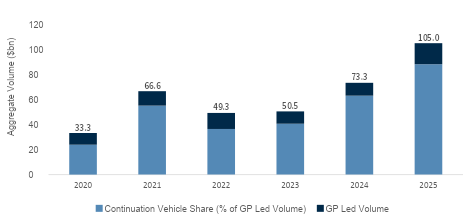
Source(s): RJ PCA market intelligence as of January 2026.

Their growing role has drawn attention, and with it a familiar refrain: that CVs amount to sponsors “selling to themselves,” a way to delay exits or avoid hard decisions. It is an understandable reaction to a structure that sits outside the traditional exit playbook. But viewed in context, CVs are better understood as a way of addressing competing pressures across the ecosystem.

For general partners, they offer a mechanism to deliver liquidity to an existing fund while maintaining exposure to assets where conviction remains high. For limited partners, they introduce choice, allowing investors to take liquidity or roll exposure forward based on updated underwriting rather than legacy assumptions. For portfolio companies, continuity of ownership can preserve strategic momentum, management relationships, and long-term planning that might otherwise be disrupted by a full change of control.

Finally, for new investors, CVs have offered access to attractive and known assets, and early performance has generally been viewed as encouraging. As a result, participation from secondary investors has expanded and fundraising across the strategy continues to gain momentum, contributing to a deeper market for GP-led transactions.

A bifurcated market

In practice, CVs are being used across a market that has become increasingly bifurcated. At one end are trophy assets: businesses that have achieved the original underwriting return targets, continue to command conviction, and still offer a credible path to further value creation. In these situations, extending ownership is a deliberate choice, allowing sponsors and investors to pursue a longer-term strategy rather than forcing an exit dictated by fund timing limitations.

At the other end are assets that have yet to meet return targets. These are businesses facing operational strain, strategic uncertainty, or cyclical pressure, where a clean exit may be difficult to achieve in the current environment. In those cases, the same structure is used to provide time and potentially additional capital for investment to effectuate growth, rather than pushing an asset into a constrained sale process. These assets carry a higher perceived risk profile and may require valuation adjustments to create an attractive secondary investment opportunity. 

Ultimately, easing the ageing‑asset backlog will require activity across both ends of the market.

A similar dynamic at the manager level.

CVs are increasingly being used by managers who are facing fundraising challenges yet control a small number of strong businesses. The structure allows sponsors to extend ownership of those assets, preserve their fee base, and maintain operating infrastructure, even as broader fundraising becomes more challenging. 

For limited partners, this has made decision-making more situational. Declining a new flagship fund does not automatically mean declining a CV, particularly when the underlying company remains compelling. Stronger franchises can use the structure to hold on to top-performing assets and capture additional value over a longer horizon. For others, CVs can serve as a stabilizing bridge while outcomes are still being worked through. In both cases, CV activity is likely to increase and further establish itself as a viable exit strategy.

The opinions expressed in Fortune.com commentary pieces are solely the views of their authors and do not necessarily reflect the opinions and beliefs of Fortune.

Join us at the Fortune Workplace Innovation Summit May 19–20, 2026, in Atlanta. The next era of workplace innovation is here—and the old playbook is being rewritten. At this exclusive, high-energy event, the world’s most innovative leaders will convene to explore how AI, humanity, and strategy converge to redefine, again, the future of work. Register now.
About the Author
By Sunaina Sinha Haldea
See full bioRight Arrow Button Icon

Latest in Commentary

Finance
Lorem ipsum dolor sit amet, consectetur adipiscing elit, sed do eiusmod tempor incididunt ut labore et dolore magna aliqua. Ut enim ad minim veniam
By Fortune Editors
October 20, 2025
Finance
Lorem ipsum dolor sit amet, consectetur adipiscing elit, sed do eiusmod tempor incididunt ut labore et dolore magna aliqua. Ut enim ad minim veniam
By Fortune Editors
October 20, 2025
Finance
Lorem ipsum dolor sit amet, consectetur adipiscing elit, sed do eiusmod tempor incididunt ut labore et dolore magna aliqua. Ut enim ad minim veniam
By Fortune Editors
October 20, 2025
Finance
Lorem ipsum dolor sit amet, consectetur adipiscing elit, sed do eiusmod tempor incididunt ut labore et dolore magna aliqua. Ut enim ad minim veniam
By Fortune Editors
October 20, 2025
Finance
Lorem ipsum dolor sit amet, consectetur adipiscing elit, sed do eiusmod tempor incididunt ut labore et dolore magna aliqua. Ut enim ad minim veniam
By Fortune Editors
October 20, 2025
Finance
Lorem ipsum dolor sit amet, consectetur adipiscing elit, sed do eiusmod tempor incididunt ut labore et dolore magna aliqua. Ut enim ad minim veniam
By Fortune Editors
October 20, 2025

Most Popular

Finance
Lorem ipsum dolor sit amet, consectetur adipiscing elit, sed do eiusmod tempor incididunt ut labore et dolore magna aliqua. Ut enim ad minim veniam
By Fortune Editors
October 20, 2025
Finance
Lorem ipsum dolor sit amet, consectetur adipiscing elit, sed do eiusmod tempor incididunt ut labore et dolore magna aliqua. Ut enim ad minim veniam
By Fortune Editors
October 20, 2025
Finance
Lorem ipsum dolor sit amet, consectetur adipiscing elit, sed do eiusmod tempor incididunt ut labore et dolore magna aliqua. Ut enim ad minim veniam
By Fortune Editors
October 20, 2025
Finance
Lorem ipsum dolor sit amet, consectetur adipiscing elit, sed do eiusmod tempor incididunt ut labore et dolore magna aliqua. Ut enim ad minim veniam
By Fortune Editors
October 20, 2025
Finance
Lorem ipsum dolor sit amet, consectetur adipiscing elit, sed do eiusmod tempor incididunt ut labore et dolore magna aliqua. Ut enim ad minim veniam
By Fortune Editors
October 20, 2025
Finance
Lorem ipsum dolor sit amet, consectetur adipiscing elit, sed do eiusmod tempor incididunt ut labore et dolore magna aliqua. Ut enim ad minim veniam
By Fortune Editors
October 20, 2025
Rankings
  • 100 Best Companies
  • Fortune 500
  • Global 500
  • Fortune 500 Europe
  • Most Powerful Women
  • Future 50
  • World’s Most Admired Companies
  • See All Rankings
Sections
  • Finance
  • Leadership
  • Success
  • Tech
  • Asia
  • Europe
  • Environment
  • Fortune Crypto
  • Health
  • Retail
  • Lifestyle
  • Politics
  • Newsletters
  • Magazine
  • Features
  • Commentary
  • Mpw
  • CEO Initiative
  • Conferences
  • Personal Finance
  • Education
Customer Support
  • Frequently Asked Questions
  • Customer Service Portal
  • Privacy Policy
  • Terms Of Use
  • Single Issues For Purchase
  • International Print
Commercial Services
  • Advertising
  • Fortune Brand Studio
  • Fortune Analytics
  • Fortune Conferences
  • Business Development
About Us
  • About Us
  • Editorial Calendar
  • Press Center
  • Work At Fortune
  • Diversity And Inclusion
  • Terms And Conditions
  • Site Map
  • Facebook icon
  • Twitter icon
  • LinkedIn icon
  • Instagram icon
  • Pinterest icon

Sunaina Sinha Haldea is the global head of Private Capital Advisory at Raymond James. She founded Cebile Capital and scaled it into a highly respected global private equity advisory firm before its acquisition by Raymond James. 

Beyond advisory, Sunaina is an active investor and seasoned board leader. She serves as chairman of SFC Energy AG, a publicly listed clean energy company, and the Board of Heritage, a wealth advisory firm. She has previously chaired high-growth consumer brands Mindful Chef (acquired by Nestlé) and Barrecore (acquired by United Fitness Brands).


Latest in Commentary

hawkinson
CommentaryInfrastructure
Your essential services are one surprise failure away from disruption. Consider how physical AI could tackle the crisis
By Alex HawkinsonFebruary 14, 2026
1 hour ago
sunaina
Commentaryprivate equity
Private equity’s playbook to shake off the zombies: meet the continuation vehicle
By Sunaina Sinha HaldeaFebruary 14, 2026
2 hours ago
school
CommentaryEducation
Our K-12 school system is sending us a message: AI tools are for the rich kids
By Jerel EzellFebruary 14, 2026
2 hours ago
ikea
CommentaryLeadership
How leaders are protecting culture while AI rewrites how work gets done
By Keith Ferrazzi and Ulrika BiesertFebruary 14, 2026
5 hours ago
dog
CommentaryAnimals
You love your dog too much. Blame the broken American Dream and loss of purpose since the pandemic
By Margret Grebowicz and The ConversationFebruary 13, 2026
1 day ago
julio
CommentaryLeadership
Why choosing not to hire was the solution for my startup — we raised over $100 million and tripled revenue with the same people
By Julio MartínezFebruary 13, 2026
1 day ago

Most Popular

placeholder alt text
AI
Microsoft AI chief gives it 18 months—for all white-collar work to be automated by AI
By Jake AngeloFebruary 13, 2026
22 hours ago
placeholder alt text
Economy
Some folks on Wall Street think yesterday’s U.S. jobs number is ‘implausible’ and thus due for a downward correction
By Jim EdwardsFebruary 12, 2026
2 days ago
placeholder alt text
North America
‘I gave another girl to Kimbal’: Inside Jeffrey Epstein’s honey-trap plan targeting Elon Musk through his brother
By Eva Roytburg and Jessica MathewsFebruary 13, 2026
24 hours ago
placeholder alt text
Success
Actress Jennifer Garner just took her $724 million organic food empire public. She started her career making just $150 weekly as a ‘broke’ understudy
By Emma BurleighFebruary 13, 2026
23 hours ago
placeholder alt text
Commentary
Something big is happening in AI — and most people will be blindsided
By Matt ShumerFebruary 11, 2026
3 days ago
placeholder alt text
Economy
‘Nothing short of self-sabotage’: Watchdog warns about national debt setting new record in just 4 years
By Tristan BoveFebruary 11, 2026
3 days ago

© 2026 Fortune Media IP Limited. All Rights Reserved. Use of this site constitutes acceptance of our Terms of Use and Privacy Policy | CA Notice at Collection and Privacy Notice | Do Not Sell/Share My Personal Information
FORTUNE is a trademark of Fortune Media IP Limited, registered in the U.S. and other countries. FORTUNE may receive compensation for some links to products and services on this website. Offers may be subject to change without notice.