S&P 500 futures were up 0.32% this morning after the index closed flat yesterday at 6,941. Investors seem to be buoyed by the strong job-market numbers published yesterday by the U.S. Bureau of Labor Statistics. With unemployment falling from 4.4% to 4.3%, many Wall Street analysts are saying that this means the U.S. Federal Reserve is now less likely to cut interest rates further. If the economy is doing just fine, there’s no need to risk inflation by delivering yet more cheaper money, the theory goes.
Some of them think the labor market is now so tight that the Fed may even raise rates (a scenario likely to provoke rage from President Donald Trump).
But, as always, the devil is in the details. A couple of analysts are worried that the latest number might be wrong, and that the level of job creation in the U.S. is lower than the stats suggest.
First, the number of jobs added in January—130,000—was roughly double analysts’ expectations. Analysts aren’t always right, of course. But it is interesting that the reported number was way out of line with economists’ estimates.
Second, the BLS revised downward the number of jobs it previously reported for 2024-2025. The real number was just 181,000, the agency said, and not the 584,000 it had estimated earlier.
That suggests the January number may also be revised downward in the months to come.
Right now, traders are choosing to believe the numbers. The highly reliable CME FedWatch index, which tracks bets on future rate-setting decisions by the Fed, shows a 92% chance of the Fed keeping rates at the 3.5% level in March, and a 78% chance of that hold continuing in April. Only in June does the chance of a cut hit 50%.
“The broad-based strength in the January jobs report vindicates our view that the Fed won’t cut under [current Fed chairman] Powell,” Shruti Mishra and her team at Bank of America advised in a note seen by Fortune. (Powell is due to leave office in May.)
Analysts at Macquarie went so far as to argue that the Fed may be forced to raise rates if the job market continues to tighten. “We continue to expect that the rate cutting is complete with the next move likely to be a hike, potentially in 2026,” David Doyle and Chinara Azizova told clients.
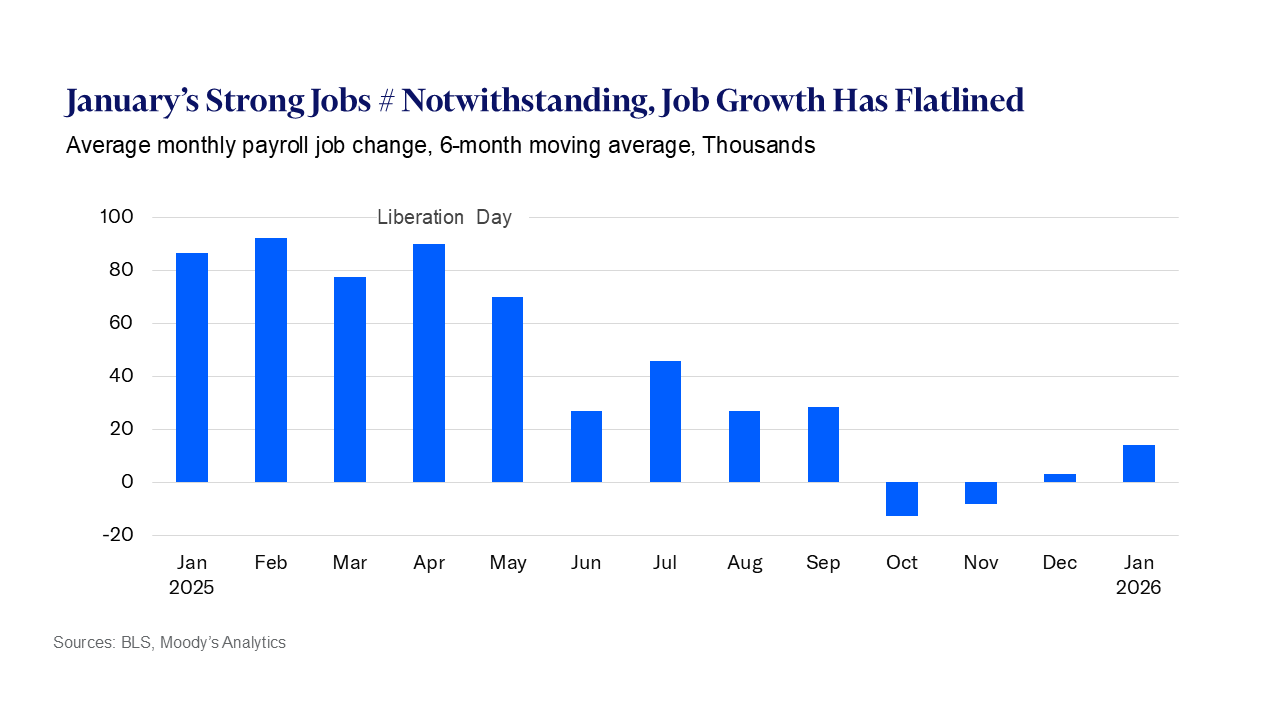
But others think the headline jobs number conceals weakness below the surface. “I wouldn’t exhale with today’s job numbers. The job market remains fragile and highly vulnerable,” Moody’s chief economist Mark Zandi told followers on X. “Yes, payroll employment increased by 130,000 in January, but given the big downward revisions to history, there has been no job growth since last April (Liberation Day).”
“Indeed, over the past year, without the job gains in health care, the economy would have lost a bunch of jobs,” he said, illustrating his point with this chart:
Samuel Tombs and Oliver Allen at Pantheon Macroeconomics went further. They noticed that most of the jobs created were in health care, and the “implausible” new number seems way out of trend.
“In January 2025, the model inferred that 40K jobs were created on net at health care businesses that either set up or closed. This January, the model assumes 85K jobs were created. Our chart [below] shows the openings-to-employment ratio in the health care sector has fallen recently and now is below its long-run average, suggesting a much weaker pace of growth in payrolls lies ahead.”
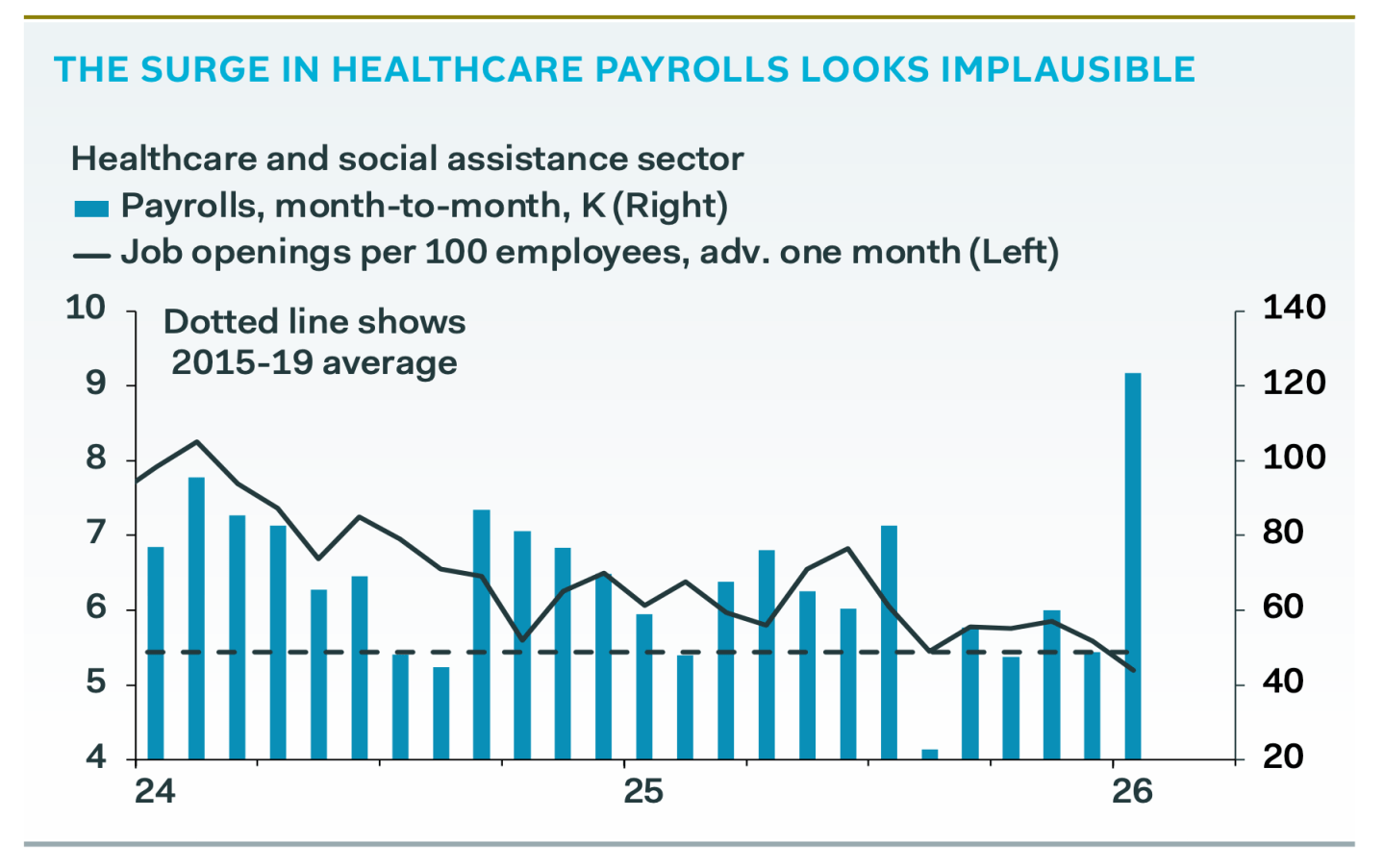
That massive spike in January reflects the flawed statistical model used to collect the data, they argue.
“It is premature to conclude the labor market has turned a corner just yet,” they said. “As a result, we still expect the FOMC to ease policy by 75 basis points this year, but we now look for cuts in June, July and September, rather than March, June and September.”
Here’s a snapshot of the markets ahead of the opening bell in New York this morning:
- S&P 500 futures were up 0.32% this morning. The last session closed flat at 6,941.
- STOXX Europe 600 was up 0.45% in early trading.
- The U.K.’s FTSE 100 was up 0.3% in early trading.
- Japan’s Nikkei 225 was flat.
- China’s CSI 300 was up 0.12%.
- The South Korea KOSPI was up 3.13%.
- India’s NIFTY 50 was down 0.57%.
- Bitcoin was up at $67.5K.