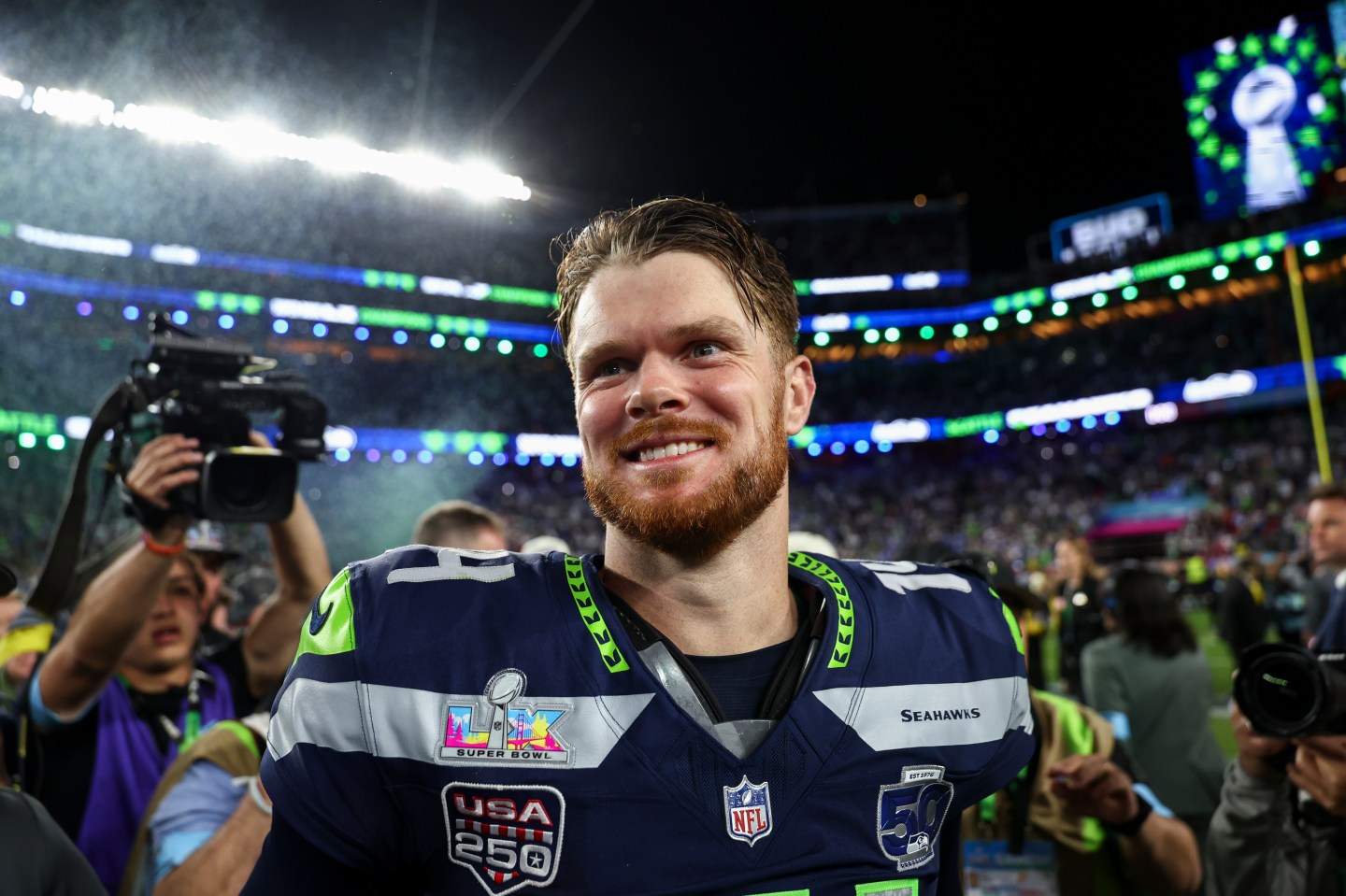

America’s new love affair with gambling reached a crescendo on Super Bowl Sunday, when federally regulated prediction market Kalshi processed an eye-popping $871 million in trading volume—most of it tied to the NFL’s biggest game of the year. The haul capped a weekend that also saw the Seattle Seahawks beat the New England Patriots 29–13, but the more telling scoreline may have been the one between old-line sportsbooks and a new generation of finance-flavored betting apps.
The gambling revolution took off around 2018, when platforms such as DraftKings and FanDuel rode a wave of state-by-state legalization, and the old stigma separating professional sports and gambling broke away dramatically. Long a feature of European soccer, with gambling sites sponsoring football clubs’ kits, the Paddy Powerization of America led to gambling partnerships with sports brands including ESPN, the NBA, and the NFL.
Now, data from Wall Street analysts and industry researchers suggest the grip of the sportsbook is loosening as Americans flock to “events contracts” on exchanges such as Kalshi and its crypto-native rival Polymarket, which let users wager on everything from playoff results to interest-rate cuts and presidential politics. On Kalshi, sports-linked contracts have shifted from an experiment to the center of the business, with football alone accounting for roughly 90% of trading volumes in recent months.
Super Bowl weekend showed how far that shift has gone. According to a Bank of America Global Research note, Kalshi’s $871 million in notional volume leading up to and on Sunday was mostly tied to the NFL game. Kalshi confirmed to Fortune that total volume in all markets related to the game was over $1 billion. According to BofA estimates, nearly a fifth of that action came via parlays—multi-leg sequences familiar to sportsbook customers but now wrapped in the language of derivatives and trading. At the same time, DraftKings, Flutter Entertainment’s FanDuel, and other gambling stocks have stumbled, pressured by evidence that a meaningful slice of “handle” is migrating to prediction markets even during what should be peak season for traditional books.
Kalshi’s business has grown from a niche prediction market into a multi-hundred-million-dollar-revenue, multibillion-dollar-volume exchange in just a few years, with growth rates in the triple and even quadruple digits. Estimated revenue grew from roughly $1.8 million in 2023 to about $24 million in 2024 (over 1,200% year over year), then to about $260 million in 2025. The company’s valuation rose to around $11 billion by late 2025 following a $1 billion funding round.
According to Kalshi, it is different from sports betting due to the way its exchange operates on a structural level. “Unlike a sportsbook, which takes the other side of every bet from customers, Kalshi is an exchange where people on both sides of trades can meet, similar to the way that stock and derivatives exchanges work,” a representative told Fortune. Where sports betting operates like a casino, with everyone playing against the “house,” Kalshi says it works like the stock market, with customers trading against other customers, and importantly, Kalshi doesn’t win when its customers lose.
The rise of the prediction market
The appeal is partly economic and partly cultural. Kalshi and Polymarket pitch themselves not as casinos but as exchanges where users trade contracts that look and feel like financial instruments, with prices moving in real time and positions that can be opened and closed like stocks. Backers from Sequoia Capital to Founders Fund describe these platforms as “truth machines,” arguing that tying money to political and economic outcomes produces sharper forecasts than polls or pundits. In practice, that lofty framing coexists with a very old impulse: the desire to sweat a game, an election, or even a celebrity rumor with some cash on the line. Super Bowl Sunday, with its wall-to-wall betting culture and party atmosphere, gave prediction markets a perfect stage.
In a recent podcast appearance on SoFi’s The Important Part, attended by Fortune, Tom Lee of Fundstrat argued that prediction markets are “actually really useful, because it’s the closest thing to a crystal ball.” For users, however, he said it’s clearly “a form of gambling,” and there’s a social consequence to that. He argued that it’s “really a big innovation for the financial industry,” as it can help break down the act of buying stock into tokenized earning streams that extend far into the future. “Then it’s a lottery ticket for you,” he said, because if that cheap future option beats, “you can make a lot more money than buying the whole company” as a stock.
“Of course, with that innovation [and] speculation, it creates winners and losers. But that’s capitalism, right?” Lee noted that 90% of publicly traded companies since the 1970s have fallen in value by more than 50%, and another 90% of those have fallen to zero, meaning 90% of 90% of stocks are eventually worth nothing.
Lee’s co-panelist, Michael Lewis, author of The Big Short, begged to differ. “It sounds like a good thing,” he said. “But it doesn’t look to me like the stock market’s saner than it was before sports gambling became legal.” Lewis marveled at “the way the country has just flipped on this subject” and highlighted the distinction between state-regulated sports gambling and prediction markets such as Kalshi and Polymarket, which are not.
Kalshi in particular has surfed a regulatory situation that treats its offerings as CFTC-regulated “events contracts,” distinct from state-licensed gambling—even as state regulators bristle at what looks, to many, like sports betting by another name. The company has raced to lock in distribution, securing a high-profile partnership with retail brokerage Robinhood that pipes its markets directly into mainstream trading apps used by millions of Americans. On Sunday night, Kalshi’s own mobile app briefly hit the No. 2 spot in the U.S. App Store, ahead of most social and entertainment mainstays, while DraftKings ranked fifth—an indication of how quickly prediction markets have moved from niche curiosity to mass consumer product.
What unites both companies is the bet that America’s newly normalized relationship with gambling is durable enough to support an entirely new asset class. During the 2024 Trump-Harris race, users wagered more than $3 billion on prediction platforms, and the contracts’ implied odds proved more accurate than many high-profile polls. Since then, Kalshi’s busiest markets have ranged from New York City’s mayoral race to March Madness brackets, with a single NCAA tournament reportedly drawing over $500 million in bets.
To Michael Lewis, even the sports leagues now are privately admitting that sports gambling is “the work of the devil.” Noting all the sponsorships that are funding sports broadcasting and leagues, Lewis said there’s a major problem with the business model. “It’s now the chief engine of growth. It’s corrupting sports. It is creating horrible incentives.” He bemoaned the wave of scandals, especially in college basketball, and predicted it would keep happening until prop betting on college sports was banned. To Lewis’s point, NCAA president Charlie Baker called on state gambling commissions just this past January, urging them to adjust state laws and regulations to eliminate gambling on individual prop bets and other high-risk prop bets such as first-half unders. Hours earlier, federal prosecutors had announced multiple indictments in a sports betting investigation involving college basketball.
Kalshi previously responded to criticism from Baker by noting that it is federally regulated, governed by the Commodity Exchange Act and its hundreds of regulations. “We as a company also have comprehensive internal policies to address trading integrity and responsibility issues, including in-house and third-party surveillance systems that monitor trading activity,” Kalshi said. “We run Know-Your-Customer checks on everyone who trades on our platform.”
Lewis said he expected the government would eventually catch up to this issue, “but we’re going to look back on a period of, it was not good for the society. It’s not fashionable to talk that way. It’s especially predatory toward young men. It’s young men who do it. And overwhelmingly, it’s a young male marketplace.” Lewis said he agreed with Lee that “prediction markets are great,” but when it comes to sports gambling, “society has to get its arms around it. It’s going to ruin sports and ruin a lot of young men’s lives.”