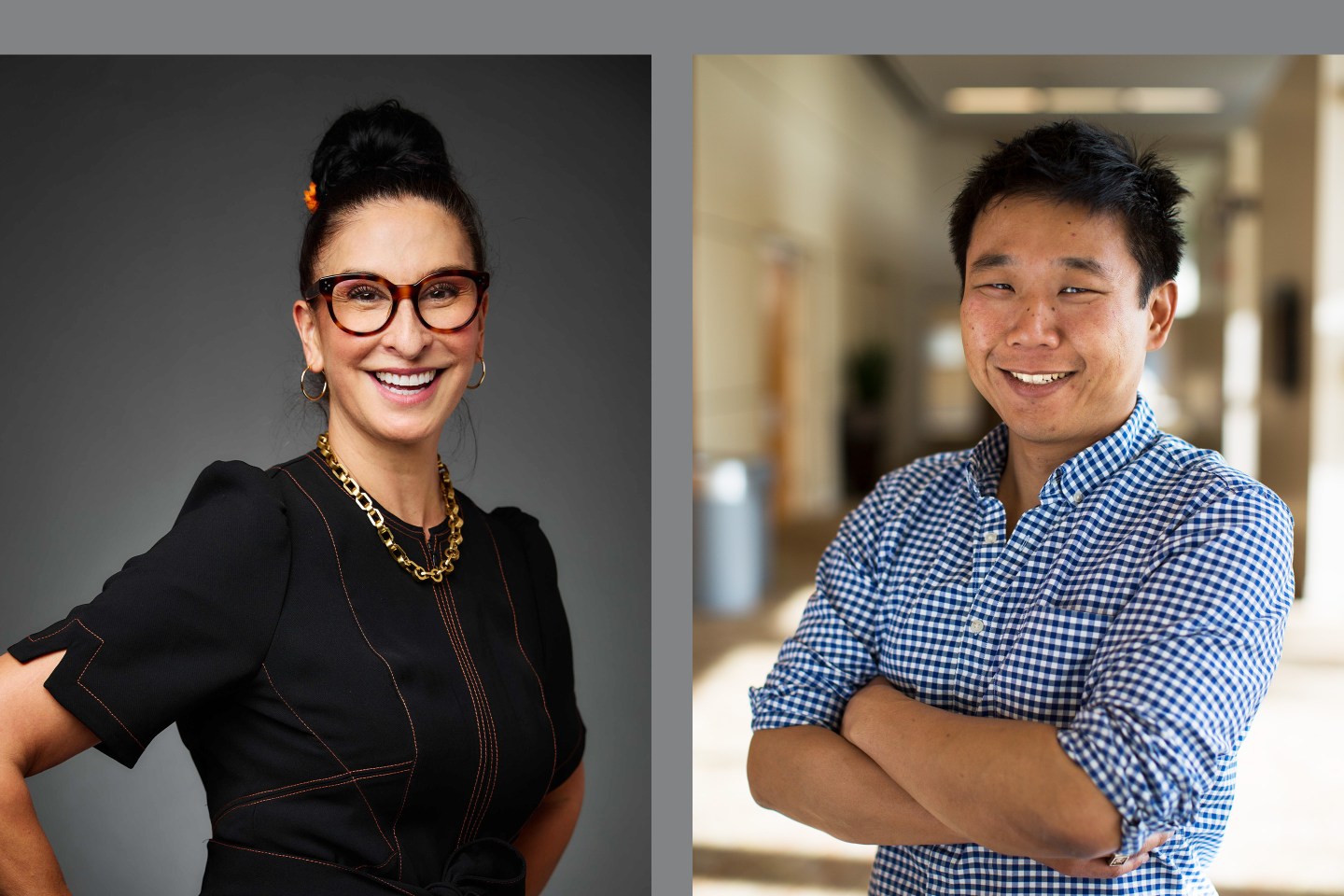
When Ali Bebo, the chief human resources officer, explores new ways to infuse artificial intelligence into the human resources department at education company Pearson, she and Chief Technology Officer Dave Treat frequently ask themselves if it’s appropriate for technology to automate a workflow. And just as importantly, when they shouldn’t.
“What are the tasks that create a strong human connection?” asks Bebo. “We want to maintain those.”
One tool that the pair deployed is a chatbot called “Cara,” which can field employee questions like “how can I get promoted” or “what skills do I need for that new job I’m eying?” In the future, agentic AI could also help provide some employee coaching, though in both cases the technology isn’t intended to replace managers entirely. There are also certain tasks where AI won’t ever be deployed. Bebo vows the technology will not make any final hiring decisions, one clear line in the sand.
“That’s the other part of the partnership that Dave and I have,” says Bebo. “We are thinking about the human plus machine and then the whole view of: can, should, and shouldn’t automate.”
The partnership between the HR leaders and top technologists like the CTO and chief information officer has become much more critical as AI usage proliferates across the workplace. But there are signs that progress has slowed, with recent research from analytics firm Gallup showing that the number of employees that use AI at least a few times a year has been relatively flat the past few quarters. Nearly half of all U.S. workers say they “never” use AI in their role. Leaders have reported substantially higher and more frequent use of AI tools compared to managers and individual contributors.
Treat says Pearson’s AI efforts focus on three areas: product, the engineering function, and AI across the enterprise for various internal teams. He’s promoted AI usage through broad licenses, including providing every employee a Microsoft Copilot license, as well as targeted use cases like in customer service, where Pearson has leveraged Salesforce’s AI agents. Agentic AI now handles 63% of those cases.
“When we think about work, we want to think of the outcome backwards and think through what is that combination of automation and human together that will best achieve that outcome,” says Treat.
Intuit’s top technologist and people team leaders, Alex Balazs and Caryl Hilliard, respectively, have both worked at the financial technology company for more than a quarter of a century. Their paths first crossed in 2013 when they worked on TurboTax, but today, CTO Balazs says he spends roughly a third of his time working with Hilliard’s team.
Together, they collaborate on what skills are needed inside Intuit to support the company’s technology roadmap and discuss when it is appropriate to allocate some resources to luring external talent, on top of the upskilling Intuit invests in. “We are competing for the talent that’s at the intersection between AI and software,” says Balazs, adding that while the market is competitive, it is not as intense as what large language model companies face.
Hilliard, Intuit’s chief people and places officer, says the company has placed a strong emphasis on hiring entry-level workers. “We think that they have knowledge and perspective that’s very different from the rest of the workforce,” says Hilliard.
Both agree this cohort requires a unique approach to onboarding that takes into account generational attributes. Gen Z workers hired to Balazs’ team have strong computer science fundamentals and know how to use AI coding tools. But they aren’t always as adept at working well with other people. Intuit runs a multi-week onboarding boot camp to get them up to speed and address those gaps.
After Chief People Officer Tanya Moore joined consulting firm West Monroe three years ago, she sought to rethink the “hire-to-retire” process, which is the HR framework mapping out an employee’s lifecycle. “We had a very large recruiting team and we were not using a ton of technology and automation,” says Moore.
West Monroe has pivoted and has invested in automation tools for scheduling and recruitment, now handling the work that’s equivalent to three full-time employees. Moore says that this automation hasn’t resulted in staffing reductions, but it has helped curtail additional hiring. One automation tool that’s been deployed across the business to make it easier for managers to input interview feedback is projected to save the business $1.5 million annually.
Moore worked closely with CIO Kevin Rooney to develop an internal chatbot that’s used by resource managers that build new project teams, typically around a half-dozen employees. Previously, a project manager delegated this request to the resource manager, who would spend a week sending emails and Microsoft Team messages across the company to build the group.
The chatbot can automate a lot of this process and asks clarifying questions about the exact skills needed for the project. Moore and Rooney say this tool can also remove bias, as project managers tend to repeatedly go back to their reliable network. But those team members may not always be the best suited for the project.
At Ralliant, a manufacturer of precision instruments and industrial sensors which spun off from Fortive last summer, has created working group councils that include team members from the technology and people functions to identify new ways to embed AI into workflows. These groups are encouraged to stay in touch and share best practices.
Karen Bick, Ralliant’s chief people officer, says the company tracks productivity and AI’s ability to reduce workflow friction. Other key metrics include speed to market for new products, employee engagement, AI adoption, and whether new skills are being cultivated.
Chief Technology and Growth Officer Amir Kazmi, who joined Ralliant a year ago, promotes a “learn-by-doing” approach to AI all the way up to senior leadership. He wants everyone to experiment with AI. Humility, he says, is also essential.
“We’re still kind of early in the journey, especially with agentic capabilities, like many other companies,” says Kazmi.
John Kell
Send thoughts or suggestions to CIO Intelligence here.
NEWS PACKETS
OpenAI makes a stronger play for scientific AI. As competitors including Anthropic and Google increasingly home in on sector-specific solutions for drug discovery and other scientific research, OpenAI this week has debuted a new free tool called Prism that the AI startup says will make it easier for scientists to use ChatGPT to draft research papers and collaborate. The company’s GPT-5.2, its most advanced model for mathematical and scientific reasoning, is integrated directly into Prism’s workflow. OpenAI says that researchers, students, and STEM-focused faculty and engineers are sending almost 8.4 million average weekly messages on advanced topics in the sciences and mathematics. The number of those monthly science messages has grown by nearly 50% last year, the company has reported.
Intel comes back to earth after a lackluster earnings forecast. The struggling chipmaker that got a cash infusion from the U.S. government last year—and recently saw its stock price get a lift after President Donald Trump hailed a meeting with CEO Lip-Bu Tan—found itself grounded in reality again after forecasting first-quarter profits and revenue that missed Wall Street’s expectations. Intel also acknowledged that while orders soared in the wake of the U.S. government’s endorsement, the company wasn’t prepared for the spike in demand, because it had spent months cutting capacity on older production lines, according to The Wall Street Journal. “We are on a multiyear journey,” said Tan. “It will take time and resolve.”
EU regulators probe X over sexualized AI images. Regulators in the European Union have launched an investigation into Elon Musk’s X after authorities say the social media platform failed to stop the spread of AI-generated sexualized images. The EU has said that X is being investigated for possibly violating the region’s Digital Services Act, which went into full effect in 2024 to put greater pressure on social media networks, app stores, and other online platforms to address illegal and harmful content, among other measures. X was already fined close to $140 million late last year for breaching the Digital Services Act, in that ruling due to a lack of transparency about advertising, failure to provide access to public data to researchers, and a lack of clarity about the verification of blue verification badges.
Nvidia invests $2 billion more into CoreWeave. Bloomberg reports that AI chipmaker Nvidia is pumping more money into CoreWeave to help the cloud computing company accelerate efforts to build more than 5 gigawatts of AI factories by 2030. “Together, we’re racing to meet extraordinary demand for Nvidia AI factories — the foundation of the AI industrial revolution,” Jensen Huang, founder and CEO of Nvidia, said in a statement. The pair are already closely linked: before the latest investment, Nvidia was the fourth-largest holder of CoreWeave shares. Additionally, Nvidia has previously agreed to buy more than $6 billion in CoreWeave’s services through 2032.
Why are so many people talking about an AI-built web browser that kinda works? Fortune reports on the curious case at coding startup Cursor, which recently disclosed that a group of AI agents were able to build a web browser while working on the task uninterrupted over the course of a week, without any human intervention. While a sort-of-working web browser isn’t a major technological breakthrough on its own, the progress of AI agents moving from limited tasks, or performing complex tasks that stretch across multiple days, rather than mere minutes for many AI-enabled tasks, is of note. The lesson learned here: Jonas Nelle, an engineer at Cursor, told Fortune that as AI models get better, engineers and researchers should revisit their assumptions every few months about what AI models can do.
ADOPTION CURVE
Big companies are loud and proud AI optimists. Despite ongoing questions around the extent of the revenue and efficiency gains businesses can extract from hefty AI investments, large enterprises remain overwhelmingly bullish on the tech. Two out of every three companies say they would maintain their spending on AI even if a recession were to occur in the next 12 months, with $124 million expected to be deployed, on average, in 2026, according to KPMG’s Q4 AI pulse survey of 130 U.S.-based C-suite business leaders at firms with annual revenue of $1 billion or more.
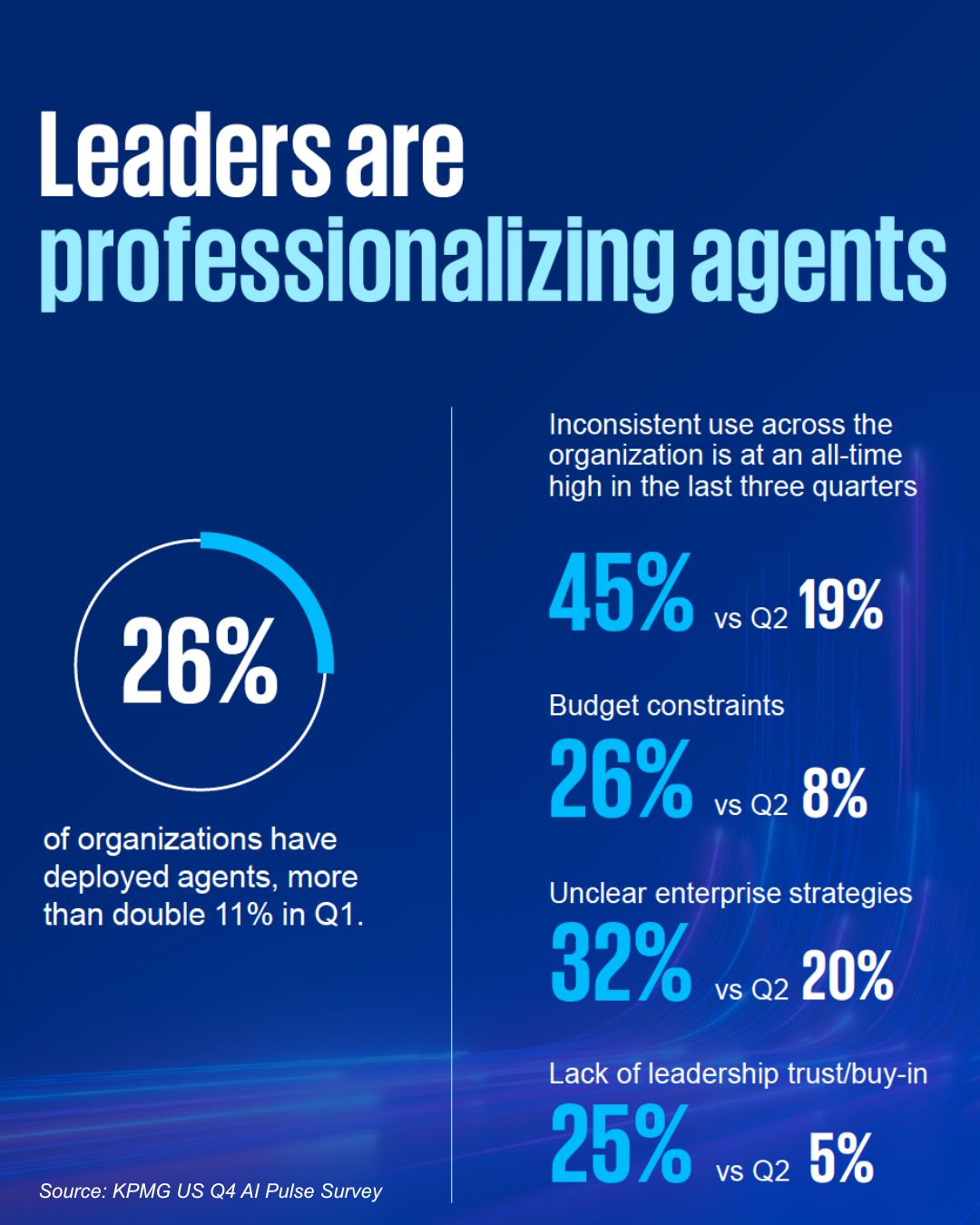
AI agents have increasingly captured a lot more of their attention. The survey found that 26% of organizations have deployed agentic AI, up from 11% a year ago. KPMG says that 44% of leaders now expect AI agents will take a lead role in managing some projects with human team members over the next two to three years. That’s a big shift from the Q3 2025 findings, when 78% expected humans to primarily manage and direct AI agents.
Rahsaan Shears, a principal at KPMG, tells Fortune that organizations are still working through what that human-agent relationship and collaboration will look like. Some of the loftier questions include just how many agents can a person manage? What is the limit of human capacity to critically evaluate and review that work? And how are agents themselves being used to review the work being done by AI?
“We’re testing out lots of different scenarios to find what works well and what we can scale,” says Shears. “People are still experimenting, but they know, as we do, that the collaboration rate is going to be what sets the stage for the million- or billion-dollar question—depending on who you talk to—on what’s the ROI?”
Courtesy of KPMG
JOBS RADAR
Hiring:
- PVH is seeking a SVP of global IT supply chain and corporate technologies, based in New York City. Posted salary range: $350K-$400K/year.
- United Way is seeking a chief information and technology officer, based in Alexandria, Virginia. Posted salary: $290K/year.
- Celigo is seeking a CIO, based in Redwood City, California. Posted salary range: $250K-$300K/year.
- Warner Music Group is seeking a VP of global IT and infrastructure, based in New York City. Posted salary range: $250K-$290K/year.
Hired:
- Sprocket Security appointed Eric Sheridan as CTO, joining the cybersecurity firm to oversee the engineering and product strategy. Previously, Sheridan served as VP of engineering for RoonCyber, a cybersecurity provider that focuses on cloud security. He also spent 11 years at security company NTT Application Security, including serving as a chief scientist.
- Novarc Technologies named Donato Montanari as CTO, joining the robotics firm after most recently serving as VP and general manager of machine vision and fixed industrial scanning at logistics equipment company Zebra Technologies. Montanari has also co-founded startups including Doorway and Deevio.
- NCR Atleos announced the appointment of Rohan Pal as CIO. Prior to joining the ATM manufacturer, Pal was the chief transformation officer at cloud-based software company ServiceNow. He also previously held leadership roles at organizations including Brinks, Tyco, HD Supply, and Home Depot.
- GBank appointed Jason Amos as EVP and CTO, overseeing the technology strategy and modernization efforts for the Las Vegas-based bank. Previously, Amos has held technology leadership positions at Microsoft and Intel and served as CTO of music rating platform BreakingHits.com.
- Hermeus has promoted Steve Furger to the role of CTO, leading the aircraft manufacturer’s long-term technical vision and engineering roadmap. Furger originally joined Hermeus in 2022 as director of flight sciences and was promoted to VP of engineering in 2023 before ascending to his new role. He also spent nine years at spacecraft manufacturer SpaceX.
- CSS has promoted Ryan Haylock as CIO, after initially joining the cybersecurity and IT company in 2023 as VP of IT. As CIO, Haylock will continue to oversee enterprise IT, cybersecurity, infrastructure, and technology innovation. Previously, Haylock served as CIO of the nonprofit Aldersgate United Methodist Retirement Community and as CIO at the mining and mineral processing company The Quartz Corp.
- Model N has appointed Dan Koellhofer as chief product officer and David Schur as CTO. Koellhofer will lead product strategy and innovation for the revenue management software company and previously served as SVP of applications for sales and marketing and business planning software provider Anaplan. As CTO, Schur will steer the engineering and platform strategy and was previously CTO of sustainability software company Sphera.