• Home
  • Latest
  • Fortune 500
  • Finance
  • Tech
  • Leadership
  • Lifestyle
  • Rankings
  • Multimedia

Trendingnow

1

Trump, who has repeatedly called climate change fake, is now threatening Brazil with tariffs over the deforestation of the Amazon

2

Pentagon accuses Alibaba, Baidu and BYD, three of China's biggest companies, of supporting the Chinese military

3

Current price of oil as of June 8, 2026

1

Trump, who has repeatedly called climate change fake, is now threatening Brazil with tariffs over the deforestation of the Amazon

2

Pentagon accuses Alibaba, Baidu and BYD, three of China's biggest companies, of supporting the Chinese military

3

Current price of oil as of June 8, 2026
PoliticsVenezuela

Why whatever’s happening in Venezuela isn’t ‘regime change’

By
Andrew Latham
Andrew Latham
and
The Conversation
The Conversation
Down Arrow Button Icon
By
Andrew Latham
Andrew Latham
and
The Conversation
The Conversation
Down Arrow Button Icon
January 8, 2026, 2:08 PM ET
maduro
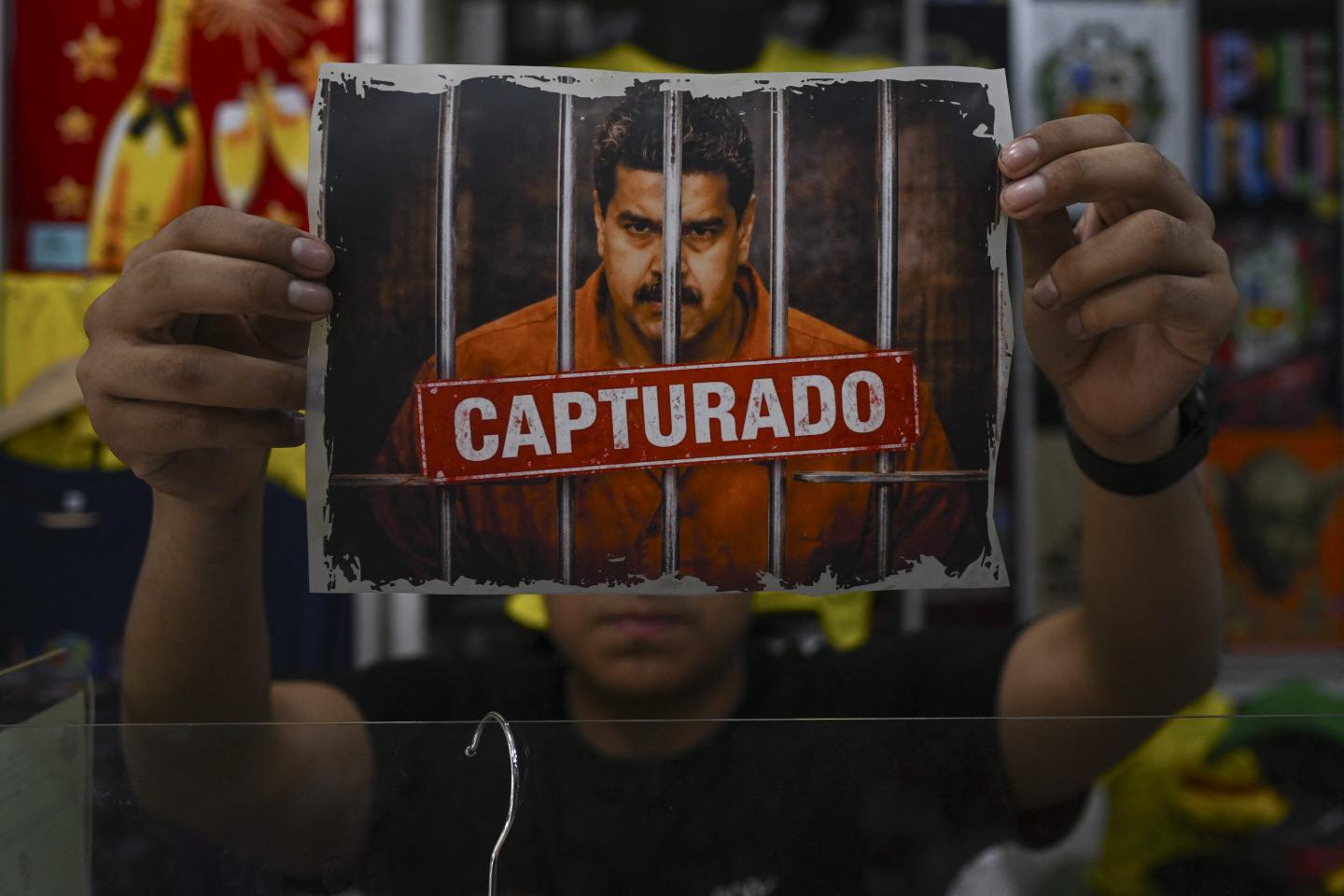
A man shows an image featuring a digitally altered image of the ousted Venezuelan President Nicolas Maduro before printing it on a shirt for sale at "Emporio Comercial de Gamarra" in Lima on January 06, 2026. ERNESTO BENAVIDES / AFP via Getty Images

The U.S. mission to seize Venezuela’s President Nicolás Maduro has pushed the concept of regime change back into everyday conversation. “Regime Change in America’s Back Yard,” declared The New Yorker in a piece that typified the response to the Jan. 3 operation that saw Maduro exchange a compound in Caracas for a jail in Brooklyn.

Recommended Video

Commentators and politicians have been using the term as shorthand for removing Maduro and ending Venezuela’s crisis, as if the two were essentially the same thing. But they are not.

In fact, to an international relations specialist like me, the use of “regime change” to explain what just went down in Venezuela muddies the term rather than clarifies it. I’ll explain.

Regime change, as it has been practiced and discussed in international politics, refers to something far more ambitious and far more consequential than plucking out a single leader. It is an attempt by an outside power to transform how another country is governed, not just change who governs it.

Of course, that doesn’t mean that regime change in Venezuela isn’t still in the cards. Only that Maduro being replaced by his deputy, former Vice President Delcy Rodríguez, doesn’t reach that bar yet – even if, as U.S. President Donald Trump has suggested, she will be under pressure to toe Washington’s line.

Understanding this distinction is essential to grasping what is at stake in Venezuela as it transitions to a post-Maduro world, but not necessarily one removed from the Chavismo ideology that Maduro inherited from his predecessor, Hugo Chavez.

A more technical removal

Regime change, as it is understood by most foreign policy analysts, refers to efforts by external actors to force a deep transformation of another state’s system of rule. The aim is to reshape who holds authority and how power is exercised by changing the structure and institutions of political power, rather than a government’s policies or even its personnel.

Once understood this way, the history of the term comes into clearer view.

The concept of “regime change” gained wider use after the Cold War as a way to describe externally imposed political transformation without relying on older, more direct terms.

Military and political leaders in earlier eras tended to speak openly of overthrow, deposition, invasion or interference in another state’s internal affairs.

In contrast, the newer term “regime change” sounded technical and restrained. It suggested planning and manageability rather than domination, softening the reality that what was being discussed was the deliberate dismantling of another country’s political order.
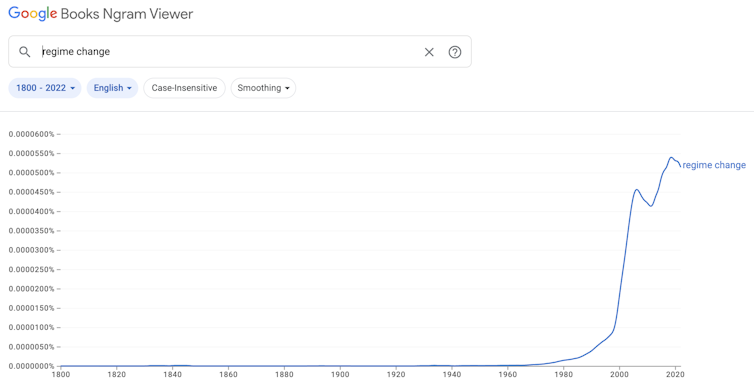
A Google Ngram graph depicts the prevalence of ‘regime change’ in text through the centuries (click to zoom).

That choice of language mattered. Describing the overthrow of governments as “regime change” reduced the moral and legal weight associated with coercive intervention.

It also carried an assumption that political systems could be taken apart and rebuilt through expertise and design.

The term implied that once an existing order was removed, a more acceptable one would take its place, and that this transition could be guided from the outside.

And then came Iraq

During the 1990s and early 2000s, this assumption became embedded in the thinking of the U.S. foreign policy establishment.

Regime change came to be associated with ambitious efforts to replace hostile governments with fundamentally different systems of rule. Iraq became the most important test of that idea.

The intervention by the U.S. in 2003 succeeded in removing Saddam Hussein’s government, but it also exposed the limits of externally driven transformation.

Along with Hussein, senior members of his long-ruling Ba’ath Party were banned from involvement in the new government – this was real regime change.

The collapse of the existing order in Iraq following the U.S.-led invasion, however, did not yield a stable successor. Instead, it produced a violent struggle for power that outside powers were unable to control.

That experience altered how the term was understood. The term regime change did not disappear from political debate, but its meaning shifted. It became a label tied to concerns about overreach and the risks of assuming that foreign powers can reengineer political systems.

In this usage, regime change no longer promised control or resolution. It functioned as a warning drawn from experience.

A fine distinction

Both meanings are now visible in discussions of Venezuela. Some audiences invoke regime change to signal resolve and a willingness to break an entrenched system that appears resistant to reform.

Others hear the same term and think of earlier cases where the collapse of a regime produced fragmentation and prolonged instability. The significance attached to the concept depends on who is using it and what political purpose it serves.

This distinction matters because externally driven regime change does not end when a government falls or a dictator is removed. It sets off a contest over how power will be reorganized once existing institutions are dismantled.

This article is part of a series explaining foreign policy terms commonly used but rarely explained.

Andrew Latham, Professor of Political Science, Macalester College

This article is republished from The Conversation under a Creative Commons license. Read the original article.

The Conversation
Subscribe to Fortune Gulf Brief. Every Tuesday, this new newsletter delivers clear-eyed, authoritative intelligence on the deals, decisions, policies, and power shifts shaping one of the world’s most consequential regions, written for the people who need to act on it. Sign up here.
About the Authors
By Andrew Latham
See full bioRight Arrow Button Icon
By The Conversation
See full bioRight Arrow Button Icon

Latest in Politics

Finance
Lorem ipsum dolor sit amet, consectetur adipiscing elit, sed do eiusmod tempor incididunt ut labore et dolore magna aliqua. Ut enim ad minim veniam
By Fortune Editors
October 20, 2025
Finance
Lorem ipsum dolor sit amet, consectetur adipiscing elit, sed do eiusmod tempor incididunt ut labore et dolore magna aliqua. Ut enim ad minim veniam
By Fortune Editors
October 20, 2025
Finance
Lorem ipsum dolor sit amet, consectetur adipiscing elit, sed do eiusmod tempor incididunt ut labore et dolore magna aliqua. Ut enim ad minim veniam
By Fortune Editors
October 20, 2025
Finance
Lorem ipsum dolor sit amet, consectetur adipiscing elit, sed do eiusmod tempor incididunt ut labore et dolore magna aliqua. Ut enim ad minim veniam
By Fortune Editors
October 20, 2025
Finance
Lorem ipsum dolor sit amet, consectetur adipiscing elit, sed do eiusmod tempor incididunt ut labore et dolore magna aliqua. Ut enim ad minim veniam
By Fortune Editors
October 20, 2025
Finance
Lorem ipsum dolor sit amet, consectetur adipiscing elit, sed do eiusmod tempor incididunt ut labore et dolore magna aliqua. Ut enim ad minim veniam
By Fortune Editors
October 20, 2025

Most Popular

Finance
Lorem ipsum dolor sit amet, consectetur adipiscing elit, sed do eiusmod tempor incididunt ut labore et dolore magna aliqua. Ut enim ad minim veniam
By Fortune Editors
October 20, 2025
Finance
Lorem ipsum dolor sit amet, consectetur adipiscing elit, sed do eiusmod tempor incididunt ut labore et dolore magna aliqua. Ut enim ad minim veniam
By Fortune Editors
October 20, 2025
Finance
Lorem ipsum dolor sit amet, consectetur adipiscing elit, sed do eiusmod tempor incididunt ut labore et dolore magna aliqua. Ut enim ad minim veniam
By Fortune Editors
October 20, 2025
Finance
Lorem ipsum dolor sit amet, consectetur adipiscing elit, sed do eiusmod tempor incididunt ut labore et dolore magna aliqua. Ut enim ad minim veniam
By Fortune Editors
October 20, 2025
Finance
Lorem ipsum dolor sit amet, consectetur adipiscing elit, sed do eiusmod tempor incididunt ut labore et dolore magna aliqua. Ut enim ad minim veniam
By Fortune Editors
October 20, 2025
Finance
Lorem ipsum dolor sit amet, consectetur adipiscing elit, sed do eiusmod tempor incididunt ut labore et dolore magna aliqua. Ut enim ad minim veniam
By Fortune Editors
October 20, 2025
Fortune Secondary Logo
Rankings
  • 100 Best Companies
  • Fortune 500
  • Global 500
  • Fortune 500 Europe
  • Most Powerful Women
  • World's Most Admired Companies
  • See All Rankings
  • Lists Calendar
Sections
  • Finance
  • Fortune Crypto
  • Features
  • Leadership
  • Health
  • Commentary
  • Success
  • Retail
  • Mpw
  • Tech
  • Lifestyle
  • CEO Initiative
  • Asia
  • Politics
  • Conferences
  • Europe
  • Newsletters
  • Personal Finance
  • Environment
  • Magazine
  • Education
Customer Support
  • Frequently Asked Questions
  • Customer Service Portal
  • Privacy Policy
  • Terms Of Use
  • Single Issues For Purchase
  • International Print
Commercial Services
  • Advertising
  • Fortune Brand Studio
  • Fortune Analytics
  • Fortune Conferences
  • Business Development
  • Group Subscriptions
About Us
  • About Us
  • Press Center
  • Work At Fortune
  • Terms And Conditions
  • Site Map
  • About Us
  • Press Center
  • Work At Fortune
  • Terms And Conditions
  • Site Map
  • Facebook icon
  • Twitter icon
  • LinkedIn icon
  • Instagram icon
  • Pinterest icon

Latest in Politics

The entrance to a U.S. Immigration and Customs (ICE) detention facility
North AmericaDepartment of Homeland Security
Texas ICE facility spent $11.5 million on guards, medical services, transportation and meals weeks before the camp even held detainees, GAO finds
By Michael Biesecker, Ryan J. Foley and The Associated PressJune 9, 2026
1 hour ago
Trump speaking into a mic.
NewslettersEye on AI
Should Americans get an equity stake in AI? Trump and progressive Democrats float public ownership of AI
By Beatrice NolanJune 9, 2026
4 hours ago
Photo of Scott Bessent
EconomySocial Security
‘We are rapidly running out of time’: Watchdog sounds Social Security alarm after 22% cut confirmed for 2032
By Nick LichtenbergJune 9, 2026
6 hours ago
ssa
North AmericaSocial Security
Crisis, what crisis? Social Security chief says ‘people boo at Yankee Stadium, even when they’re winning’
By Fatima Hussein and The Associated PressJune 9, 2026
6 hours ago
tariff
LawTariffs
The $166 billion tariff refund question: Who actually gets paid back?
By Mae Anderson and The Associated PressJune 9, 2026
7 hours ago
trump
Arts & EntertainmentWhite House
Trump on getting loudly booed by hometown New York: ‘It was, I think, mostly cheers’
By Stephen Whyno, Michelle L. Price and The Associated PressJune 9, 2026
7 hours ago

Most Popular

Trump, who has repeatedly called climate change fake, is now threatening Brazil with tariffs over the deforestation of the Amazon
Environment
Trump, who has repeatedly called climate change fake, is now threatening Brazil with tariffs over the deforestation of the Amazon
By Sasha RogelbergJune 8, 2026
1 day ago
Pentagon accuses Alibaba, Baidu and BYD, three of China's biggest companies, of supporting the Chinese military
Asia
Pentagon accuses Alibaba, Baidu and BYD, three of China's biggest companies, of supporting the Chinese military
By Kate O'Keeffe and BloombergJune 8, 2026
24 hours ago
Current price of oil as of June 8, 2026
Personal Finance
Current price of oil as of June 8, 2026
By Joseph HostetlerJune 8, 2026
1 day ago
Gen Zers are arriving at college unable to even read a sentence—professors warn it could lead to a generation of anxious and lonely graduates
Success
Gen Zers are arriving at college unable to even read a sentence—professors warn it could lead to a generation of anxious and lonely graduates
By Preston ForeJune 7, 2026
2 days ago
'We are rapidly running out of time': Watchdog sounds Social Security alarm after 22% cut confirmed for 2032
Economy
'We are rapidly running out of time': Watchdog sounds Social Security alarm after 22% cut confirmed for 2032
By Nick LichtenbergJune 9, 2026
6 hours ago
'The golden years are not golden': Boomers are hoarding most of America's wealth and power because they're terrified of outliving their money
Economy
'The golden years are not golden': Boomers are hoarding most of America's wealth and power because they're terrified of outliving their money
By Nick LichtenbergJune 7, 2026
2 days ago

© 2026 Fortune Media IP Limited. All Rights Reserved. Use of this site constitutes acceptance of our Terms of Use and Privacy Policy | CA Notice at Collection and Privacy Notice | Do Not Sell/Share My Personal Information
FORTUNE is a trademark of Fortune Media IP Limited, registered in the U.S. and other countries. FORTUNE may receive compensation for some links to products and services on this website. Offers may be subject to change without notice.