
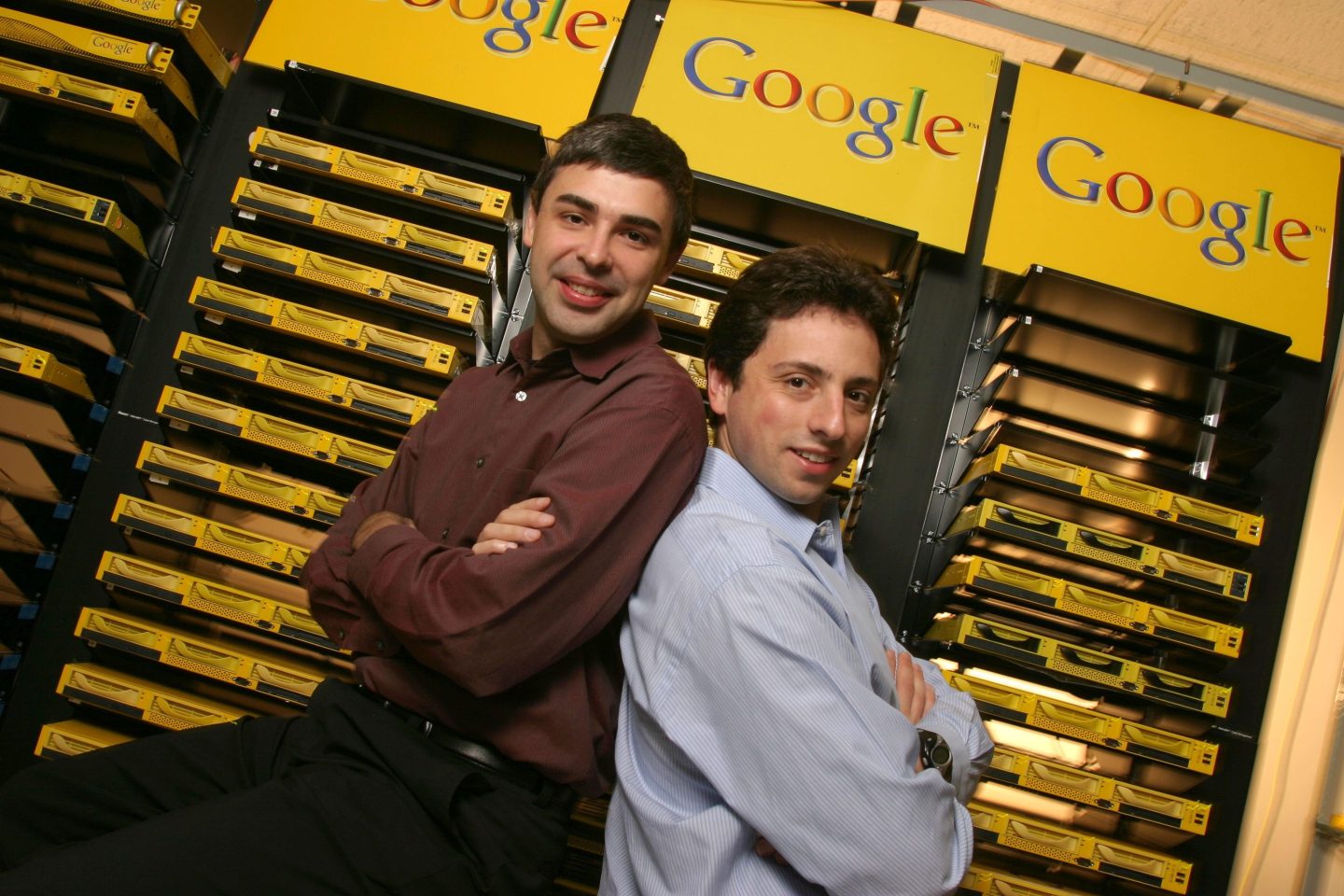
Google cofounder Larry Page had a vision for search engines 25 years ago that sounds eerily close to what its AI product Gemini is making possible today.
Page, who started Google with cofounder Sergey Brin, served in his first stint as CEO from the company’s founding in 1998 until 2001 when he was replaced by Eric Schmidt, who would serve in the role for a decade.
When Google was founded, the concept of the search engine was still fairly new. Google took it to the next level with its PageRank algorithm, which looked at hyperlinks between web pages to rank the best results rather than using keywords.
“Search engines didn’t really understand the notion of which pages were more important,” Page said at the time. “If you type Stanford, you get sort of random pages that mention Stanford. This obviously wasn’t going to work.”
In just a couple of years, Google’s innovation took it from a non-player dwarfed by market leaders like AltaVista and Yahoo to a real competitor.
By 2000 the upstart company had captured 25% of the search market—a significant advance but still far from its 90% dominance now. Page claimed the company was making $80 million a year in ad search revenue in 2000, compared with just under $200 billion in 2024.
Yet Page had grand hopes for what the future of Google and search could look like.
“Artificial intelligence would be the ultimate version of Google,” he said in a resurfaced interview conducted by the nonprofit educational organization American Academy of Achievement, from October 2000. “If we had the ultimate search engine, it would understand everything on the web. It would understand exactly what you wanted, and it would give you the right thing. And that’s obviously artificial intelligence—able to answer any question, basically because almost everything is on the web.”
While he added at the time, “We’re nowhere near doing that now,” Google’s Gemini, which the company recently upgraded, may be the closest it has come to realizing Page’s 25-year-old vision.
OpenAI beat Google to the punch by launching ChatGPT in late 2022, and for months the company scrambled to release its own large language model. In February 2023, Google put out Bard, which it later rebranded to Gemini.
The company has also made major strides to bring AI to search. In May, Google reimagined its iconic search engine by incorporating Gemini in a tab called “AI Mode.” Rather than presenting a list of links, this mode answers search questions in natural language. That’s as ChatGPT is replacing at least some queries once reserved for Google.
Google may also have pulled ahead of competitors with its most recent update to Gemini. The new version of the company’s flagship large language model has outpaced ChatGPT and other competitors like Anthropic’s Claude, according to industry benchmark tests, the Wall Street Journal reported.
Last week, the company incorporated a version of its latest LLM, Gemini 3 Flash, into the AI Mode search tool for all users globally. Its advanced reasoning, the company argues, will deliver users better answers to more complicated questions.
With its multimodal reasoning, Google’s most advanced AI can interpret and reason based on text, images, audio, video, and code in a single prompt. While it may not be able yet to predict a user’s needs, it maintains a 1-million-token context window, meaning it can draw on a large amount of previous information to inform its responses to user queries—especially long and nuanced prompts.
More than just a passive search engine, Gemini can also act on a user’s behalf better than previous versions. Gemini can work across Google’s ecosystem to manage a user’s inbox and send emails. When it comes to coding, the LLM can watch and respond in seconds with how to proceed. Google claims Gemini 3 can help turn an idea into a working prototype in minutes.
While 25 years ago, Page painted the “ultimate search engine” as a faraway goal, the company is moving closer to achieving his vision.