• Home
  • News
  • Fortune 500
  • Tech
  • Finance
  • Leadership
  • Lifestyle
  • Rankings
  • Multimedia
Politicsnational debt

‘This is a bad idea made worse’: Senate Dems’ plan to fix Obamacare premiums adds nearly $300 billion to deficit, CRFB says

Nick Lichtenberg
By
Nick Lichtenberg
Nick Lichtenberg
Business Editor
Down Arrow Button Icon
Nick Lichtenberg
By
Nick Lichtenberg
Nick Lichtenberg
Business Editor
Down Arrow Button Icon
December 5, 2025, 4:43 PM ET
Schumer
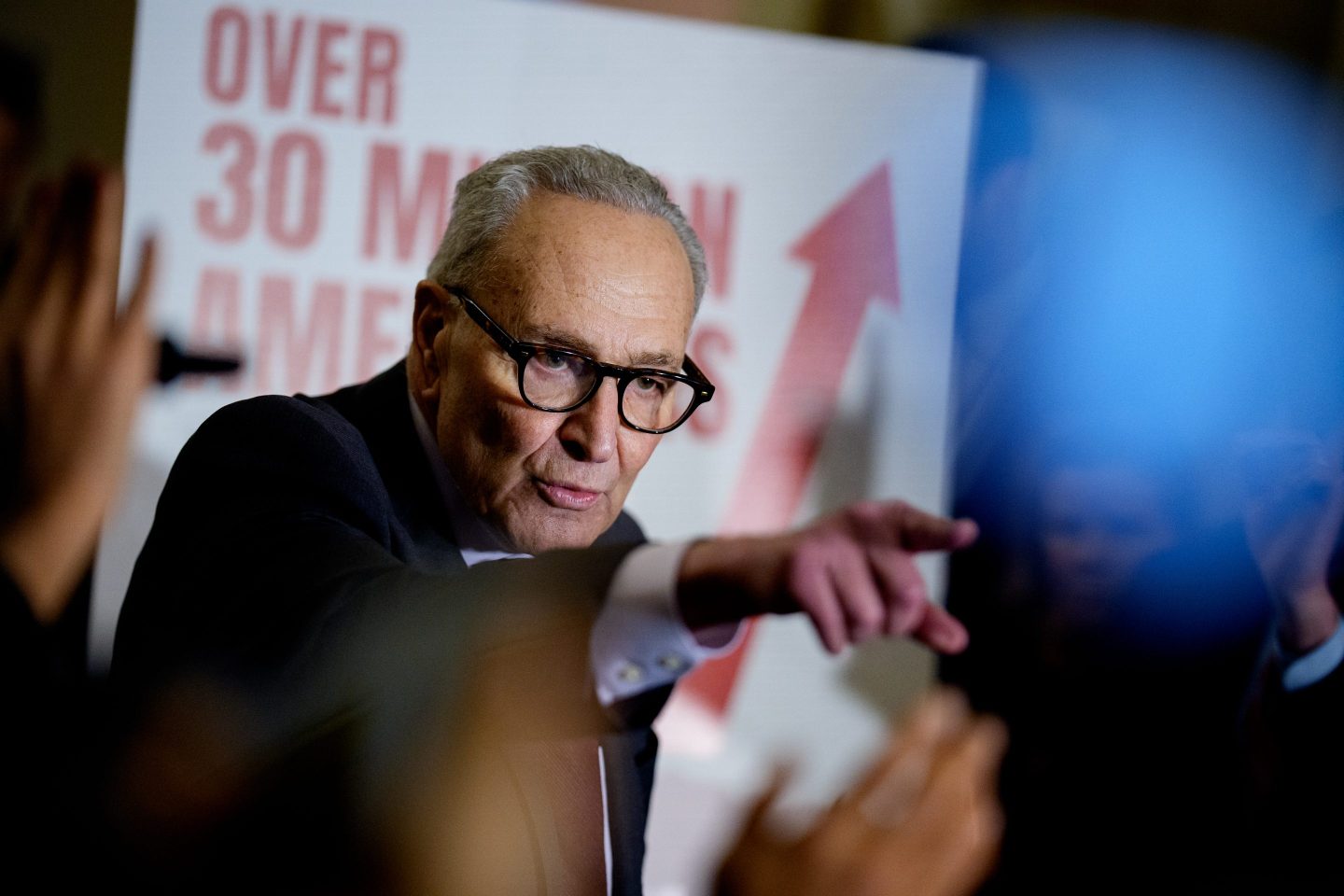
Senate Minority Leader Chuck Schumer (D-NY) takes a question from a reporter following a Democratic policy luncheon at the U.S. Capitol Building on December 2, 2025, in Washington, DC. Schumer focused his remarks on healthcare and took questions on boat strikes by the U.S. military in the Caribbean, security for elected officials, upcoming elections in the Senate and other topics. Andrew Harnik/Getty Images

The Committee for a Responsible Federal Budget (CRFB) is a nonpartisan watchdog that regularly estimates how much the U.S. Congress is adding to the $38 trillion national debt.

Recommended Video

With enhanced Affordable Care Act (ACA) subsidies due to expire within days, some Senate Democrats are scrambling to protect millions of Americans from getting the unpleasant holiday gift of spiking health insurance premiums. The CRFB says there’s just one problem with the plan: it’s not funded.

“With the national debt as large as the economy and interest payments costing $1 trillion annually, it is absurd to suggest adding hundreds of billions more to the debt,” CRFB President Maya MacGuineas wrote in a statement on Friday afternoon.

The proposal, backed by members of the Senate Democratic caucus, would fully extend the enhanced ACA subsidies for three years, from 2026 through 2028, with no additional income limits on who can qualify. Those subsidies, originally boosted during the pandemic and later renewed, were designed to lower premiums and prevent coverage losses for middle‑ and lower‑income households purchasing insurance on the ACA exchanges.

CRFB estimated that even this three‑year extension alone would add roughly $300 billion to federal deficits over the next decade, largely because the federal government would continue to shoulder a larger share of premium costs while enrollment and subsidy amounts remain elevated. If Congress ultimately moves to make the enhanced subsidies permanent—as many advocates have urged—the total cost could swell to nearly $550 billion in additional borrowing over the next decade.

Reversing recent guardrails

MacGuineas called the Senate bill “far worse than even a debt-financed extension” as it would roll back several “program integrity” measures that were enacted as part of a 2025 reconciliation law and were intended to tighten oversight of ACA subsidies. On top of that, it would be funded by borrowing even more. “This is a bad idea made worse,” MacGuineas added.

The watchdog group’s central critique is that the new Senate plan does not attempt to offset its costs through spending cuts or new revenue and, in their view, goes beyond a simple extension by expanding the underlying subsidy structure.

The legislation would permanently repeal restrictions that eliminated subsidies for certain groups enrolling during special enrollment periods and would scrap rules requiring full repayment of excess advance subsidies and stricter verification of eligibility and tax reconciliation. The bill would also nullify portions of a 2025 federal regulation that loosened limits on the actuarial value of exchange plans and altered how subsidies are calculated, effectively reshaping how generous plans can be and how federal support is determined. CRFB warned these reversals would increase costs further while weakening safeguards designed to reduce misuse and error in the subsidy system.

MacGuineas said that any subsidy extension should be paired with broader reforms to curb health spending and reduce overall borrowing. In her view, lawmakers are missing a chance to redesign ACA support in a way that lowers premiums while also improving the long‑term budget outlook.

The debate over ACA subsidies recently contributed to a government funding standoff, and CRFB argued that the new Senate bill reflects a political compromise that prioritizes short‑term relief over long‑term fiscal responsibility.

“After a pointless government shutdown over this issue, it is beyond disappointing that this is the preferred solution to such an important issue,” MacGuineas wrote.

The off-year elections cast the government shutdown and the cost-of-living arguments in a different light. Democrats made stunning gains and almost flipped a deep-red district in Tennessee as politicians from the far left and center coalesced around “affordability.”

Senate Minority Leader Chuck Schumer is reportedly smelling blood in the water and doubling down on the theme heading into the pivotal midterm elections of 2026. President Donald Trump is scheduled to visit Pennsylvania soon to discuss pocketbook anxieties. But he is repeating predecessor Joe Biden’s habit of dismissing inflation, despite widespread evidence to the contrary.

“We fixed inflation, and we fixed almost everything,” Trump said in a Tuesday cabinet meeting, in which he also dismissed affordability as a “hoax” pushed by Democrats.​

Lawmakers on both sides of the aisle now face a politically fraught choice: allow premiums to jump sharply—including in swing states like Pennsylvania where ACA enrollees face double‑digit increases—or pass an expensive subsidy extension that would, as CRFB calculates, explode the deficit without addressing underlying health‑care costs.

About the Author
Nick Lichtenberg
By Nick LichtenbergBusiness Editor
LinkedIn icon

Nick Lichtenberg is business editor and was formerly Fortune's executive editor of global news.

See full bioRight Arrow Button Icon

Latest in Politics

AIMeta
It’s ‘kind of jarring’: AI labs like Meta, Deepseek, and Xai earned some of the worst grades possible on an existential safety index
By Patrick Kulp and Tech BrewDecember 5, 2025
43 minutes ago
Schumer
Politicsnational debt
‘This is a bad idea made worse’: Senate Dems’ plan to fix Obamacare premiums adds nearly $300 billion to deficit, CRFB says
By Nick LichtenbergDecember 5, 2025
1 hour ago
Trump
PoliticsWhite House
Trump finally got his peace prize—from a soccer federation widely known for corruption
By Seung Min Kim, Nick Lichtenberg and The Associated PressDecember 5, 2025
1 hour ago
Trump
PoliticsImmigration
4 times in 7 seconds: Trump calls Somali immigrants ‘garbage’
By Laurie Kellman and The Associated PressDecember 5, 2025
2 hours ago
Robert F. Kennedy
PoliticsHealth
Robert F. Kennedy Jr. turns to AI to make America healthy again
By Ali Swenson and The Associated PressDecember 5, 2025
7 hours ago
Trump
Personal FinanceHealth Insurance
Trump wants more health savings accounts. A catch: they can’t pay insurance premiums
By Amanda Seitz and KFF Health NewsDecember 5, 2025
9 hours ago

Most Popular

placeholder alt text
Economy
Two months into the new fiscal year and the U.S. government is already spending more than $10 billion a week servicing national debt
By Eleanor PringleDecember 4, 2025
1 day ago
placeholder alt text
Success
‘Godfather of AI’ says Bill Gates and Elon Musk are right about the future of work—but he predicts mass unemployment is on its way
By Preston ForeDecember 4, 2025
1 day ago
placeholder alt text
Success
Nearly 4 million new manufacturing jobs are coming to America as boomers retire—but it's the one trade job Gen Z doesn't want
By Emma BurleighDecember 4, 2025
1 day ago
placeholder alt text
Success
Nvidia CEO Jensen Huang admits he works 7 days a week, including holidays, in a constant 'state of anxiety' out of fear of going bankrupt
By Jessica CoacciDecember 4, 2025
1 day ago
placeholder alt text
Real Estate
‘There is no Mamdani effect’: Manhattan luxury home sales surge after mayoral election, undercutting predictions of doom and escape to Florida
By Sasha RogelbergDecember 4, 2025
1 day ago
placeholder alt text
Economy
Tariffs and the $38 trillion national debt: Kevin Hassett sees ’big reductions’ in deficit while Scott Bessent sees a ‘shrinking ice cube’
By Nick LichtenbergDecember 4, 2025
1 day ago
Rankings
  • 100 Best Companies
  • Fortune 500
  • Global 500
  • Fortune 500 Europe
  • Most Powerful Women
  • Future 50
  • World’s Most Admired Companies
  • See All Rankings
Sections
  • Finance
  • Leadership
  • Success
  • Tech
  • Asia
  • Europe
  • Environment
  • Fortune Crypto
  • Health
  • Retail
  • Lifestyle
  • Politics
  • Newsletters
  • Magazine
  • Features
  • Commentary
  • Mpw
  • CEO Initiative
  • Conferences
  • Personal Finance
  • Education
Customer Support
  • Frequently Asked Questions
  • Customer Service Portal
  • Privacy Policy
  • Terms Of Use
  • Single Issues For Purchase
  • International Print
Commercial Services
  • Advertising
  • Fortune Brand Studio
  • Fortune Analytics
  • Fortune Conferences
  • Business Development
About Us
  • About Us
  • Editorial Calendar
  • Press Center
  • Work At Fortune
  • Diversity And Inclusion
  • Terms And Conditions
  • Site Map

© 2025 Fortune Media IP Limited. All Rights Reserved. Use of this site constitutes acceptance of our Terms of Use and Privacy Policy | CA Notice at Collection and Privacy Notice | Do Not Sell/Share My Personal Information
FORTUNE is a trademark of Fortune Media IP Limited, registered in the U.S. and other countries. FORTUNE may receive compensation for some links to products and services on this website. Offers may be subject to change without notice.