
Billionaire Michael Saylor has been in tight spots before but nothing like this. The share price of Saylor’s firm, Strategy, which owns over 3% of the world’s Bitcoin, is down dramatically. Worse, the company faces twin headwinds in the form of a bearish crypto market and an impending rule change that will likely trigger a mass selloff of its stock. On Monday, the company announced a $1.2 billion reserve fund to meet impending interest and dividend obligations, but that did little to prop up its shares. All of this fueled fresh attacks from Saylor’s critics who say Strategy’s unusual business model, which revolves around selling stock to buy Bitcoin, is unsustainable or even a Ponzi scheme.
Saylor has ridden out storms in the past. That includes an accounting scandal in 2000 that almost sank one of his previous companies and saw him lose $6 billion of his personal fortune in a day. Saylor’s defenders, meanwhile, dismiss critics as knee-jerk Bitcoin detractors who don’t understand the currency or the corporate finance techniques underlying Strategy’s operations.
Saylor may escape from this bind, as he has in the past, but this time the stakes are higher. In recent years, Strategy’s purchases have helped fuel crypto’s record rise, and turned Saylor into Bitcoin’s leading evangelist. This means any move by Strategy to dump part of its holdings—something its CEO hinted last week could happen—would not only depress prices, but could spark a crisis of confidence and a broader selloff. Meanwhile, a further plunge in Strategy’s share price could not only threaten its future viability, but spur the collapse of dozens of other firms that have copied its business model. The coming months are likely to demonstrate once and for all whether Saylor is a pioneer in crypto finance, as his backers claim, or just another high-stakes gambler whose luck has run out.
A looming $8 billion selloff
The crypto industry likes to hail October as “Uptober,” but this year failed to deliver the customary double-digit price boost. Instead, the month brought one of the biggest wipeouts in the industry’s history, and for Strategy, the month brought an extra helping of bad news when, on Oct. 10, financial giant MSCI proposed a new rule that would exclude it from a series of popular indexes.
This delisting process, which looks set to go into effect in February, would oblige fund managers around the world to shed their holdings of Strategy, and other firms whose assets consist of 50% or more of crypto. In November, JPMorgan warned the rule change could see funds dump $2.3 billion worth of Strategy shares, and that the selloff could climb to over $8 billion if other index compilers followed MSCI’s example.
The market’s growing awareness about MSCI’s plans has already triggered a selloff. Shares of MSTR (the MSTR ticker sign reflects Strategy’s previous name, Microstrategy) are down around 50% since Oct. 1. This has led a key metric known as mNAV, which reflects the value of a crypto company’s shares as a ratio of its Bitcoin holdings, to drop below one on several recent occasions. For a company whose mNAV a year ago reached around 2.45, the current figure underscores how the longtime premium that Strategy shares held over Bitcoin has evaporated.
In response to such a spate of bad news, most CEOs would have issued a series of muted statements asking for patience. But Saylor is not an ordinary CEO and has instead responded by cranking up the number of memes he posts on social media. The memes extol Bitcoin and depict Saylor in AI-generated action hero poses—leading his many acolytes to retweet the memes or post their own version of them.
These meme tactics have served Saylor well in the past, turning Strategy into a momentum play during bull markets. More recently, though, the gimmick has failed to stanch the stock’s downturn, and last month, Saylor posted a rare social media misfire. Seeking to rebut a rumor the company was selling its Bitcoin, Saylor shared an image of himself riding a life preserver in storm-tossed seas as a flaming ocean liner sank behind him. Critics, including Saylor fans, pointed out the meme implied Strategy’s captain was saving himself at a time of trouble rather than going down with his ship.
HODL pic.twitter.com/sQysm4i88t
— Michael Saylor (@saylor) November 14, 2025
Regardless of Saylor’s intent, the minor controversy raises questions about whether Strategy will resort to selling its Bitcoin holdings—a move the company has portrayed as unthinkable but, in recent weeks, appears set to accept.
Selling stock to buy Bitcoin
In late November, Strategy acquired 130 Bitcoin, bringing its total hoard to an even 650,000, which is worth around $58.5 billion at early December prices. For context, that amounts to around 3.1% of Bitcoin’s total supply of 21 million (95% of which has been mined), and makes Strategy the biggest holder of the currency save for its creator, Satoshi Nakamoto, whose 1.1 million coins are believed to be gone forever.
According to Saylor, the company has paid an average price of $74,436 per Bitcoin, spending a total of around $48.4 billion, including fees and expenses. In order to pull this off, Strategy has needed a source of capital, and given that Bitcoin does not produce any yield, the company’s go-to technique has been to sell common shares to fund its purchases.
A big upside to this approach is that, unlike debt, common shares do not create any financial obligations for the company. That’s not the case, though, with preferred shares—and Strategy has issued plenty of these as well, which obliges it to pay regular dividends to shareholders. These obligations include payments of roughly $200 million that are due by Dec. 31, the bulk of which are owed in the form of dividends (Strategy, like most companies, also carries some debt).
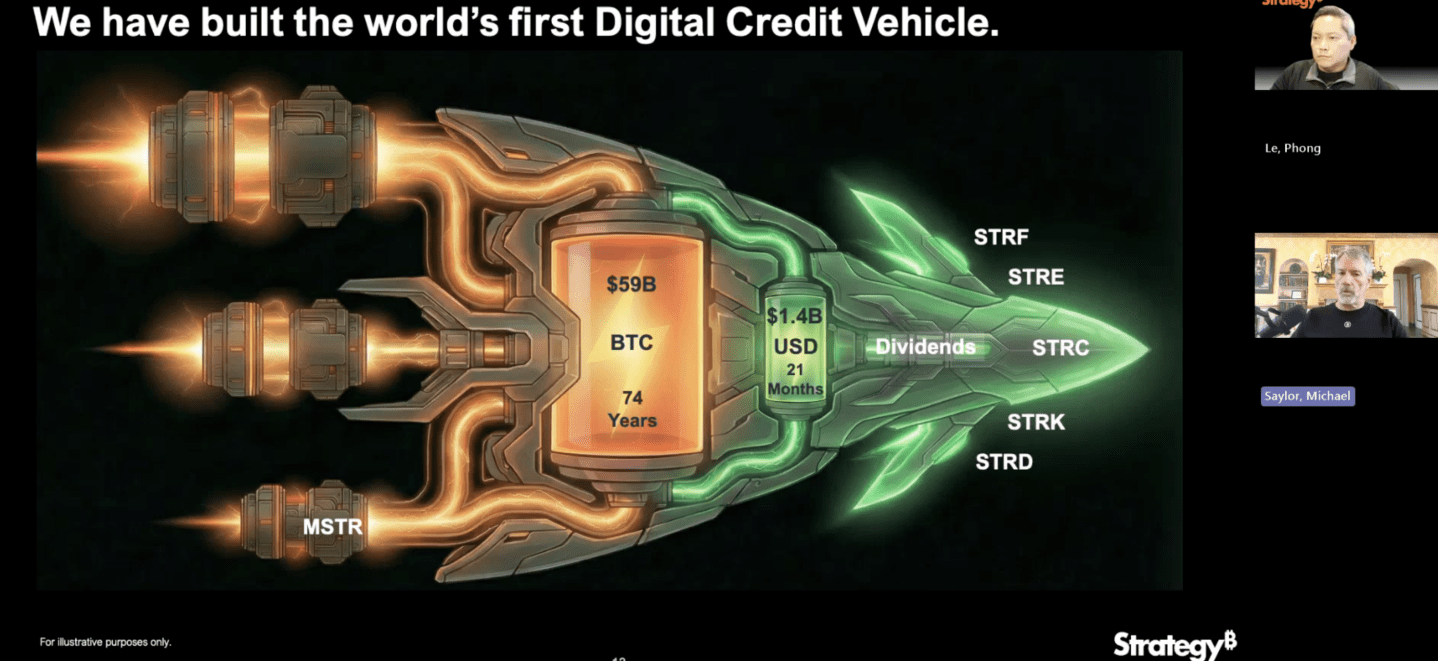
In order to project a sense of financial stability, Strategy took the unusual step in early December of creating a so-called dollar reserve of $1.4 billion that Saylor says will be enough to cover the next 21 months of dividend obligations.
Saylor announced the reserve fund at a Dec. 1 investor presentation where he added, with his usual bravado: “It’s our intention to keep stacking Bitcoin.” In the near future, though, that goal is likely to be aspirational and Strategy may instead find itself selling Bitcoin instead.
“We can sell Bitcoin and we would sell Bitcoin if we needed to fund our dividend payments below 1x mNAV,” Strategy CEO Phong Le said on a podcast last Friday. It was a remarkable statement from a company that is premised on the value of Bitcoin always increasing. More remarkable was when Saylor, who frequently exhorts the popular hold-on-to-your-Bitcoin phrase “HODL,” repeated on Monday that Strategy could sell some Bitcoin.
On Tuesday, Strategy CFO Andrew Kang qualified the statement by saying the company planned to sell Bitcoin as a last resort and only if mNAV stays below one for a “very extended period.”
Whatever the specifics, Strategy’s acknowledgment it could sell Bitcoin combined with the new dollar reserve fund has sparked a new wave of vitriol from Strategy critics. Those include Peter Schiff, an advocate for the gold industry and longtime crypto critic, who claims the company is coming undone, and that Saylor is the “biggest con man” on Wall Street.
Today is the beginning of the end of $MSTR. Saylor was forced to sell stock not to buy Bitcoin, but to buy U.S. dollars merely to fund MSTR's interest and dividend obligations. The stock is broken. The business model is a fraud, and @Saylor is the biggest con man on Wall Street.
— Peter Schiff (@PeterSchiff) December 1, 2025
If Schiff’s view—hardly a consensus one—is correct and Strategy has to liquidate, then the broader crypto market could be hit hard since the selloff would almost certainly trigger a downward price spiral for Bitcoin. Even if Strategy has to sell only a portion of its holdings, it could trigger a contagion in which hundreds of other so-called digital asset treasuries (DATs) do the same.
But even as skeptics label Strategy and the DAT model as a house of cards built on financial chicanery, others view them as early leaders in an emerging category of crypto banks.
‘All the bad news is out there’
Whatever one thinks of Saylor, there is no denying he is a natural showman. In his Dec. 1 presentation announcing the new U.S. dollar reserve, he displayed a futuristic-looking spaceship in garish green and orange with a Bitcoin powered reactor at its core. “Think of [the dollar reserve] as a $USD battery. We’re basically using a nuclear reactor to spin a generator to charge a battery,” explained Saylor.
For Saylor’s detractors, all of this smacks of the worst type of hucksterism. Others see a visionary who is using compelling metaphors and imagery to help the public understand a complex new financial mechanism.
The latter include Sebastian Bea, a former longtime BlackRock executive and Olympic rower, who is now president of a digital asset treasury called ReserveOne. According to Bea, Saylor is pursuing a sophisticated long-term strategy, and has surrounded himself with a team of corporate finance experts, including board member Peter Briger, who has had a distinguished career at Goldman Sachs and Fortress Investment Group.
In this context, Saylor’s plans to purchase a growing supply of Bitcoin by tapping into capital markets for equity, commodities, and derivatives makes sense. As he and Strategy’s CFO explained this week, that plan includes bringing in revenue by lending Bitcoin and selling covered call options.
For all of this to work, though, the value of Bitcoin will have to keep appreciating. This notion strikes crypto skeptics as absurd, but crypto advocates point out correctly that Bitcoin has grown faster than nearly any other asset over the past decade, and is poised for longer-term gains as large entities ranging from sovereign wealth funds to university endowments add it to their portfolios. In the latest bullish signal, Vanguard—which has refused to add crypto to its portfolio for years—elected to add Bitcoin and other crypto ETFs this week.
If Bitcoin does keep appreciating, Strategy will be able to keep obtaining credit against the surplus value in the same way a company can do with real estate in a desirable market. There will of course be downturns but, according to Bea, Strategy “has planned for this” and has a healthy overall asset to debt ratio.
Bea adds that the recent wave of digital asset treasury companies are akin to a new type of bank, and that their model is evolving rapidly. He points out that some, including ReserveOne, are based around cryptocurrencies like Ethereum that do provide yield unlike Bitcoin, which provides additional breathing room on the corporate finance front. Bea acknowledged that the impending move by MSCI to exclude DATs from indexes could be a significant headwind, and said that companies based around crypto holdings need time to evolve.
Cosmo Jiang, a partner at the crypto-focused venture capital firm Pantera, likewise believes that digital asset treasuries—including a Solana-focused company he is backing—will become a permanent feature of the financial landscape.
“We’re seeing the genesis of a whole new category of business,” Jiang told Fortune, adding that DATs are poised to earn significant revenue from the fast-growing world of decentralized finance.
In separate remarks to Bloomberg, Jiang made the case that the sector is currently at a low point, but that the current malaise around Strategy and similar firms is temporary. “We’re at the point where all the bad news is out there, and the bears are the loudest voices in the room.”
Jiang noted, however, that many in the recent wave of crypto-hoarding companies are unlikely to survive, and that the business model required not just a stash of tokens, but deep experience in capital markets and corporate finance.
“There will be two or three large winners” for each major cryptocurrency, he predicted. If this is the case, the coming months will likely determine whether one of those is Strategy.