• Home
  • Latest
  • Fortune 500
  • Finance
  • Tech
  • Leadership
  • Lifestyle
  • Rankings
  • Multimedia

Trendingnow

1

After forcing workers back to the office, Goldman Sachs and JPMorgan Chase are now letting their staff work remotely—but only for the World Cup

2

The Pentagon said Iran War costs $29 billion, but the real cost is closer to $200 billion—and counting

3

Markets tumble worldwide as Fed resets expectations: $400 billion wiped off SpaceX stock

1

After forcing workers back to the office, Goldman Sachs and JPMorgan Chase are now letting their staff work remotely—but only for the World Cup

2

The Pentagon said Iran War costs $29 billion, but the real cost is closer to $200 billion—and counting

3

Markets tumble worldwide as Fed resets expectations: $400 billion wiped off SpaceX stock
Politicshistory

Is American history reminding you of dark, tumultuous periods from the past? Consider the Gilded Age of the late 19th century

By
Robert A. Strong
Robert A. Strong
and
The Conversation
The Conversation
Down Arrow Button Icon
By
Robert A. Strong
Robert A. Strong
and
The Conversation
The Conversation
Down Arrow Button Icon
November 10, 2025, 11:19 AM ET
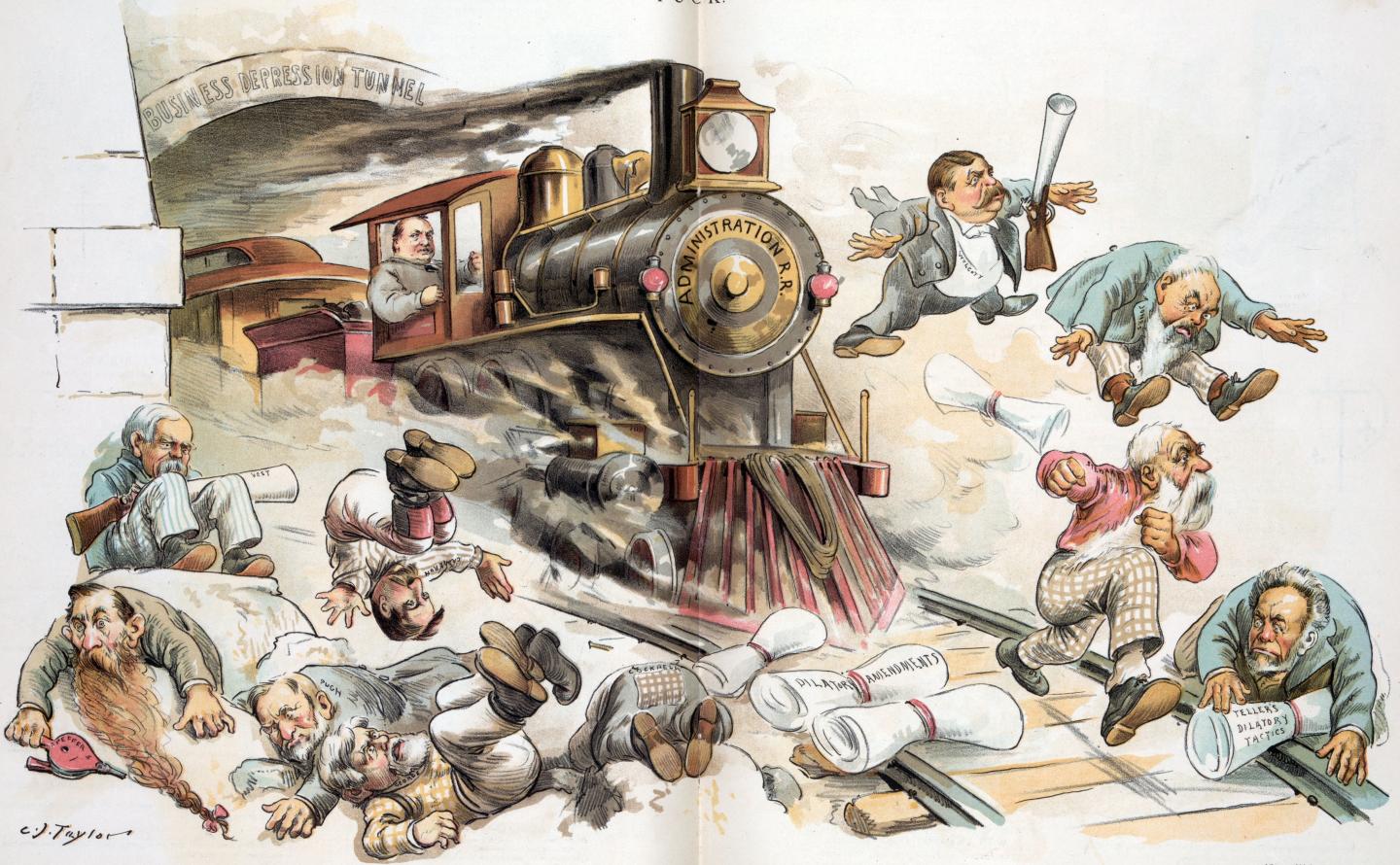
An 1893 political cartoon by Charles Jay Taylor showing President Grover Cleveland as a railroad engineer driving a locomotive labelled "Administration R.R." that is roaring out of a tunnel labelled "Business Depression Tunnel."
An 1893 political cartoon by Charles Jay Taylor showing President Grover Cleveland as a railroad engineer driving a locomotive labelled "Administration R.R." that is roaring out of a tunnel labelled "Business Depression Tunnel."Universal History Archive/Universal Images Group via Getty Images
Add Fortune on Google for similar content.

People trying to understand politics in the United States today often turn to history for precedents and perspective. Are our current divisions like the ones that preceded the American Revolution or the Civil War? Did the dramatic events of the 1960s generate the same kind of social and political forces seen today? Are there lessons from the past that show us how eras of intense political turmoil eventually subside?

Recommended Video

As a scholar of American politics and the presidency, I believe one American historical period is especially worth revisiting in this turbulent moment in the U.S.: the 20 tumultuous years between the presidencies of Ulysses S. Grant and William McKinley in the second half of the 19th century.

The two decades between 1876 and 1896 are usually remembered as a time when the cities in the East grew rich and the West was wild – a “Gilded Age” in New York City and gunslingers on the frontier.

It was also a time when Americans struggled with immigration issues, racial injustice, tariff levels, technological change, economic volatility and political violence.

There was even a president, Grover Cleveland, who served two nonconsecutive terms in the White House – the only time that happened before Donald Trump.

In the elections between Grant and McKinley, the nation was closely divided. No president in those years – not Rutherford Hayes, James Garfield, Chester Arthur, Cleveland or Benjamin Harrison – served for two consecutive terms. No presidential candidate won more than 50% of the popular vote, except the Democrat Samuel Tilden. And Tilden, after winning 50.1% of the ballots cast in 1876, lost in the Electoral College. That happened again in 1888 when Cleveland, the first time he was seeking a second term, won the popular vote but failed in the Electoral College.

The narrow victories that characterized presidential politics in the 1870s and 1880s were matched by constant shifts on Capitol Hill. In the 20 years between Grant and McKinley, there were only six years of unified government, when one political party controlled the White House, the Senate and the House of Representatives. In the remaining 14 years, presidents encountered opposition in Congress.

The U.S. has the same kind of divided politics today.

Heating up partisanship and raising stakes

President Bill Clinton had two years of unified government; President George W. Bush had less than that. Barack Obama, Donald Trump in his first term and Joe Biden all came into office with party majorities in the House and Senate, and then, like Clinton, their parties lost the House two years later.

Divided politics, with close elections and neither party in power for very long, make partisanship more intense, campaigns harder fought and the stakes sky high whenever voters go to the polls. That’s part of what produced instability in the second half of the 19th century and part of what produces it today.

Divided government is, of course, one of the most powerful “checks” in the constitutional system of checks and balances. Intense competition between political parties can prevent the national government from making rash decisions and serious mistakes. It can sometimes generate compromise.

But there’s a cost. Political division can also allow critical problems to fester for far too long. The dramatic changes brought on by the Industrial Revolution after the Civil War were not seriously addressed in federal legislation until the Progressive Era early in the 20th century.

In the second half of the 19th century, Congress raised or lowered tariffs – depending on which party controlled the White House and Capitol Hill. The nation debated immigration but only once passed meaningful legislation, the Chinese Exclusion Act of 1882. A long list of issues connected to railroads, banks, currency, civil service, corruption and the implementation of the post-Civil War constitutional amendments were ignored or only partially addressed.

When major legislation was passed in 1883 to create a merit-based civil service – reforming the spoils system of political appointments – it passed because Garfield’s 1881 assassination by a disgruntled federal job seeker temporarily pushed the issue to the top of the national agenda.

Immigration, fake news and riots

Political violence accompanied the period of closely divided national elections in the 1870s and 1880s.

In the 1880 presidential campaign, both candidates – the Republican, Garfield, and the Democrat, Winfield Hancock – called for restrictions on Chinese immigration to the United States. Neither supported the complete ban that many Westerners wanted.

But just before Americans went to the polls, newspapers across the country printed a letter, allegedly written and signed by Garfield, that endorsed an open border to Chinese immigrants. Before anyone could learn that the letter was a fake, there was public uproar. In Denver, an angry mob burned down all the homes in Chinese neighborhoods.

There were more incidents of political violence: anti-Chinese riots in Los Angeles in 1871, in San Francisco in 1877 and in Seattle in 1886.

Throughout the 1880s, anti-immigrant nativists targeted immigrants from Italy and sometimes vandalized Catholic churches.

Political violence in the South successfully suppressed Black voting rights and reestablished white control of state and local politics.

A scene of mourners at the deathbed of President James Garfield.
Political violence accompanied the period of closely divided national elections in the 1870s and 1880s, including the assassination of President James Garfield in 1881. Glasshouse Vintage/Universal History Archive/Universal Images Group via Getty Images

Realignment

Political division in the second half of the 19th century produced more problems than solutions. How and when did it end, or become less intense?

The simple answer is what political scientists call a “realignment,” a major shift in national electoral patterns.

In 1893, the first year of Cleveland’s second term, the nation suffered a financial crisis followed by a severe economic depression. As a result, McKinley was able to win solid victories in 1896 and 1900 and build a Republican coalition that dominated presidential politics until the election in 1932 of Democrat Franklin Roosevelt.

It’s not hard to imagine how an economic disaster, or a crisis of some kind, could shake the country out of a period of closely divided politics. But that’s a painful way of building a higher level of national unity.

Can it happen when large numbers of voters get thoroughly frustrated by languishing issues, swings back and forth in Washington, nasty elections and rising political violence?

Perhaps.

But either way – responding to crisis or finding a public change of heart – is a reminder that voters are the ultimate arbiters in a functioning democracy. Today, as in late-19th-century America, elections make a difference. They can mark continued division or they can take the nation in a new, and perhaps more unified, direction.

Robert A. Strong, Senior Fellow, Miller Center, University of Virginia

This article is republished from The Conversation under a Creative Commons license. Read the original article.

The Conversation

Subscribe to Fortune Gulf Brief. Every Tuesday, this new newsletter delivers clear-eyed, authoritative intelligence on the deals, decisions, policies, and power shifts shaping one of the world’s most consequential regions, written for the people who need to act on it. Sign up here.
About the Authors
By Robert A. Strong
See full bioRight Arrow Button Icon
By The Conversation
See full bioRight Arrow Button Icon
Add Fortune on Google for similar content.

Latest in Politics

Finance
Lorem ipsum dolor sit amet, consectetur adipiscing elit, sed do eiusmod tempor incididunt ut labore et dolore magna aliqua. Ut enim ad minim veniam
By Fortune Editors
October 20, 2025
Finance
Lorem ipsum dolor sit amet, consectetur adipiscing elit, sed do eiusmod tempor incididunt ut labore et dolore magna aliqua. Ut enim ad minim veniam
By Fortune Editors
October 20, 2025
Finance
Lorem ipsum dolor sit amet, consectetur adipiscing elit, sed do eiusmod tempor incididunt ut labore et dolore magna aliqua. Ut enim ad minim veniam
By Fortune Editors
October 20, 2025
Finance
Lorem ipsum dolor sit amet, consectetur adipiscing elit, sed do eiusmod tempor incididunt ut labore et dolore magna aliqua. Ut enim ad minim veniam
By Fortune Editors
October 20, 2025
Finance
Lorem ipsum dolor sit amet, consectetur adipiscing elit, sed do eiusmod tempor incididunt ut labore et dolore magna aliqua. Ut enim ad minim veniam
By Fortune Editors
October 20, 2025
Finance
Lorem ipsum dolor sit amet, consectetur adipiscing elit, sed do eiusmod tempor incididunt ut labore et dolore magna aliqua. Ut enim ad minim veniam
By Fortune Editors
October 20, 2025

Most Popular

Finance
Lorem ipsum dolor sit amet, consectetur adipiscing elit, sed do eiusmod tempor incididunt ut labore et dolore magna aliqua. Ut enim ad minim veniam
By Fortune Editors
October 20, 2025
Finance
Lorem ipsum dolor sit amet, consectetur adipiscing elit, sed do eiusmod tempor incididunt ut labore et dolore magna aliqua. Ut enim ad minim veniam
By Fortune Editors
October 20, 2025
Finance
Lorem ipsum dolor sit amet, consectetur adipiscing elit, sed do eiusmod tempor incididunt ut labore et dolore magna aliqua. Ut enim ad minim veniam
By Fortune Editors
October 20, 2025
Finance
Lorem ipsum dolor sit amet, consectetur adipiscing elit, sed do eiusmod tempor incididunt ut labore et dolore magna aliqua. Ut enim ad minim veniam
By Fortune Editors
October 20, 2025
Finance
Lorem ipsum dolor sit amet, consectetur adipiscing elit, sed do eiusmod tempor incididunt ut labore et dolore magna aliqua. Ut enim ad minim veniam
By Fortune Editors
October 20, 2025
Finance
Lorem ipsum dolor sit amet, consectetur adipiscing elit, sed do eiusmod tempor incididunt ut labore et dolore magna aliqua. Ut enim ad minim veniam
By Fortune Editors
October 20, 2025
Fortune Secondary Logo
Rankings
  • 100 Best Companies
  • Fortune 500
  • Global 500
  • Fortune 500 Europe
  • Most Powerful Women
  • World's Most Admired Companies
  • See All Rankings
  • Lists Calendar
Sections
  • Finance
  • Fortune Crypto
  • Features
  • Leadership
  • Health
  • Commentary
  • Success
  • Retail
  • Mpw
  • Tech
  • Lifestyle
  • CEO Initiative
  • Asia
  • Politics
  • Conferences
  • Europe
  • Newsletters
  • Personal Finance
  • Environment
  • Magazine
  • Education
Customer Support
  • Frequently Asked Questions
  • Customer Service Portal
  • Privacy Policy
  • Terms Of Use
  • Single Issues For Purchase
  • International Print
Commercial Services
  • Advertising
  • Fortune Brand Studio
  • Fortune Analytics
  • Fortune Conferences
  • Business Development
  • Group Subscriptions
About Us
  • About Us
  • Press Center
  • Work At Fortune
  • Terms And Conditions
  • Site Map
  • About Us
  • Press Center
  • Work At Fortune
  • Terms And Conditions
  • Site Map
  • Facebook icon
  • Twitter icon
  • LinkedIn icon
  • Instagram icon
  • Pinterest icon

Latest in Politics

Trump cancels signing a housing bill and blindsides his own party in a social media post
PoliticsDonald Trump
Trump cancels signing a housing bill and blindsides his own party in a social media post
By The Associated Press, Mary Clare Jalonick, Kevin Freking, Josh Boak and Lisa MascaroJune 24, 2026
1 hour ago
t
PoliticsDonald Trump
Trumps holds landmark affordable housing bill hostage over his pet issue: the ‘national emergency’ of voter ID
By Mary Clare Jalonick and The Associated PressJune 24, 2026
1 hour ago
Jack Schlossberg built a sardonic social media campaign filled just to barely break 10% in Tuesday’s primary
PoliticsPolitics
Jack Schlossberg built a sardonic social media campaign filled just to barely break 10% in Tuesday’s primary
By The Associated Press, Danny Peltz and Anthony IzaguirreJune 24, 2026
1 hour ago
NYC Mayor Zohran Mamdani 3 for 3 on his ‘better Democrats’ endorsements: ‘Put working people back at the heart of politics’
PoliticsNew York City
NYC Mayor Zohran Mamdani 3 for 3 on his ‘better Democrats’ endorsements: ‘Put working people back at the heart of politics’
By The Associated Press, Jesse Bedayn, Thomas Beaumont and HUMERA LODHIJune 24, 2026
2 hours ago
s
BankingScott Bessent
Scott Bessent calls Mamdani ‘leader of the Democratic Party,’ touts weekly Warsh breakfasts and a new push to put every American in the stock market
By Nick LichtenbergJune 24, 2026
2 hours ago
White House blames ‘leftist activists’ for Reflecting Pool snafus as crews put up fencing to block off the algae- and peeling paint-filled water
LawWhite House
White House blames ‘leftist activists’ for Reflecting Pool snafus as crews put up fencing to block off the algae- and peeling paint-filled water
By Matthew Daly and The Associated PressJune 24, 2026
2 hours ago

Most Popular

After forcing workers back to the office, Goldman Sachs and JPMorgan Chase are now letting their staff work remotely—but only for the World Cup
Success
After forcing workers back to the office, Goldman Sachs and JPMorgan Chase are now letting their staff work remotely—but only for the World Cup
By Orianna Rosa RoyleJune 23, 2026
1 day ago
The Pentagon said Iran War costs $29 billion, but the real cost is closer to $200 billion—and counting
Economy
The Pentagon said Iran War costs $29 billion, but the real cost is closer to $200 billion—and counting
By Jacqueline MunisJune 24, 2026
10 hours ago
Markets tumble worldwide as Fed resets expectations: $400 billion wiped off SpaceX stock
Banking
Markets tumble worldwide as Fed resets expectations: $400 billion wiped off SpaceX stock
By Jim EdwardsJune 23, 2026
1 day ago
Current price of oil as of June 23, 2026
Personal Finance
Current price of oil as of June 23, 2026
By Joseph HostetlerJune 23, 2026
1 day ago
Current price of gold as of June 23, 2026
Personal Finance
Current price of gold as of June 23, 2026
By Danny BakstJune 23, 2026
1 day ago
Texas and Charlotte used to build huge McMansions—now they're copying the California design tricks they once mocked
Real Estate
Texas and Charlotte used to build huge McMansions—now they're copying the California design tricks they once mocked
By Sydney LakeJune 22, 2026
2 days ago

© 2026 Fortune Media IP Limited. All Rights Reserved. Use of this site constitutes acceptance of our Terms of Use and Privacy Policy | CA Notice at Collection and Privacy Notice | Do Not Sell/Share My Personal Information
FORTUNE is a trademark of Fortune Media IP Limited, registered in the U.S. and other countries. FORTUNE may receive compensation for some links to products and services on this website. Offers may be subject to change without notice.