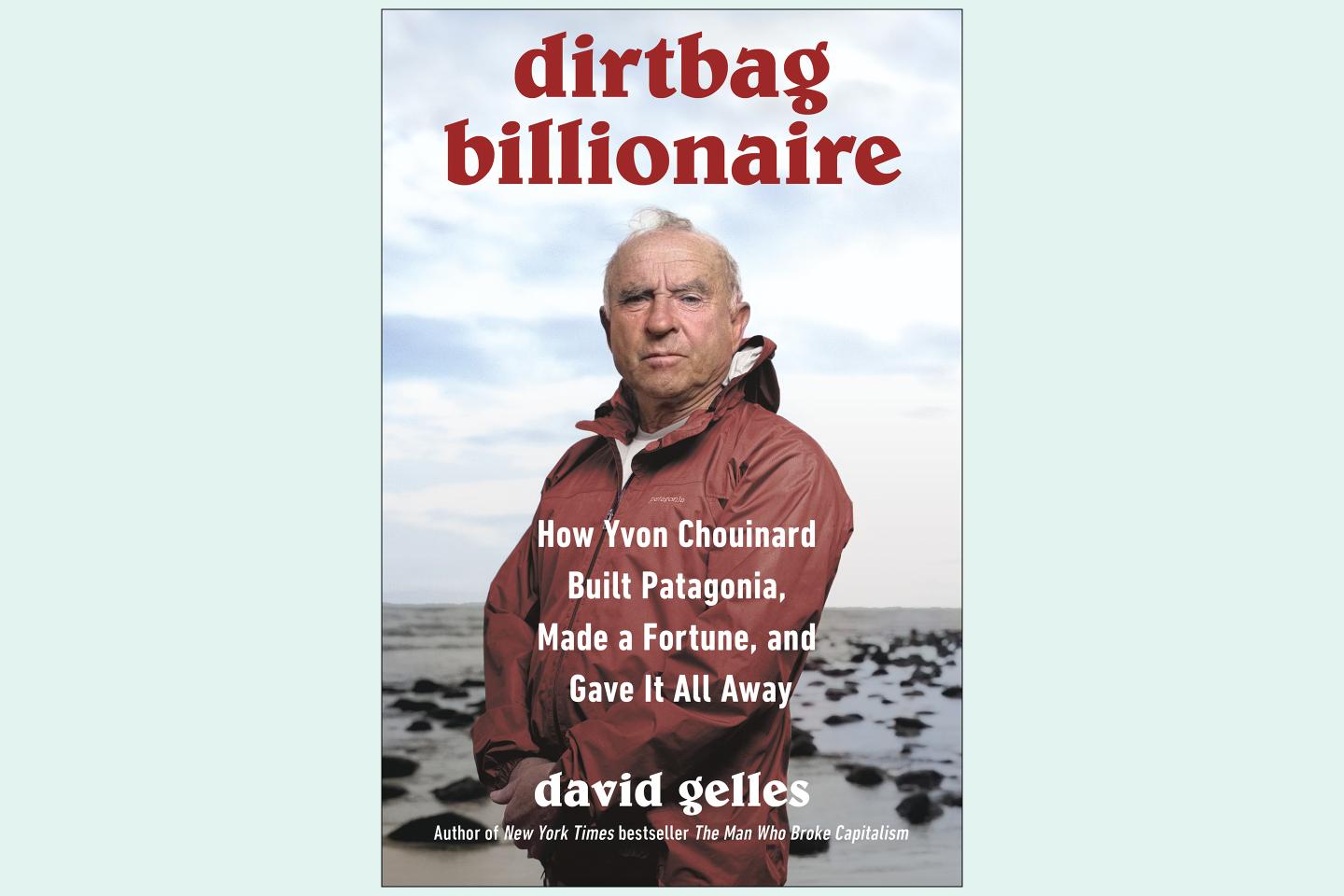
Excerpted from Dirtbag Billionaire: How Yvon Chouinard Built Patagonia, Made a Fortune, and Gave It All Away by David Gelles. Copyright © 2025 by David Gelles. Reprinted by permission of Simon & Schuster, Inc.
In 2017, for the first time, Forbes magazine placed Patagonia founder Yvon Chouinard on its annual list of billionaires. For most businessmen, inclusion in the prestigious ranking of the world’s wealthiest people would have been a badge of honor. For Chouinard, it was a nightmare come true. The perennial outsider who grew up loathing what he called “greaseball” businessmen was now enshrined as one of the biggest moguls of them all.
“It really, really pissed me off,” he said upon learning of the ranking. “I don’t have $1 billion in the bank. You know, I don’t drive Lexuses.” All day, Chouinard tromped around the office, demanding something be done to rectify the situation. “Get me off that list!” he told anyone who would listen. “I hate that list!”
Chouinard had maintained a fraught relationship with financial success his entire career. He grew up as a vagabond climber, often sleeping in the dirt and surviving on $1 a day. As Patagonia grew, he had more money at his disposal, but eschewed materialism. Even as he became wealthy, he continued living in a log cabin cluttered with second-hand furniture. And while he had plenty of cash at his disposal, he gave much of it away to environmental activists. Now, in the twilight of his career, he vowed to rid himself of his fortune once and for all.
In 2020, he turned to his inner circle and put forward an ultimatum: either they figured out how to get him off the list, or he would do it himself. For several months, nothing happened. Then, in February 2021, Chouinard summoned Patagonia CEO Ryan Gellert to his home in Ventura and threatened to sell the company. “I swear to God, if you guys don’t start moving on this, I’m going to go get the Forbes magazine list of billionaires and start cold-calling people,” he said. Gellert was still new to the job, but he quickly understood his boss was serious.
As Chouinard pondered possible options that would relieve him of the burden of owning a multibillion-dollar company, he turned to Charles Conn, a successful entrepreneur and executive who served on Patagonia’s board. Conn and Chouinard had met 20 years earlier on a fishing trip. When they arrived at their campsite, it was pouring rain, and Chouinard was preparing to curl up and sleep under a truck. Conn invited him to share his tent, and they had been friends ever since.
A few years after that, while standing hip-deep in an Argentinian river, casting flies, Conn asked Chouinard what would happen to Patagonia when he died. “Well,” Chouinard said, “we’re going to have to shut the company down, because I don’t trust anyone else to run the company.”
In search of more palatable alternatives, Gellert and Conn brought in Patagonia’s general counsel, Hilary Dessouky, and her deputy, Greg Curtis. Together, it would be up to this group to help Chouinard figure out what to do with his company.
Preserving Patagonia and taking away the Chouinards’ wealth
From the start, it became clear that there were no obvious solutions to a problem like this.
Patagonia had survived for 50 years. It deserved the chance to make it for another 50 years. But simultaneously preserving Patagonia’s independence and ridding the Chouinard and his family of their wealth would necessitate a creative approach to the handling of the company’s equity. While Chouinard, his wife and their two children owned all the shares in the company—worth some $3 billion—they didn’t want to keep that stock and didn’t want anyone else to have it, either. This made a conventional sale of the company all but impossible.
Also, whatever would happen needed to happen soon. Chouinard was as vigorous as an octogenarian could be, but he didn’t want to die with the situation unresolved.
Chouinard had long ago given up on the idea of taking Patagonia public. An initial public offering—which lets institutional investors and individuals acquire shares in a company—would have created a series of entanglements that permanently handicapped Patagonia’s ability to live up to its values. Investors would have been expecting endless growth, executives would have been thinking about quarterly profits, and activist hedge funds would have surely pounced. “I don’t respect the stock market at all,” Chouinard said. “Once you’re public, you’ve lost control over the company, and you have to maximize profits for the shareholder. You lose all control, and then you become one of these irresponsible companies.”
In search of an acceptable solution, management meetings on the succession planning veered into the philosophical as the team debated existential questions:
“How and when do we know if the Patagonia experiment has succeeded or failed?” read the minutes of one meeting.
“If the company can’t succeed without the Chouinards, isn’t that a failure?”
“How do we stop or reverse the negative effects of business and even affect change in capitalism in order to save our whole planet?”
Conn said it was like being in therapy. “It sounds ridiculous,” he said. “But it was like Gestalt sessions every week or every other week for more than two years.”
The family had a trip planned for August of 2021. Worried they all might die together in an accident and leave the company directionless, they asked for some kind of plan before they left. But when the Chouinards came back from their trip, the team concluded that the initial plan they had devised still wasn’t acceptable.
Exploring how to give it away
At this point, Conn thought to bring in a new set of eyes.
Dan Mosley has spent his career as a kind of fixer for the very rich. Early in his career, as a partner at Cravath, Swaine & Moore, one of the most prestigious corporate law firms in New York, he fixed problems for multinational corporations: litigation, mergers and acquisitions, patent disputes. There wasn’t much he couldn’t sort out on behalf of his clients. After 30 years at Cravath, Mosley moved to BDT, a financial advisory firm founded by Byron Trott, who is best known as Warren Buffett’s banker, and was now focused on helping wealthy people manage their estates.
The Wall Street veteran was astonished by the Chouinards’ sincere desire to part with their fortune. “It’s hard to find a family that owned and controlled a phenomenal company like this that are willing just to give it away entirely during their lifetime,” he said.
Mosley quickly homed in on an option that the Patagonia team had not considered, and suggested investigating the use of a purpose trust, a noncharitable entity that is established and operates for the benefit of a special purpose, rather than a specific individual. Purpose trusts have been around for decades as part of the arcane laws governing how estates are managed. But for the most part, they had been used for relatively small tasks—caring for a pet after its owner died, or funding the management of a piece of property, or a cemetery plot.
What if they used a purpose trust to enshrine the values of Patagonia itself? What if that was the linchpin that made possible an entirely new form of corporate succession planning? Using the trust as the cornerstone, they devised a new structure that would rid the family of their equity, preserve Patagonia as an independent company, and ensure that all of its future profits went toward funding conservation and environmental activism through a new organization called the Holdfast Collective.
In December of 2021, Patagonia’s inner circle gathered in person for the first time in more than a year, the pandemic having forced even the closest of friends to go remote. Now, they had reunited in order to give the company away. Questions were fielded, concerns aired, and one by one, the reservations fell away. When it came time to secure the final blessing from everyone in attendance, the consent was unanimous.
“Yeah, this feels good. This feels right.”
“I like everything that you said.”
“This is exactly what we were looking for.”
“Let’s do it.”
A question more than 50 years in the making finally had its answer. “That was a day where it actually seemed like the stars aligned and you could see the solution starting to line up,” Gellert said. “We still had a million and one things to figure out, but it started to feel like, ‘Holy shit, this might actually work.’ And I think you really felt everybody involved go ‘Wow, I get this. I trust this. I actually think I’m seeing how this solves the things that are most important to me.’”
A month later, it was time to reveal the news to the rest of the company, and the world. The secret had been remarkably well kept. Outside of those few who had planned the ownership change and those who had to sign off on it, no one else knew. When the moment finally came to inform the staff, Patagonia threw itself a party. On the evening of September 13, employees had an all-day hold put on their calendars. When those in Ventura showed up at the office the next morning, they were greeted by food trucks in the parking lot, an interactive exhibit charting the company’s half century of milestones, and a stage set up with cameras broadcasting the event to the rest of the company’s offices around the world. Former employees had been invited, too. Rumors swirled.
A montage of the company’s history played, followed by footage of Chouinard, who looked into the camera and explained what he and the family were doing. With his brief remarks, he tried to make a complex series of trusts, nonprofit organizations, and advisory boards comprehensible to a few thousand surfers and climbers. It wasn’t altogether successful. After the film ran, many employees were still confused. Had the company been sold? Did they still have a job? Were they getting any of the money? The executive team fielded questions from the audience and tried to simplify it all, and bit by bit, the contours of the transaction became clear to most of those inside the company.
Then Chouinard himself took the stage. Wearing jeans and a Hawaiian shirt, he reflected on his career, and the significance of the moment. “By turning over the ownership of the corporation to our home planet, we are now reinventing capitalism,” he said.
“I believe we will not only survive but thrive because of this new structure. It does two of the most important things. It locks in our values, and it gives away more money to the environmental crisis.”
As he concluded his remarks, Chouinard teared up. “I never cry at funerals,” he said. “I only cry at rodeos and days like this.”
Soon after the ink was dry on the contracts, Patagonia wired $50 million in cash to the Holdfast Collective, seeding the organization with an initial dividend that instantly made it one of the most formidable environmental philanthropies in the country.
More than an exit strategy, the ownership change was Chouinard’s way of finishing the job on his own terms. For decades, the question of what would happen to this most unusual company had hung in the air. Until it was resolved, there could be no final accounting of Patagonia’s legacy, no real way to measure the impact of Chouinard’s lifetime of work.
But by giving it all away, Chouinard made an emphatic statement. There was indeed another way to do business. He had created lasting value, not for himself, but for the planet. He had resisted the allure of material wealth until the end and plowed his fortune into protecting something truly priceless: the natural world. And by devising a structure that insulated the company from outside meddling, he had codified this arrangement in perpetuity, forging an ironclad guarantee that Patagonia would endure, its profits going to protect nature, even after he was gone.