• Home
  • Latest
  • Fortune 500
  • Finance
  • Tech
  • Leadership
  • Lifestyle
  • Rankings
  • Multimedia
EconomyFortune Intelligence

Even if you can’t trust the data, these 13 warning signs will tell you the economy is in trouble

By
Dave Smith
Dave Smith
Former Editor, U.S. News
Down Arrow Button Icon
By
Dave Smith
Dave Smith
Former Editor, U.S. News
Down Arrow Button Icon
August 18, 2025, 12:00 PM ET
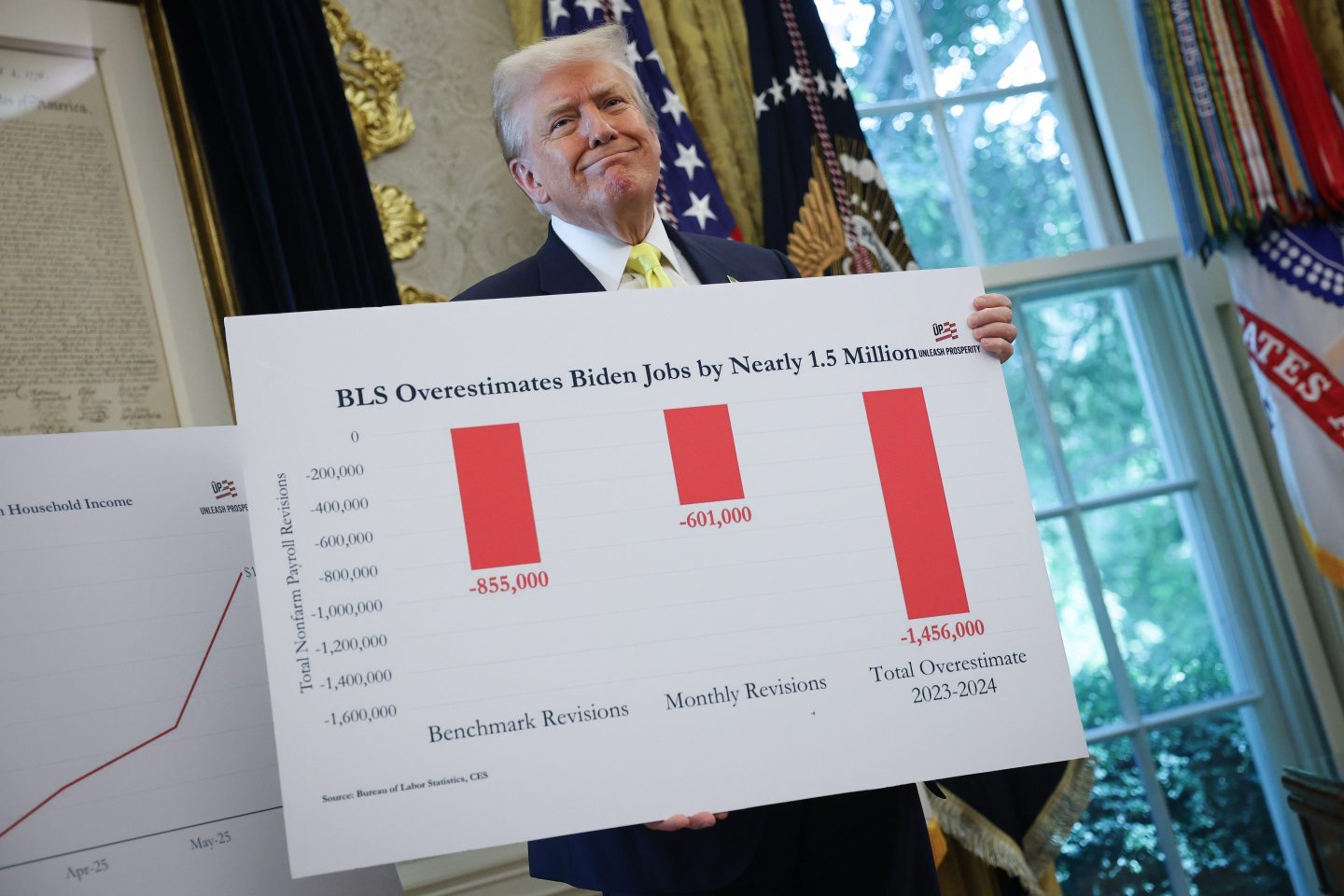
Donald Trump holds up a chart alleging BLS data has been inaccurate
President Donald Trump holds a chart that reads, “Bureau of Labor Statistics (BLS) Overestimates Biden Jobs by Nearly 1.5 Million,” in the Oval Office on Aug. 7, 2025.Win McNamee—Getty Images

For decades, statistics that came directly from the U.S. government, especially from agencies like the Bureau of Labor Statistics (BLS), have long been the gold standard for measuring the health of the American economy. But this trust has been shaken by recent events, including substantial downward revisions to jobs data, bruising political accusations, and the unceremonious dismissal of Erika McEntarfer, the BLS’s top official, at the beginning of the month. The resulting uncertainty has left many Americans asking: If official government data can’t be trusted, how can you know if the economy is struggling?

For decades, regular reports from the BLS and other agencies have offered a detailed portrait of economic activity, from employment levels to inflation to productivity. Businesses, investors, and policymakers depend on these numbers to make informed decisions. But collecting this data is an imperfect, daunting task, particularly in an economy as large and fast-moving as that of the U.S.

The most recent jobs report underscored this difficulty. Initially, BLS figures showed moderate job growth. But after significant downward revisions, the numbers painted a far bleaker picture: Job growth was much weaker than what was previously reported, with the pace of job creation weaker than it’s been in decades, excluding the pandemic-era years. Such revisions are common but usually not this dramatic, and the political repercussions—especially President Donald Trump’s firing of the BLS commissioner and claims of political tampering—have further fueled doubt, criticism, and confusion.

So this invites the question: If you cannot trust official numbers, what concrete signs reveal economic trouble? Economists point to several alternative indicators that, individually and collectively, offer insight—often visible without needing to consult official statistics. Here are the telltale signs the average person, or a skeptical observer, should watch for.

Beyond the numbers: Recognizing economic distress

1. Labor market conditions

Even in the absence of official jobs figures, warning signs often emerge in the labor market:

  • More visibly unemployed people: Lines lengthening at job centers, more “help wanted” signs vanishing, and rising rates of layoffs reported by major companies.
  • Wage stagnation: If you and those around you are not receiving raises, or if companies pull back on hiring bonuses and perks, it often reflects broader malaise.
  • Surge in part-time or gig work: In downturns, full-time jobs often give way to part-time or contract gigs, sometimes observable through employer and media reports.

2. Consumer behavior and social signals

The everyday economy leaves trails in consumer behavior and community life:

  • Reduced spending: Noticeable drops in traffic at restaurants, shops, and malls; fewer people traveling or eating out; increased coupon clipping and price sensitivity.
  • Rising defaults: More “for sale” and “foreclosure” signs, growing anecdotes of evictions or missed payments, and upticks in bankruptcies reported by courts and real estate boards.
  • Charity demand: Food banks, shelters, and local charities may report higher demand, sometimes before the effects register in official figures.

3. Business activity

Businesses are often quicker than government statistics to reflect trouble:

  • Layoff announcements: Corporate press releases, layoff tracker websites, and industry newsletters provide early warnings about sectors in distress.
  • Inventory and discounting: Retailers stuck with excess unsold goods may start offering steeper discounts or holding clearance sales.
  • Small-business closures: More empty storefronts, business liquidations, or community announcements about long-standing establishments shutting their doors.

4. Alternative and composite data

When government data falters, or is mistrusted, private sector and international organizations’ indices become invaluable:

  • ADP private payroll data: While not always fully aligned with BLS figures, private payroll processors like ADP provide independent snapshots of employment trends.
  • Human Development Index (HDI) and Genuine Progress Indicator (GPI): These composite measures integrate health, education, and income measures to provide a broader sense of economic well-being. States such as Maryland and Vermont have implemented GPI to supplement GDP, for example, to offer more nuanced local insights.
  • Well-being indexes and social metrics: Life expectancy, educational attainment, and even poll-based “happiness” measures often capture public sentiment and living standards in ways GDP and job tallies alone cannot.

5. Public mood and media reporting

  • Media and social media can be canaries in the coal mine: When headlines become dominated by stories of job losses, business failures, or personal financial hardship, it usually signals real underlying distress, even if official data has not yet caught up.

It’s understandable to be skeptical of government data, especially in the current climate. But it’s important to understand the economy is more than just a set of aggregated numbers. There will be plenty of warning signs if things are trending downward, from empty storefronts to rising bankruptcy rates to visible community distress. So if you don’t feel as if you can rely exclusively on official figures, experts advise keeping your ears to the ground: Pay attention to local businesses, listen to stories from regular people, and keep track of movement in the private sector. The telltale signs are rarely hidden; they are, for better or worse, all around us.

For this story, Fortune used generative AI to help with an initial draft. An editor verified the accuracy of the information before publishing.

The Fortune 500 Innovation Forum will convene Fortune 500 executives, U.S. policy officials, top founders, and thought leaders to help define what’s next for the American economy, Nov. 16-17 in Detroit. Apply here.
About the Author
By Dave SmithFormer Editor, U.S. News

Dave Smith is a writer and editor who also has been published in Business Insider, Newsweek, ABC News, and USA Today.

See full bioRight Arrow Button Icon

Latest in Economy

Finance
Lorem ipsum dolor sit amet, consectetur adipiscing elit, sed do eiusmod tempor incididunt ut labore et dolore magna aliqua. Ut enim ad minim veniam
By Fortune Editors
October 20, 2025
Finance
Lorem ipsum dolor sit amet, consectetur adipiscing elit, sed do eiusmod tempor incididunt ut labore et dolore magna aliqua. Ut enim ad minim veniam
By Fortune Editors
October 20, 2025
Finance
Lorem ipsum dolor sit amet, consectetur adipiscing elit, sed do eiusmod tempor incididunt ut labore et dolore magna aliqua. Ut enim ad minim veniam
By Fortune Editors
October 20, 2025
Finance
Lorem ipsum dolor sit amet, consectetur adipiscing elit, sed do eiusmod tempor incididunt ut labore et dolore magna aliqua. Ut enim ad minim veniam
By Fortune Editors
October 20, 2025
Finance
Lorem ipsum dolor sit amet, consectetur adipiscing elit, sed do eiusmod tempor incididunt ut labore et dolore magna aliqua. Ut enim ad minim veniam
By Fortune Editors
October 20, 2025
Finance
Lorem ipsum dolor sit amet, consectetur adipiscing elit, sed do eiusmod tempor incididunt ut labore et dolore magna aliqua. Ut enim ad minim veniam
By Fortune Editors
October 20, 2025

Most Popular

Finance
Lorem ipsum dolor sit amet, consectetur adipiscing elit, sed do eiusmod tempor incididunt ut labore et dolore magna aliqua. Ut enim ad minim veniam
By Fortune Editors
October 20, 2025
Finance
Lorem ipsum dolor sit amet, consectetur adipiscing elit, sed do eiusmod tempor incididunt ut labore et dolore magna aliqua. Ut enim ad minim veniam
By Fortune Editors
October 20, 2025
Finance
Lorem ipsum dolor sit amet, consectetur adipiscing elit, sed do eiusmod tempor incididunt ut labore et dolore magna aliqua. Ut enim ad minim veniam
By Fortune Editors
October 20, 2025
Finance
Lorem ipsum dolor sit amet, consectetur adipiscing elit, sed do eiusmod tempor incididunt ut labore et dolore magna aliqua. Ut enim ad minim veniam
By Fortune Editors
October 20, 2025
Finance
Lorem ipsum dolor sit amet, consectetur adipiscing elit, sed do eiusmod tempor incididunt ut labore et dolore magna aliqua. Ut enim ad minim veniam
By Fortune Editors
October 20, 2025
Finance
Lorem ipsum dolor sit amet, consectetur adipiscing elit, sed do eiusmod tempor incididunt ut labore et dolore magna aliqua. Ut enim ad minim veniam
By Fortune Editors
October 20, 2025
Fortune Secondary Logo
Rankings
  • 100 Best Companies
  • Fortune 500
  • Global 500
  • Fortune 500 Europe
  • Most Powerful Women
  • Future 50
  • World’s Most Admired Companies
  • See All Rankings
Sections
  • Finance
  • Fortune Crypto
  • Features
  • Leadership
  • Health
  • Commentary
  • Success
  • Retail
  • Mpw
  • Tech
  • Lifestyle
  • CEO Initiative
  • Asia
  • Politics
  • Conferences
  • Europe
  • Newsletters
  • Personal Finance
  • Environment
  • Magazine
  • Education
Customer Support
  • Frequently Asked Questions
  • Customer Service Portal
  • Privacy Policy
  • Terms Of Use
  • Single Issues For Purchase
  • International Print
Commercial Services
  • Advertising
  • Fortune Brand Studio
  • Fortune Analytics
  • Fortune Conferences
  • Business Development
  • Group Subscriptions
About Us
  • About Us
  • Editorial Calendar
  • Press Center
  • Work At Fortune
  • Diversity And Inclusion
  • Terms And Conditions
  • Site Map
  • About Us
  • Editorial Calendar
  • Press Center
  • Work At Fortune
  • Diversity And Inclusion
  • Terms And Conditions
  • Site Map
  • Facebook icon
  • Twitter icon
  • LinkedIn icon
  • Instagram icon
  • Pinterest icon

Latest in Economy

EconomyHiring
‘Don’t leave’: the remote work guru who nailed the labor market during the Great Resignation offers job advice for 2026
By Marco Quiroz-GutierrezMarch 25, 2026
2 hours ago
Warner gestures
AIAmerican Politics
New college grad unemployment will spike to 35% in 2 years, senator warns, forcing ‘Dario, Sam’ to quit AI fear-mongering
By Jacqueline MunisMarch 25, 2026
3 hours ago
Pete Hegseth speaks behind a podium as Donald Trump watches behind him.
EconomyRecession
Mark Zandi warns recession odds are creeping toward 50%, and the Iran war could launch us into economic turmoil by midyear
By Sasha RogelbergMarch 25, 2026
4 hours ago
People on a breakwater backdropped by commercial vessels anchored in the Gulf, near the Strait of Hormuz, on March 22, 2026 in Ajman, United Arab Emirates.
EnergyIran
Trump wrote the tariff playbook. Now Iran is using it on the world’s most important oil route.
By Eva RoytburgMarch 25, 2026
4 hours ago
University graduate
SuccessEducation
Harvard is the No. 1 ‘dream college’ of choice among Gen Z students—despite its war with the Trump administration and an $87,000 a year price tag
By Preston ForeMarch 25, 2026
6 hours ago
Working woman standing outside office happy
SuccessCareers
Women are gaining ground in traditionally male-dominated jobs like surgeons, airline pilots, and software developers—and earning well over $100,000
By Emma BurleighMarch 25, 2026
7 hours ago

Most Popular

Magazine
The youngest-ever female CEO of a Fortune 500 company is fighting Trump's cuts to keep Medicaid strong
By Fortune EditorsMarch 24, 2026
2 days ago
Commentary
The Treasury just declared the U.S. insolvent. The media missed it
By Fortune EditorsMarch 23, 2026
2 days ago
Success
Palantir’s billionaire CEO says only two kinds of people will succeed in the AI era: trade workers — ‘or you’re neurodivergent’
By Fortune EditorsMarch 24, 2026
1 day ago
Energy
Nobel laureate Paul Krugman calls it 'treason': $580 million in suspicious oil futures traded minutes before Trump's Iran reversal
By Fortune EditorsMarch 24, 2026
1 day ago
Success
The job market is so bad that ‘reverse recruiters’ are charging $1,500 a month just to help people look for jobs
By Fortune EditorsMarch 25, 2026
14 hours ago
Success
JPMorgan has started monitoring the keystrokes, video calls, and meetings of its junior investment bankers—and they say it's for employee well-being
By Fortune EditorsMarch 24, 2026
1 day ago

© 2026 Fortune Media IP Limited. All Rights Reserved. Use of this site constitutes acceptance of our Terms of Use and Privacy Policy | CA Notice at Collection and Privacy Notice | Do Not Sell/Share My Personal Information
FORTUNE is a trademark of Fortune Media IP Limited, registered in the U.S. and other countries. FORTUNE may receive compensation for some links to products and services on this website. Offers may be subject to change without notice.