
• Home
  • Latest
  • Fortune 500
  • Finance
  • Tech
  • Leadership
  • Lifestyle
  • Rankings
  • Multimedia

Trendingnow

1

The Pentagon said Iran War costs $29 billion, but the real cost is closer to $200 billion—and counting

2

Now worth $200 million, Sarah Jessica Parker credits being ‘one of eight kids that struggled financially’ for her hunger, ambition, and work ethic

3

After forcing workers back to the office, Goldman Sachs and JPMorgan Chase are now letting their staff work remotely—but only for the World Cup

1

The Pentagon said Iran War costs $29 billion, but the real cost is closer to $200 billion—and counting

2

Now worth $200 million, Sarah Jessica Parker credits being ‘one of eight kids that struggled financially’ for her hunger, ambition, and work ethic

3

After forcing workers back to the office, Goldman Sachs and JPMorgan Chase are now letting their staff work remotely—but only for the World Cup
AIEmployment

AI companies are throwing big money at newly minted PhDs, sparking fears of an academic ‘brain drain’

Alexandra Sternlicht
By
Alexandra Sternlicht
Down Arrow Button Icon
Alexandra Sternlicht
By
Alexandra Sternlicht
Down Arrow Button Icon
June 25, 2025, 11:49 AM ET
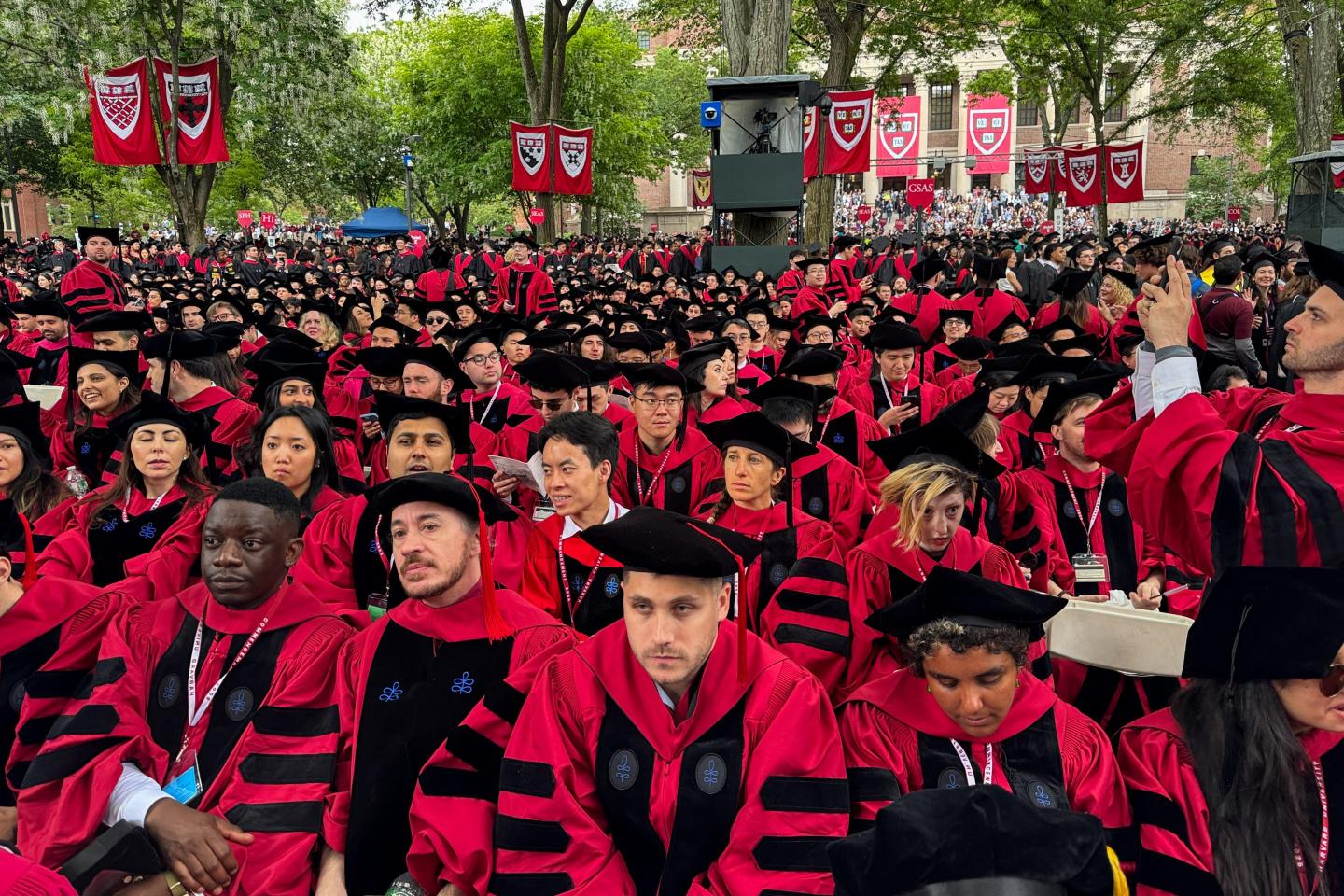
Photo of students dressed in academic gowns at Harvard University's graduation.
Students at Harvard University’s graduation ceremony. Newly minted PhDs in AI-related fields are commanding high six- and even seven-figure salaries from tech companies, sparking fears of a “brain drain” from academia among some professors. Rick Friedman—AFP/Getty Images
Add Fortune on Google for similar content.

Larry Birnbaum, a professor of computer science at Northwestern University was recruiting a promising PhD to become a graduate researcher. Simultaneously, Google was wooing the student. And when he visited the tech giant’s campus in Mountain View, Calif., the company slated him to chat with its cofounder Sergey Brin and CEO Sundar Pichai, who are collectively worth about $140 billion and command over 183,000 employees. 

Recommended Video

“How are we going to compete with that?” Birnbaum asks, noting that PhDs in corporate research roles can make as much as five times professorial salaries, which average $155,000 annually. “That’s the environment that every chair of computer science has to cope with right now.”

Though Birnbaum says these recruitment scenarios have been “happening for a while,” the phenomenon has reportedly worsened as salaries across the industry have been skyrocketing. The trend recently became headline news after reports surfaced of Meta offering to pay some highly experienced AI researchers between seven- and eight-figure salaries. Those offers—coupled with the strong demand for leaders to propel AI applications—may be helping to pull up the salary levels of even newly minted PhDs. Even though some of these graduates have no professional experience, they are being offered the types of comma-filled levels traditionally reserved for director- and executive-level talent.

Some academics fear a ‘brain drain’

Engineering professors and department chairs at Johns Hopkins, University of Chicago, Northwestern, and New York University interviewed by Fortune are divided on whether these lucrative offers lead to a “brain drain” from academic labs.

The brain drain camp believes this phenomenon depletes the ranks of academic AI departments, which still do important research and also are responsible for training the next generation of PhD students. At the private labs, the AI researchers help juice Big Tech’s bottom line while providing, in these critics’ view, no public benefit. The unconcerned argue that academia is a thriving component of this booming labor market. 

Anasse Bari, a professor of computer science and director of the predictive analytics and AI research lab at New York University, says that the corporate opportunities available to AI-focused academics is “significantly” affecting academia. “My general theory is that If we want a responsible future for AI, we must first invest in a solid AI education that upholds these values, cultivating thoughtful AI practitioners, researchers, and educators who will carry this mission forward,” he wrote to Fortune via email, emphasizing that despite receiving “many” offers for industry-side work, his NYU commitments take precedence.

In the days before ChatGPT, top AI researchers were in high demand, just as today. But many of the top corporate AI labs, such as OpenAI, Google DeepMind, and Meta’s FAIR (Fundamental AI Research), would allow established academics to keep their university appointments, at least part-time. This would allow them to continue to teach and train graduate students, while also conducting research for the tech companies.

While some professors say that there’s been no change in how frequently corporate labs and universities are able to reach these dual corporate-academic appointments, others disagree. NYU’s Bari says this model has declined owing to “intense talent competition, with companies offering millions of dollars for full-time commitment which outpaces university resources and shifts focus to proprietary innovation.”

Commitment to their faculty appointments remains true for all the academics Fortune interviewed for this story. But professors like Henry Hoffman, who chairs the University of Chicago’s Department of Computer Science, has watched his PhD students get courted by tech companies since he began his professorship in 2013.

“The biggest thing to me is the salaries,” he says. He mentions a star student with zero professional experience who recently dropped out of the UChicago PhD program to accept a “high six-figure” offer from ByteDance. “When students can get the kind of job they want [as students], there’s no reason to force them to keep going.”

While PhDs thrive, undergrad computer science students struggle

The job market for computer science and engineering PhDs who study AI sits in stark contrast to the one faced by undergraduates in the field. This degree-level polarization exists because many of those with bachelor’s degrees in computer science would traditionally find jobs as coders. But LLMs are now writing large portions of code at many companies, including Microsoft and Salesforce. Meanwhile, most AI-relevant PhD students have their pick of frothy jobs—in academia, tech, and finance. These graduates are courted by the private sector because their training propels AI and machine learning applications, which, in turn, can increase revenue opportunities for model makers.

There were 4,854 people who graduated with AI-relevant PhDs in mathematics and computer science across U.S. universities, according to 2022 data. This number has increased significantly—by about 20%—since 2014. These PhDs’ postgraduate employment rate is greater than those graduating with bachelor’s degrees in similar fields. And in 2023, 70% of AI-relevant PhDs took private sector jobs postgrad, a huge increase from two decades ago when just 20% of these grads accepted corporate work, per MIT.

Make no mistake: PhDs in AI, computer science, applied mathematics, and related fields have always had lucrative opportunities available after graduation. Until now, one of the most financially rewarding paths was quantitative research at hedge funds: All-in compensation for PhDs fresh out of school can climb to $1 million–plus in these roles. It’s a compelling pitch, especially for students who’ve spent up to seven years living off meager stipends of about $40,000 a year.

The all-but-assured path to prosperity has made relevant PhD programs in computer science and math extremely popular. AI and machine learning are the most popular disciplines among engineering PhDs, according to a 2023 Computing Research Association survey. UChicago computer science department chair Hoffman says that PhD admissions applications have surged by about 12% in the past few years alone, pressuring him and his colleagues to hire new faculty to increase enrollment and meet the demand.

Applications to AI PhD programs are on the rise

Though Trump’s federal funding cuts to universities have significant impacts on research in many departments, they may be less pertinent to those working on AI-related projects. This is partially because some of this research is funded by corporations. Google, for example, is collaborating with the University of Chicago to research trustworthy AI.

That dichotomy probably underscores Johns Hopkins University’s decision to open its Data Science and AI Institute: a $2 billion five-year effort to enroll 750 PhD students in engineering disciplines and hire over 100 new tenure-track faculty members, making it one of the largest PhD programs in the country.

“Despite the dreary mood elsewhere, the AI and data science area at Hopkins is rosy,” says Anton Dahbura, the executive director of Johns Hopkins’ Information Security Institute and codirector of the Institute for Assured Autonomy, likely referring to his university’s cut of 2,000 workers after it lost $800 million in federal funding earlier this year. Dahbura supports this argument by noting that Hopkins received “hundreds” of applications for professor positions in its Data Science and AI Institute. 

For some, the reasons to remain in academia are ethical.

Luís Amaral, a computer science professor at Northwestern, is “really concerned” that AI companies have overhyped the capabilities of their large language models and that their strategies will breed catastrophic societal implications, including environmental destruction. He says of OpenAI leadership, “If I’m a smart person, I actually know how bad the team was.”

Because most corporate labs are largely focused on LLM- and transformer-based approaches, if these methods ultimately fall short of the hype, there could be a reckoning for the industry. “Academic labs are among the few places actively exploring alternative AI architectures beyond LLMs and transformers,” says NYU’s Bari, who is researching creative applications for AI using a model based on birds’ intelligence. “In this corporate-dominated landscape, academia’s role as a hub for nonmainstream experimentation has likely become more important.”

Subscribe to Fortune Gulf Brief. Every Tuesday, this new newsletter delivers clear-eyed, authoritative intelligence on the deals, decisions, policies, and power shifts shaping one of the world’s most consequential regions, written for the people who need to act on it. Sign up here.
About the Author
Alexandra Sternlicht
By Alexandra Sternlicht
Instagram iconLinkedIn iconTwitter icon
See full bioRight Arrow Button Icon
Add Fortune on Google for similar content.

Latest in AI

Finance
Lorem ipsum dolor sit amet, consectetur adipiscing elit, sed do eiusmod tempor incididunt ut labore et dolore magna aliqua. Ut enim ad minim veniam
By Fortune Editors
October 20, 2025
Finance
Lorem ipsum dolor sit amet, consectetur adipiscing elit, sed do eiusmod tempor incididunt ut labore et dolore magna aliqua. Ut enim ad minim veniam
By Fortune Editors
October 20, 2025
Finance
Lorem ipsum dolor sit amet, consectetur adipiscing elit, sed do eiusmod tempor incididunt ut labore et dolore magna aliqua. Ut enim ad minim veniam
By Fortune Editors
October 20, 2025
Finance
Lorem ipsum dolor sit amet, consectetur adipiscing elit, sed do eiusmod tempor incididunt ut labore et dolore magna aliqua. Ut enim ad minim veniam
By Fortune Editors
October 20, 2025
Finance
Lorem ipsum dolor sit amet, consectetur adipiscing elit, sed do eiusmod tempor incididunt ut labore et dolore magna aliqua. Ut enim ad minim veniam
By Fortune Editors
October 20, 2025
Finance
Lorem ipsum dolor sit amet, consectetur adipiscing elit, sed do eiusmod tempor incididunt ut labore et dolore magna aliqua. Ut enim ad minim veniam
By Fortune Editors
October 20, 2025

Most Popular

Finance
Lorem ipsum dolor sit amet, consectetur adipiscing elit, sed do eiusmod tempor incididunt ut labore et dolore magna aliqua. Ut enim ad minim veniam
By Fortune Editors
October 20, 2025
Finance
Lorem ipsum dolor sit amet, consectetur adipiscing elit, sed do eiusmod tempor incididunt ut labore et dolore magna aliqua. Ut enim ad minim veniam
By Fortune Editors
October 20, 2025
Finance
Lorem ipsum dolor sit amet, consectetur adipiscing elit, sed do eiusmod tempor incididunt ut labore et dolore magna aliqua. Ut enim ad minim veniam
By Fortune Editors
October 20, 2025
Finance
Lorem ipsum dolor sit amet, consectetur adipiscing elit, sed do eiusmod tempor incididunt ut labore et dolore magna aliqua. Ut enim ad minim veniam
By Fortune Editors
October 20, 2025
Finance
Lorem ipsum dolor sit amet, consectetur adipiscing elit, sed do eiusmod tempor incididunt ut labore et dolore magna aliqua. Ut enim ad minim veniam
By Fortune Editors
October 20, 2025
Finance
Lorem ipsum dolor sit amet, consectetur adipiscing elit, sed do eiusmod tempor incididunt ut labore et dolore magna aliqua. Ut enim ad minim veniam
By Fortune Editors
October 20, 2025
Fortune Secondary Logo
Rankings
  • 100 Best Companies
  • Fortune 500
  • Global 500
  • Fortune 500 Europe
  • Most Powerful Women
  • World's Most Admired Companies
  • See All Rankings
  • Lists Calendar
Sections
  • Finance
  • Fortune Crypto
  • Features
  • Leadership
  • Health
  • Commentary
  • Success
  • Retail
  • Mpw
  • Tech
  • Lifestyle
  • CEO Initiative
  • Asia
  • Politics
  • Conferences
  • Europe
  • Newsletters
  • Personal Finance
  • Environment
  • Magazine
  • Education
Customer Support
  • Frequently Asked Questions
  • Customer Service Portal
  • Privacy Policy
  • Terms Of Use
  • Single Issues For Purchase
  • International Print
Commercial Services
  • Advertising
  • Fortune Brand Studio
  • Fortune Analytics
  • Fortune Conferences
  • Business Development
  • Group Subscriptions
About Us
  • About Us
  • Press Center
  • Work At Fortune
  • Terms And Conditions
  • Site Map
  • About Us
  • Press Center
  • Work At Fortune
  • Terms And Conditions
  • Site Map
  • Facebook icon
  • Twitter icon
  • LinkedIn icon
  • Instagram icon
  • Pinterest icon

Latest in AI

Getting past the pilot: Why so many AI test projects have trouble scaling
SuccessBrainstorm Tech
Getting past the pilot: Why so many AI test projects have trouble scaling
By Alexei OreskovicJune 24, 2026
8 hours ago
‘Godmother of AI’ and tech entrepreneurs draw investors by pivoting from chatbots to ‘world models’ saying AI has to read the room, not just books
AIRobots
‘Godmother of AI’ and tech entrepreneurs draw investors by pivoting from chatbots to ‘world models’ saying AI has to read the room, not just books
By The Associated PressJune 24, 2026
9 hours ago
Asia’s defense boom is rewiring the global arms supply chain
Commentaryarms, weapons, and defense
Asia’s defense boom is rewiring the global arms supply chain
By Chris OberoiJune 24, 2026
10 hours ago
How Home Depot is rebuilding retailing with AI
NewslettersCIO Intelligence
How Home Depot is rebuilding retailing with AI
By John KellJune 24, 2026
14 hours ago
bob
AIbooks
Robert Wright sees an ‘earthquake’ coming from AI that goes far beyond jobs: ‘cultural, political, personal, family, psychological’
By Nick LichtenbergJune 24, 2026
14 hours ago
A man wearing a red and black jacket and a red hat walks down a hallway lined with servers.
InnovationChina
For the first time since 2017, it’s China, not the U.S., that has the world’s most powerful supercomputer
By The Associated PressJune 24, 2026
15 hours ago

Most Popular

The Pentagon said Iran War costs $29 billion, but the real cost is closer to $200 billion—and counting
Economy
The Pentagon said Iran War costs $29 billion, but the real cost is closer to $200 billion—and counting
By Jacqueline MunisJune 24, 2026
24 hours ago
Now worth $200 million, Sarah Jessica Parker credits being ‘one of eight kids that struggled financially’ for her hunger, ambition, and work ethic
Success
Now worth $200 million, Sarah Jessica Parker credits being ‘one of eight kids that struggled financially’ for her hunger, ambition, and work ethic
By Orianna Rosa RoyleJune 24, 2026
24 hours ago
After forcing workers back to the office, Goldman Sachs and JPMorgan Chase are now letting their staff work remotely—but only for the World Cup
Success
After forcing workers back to the office, Goldman Sachs and JPMorgan Chase are now letting their staff work remotely—but only for the World Cup
By Orianna Rosa RoyleJune 23, 2026
2 days ago
Amazon's record Prime Day masks a darker truth: Americans are spending more and getting less
Retail
Amazon's record Prime Day masks a darker truth: Americans are spending more and getting less
By Nick LichtenbergJune 24, 2026
16 hours ago
Ray Dalio just finished a 10-day trip to China. He says global leaders know America ‘doesn’t have what it takes to fight to maintain its empire’
Asia
Ray Dalio just finished a 10-day trip to China. He says global leaders know America ‘doesn’t have what it takes to fight to maintain its empire’
By Nick LichtenbergJune 24, 2026
17 hours ago
Current price of gold as of June 23, 2026
Personal Finance
Current price of gold as of June 23, 2026
By Danny BakstJune 23, 2026
2 days ago

© 2026 Fortune Media IP Limited. All Rights Reserved. Use of this site constitutes acceptance of our Terms of Use and Privacy Policy | CA Notice at Collection and Privacy Notice | Do Not Sell/Share My Personal Information
FORTUNE is a trademark of Fortune Media IP Limited, registered in the U.S. and other countries. FORTUNE may receive compensation for some links to products and services on this website. Offers may be subject to change without notice.