
• Home
  • Latest
  • Fortune 500
  • Finance
  • Tech
  • Leadership
  • Lifestyle
  • Rankings
  • Multimedia

Trendingnow

1

MacKenzie Scott alone accounted for one-third of America's $19.2 billion in megagifts last year

2

Now worth $200 million, Sarah Jessica Parker credits being ‘one of eight kids that struggled financially’ for her hunger, ambition, and work ethic

3

Ray Dalio says the U.S. just had its 'Suez moment'—and history says what comes next could end an empire

1

MacKenzie Scott alone accounted for one-third of America's $19.2 billion in megagifts last year

2

Now worth $200 million, Sarah Jessica Parker credits being ‘one of eight kids that struggled financially’ for her hunger, ambition, and work ethic

3

Ray Dalio says the U.S. just had its 'Suez moment'—and history says what comes next could end an empire
Finance

Trump’s tariff formula used the wrong value in its calculations, conservative think tank says. ‘This whole thing was rigged’

Paolo Confino
By
Paolo Confino
Paolo Confino
Reporter
Down Arrow Button Icon
Paolo Confino
By
Paolo Confino
Paolo Confino
Reporter
Down Arrow Button Icon
April 7, 2025, 8:52 PM ET
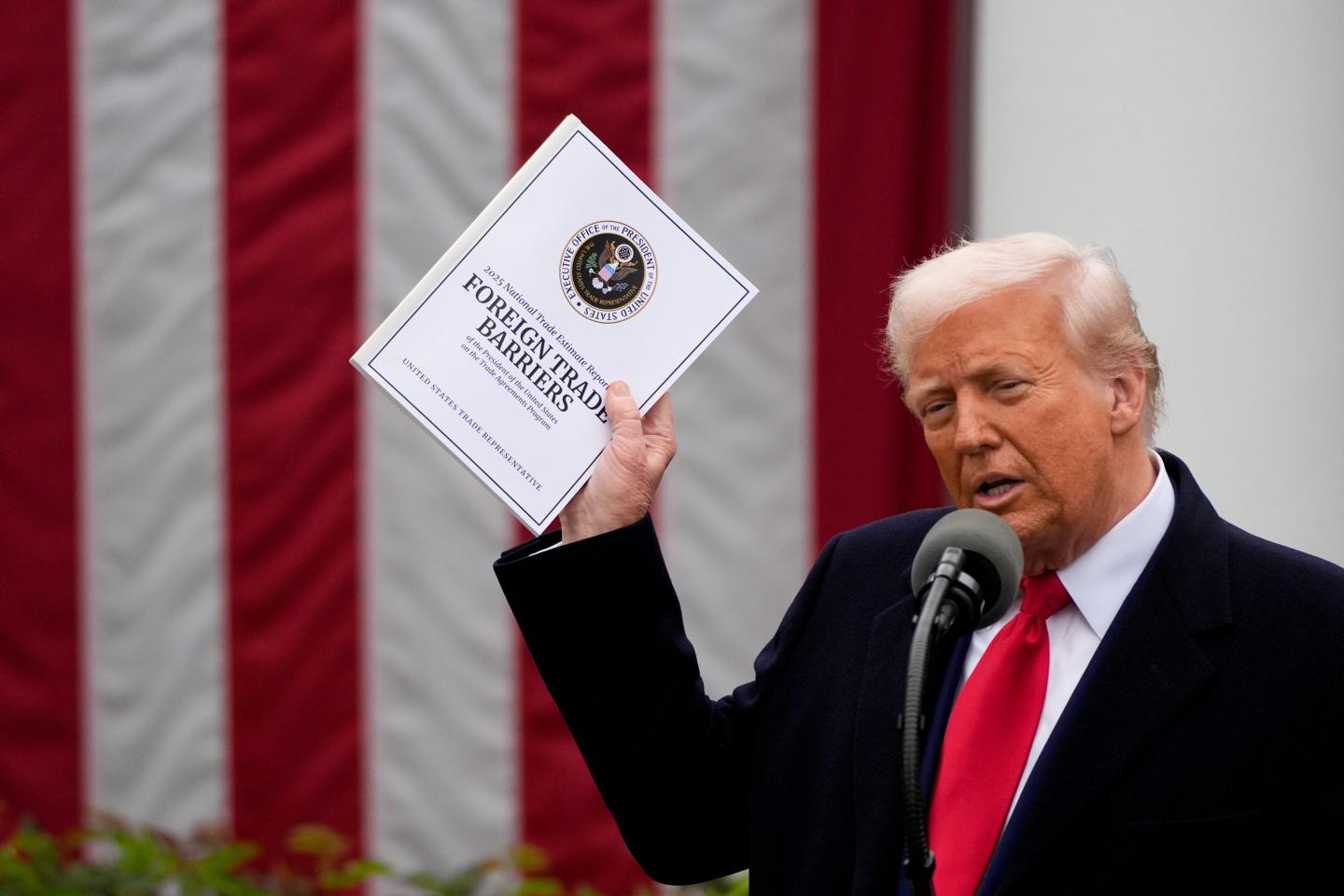
Photo of Donald Trump
President Donald Trump holds up a report authored by the Office of the U.S. Trade Representative that he cited as instrumental in his tariff policy. Kent Nishimura/Bloomberg
Add Fortune on Google for similar content.
  • A conservative think tank found the White House measured retail price elasticity when it should have used import price elasticity. That mistake meant the tariff outputs were about four times higher than they should have been. 

The formula the White House used to calculate its recent tariff is based on an error that roughly quadrupled the rates from what they should have been. 

Recommended Video

Two scholars at the American Enterprise Institute (AEI), a conservative think tank, found the White House used the wrong value when assessing the rate at which prices would change as a result of tariffs. The correct version of the formula uses price changes in the cost of imports, meaning how much it costs a U.S.-based company to buy a good from a foreign seller. Instead, the White House factored in the retail price change, which is what consumers pay. 

That meant the formula was off by a factor of four, because the White House valued the elasticity of import prices at 0.25 when it should have been 0.945, according to AEI. 

“It’s pretty bush league,” Stan Veuger, one of the AEI fellows, told Fortune in a phone call. “For such a big policy you’d expect a much higher level of professionalism.”

Using the wrong value rendered the formula inaccurate, according to Veuger and his coauthor Kevin Corinth.

“Now, our view is that the formula the administration relied on has no foundation in either economic theory or trade law,” Corinth and Veuger wrote. “But if we are going to pretend that it is a sound basis for U.S. trade policy, we should at least be allowed to expect that the relevant White House officials do their calculations carefully.”

Another AEI economist, Derek Scissors, went even further, saying the administration hadn’t made a mistake so much as intentionally fudged the math to get the outcome officials wanted. 

“This whole thing was rigged,” Scissors said Monday on CNBC. “It was a manipulated way to get very high tariffs because President Trump wanted to announce very high tariffs.” 

In their original report Corinth and Veuger said they hoped the White House would lower its tariff rates as a result of their discovery. “Hopefully they will correct their mistake soon: The resulting trade liberalization would provide a much-needed boost to the economy and may yet help us stave off a recession,” they wrote. 

The three trading days since President Donald Trump announced the U.S.’s new tariff regime saw markets across the world tank. In the U.S., the Dow Jones, S&P 500, and Nasdaq composite index all cratered. In Asia, stocks in Japan and Hong Kong sank even further on Monday, after Trump vowed to escalate the ongoing trade war. In Europe stocks fell roughly 4.5% on Monday, after a dismal performance last week. 

The calculations used by the White House were already somewhat controversial after it became apparent that discounted “reciprocal tariff” amounts were based on a simple formula of dividing the U.S.’s trade deficit with a foreign country by that country’s total exports to the U.S. The resulting number was then divided by two and used as the tariff rate for said country. 

Even without the error, the formula was dubious, Corinth and Veuger said. The formula “does not make economic sense,” they wrote. “The trade deficit with a given country is not determined only by tariffs and nontariff trade barriers, but also by international capital flows, supply chains, comparative advantage, geography, etc.”  

Given that the Trump administration’s tariffs were billed as reciprocal tariffs, analysts and investors had expected they would be based on a careful examination of a country’s trade and non-trade barriers with respect to American-made goods. Instead they were based on the formula, which the Washington Post reports President Donald Trump personally insisted on using.  

Trump’s personal views on tariffs were, in Veuger’s view, the principal reason for the recent tariff policy.

“What’s driving the policy is that since the 1980s Trump has been a protectionist, and he thinks trade deficits are losses and trade surpluses are profits,” Veuger said. “He just likes tariffs. Then you can backfill them with more sophisticated, intellectualized rationalizations. But that’s what it is—it’s rationalization.”

The White House said using retail prices instead of import prices was warranted because consumers make purchasing decisions based on retail rather than wholesale prices. A spokesperson added that in their view the tariff rates should actually have been larger.

Corinth and Veuger pointed to research from Harvard Business School professor Alberto Cavallo cited in the U.S. trade representative’s (USTR) memo about the tariff formula, as evidence the calculations misinterpreted the difference between retail prices and import prices. Cavallo’s work “makes this distinction clear,” they wrote. 

Cavallo himself also addressed the fact his work was referenced in the USTR’s report. 

“It is not entirely clear how they use our findings,” Cavallo wrote on X last week. “Based on our research, the elasticity of import prices with respect to tariffs is closer to 1. If that figure were used instead of 0.25, the implied reciprocal tariffs would come out about four times smaller.”

If that version of the formula were adopted it would drastically lower the tariff rates imposed on countries. For example, Cambodia’s 49% rate would drop down to 13%, and Vietnam’s would go from 46% to 12.2%. The vast majority of countries would end up being subject to the 10% tariff minimum that is part of the White House’s new policy.

About the Author
Paolo Confino
By Paolo ConfinoReporter

Paolo Confino is a former reporter on Fortune’s global news desk where he covers each day’s most important stories.

See full bioRight Arrow Button Icon
Add Fortune on Google for similar content.

Latest in Finance

Finance
Lorem ipsum dolor sit amet, consectetur adipiscing elit, sed do eiusmod tempor incididunt ut labore et dolore magna aliqua. Ut enim ad minim veniam
By Fortune Editors
October 20, 2025
Finance
Lorem ipsum dolor sit amet, consectetur adipiscing elit, sed do eiusmod tempor incididunt ut labore et dolore magna aliqua. Ut enim ad minim veniam
By Fortune Editors
October 20, 2025
Finance
Lorem ipsum dolor sit amet, consectetur adipiscing elit, sed do eiusmod tempor incididunt ut labore et dolore magna aliqua. Ut enim ad minim veniam
By Fortune Editors
October 20, 2025
Finance
Lorem ipsum dolor sit amet, consectetur adipiscing elit, sed do eiusmod tempor incididunt ut labore et dolore magna aliqua. Ut enim ad minim veniam
By Fortune Editors
October 20, 2025
Finance
Lorem ipsum dolor sit amet, consectetur adipiscing elit, sed do eiusmod tempor incididunt ut labore et dolore magna aliqua. Ut enim ad minim veniam
By Fortune Editors
October 20, 2025
Finance
Lorem ipsum dolor sit amet, consectetur adipiscing elit, sed do eiusmod tempor incididunt ut labore et dolore magna aliqua. Ut enim ad minim veniam
By Fortune Editors
October 20, 2025

Most Popular

Finance
Lorem ipsum dolor sit amet, consectetur adipiscing elit, sed do eiusmod tempor incididunt ut labore et dolore magna aliqua. Ut enim ad minim veniam
By Fortune Editors
October 20, 2025
Finance
Lorem ipsum dolor sit amet, consectetur adipiscing elit, sed do eiusmod tempor incididunt ut labore et dolore magna aliqua. Ut enim ad minim veniam
By Fortune Editors
October 20, 2025
Finance
Lorem ipsum dolor sit amet, consectetur adipiscing elit, sed do eiusmod tempor incididunt ut labore et dolore magna aliqua. Ut enim ad minim veniam
By Fortune Editors
October 20, 2025
Finance
Lorem ipsum dolor sit amet, consectetur adipiscing elit, sed do eiusmod tempor incididunt ut labore et dolore magna aliqua. Ut enim ad minim veniam
By Fortune Editors
October 20, 2025
Finance
Lorem ipsum dolor sit amet, consectetur adipiscing elit, sed do eiusmod tempor incididunt ut labore et dolore magna aliqua. Ut enim ad minim veniam
By Fortune Editors
October 20, 2025
Finance
Lorem ipsum dolor sit amet, consectetur adipiscing elit, sed do eiusmod tempor incididunt ut labore et dolore magna aliqua. Ut enim ad minim veniam
By Fortune Editors
October 20, 2025
Fortune Secondary Logo
Rankings
  • 100 Best Companies
  • Fortune 500
  • Global 500
  • Fortune 500 Europe
  • Most Powerful Women
  • World's Most Admired Companies
  • See All Rankings
  • Lists Calendar
Sections
  • Finance
  • Fortune Crypto
  • Features
  • Leadership
  • Health
  • Commentary
  • Success
  • Retail
  • Mpw
  • Tech
  • Lifestyle
  • CEO Initiative
  • Asia
  • Politics
  • Conferences
  • Europe
  • Newsletters
  • Personal Finance
  • Environment
  • Magazine
  • Education
Customer Support
  • Frequently Asked Questions
  • Customer Service Portal
  • Privacy Policy
  • Terms Of Use
  • Single Issues For Purchase
  • International Print
Commercial Services
  • Advertising
  • Fortune Brand Studio
  • Fortune Analytics
  • Fortune Conferences
  • Business Development
  • Group Subscriptions
About Us
  • About Us
  • Press Center
  • Work At Fortune
  • Terms And Conditions
  • Site Map
  • About Us
  • Press Center
  • Work At Fortune
  • Terms And Conditions
  • Site Map
  • Facebook icon
  • Twitter icon
  • LinkedIn icon
  • Instagram icon
  • Pinterest icon

Latest in Finance

Big Short legend Steve Eisman says everyone is buying the wrong AI stocks
InvestingFinance
Big Short legend Steve Eisman says everyone is buying the wrong AI stocks
By Shawn TullyJune 27, 2026
1 hour ago
Illustration of a bomb with the Bitcoin logo printed on it, against an orange background.
CryptoCryptocurrency
Bitcoin down 20% since May as Strategy fallout spooks investors
By Camila Grigera NaónJune 26, 2026
15 hours ago
One chart explains the economy’s terrible baby boomer hangover, Gen X’s invisibility, and millennial and Gen Z irrelevance
Economybaby boomers
One chart explains the economy’s terrible baby boomer hangover, Gen X’s invisibility, and millennial and Gen Z irrelevance
By Tristan BoveJune 26, 2026
16 hours ago
AI boom may be on its last legs amid stock volatility and dash for cash—but will go out in a blaze of glory with ‘blow-off phase’ before bubble pops
AItech stocks
AI boom may be on its last legs amid stock volatility and dash for cash—but will go out in a blaze of glory with ‘blow-off phase’ before bubble pops
By Jason MaJune 26, 2026
17 hours ago
m
PoliticsNew York City
Mamdani lives up to campaign promise, freezing rent for about 1 million New Yorkers
By Anthony Izaguirre and The Associated PressJune 26, 2026
17 hours ago
gavin
PoliticsTaxes
Newsom calls for a national billionaires’ tax — just not the one his state’s voters are about to pass
By Jonathan J. Cooper and The Associated PressJune 26, 2026
17 hours ago

Most Popular

MacKenzie Scott alone accounted for one-third of America's $19.2 billion in megagifts last year
Success
MacKenzie Scott alone accounted for one-third of America's $19.2 billion in megagifts last year
By Sydney LakeJune 25, 2026
2 days ago
Now worth $200 million, Sarah Jessica Parker credits being ‘one of eight kids that struggled financially’ for her hunger, ambition, and work ethic
Success
Now worth $200 million, Sarah Jessica Parker credits being ‘one of eight kids that struggled financially’ for her hunger, ambition, and work ethic
By Orianna Rosa RoyleJune 24, 2026
3 days ago
Ray Dalio says the U.S. just had its 'Suez moment'—and history says what comes next could end an empire
Economy
Ray Dalio says the U.S. just had its 'Suez moment'—and history says what comes next could end an empire
By Nick LichtenbergJune 26, 2026
1 day ago
The bond market knows something about the $39 trillion national debt that Washington doesn’t
Economy
The bond market knows something about the $39 trillion national debt that Washington doesn’t
By Eva RoytburgJune 25, 2026
1 day ago
Current price of oil as of June 26, 2026
Personal Finance
Current price of oil as of June 26, 2026
By Joseph HostetlerJune 26, 2026
20 hours ago
The richest 20% are the only ones powering the U.S. economy, says top economist, but their prospects are entirely reliant on teetering stock prices
Economy
The richest 20% are the only ones powering the U.S. economy, says top economist, but their prospects are entirely reliant on teetering stock prices
By Eleanor PringleJune 26, 2026
22 hours ago

© 2026 Fortune Media IP Limited. All Rights Reserved. Use of this site constitutes acceptance of our Terms of Use and Privacy Policy | CA Notice at Collection and Privacy Notice | Do Not Sell/Share My Personal Information
FORTUNE is a trademark of Fortune Media IP Limited, registered in the U.S. and other countries. FORTUNE may receive compensation for some links to products and services on this website. Offers may be subject to change without notice.