• Home
  • Latest
  • Fortune 500
  • Finance
  • Tech
  • Leadership
  • Lifestyle
  • Rankings
  • Multimedia
CommentaryInvesting

Warren Buffett acts like the U.S. stock market is in bubble territory. He might be onto something

By
Steve H. Hanke
Steve H. Hanke
and
Caleb Hofmann
Caleb Hofmann
Down Arrow Button Icon
By
Steve H. Hanke
Steve H. Hanke
and
Caleb Hofmann
Caleb Hofmann
Down Arrow Button Icon
March 5, 2025, 2:39 PM ET
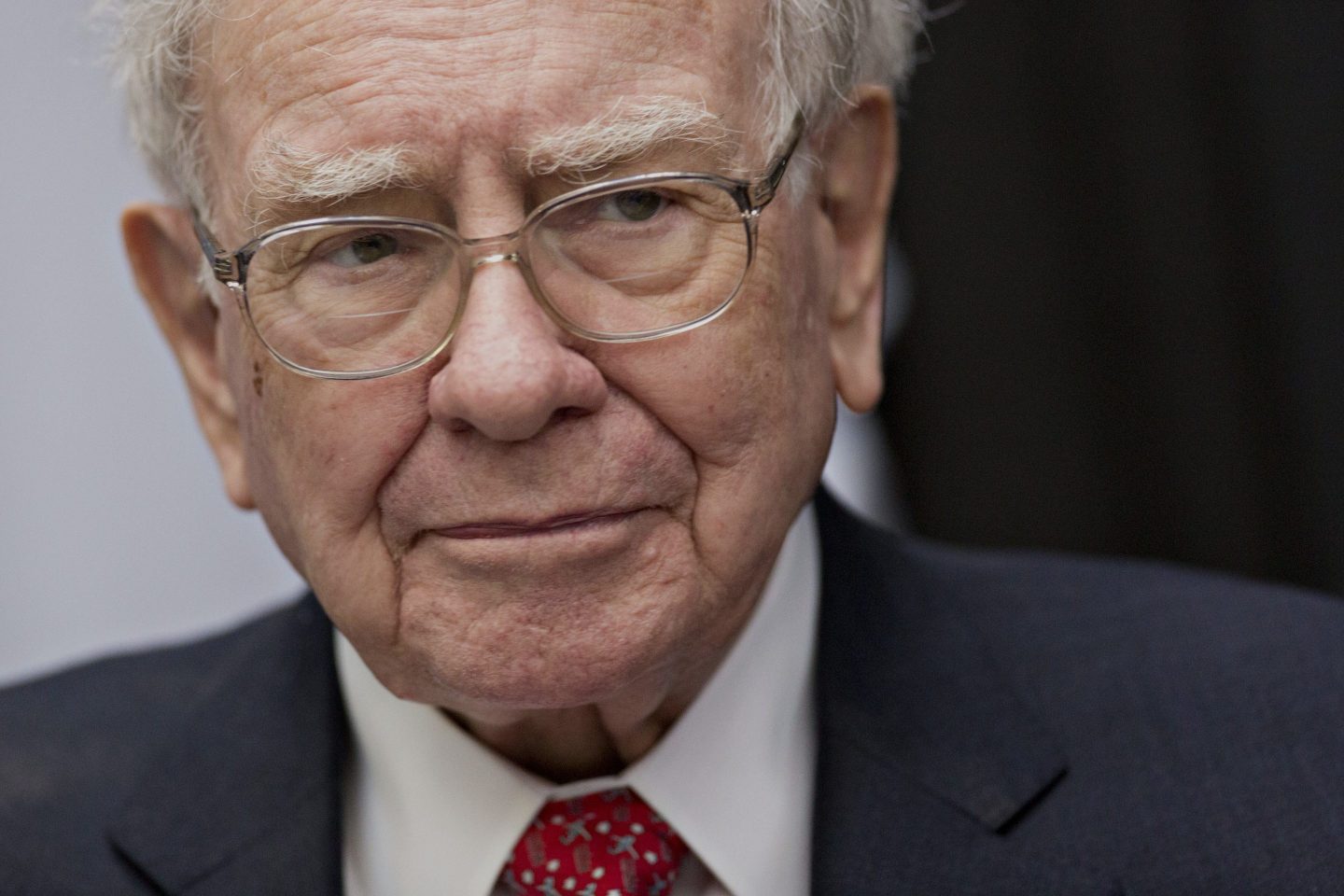
Warren Buffett has offloaded all of Berkshire’s market-tracking ETFs.
Warren Buffett has offloaded all of Berkshire’s market-tracking ETFs.Daniel Acker/Bloomberg via Getty Images

Over the last five years, Americans have watched equity markets soar. Just last month, the S&P 500 reached an all-time high of 6,144, up over 89% from January 2020. Such a precipitous increase in the value of U.S. equities has stirred up the usual cacophony of equity-bears screaming “bubble!”

“Bubble” is a popular term, but, as it turns out, is rather ill-defined and fuzzy. It is supposed to refer to a period in markets when asset prices are above a level justified by their fundamentals. Indeed, many economists have beefs with bubbles. Peter Garber, the author of Famous First Bubbles: The Fundamentals of Early Manias, argues that so-called bubbles are in fact rhetorical weapons used to argue the markets are “crazy” and need to be more severely regulated. Nobelist Eugene Fama, colloquially known as the “father of modern finance,” takes issue with the term “bubble,” too. He argues that, if bubbles did exist in equity markets, then large increases in a stock’s price should predict lower returns going forward, which is usually not the case. Research from Harvard economists Robin Greenwood, Andrei Shleifer, and Yang You lend credence to Fama’s claim, although the authors did find that the nature of a stock-price run-up can help predict a future crash.

Buffett hoarding cash

So, is the U.S. stock market in bubble territory? High-profile investors like Warren Buffett seem to think so: Berkshire Hathaway’s cash as a percentage of assets hit a record high of 27% last quarter, and Buffett has even offloaded all of Berkshire’s market-tracking ETFs.  To decide whether we agree with Buffett, we employ Dr. X’s Bubble Detector—a concept that was conveyed to one of us (Hanke) in an August 1996 letter by a late Nobel laureate in economics.

Dr. X’s bubble detector is the wealth-to-income ratio for stocks divided by the wealth-to-income ratio for bonds. The wealth-to-income ratio indicates the length of time it takes for a constant flow of income to “purchase” a given stock of income-producing assets—1,000 shares of Apple, say, or 1,000 T-Bills. As the ratio increases, more time is required to purchase a source of income, implying that assets are becoming more expensive relative to income. Therefore, the bubble detector essentially measures the value of equities relative to that of fixed income securities.

The readings for the bubble detector increase when the wealth/income ratio for stocks increases relative to the ratio for bonds. In other words, red lights flash when it becomes significantly more expensive to purchase $1 worth of earnings from stocks than to purchase $1 worth of interest income from bonds.

As a proxy for the wealth/income ratio for stocks, Dr. X used the ratio of the S&P 500 to personal income per capita. If stock prices rise and income stays the same, the wealth/income ratio for stocks increases, and it takes more time to purchase a given quantity of stocks. As of December 2024, which is the most current data point calculable for the bubble detector, this component is 5,881.6/73,259, or 0.08. The proxy for bonds is the reciprocal of the 10-year Treasury bill rate, or 1/(interest rate). This component is 1/4.569, or 0.219. Note that you can also arrive at the “bubble detector” by simply multiplying by the Treasury yield, rather than dividing by its reciprocal (see the chart below).
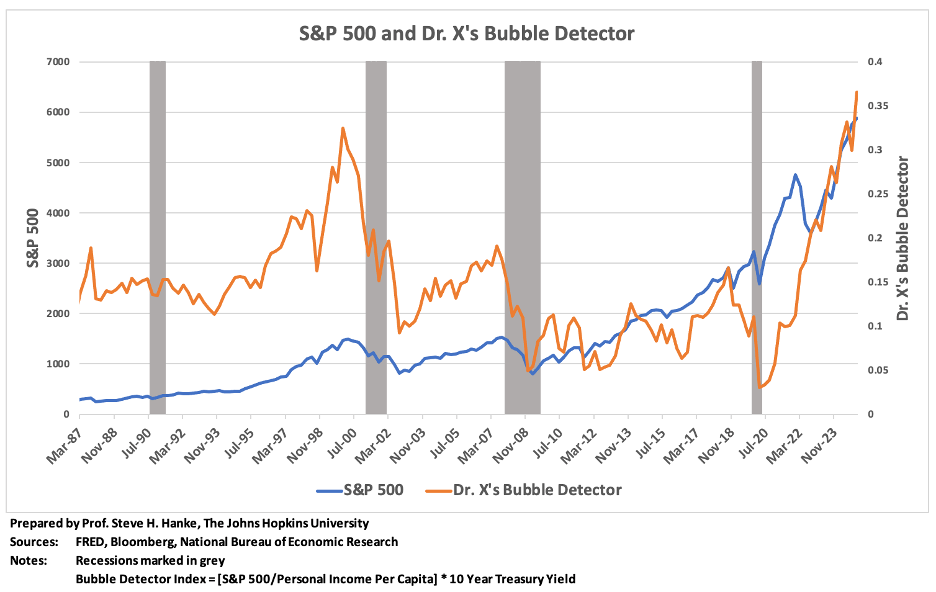
The bubble detector has averaged 0.141 since January 1987. Before the dot-com bubble in the early 2000s, it peaked at 0.3229. Since then, it has dropped as low as 0.0536 in September 2012, and even lower to 0.0306 at the onset of the COVID-19 pandemic. As of December, the bubble detector level is 0.08/0.219, or 0.3655.

The decline in Dr. X’s bubble detector at the start of COVID-19 is an instructive example of how sensitive the value is to financial market conditions. The S&P 500 fell by 20%, and the 10-year Treasury yield was cut in half. The result was that the wealth-to-income ratio for bonds rose and the wealth-to-income ratio for stocks fell. Dr. X’s bubble detector told us it was a great time to buy stocks—and it turned out to be right.

All the makings of a bubble

The current value of the bubble detector—an all-time high of 0.3655—is a product of the exact opposite dynamic. Thanks to a “healthy” dose of helicopter money from the Fed during the pandemic, as well as (albeit exciting) AI-related breakthroughs in the U.S. tech industry, stocks have ripped higher for the last five years, outpacing growth in personal income per capita. At the same time, the inflation that resulted from the Fed’s monetary excesses has driven bond yields higher. So, we have had a trend opposite to that of the early stages of COVID-19:  The wealth-to-income ratio for bonds fell and the wealth-to-income ratio for stocks rose.

What we see has all the makings of the dot-com bubble of the late 1990s that popped in 2001. Indeed, the last time the bubble detector has ever come close to its current level of 0.3655 were the months before the dot-com bubble, when it reached 0.3249. In anticipating that the bubble would pop, Nobelist Robert Shiller argued in Irrational Exuberance that bubbles were a psychological phenomenon that resulted from a confluence of factors: a plausible basis for speculators, like a new invention or technology, plus rumors about fortunes people were making, and both being reinforced by media coverage.

“Calling the top” is a dangerous game to play in markets—no one has a crystal ball. At the same time, a good signal should never be ignored. Dr. X’s bubble detector leads us to believe that Mr. Buffett might be on to something.

Steve H. Hanke is a professor of applied economics at the Johns Hopkins University and the author, with Leland Yeager, of Capital, Interest, and Waiting. Caleb Hofmann is a research scholar at the Johns Hopkins Institute for Applied Economics, Global Health, and the Study of Business Enterprise.

The opinions expressed in Fortune.com commentary pieces are solely the views of their authors and do not necessarily reflect the opinions and beliefs of Fortune.

Join us at the Fortune Workplace Innovation Summit May 19–20, 2026, in Atlanta. The next era of workplace innovation is here—and the old playbook is being rewritten. At this exclusive, high-energy event, the world’s most innovative leaders will convene to explore how AI, humanity, and strategy converge to redefine, again, the future of work. Register now.
About the Authors
Steve H. Hanke
By Steve H. Hanke
Twitter icon
See full bioRight Arrow Button Icon
By Caleb Hofmann
See full bioRight Arrow Button Icon

Latest in Commentary

Finance
Lorem ipsum dolor sit amet, consectetur adipiscing elit, sed do eiusmod tempor incididunt ut labore et dolore magna aliqua. Ut enim ad minim veniam
By Fortune Editors
October 20, 2025
Finance
Lorem ipsum dolor sit amet, consectetur adipiscing elit, sed do eiusmod tempor incididunt ut labore et dolore magna aliqua. Ut enim ad minim veniam
By Fortune Editors
October 20, 2025
Finance
Lorem ipsum dolor sit amet, consectetur adipiscing elit, sed do eiusmod tempor incididunt ut labore et dolore magna aliqua. Ut enim ad minim veniam
By Fortune Editors
October 20, 2025
Finance
Lorem ipsum dolor sit amet, consectetur adipiscing elit, sed do eiusmod tempor incididunt ut labore et dolore magna aliqua. Ut enim ad minim veniam
By Fortune Editors
October 20, 2025
Finance
Lorem ipsum dolor sit amet, consectetur adipiscing elit, sed do eiusmod tempor incididunt ut labore et dolore magna aliqua. Ut enim ad minim veniam
By Fortune Editors
October 20, 2025
Finance
Lorem ipsum dolor sit amet, consectetur adipiscing elit, sed do eiusmod tempor incididunt ut labore et dolore magna aliqua. Ut enim ad minim veniam
By Fortune Editors
October 20, 2025

Most Popular

Finance
Lorem ipsum dolor sit amet, consectetur adipiscing elit, sed do eiusmod tempor incididunt ut labore et dolore magna aliqua. Ut enim ad minim veniam
By Fortune Editors
October 20, 2025
Finance
Lorem ipsum dolor sit amet, consectetur adipiscing elit, sed do eiusmod tempor incididunt ut labore et dolore magna aliqua. Ut enim ad minim veniam
By Fortune Editors
October 20, 2025
Finance
Lorem ipsum dolor sit amet, consectetur adipiscing elit, sed do eiusmod tempor incididunt ut labore et dolore magna aliqua. Ut enim ad minim veniam
By Fortune Editors
October 20, 2025
Finance
Lorem ipsum dolor sit amet, consectetur adipiscing elit, sed do eiusmod tempor incididunt ut labore et dolore magna aliqua. Ut enim ad minim veniam
By Fortune Editors
October 20, 2025
Finance
Lorem ipsum dolor sit amet, consectetur adipiscing elit, sed do eiusmod tempor incididunt ut labore et dolore magna aliqua. Ut enim ad minim veniam
By Fortune Editors
October 20, 2025
Finance
Lorem ipsum dolor sit amet, consectetur adipiscing elit, sed do eiusmod tempor incididunt ut labore et dolore magna aliqua. Ut enim ad minim veniam
By Fortune Editors
October 20, 2025
Fortune Secondary Logo
Rankings
  • 100 Best Companies
  • Fortune 500
  • Global 500
  • Fortune 500 Europe
  • Most Powerful Women
  • Future 50
  • World’s Most Admired Companies
  • See All Rankings
Sections
  • Finance
  • Fortune Crypto
  • Features
  • Leadership
  • Health
  • Commentary
  • Success
  • Retail
  • Mpw
  • Tech
  • Lifestyle
  • CEO Initiative
  • Asia
  • Politics
  • Conferences
  • Europe
  • Newsletters
  • Personal Finance
  • Environment
  • Magazine
  • Education
Customer Support
  • Frequently Asked Questions
  • Customer Service Portal
  • Privacy Policy
  • Terms Of Use
  • Single Issues For Purchase
  • International Print
Commercial Services
  • Advertising
  • Fortune Brand Studio
  • Fortune Analytics
  • Fortune Conferences
  • Business Development
  • Group Subscriptions
About Us
  • About Us
  • Editorial Calendar
  • Press Center
  • Work At Fortune
  • Diversity And Inclusion
  • Terms And Conditions
  • Site Map
  • About Us
  • Editorial Calendar
  • Press Center
  • Work At Fortune
  • Diversity And Inclusion
  • Terms And Conditions
  • Site Map
  • Facebook icon
  • Twitter icon
  • LinkedIn icon
  • Instagram icon
  • Pinterest icon

Latest in Commentary

EuropeLetter from London
Rishi Sunak is giving advice to CEOs on AI. Here are his golden rules
By Kamal AhmedMarch 25, 2026
3 hours ago
retirement
CommentaryRetirement
Our retirement system gets a C-plus; policymakers have an opportunity to make it A grade
By Chris MahoneyMarch 25, 2026
10 hours ago
david-f
CommentaryVenture Capital
Europe has survived 3 energy shocks in 4 years. The only way out is to stop buying power from its enemies
By David FrykmanMarch 25, 2026
11 hours ago
fauci
CommentaryCOVID-19 vaccines
How COVID turned America against science — and what it will take to win it back
By David Blumenthal and James A. MoroneMarch 24, 2026
1 day ago
alex
Commentarydisruption
AI’s disruption is a choice, not a forecast
By Alex StephanyMarch 24, 2026
1 day ago
trump
Commentarynational debt
The Treasury just declared the U.S. insolvent. The media missed it
By Steve H. Hanke and David M. WalkerMarch 23, 2026
2 days ago

Most Popular

Magazine
The youngest-ever female CEO of a Fortune 500 company is fighting Trump's cuts to keep Medicaid strong
By Fortune EditorsMarch 24, 2026
1 day ago
Commentary
The Treasury just declared the U.S. insolvent. The media missed it
By Fortune EditorsMarch 23, 2026
2 days ago
Success
Palantir’s billionaire CEO says only two kinds of people will succeed in the AI era: trade workers — ‘or you’re neurodivergent’
By Fortune EditorsMarch 24, 2026
1 day ago
Energy
Nobel laureate Paul Krugman calls it 'treason': $580 million in suspicious oil futures traded minutes before Trump's Iran reversal
By Fortune EditorsMarch 24, 2026
1 day ago
Success
JPMorgan has started monitoring the keystrokes, video calls, and meetings of its junior investment bankers—and they say it's for employee well-being
By Fortune EditorsMarch 24, 2026
1 day ago
Success
The job market is so bad that ‘reverse recruiters’ are charging $1,500 a month just to help people look for jobs
By Fortune EditorsMarch 25, 2026
12 hours ago

© 2026 Fortune Media IP Limited. All Rights Reserved. Use of this site constitutes acceptance of our Terms of Use and Privacy Policy | CA Notice at Collection and Privacy Notice | Do Not Sell/Share My Personal Information
FORTUNE is a trademark of Fortune Media IP Limited, registered in the U.S. and other countries. FORTUNE may receive compensation for some links to products and services on this website. Offers may be subject to change without notice.