Over the past several years, Big Tech firms like Google and Microsoft have trumpeted ambitious plans to go carbon-neutral, or even carbon-negative, by 2030. But then the generative-AI boom came along and threw a giant wrench in their plans.
AI models such as OpenAI’s GPT-4o and Google’s Gemini, which underpin this latest tech craze, suck up vast amounts of energy. In the race to develop better models, with the help of more data centers to train and operate them, companies will need a lot more power to come online, and soon.
One way Big Tech hopes to achieve this, while also keeping its commitment to carbon-free emissions, is by tapping a source that has been much maligned in the U.S.: nuclear power.
In recent months, Google, Microsoft, and Amazon have all signed deals to help boost the development of new reactors and restart decommissioned ones. Their agreements are a huge endorsement for the nuclear industry and a sign that the tide against it may be turning.
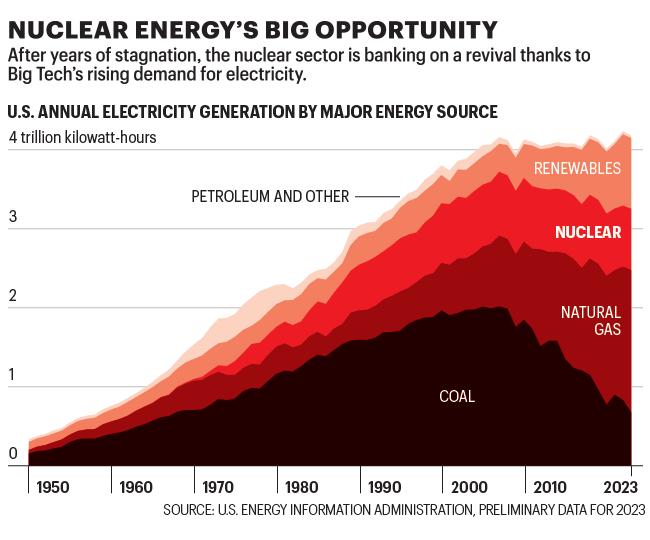
But getting these ambitious projects to the finish line is far from assured, if the industry’s track record is any guide. Of the 94 reactors currently active in the U.S., only four were built within the past three decades.
Public opposition over safety and questions about long-term storage of radioactive waste have made building new nuclear facilities almost a nonstarter. The industry is also facing competition from increasingly cheaper renewable energy that has made nuclear far less attractive financially.
But with the rise of artificial intelligence, and its huge demand for electricity, supporters of nuclear energy feel they have a new opening. And the tech industry has become their new best friend.
The rising impact of data centers on the electrical grid, in many cases to fuel artificial intelligence, is dramatic. Earlier this year, Goldman Sachs predicted that server farms would suck up 8% of all U.S. electricity by 2030, up from just 3% in 2022. The data center boom is already a prime reason for soaring power costs across the country.
Big Tech’s rapid expansion into AI threatens to overwhelm grids and “blow apart” the sector’s climate promises, argues Tyson Slocum, energy program director at consumer advocacy group Public Citizen, which opposes nuclear energy. “Their Hail Mary is nukes.”
Among the sector’s attractions are its nearly carbonless footprint and around-the-clock availability, in contrast to solar and wind, which generate electricity that fluctuates depending on the elements. And the argument for it isn’t entirely based on AI and data centers, but also on the rise of electric vehicle charging and the electrification of heating.
“The demand picture has changed so radically that the economics actually get helped out a lot,” says Bobby Hollis, Microsoft’s vice president of energy.
There is plenty of enthusiasm among lawmakers for this potential nuclear revival. Last December, 25 countries including the U.S. signed a declaration calling for the tripling of nuclear-energy generation by 2050.
Then this year, the U.S. passed the Advance Act, which promises to simplify the permitting process for new nuclear reactors. Traditional reactors have taken as long as a decade to approve, which adds to their already huge cost.
A big part of the nuclear revival hinges on what are known as small modular reactors, or SMRs, a largely unproven technology. They involve mini reactors that are made in factories and assembled on-site, which would theoretically speed up the notoriously lengthy process of building nuclear plants.
“Mini,” however, is a relative term. The reactors can still be as big as an office building.
So far, there are no functioning SMRs in the U.S. The only examples are a few that recently went live in Russia and China.
In October, Google kicked off tech’s dealmaking for SMR-produced energy by signing an agreement with Kairos Power, which promises to deliver six or seven reactors between 2030 and 2035.
Just two days later, Amazon gave X-energy, another startup hoping to introduce SMRs, a high-profile lift by anchoring a $500 million investment round in the company. The e-commerce giant has also plowed money into public power agency Energy Northwest’s nuclear project in Washington, due in 2031, which would be powered by SMRs built by X-energy.
But many are unconvinced that SMRs are the answer. “We still have to see how much they cost and how well the designs being marketed actually work,” says David Schlissel, an analyst at the Institute for Energy Economics and Financial Analysis, a think tank that is skeptical about nuclear power.
Greg Cullen, a vice president at Amazon SMR partner Energy Northwest, acknowledged the possibility that early projects may be more expensive on a dollar-per-kilowatt basis than large reactors are. However, he said lessons from these initial deployments could lead to lower costs in future SMR projects.
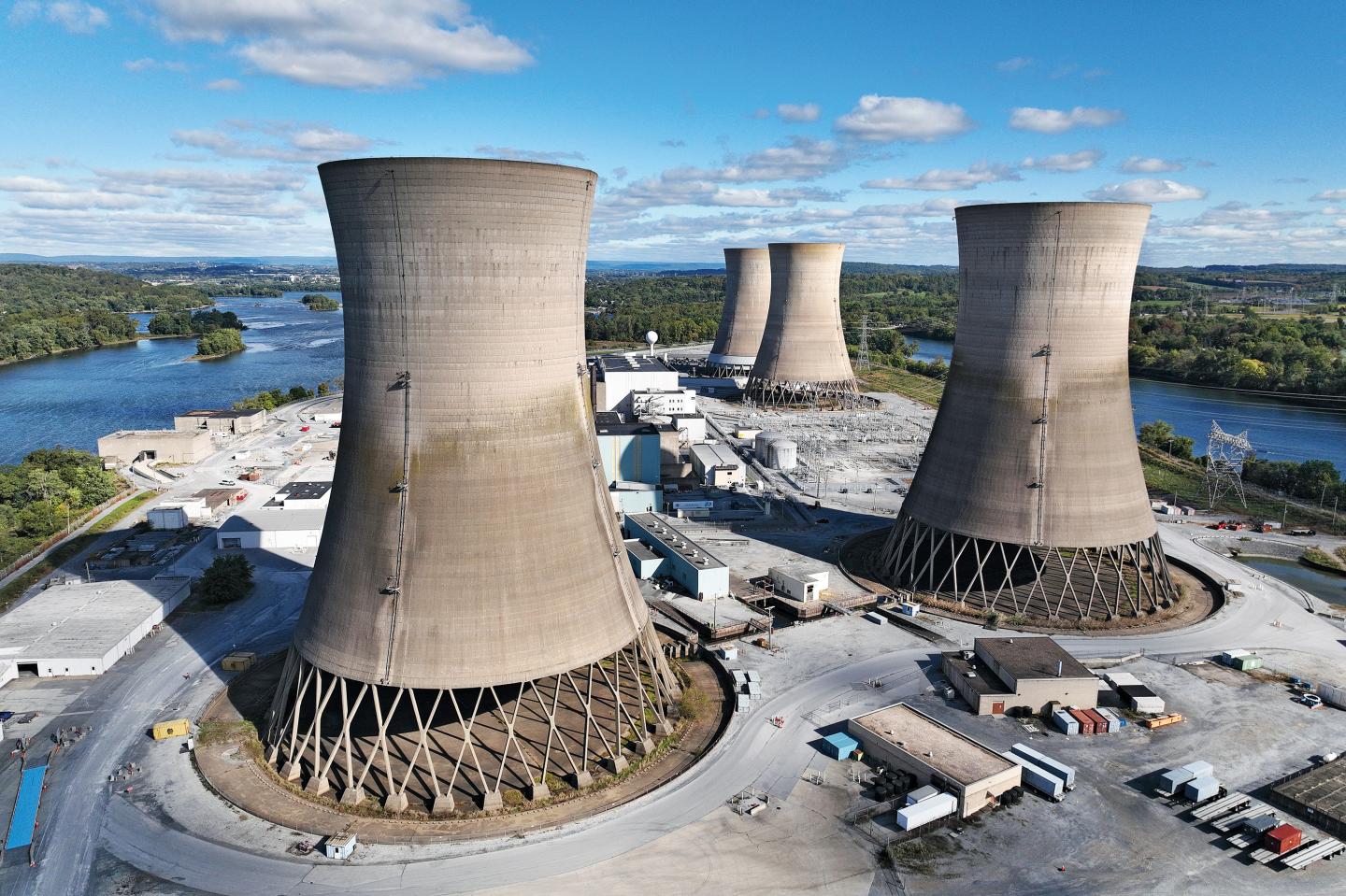
Meanwhile, in September, Microsoft signed a deal with Constellation Energy to revive Unit 1 at Pennsylvania’s Three Mile Island plant, the site, in 1979, of the worst nuclear accident in U.S. history. The reactor in question wasn’t the one involved in the partial meltdown, but rather one that had been shuttered in 2019 because it was too expensive to operate.
Constellation says the reactor, now renamed the Crane Clean Energy Center, will return to service a few years from now. Microsoft won’t directly draw on Crane’s output, but will instead use it to “match” its energy needs elsewhere and therefore avoid additional fossil-fuel plants having to be built, says Hollis.
Elsewhere in Pennsylvania, Amazon is also trying to tap into an existing nuclear plant, the Susquehanna Steam Electric Station, by using the energy the facility produces to power an adjacent data center. However, the company’s plans to expand the data center hit a major snag in November. Regulators sided with complaints from utilities, which buy electricity from the plant’s owner, that the Amazon deal would increase prices for regular power users and threaten the grid’s reliability.
Amazon insists that—even after claiming as much as 960 megawatts of power from Susquehanna, as it would like to—there would be enough left over to satisfy local demand. While the deal doesn’t introduce new power to the grid, Amazon says it should provide enough stable revenue to the plant’s operator to keep the facility active for the foreseeable future.
Financially, most of the tech companies are taking on little risk with their nuclear alliances. The so-called power purchase agreements they’ve signed give some financial security to the power-generation projects without placing any risk on themselves if the projects fail to pan out.
Public Citizen’s Slocum says the reluctance of tech companies to provide upfront funding for nuclear development suggests “there is still hesitation about risk uncertainty with the nuclear build-out.”
Amazon is the exception by leading the big investment in X-energy, which Amazon data center chief Kevin Miller says is the right way to “help companies develop their climate solutions faster.”
In the case of the former Three Mile Island, Constellation has reportedly applied for a federal loan guarantee that would cover the $1.6 billion cost of restarting the reactor. Some have argued that this shifts much of the risk onto taxpayers, though Constellation says it just enables lower-interest-rate financing, and insists the company would repay such a loan itself.
There are also concerns about the length of time it will take for any new nuclear power to come online. The demand for more energy is immediate, but none of the production related to the recent deals with Big Tech will be completed for at least a few years. The focus instead, nuclear critics say, should be on renewables like wind and solar, which are widely proven to work. Also, renewables could soon provide reliable 24/7 power, thanks to advances in energy storage like batteries and gradual improvements in connecting clean power projects to the broader electrical grid.
Microsoft’s Hollis reckons renewables could plausibly satisfy Big Tech’s energy cravings, once the connection and storage pieces of the puzzle are in place. But certainly for the next couple of decades, says Hollis, “nuclear will have a role to play.”
Going nuclear
Tech giants are racing to sign deals for nuclear energy to power their growing ambitions in AI.
Microsoft
Microsoft and Constellation Energy plan to restart the decommissioned Unit 1 at Pennsylvania’s Crane Clean Energy Center, formerly Three Mile Island, by 2028.
Google has signed an agreement with California reactor developer Kairos Power to buy energy from six or seven SMRs, to be completed from 2030 through 2035.
Amazon
Amazon has invested in SMR developer X-energy and utilityconsortium Energy Northwest, with a go-live target of the early 2030s. It’s also exploring an SMR project in Virginia with Dominion Energy, and bought a data center collocated with the Susquehanna Steam Electric Station, a nuclear plant in Pennsylvania.
Oracle
Oracle intends to soon build a large data center powered by three SMRs, chairman Larry Ellison announced in September.
This article appears in the December 2024/January 2025 issue of Fortune with the headline “Why big tech is the nuclear industry’s new best friend.”