• Home
  • Latest
  • Fortune 500
  • Finance
  • Tech
  • Leadership
  • Lifestyle
  • Rankings
  • Multimedia
PoliticsElections

Since the pandemic, incumbents have been ousted in 40 of 54 elections in Western democracies — ‘A kind of electoral long COVID’

By
David Rising
David Rising
,
Jill Lawless
Jill Lawless
,
Nicholas Riccardi
Nicholas Riccardi
, and
The Associated Press
Down Arrow Button Icon
By
David Rising
David Rising
,
Jill Lawless
Jill Lawless
,
Nicholas Riccardi
Nicholas Riccardi
, and
The Associated Press
Down Arrow Button Icon
November 17, 2024, 10:41 AM ET
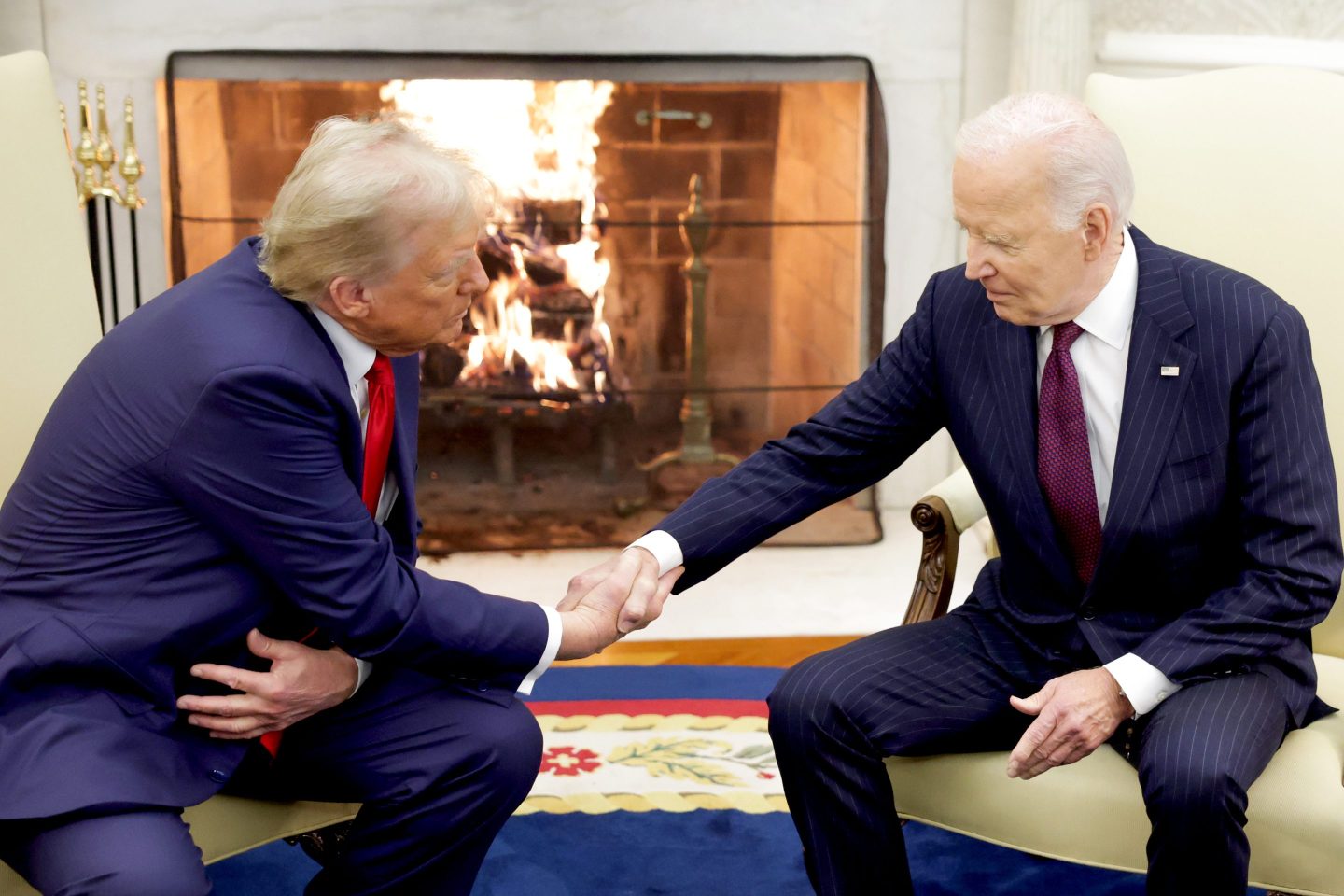
Joe Biden and Donald Trump
Joe Biden and Donald Trump in the Oval Office of the White House on Wednesday.Alex Wong—Getty Images

Whether on the left or the right, regardless of how long they’ve been in power, sitting governments around the world have been drubbed this year by disgruntled voters in what has been called the “super year” for elections.

Recommended Video

Donald Trump’s victory in the U.S. presidential election was just the latest in a long line of losses for incumbent parties in 2024, with people in some 70 countries accounting for about half the world’s population going to the polls.

Issues driving voter discontent have varied widely, though there has been almost universal malaise since the COVID-19 pandemic as people and businesses struggle to get back on their feet while facing stubbornly high prices, cash-strapped governments and a surge in migration.

“There’s an overall sense of frustration with political elites, viewing them as out of touch, that cuts across ideological lines,” said Richard Wike, director of global attitudes research at the Pew Research Center.

He noted that a Pew poll of 24 countries found that the appeal of democracy itself was slipping as voters reported increasing economic distress and a sense that no political faction truly represents them.

“Lots of factors are driving this,” Wike said, “but certainly feelings about the economy and inflation are a big factor.”

Since the pandemic hit in 2020, incumbents have been removed from office in 40 of 54 elections in Western democracies, said Steven Levitsky, a political scientist at Harvard University, revealing “a huge incumbent disadvantage.”

In Britain, the right-of-center Conservatives suffered their worst result since 1832 in July’s election, which returned the center-left Labour Party to power after 14 years.

But just across the English Channel, the far right rocked the governing parties of France and Germany, the European Union’s biggest and most powerful members, in June elections for the parliament of the 27-nation bloc.

The results pushed French President Emmanuel Macron to call a parliamentary election in hope of stemming a far-right surge at home. The anti-immigration National Rally party won the first round, but alliances and tactical voting knocked it down to third place in the second round, producing a fragile government atop a divided legislature.

In Asia, a group of South Korean liberal opposition parties, led by the Democratic Party, defeated the ruling conservative People Power Party in April’s parliamentary elections.

India’s Narendra Modi, meanwhile, had been widely expected to easily sweep to a third straight term in June but instead voters turned away from his Hindu nationalist Bharatiya Janata Party in droves, costing it its majority in parliament, though it was able to remain in power with the help of allies.

Likewise, Japanese voters in October punished the Liberal Democratic Party, which has governed the country nearly without interruption since 1955.

Japanese Prime Minister Shigeru Ishiba will stay in power, but the greater-than-expected loss ended the LDP’s one-sided rule, giving the opposition a chance to achieve policy changes long opposed by the conservatives.

“If you were to ask me to explain Japan in a vacuum, that’s not too difficult,” said Paul Nadeau, an adjunct assistant professor at Temple University’s Japan campus in Tokyo.

“Voters were punishing an incumbent party for a corruption scandal, and this gave them a chance to express a lot more frustrations that they already had.”

Globally, however, it’s harder to draw conclusions.

“This is pretty consistent across different situations, different countries, different elections — incumbents are getting a crack on the shins,” he said. “And I don’t have any good big picture explanations for why that is.”

Rob Ford, professor of political science at the University of Manchester, said inflation has been a major driver of “the greatest wave of anti-incumbent voting ever seen” — though the reasons behind the backlash may also be “broader and more diffuse.”

“It could be something directly to do with the long-term effects of the COVID pandemic — a big wave of ill health, disrupted education, disrupted workplace experiences and so forth making people less happy everywhere, and they are taking it out on governments,” he said.

“A kind of electoral long COVID.”

In South Africa, high unemployment and inequality helped drive a dramatic loss of support for the African National Congress, which had governed for three decades since the end of the apartheid system of white minority rule. The party once led by Nelson Mandela lost its parliamentary majority in May’s election and was forced to go into coalition with opposition parties.

Other elections in Africa presented a mixed picture, said Alex Vines, director of the African Program at the international affairs think tank Chatham House, partially clouded by countries with authoritarian leaders whose reelections were not in doubt, like Rwanda’s long-serving President Paul Kagame who got 99% of the vote.

In African countries with strong democratic institutions, however, the pattern of incumbents being punished holds, Vines said.

“The countries with stronger institutions — South Africa, Senegal, Botswana — have witnessed either a government of national unity or change of party of government,” he said.

In Botswana, voters unexpectedly ejected a party that had ruled for 58 years since independence from Britain in an October election.

Vines said that across the continent, “you’ve got this electorate now who have no memory of decolonization or the end of apartheid and so have different priorities, who are also feeling the cost-of-living pressures.”

In Latin America, one major country stands out for bucking the anti-incumbent wave – Mexico.

Andrés Manuel López Obrador, limited to a single term, selected Claudia Sheinbaum, a member of his party, to succeed him. Sheinbaum easily won the presidency in June’s election.

Wike noted that Mexico is one of the few countries in Pew’s survey where voters reported satisfaction with economic conditions.

Some newcomers to office have already found that the honeymoon following their victories has been short, as people have rapidly turned on them.

British Prime Minister Keir Starmer has seen his approval ratings plummet from a jaded electorate that wants lower prices and better public services — but is deeply skeptical of politicians’ intention and ability to deliver change.

Ford, of the University of Manchester, said it’s a problem for democracy when voters, whose task is to hold governments to account, are so quick to pass judgment.

“If voters are the electoral equivalent of a hanging judge, putting politicians to the gallows whether they be guilty or innocent, then what incentive is there for governments to try?” he asked. “The angels and the devils get chucked out alike, but being an angel is harder.”

Trump first came to power as a challenger in the 2016 election, and then lost as an incumbent in the 2020 election to Joe Biden. This year, he defeated Biden’s vice president, Kamala Harris, who stepped in late in the race when the president unexpectedly dropped out.

Trump’s win is one of the conservative populist movement’s highest-profile triumphs. But another icon of the cause, Hungarian Prime Minister Viktor Orbán, saw his own party suffer its worst showing in decades in this year’s European Union election, demonstrating that no movement is safe from backlash.

Nadeau, of Temple University, suggested that perhaps analysts had previously misunderstood global electoral trends — parsing them as ideological shifts — “when all along it was actually an anti-incumbent mood.”

“Maybe it has always been anti-incumbent, and we were just misdiagnosing it,” he said.

The Fortune 500 Innovation Forum will convene Fortune 500 executives, U.S. policy officials, top founders, and thought leaders to help define what’s next for the American economy, Nov. 16-17 in Detroit. Apply here.
About the Authors
By David Rising
See full bioRight Arrow Button Icon
By Jill Lawless
See full bioRight Arrow Button Icon
By Nicholas Riccardi
See full bioRight Arrow Button Icon
By The Associated Press
See full bioRight Arrow Button Icon

Latest in Politics

Finance
Lorem ipsum dolor sit amet, consectetur adipiscing elit, sed do eiusmod tempor incididunt ut labore et dolore magna aliqua. Ut enim ad minim veniam
By Fortune Editors
October 20, 2025
Finance
Lorem ipsum dolor sit amet, consectetur adipiscing elit, sed do eiusmod tempor incididunt ut labore et dolore magna aliqua. Ut enim ad minim veniam
By Fortune Editors
October 20, 2025
Finance
Lorem ipsum dolor sit amet, consectetur adipiscing elit, sed do eiusmod tempor incididunt ut labore et dolore magna aliqua. Ut enim ad minim veniam
By Fortune Editors
October 20, 2025
Finance
Lorem ipsum dolor sit amet, consectetur adipiscing elit, sed do eiusmod tempor incididunt ut labore et dolore magna aliqua. Ut enim ad minim veniam
By Fortune Editors
October 20, 2025
Finance
Lorem ipsum dolor sit amet, consectetur adipiscing elit, sed do eiusmod tempor incididunt ut labore et dolore magna aliqua. Ut enim ad minim veniam
By Fortune Editors
October 20, 2025
Finance
Lorem ipsum dolor sit amet, consectetur adipiscing elit, sed do eiusmod tempor incididunt ut labore et dolore magna aliqua. Ut enim ad minim veniam
By Fortune Editors
October 20, 2025

Most Popular

Finance
Lorem ipsum dolor sit amet, consectetur adipiscing elit, sed do eiusmod tempor incididunt ut labore et dolore magna aliqua. Ut enim ad minim veniam
By Fortune Editors
October 20, 2025
Finance
Lorem ipsum dolor sit amet, consectetur adipiscing elit, sed do eiusmod tempor incididunt ut labore et dolore magna aliqua. Ut enim ad minim veniam
By Fortune Editors
October 20, 2025
Finance
Lorem ipsum dolor sit amet, consectetur adipiscing elit, sed do eiusmod tempor incididunt ut labore et dolore magna aliqua. Ut enim ad minim veniam
By Fortune Editors
October 20, 2025
Finance
Lorem ipsum dolor sit amet, consectetur adipiscing elit, sed do eiusmod tempor incididunt ut labore et dolore magna aliqua. Ut enim ad minim veniam
By Fortune Editors
October 20, 2025
Finance
Lorem ipsum dolor sit amet, consectetur adipiscing elit, sed do eiusmod tempor incididunt ut labore et dolore magna aliqua. Ut enim ad minim veniam
By Fortune Editors
October 20, 2025
Finance
Lorem ipsum dolor sit amet, consectetur adipiscing elit, sed do eiusmod tempor incididunt ut labore et dolore magna aliqua. Ut enim ad minim veniam
By Fortune Editors
October 20, 2025
Fortune Secondary Logo
Rankings
  • 100 Best Companies
  • Fortune 500
  • Global 500
  • Fortune 500 Europe
  • Most Powerful Women
  • Future 50
  • World’s Most Admired Companies
  • See All Rankings
Sections
  • Finance
  • Fortune Crypto
  • Features
  • Leadership
  • Health
  • Commentary
  • Success
  • Retail
  • Mpw
  • Tech
  • Lifestyle
  • CEO Initiative
  • Asia
  • Politics
  • Conferences
  • Europe
  • Newsletters
  • Personal Finance
  • Environment
  • Magazine
  • Education
Customer Support
  • Frequently Asked Questions
  • Customer Service Portal
  • Privacy Policy
  • Terms Of Use
  • Single Issues For Purchase
  • International Print
Commercial Services
  • Advertising
  • Fortune Brand Studio
  • Fortune Analytics
  • Fortune Conferences
  • Business Development
  • Group Subscriptions
About Us
  • About Us
  • Editorial Calendar
  • Press Center
  • Work At Fortune
  • Diversity And Inclusion
  • Terms And Conditions
  • Site Map
  • About Us
  • Editorial Calendar
  • Press Center
  • Work At Fortune
  • Diversity And Inclusion
  • Terms And Conditions
  • Site Map
  • Facebook icon
  • Twitter icon
  • LinkedIn icon
  • Instagram icon
  • Pinterest icon

Latest in Politics

Tesla CEO Elon Musk listens as U.S. President Donald Trump speaks to reporters in the Oval Office of the White House on May 30, 2025 in Washington, DC.
PoliticsElon Musk
The White House snubs Elon Musk’s offer to cover TSA salaries as airport miseries hit record levels
By Eva RoytburgMarch 25, 2026
28 minutes ago
UN
PoliticsUnited Nations
It’s time for slavery reparations, ‘the gravest crime against humanity,’ UN General Assembly says
By Edith M. Lederer and The Associated PressMarch 25, 2026
46 minutes ago
melania
PoliticsWhite House
Enter Melania Trump, escorted by humanoid robot: ‘I’m Figure 03, a humanoid built for the United States of America’
By Darlene Superville and The Associated PressMarch 25, 2026
50 minutes ago
iran
Middle EastMiddle East
‘We do not plan on any negotiations’: Iran laughs at White House’s claims of cease-fire talks
By Jon Gambrell, Mike Corder, Munir Ahmed, Aamer Madhani and The Associated PressMarch 25, 2026
57 minutes ago
emily
PoliticsElections
Meet the 40-year-old Democrat who owns a fitness company for pregnant and postpartum women and just won in Trump’s district
By Bill Barrow, Mike Schneider and The Associated PressMarch 25, 2026
1 hour ago
Pete Hegseth speaks behind a podium as Donald Trump watches behind him.
EconomyRecession
Mark Zandi warns recession odds are creeping toward 50%, and the Iran war could launch us into economic turmoil by midyear
By Sasha RogelbergMarch 25, 2026
4 hours ago

Most Popular

Magazine
The youngest-ever female CEO of a Fortune 500 company is fighting Trump's cuts to keep Medicaid strong
By Fortune EditorsMarch 24, 2026
2 days ago
Commentary
The Treasury just declared the U.S. insolvent. The media missed it
By Fortune EditorsMarch 23, 2026
2 days ago
Success
Palantir’s billionaire CEO says only two kinds of people will succeed in the AI era: trade workers — ‘or you’re neurodivergent’
By Fortune EditorsMarch 24, 2026
1 day ago
Energy
Nobel laureate Paul Krugman calls it 'treason': $580 million in suspicious oil futures traded minutes before Trump's Iran reversal
By Fortune EditorsMarch 24, 2026
1 day ago
Success
The job market is so bad that ‘reverse recruiters’ are charging $1,500 a month just to help people look for jobs
By Fortune EditorsMarch 25, 2026
14 hours ago
Success
JPMorgan has started monitoring the keystrokes, video calls, and meetings of its junior investment bankers—and they say it's for employee well-being
By Fortune EditorsMarch 24, 2026
1 day ago

© 2026 Fortune Media IP Limited. All Rights Reserved. Use of this site constitutes acceptance of our Terms of Use and Privacy Policy | CA Notice at Collection and Privacy Notice | Do Not Sell/Share My Personal Information
FORTUNE is a trademark of Fortune Media IP Limited, registered in the U.S. and other countries. FORTUNE may receive compensation for some links to products and services on this website. Offers may be subject to change without notice.