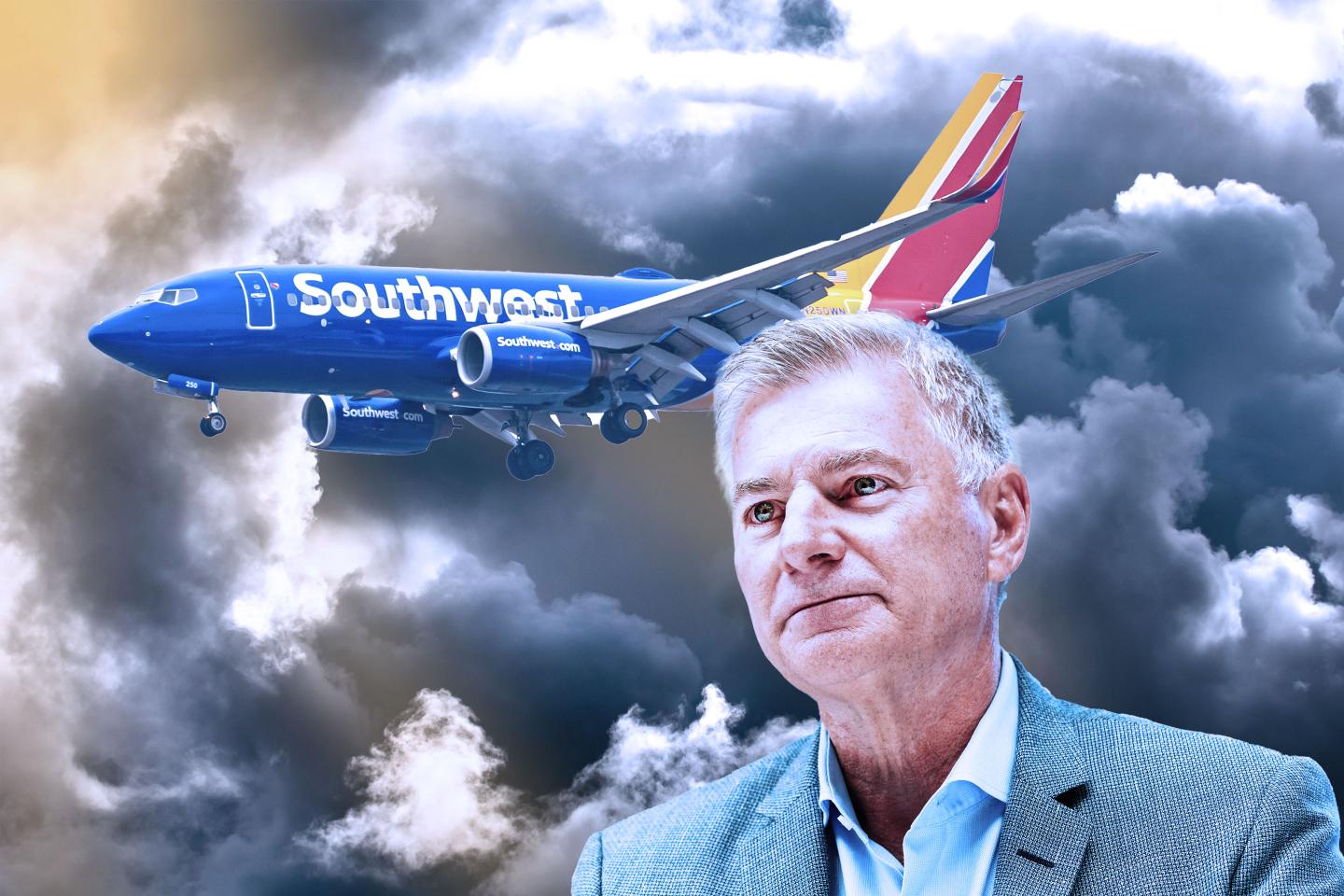
The storm’s timing couldn’t have been worse.
In late December of 2022, an “extratropical cyclone” brought all manner of menacing winter conditions to two-thirds of the U.S., including the entire Eastern Seaboard and parts of Canada. Wind-chill warnings, whiteouts, and extraordinary snowfall complicated travel for millions.
Flight cancellations from what was unofficially dubbed Winter Storm Elliott were inevitable, creating chaos at most airlines for a day. But for Southwest Airlines and its outdated crew-scheduling software, the madness dragged on for over 72 hours as the carrier canceled more than 16,000 flights. An undisclosed number of people were forced to sleep in airports or improvise road trips with strangers to salvage their holidays. The meltdown was so bad that Southwest was pilloried by Saturday Night Live.
The company eventually got back to business as usual, until this year, when a barrage of attacks from another Elliott—this one an activist hedge fund—led to a high-profile reckoning and major leadership shakeup.
The battle alarmed Southwest’s loyal flyers, who are legion. Over 50 years, the Texas-based company has built a cult-favorite brand on a combination of economy-class-only flights, free bag checks and flight changes, and often self-deprecating humor. Flight attendants are known for bookending their safety procedure announcements with comedy bits and dad jokes.
But some investors say Southwest’s foundational practices haven’t aged well as industry operating costs have risen. Since the pandemic, Southwest has lagged competitors in financial performance, and its share price is down 50% compared to 2021.
Seeing a turnaround opportunity, Elliott Management, an activist hedge fund with an 11% stake in the $18 billion airline, launched an aggressive campaign earlier this year to push out CEO Bob Jordan, as well as chairman and former CEO Gary Kelly, and replace half of Southwest’s board. Elliott asserted that the company’s leadership is too entrenched in the airline’s existing operating and pricing model to make changes to boost revenue. “Southwest’s rigid commitment to a decades-old approach has inhibited its ability to compete in the modern airline industry,” the hedge fund said in its opening salvo.
The two sides reached an agreement this week, averting a proxy battle. Southwest agreed to take on six new board members, five of whom were Elliott nominees, including former CEOs from Virgin America and WestJet. The board also added former Chevron CFO Pierre Breber. Kelly, who had led Southwest for 18 years, will now retire earlier than previously planned as part of the truce. But Jordan, a 30-year company veteran who became CEO in 2022, will hold on to his job.
Southwest Airlines and Elliott Management declined to comment.
Not long ago, such activist drama at Southwest would have been unthinkable. The airline’s remarkable growth story from startup to a top-four U.S. airline—along with American Airlines, Delta Air Lines, and United Airlines—made it a business-school case-study favorite. And before the pandemic, Southwest was profitable for 47 straight years. No other domestic or global airline can claim the same profitability streak. In fact, all three of Southwest’s main U.S. competitors have gone bankrupt at least once in the past half-century.
But the same unique traits that made Southwest soar—its egalitarian seating and anti-fee stance—have paradoxically weighed it down, says Donald Sull, an MIT Sloan School of Management professor of business practice and author of Revival of the Fittest: Why Good Companies Go Bad and How Great Managers Can Remake Them.
Sull, who has followed Southwest’s story for years, tells Fortune that the airline’s current crisis is reminiscent of companies like Blockbuster and Compaq. In short, Southwest has been responding to changes in the business landscape by doubling down on its existing strategy.
“Business history is littered with the corpses of companies that have fallen prey to active inertia,” he adds.
No frills and few fees
Herbert Kelleher cofounded Southwest more than 50 years ago as a local, low-cost airline serving Texan cities. As the airline grew, it took a radically different approach to air travel than its competitors. In addition to creating a no-frills, few-fees experience, Southwest adopted a point-to-point routing system, allowing passengers to fly between cities without transferring, rather than the hub-and-spoke model, which requires fliers to stop over in another city. Southwest also used only one type of plane, a Boeing 737, to standardize operations. And most famously, the startup embraced an open seating plan and, until 2007, a first-come, first serve policy.
Over time, Kelleher became known as much for his business prowess as his sense of humor. In a 1994 profile, Fortune called him “the airline industry’s jokemeister, the High Priest of Ha-Ha, a man who has appeared in public dressed as Elvis and the Easter Bunny, who has carved an antic public persona out of his affection for cigarettes, bourbon, and bawdy stories.” But he was revered as a strategist too. After Kelleher died in 2019, management guru Roger Martin paid tribute to the founder, writing that he was one of a few who understood that “the only path to distinctive results is with distinctive choices.”
At the time, those choices had been working for decades. There was little deviation, aside from a tweak to its seating policy following increased security requirements after 9/11. And 2015 to 2019 was a particularly heady time for the U.S. airline industry in general, characterized by strong demand and profitability, Nicolas Owens, airline analyst at research firm Morningstar, tells Fortune. Low oil prices were the key tailwinds at the time, Owens argues, since airlines tend to pass on fuel costs to passengers when oil is expensive, and chop ticket prices when fuel costs drop.
But the pandemic and temporary plane groundings brought an abrupt halt to this period. “COVID comes along and totally disrupts the industry,” says Owens. “Planes aren't flying, people aren't flying, etc etera.”
The pandemic briefly sent airline valuations into a free fall. But another change came as the pandemic eased and airlines began ramping up again. Customer preferences shifted, and more Americans chose to fly internationally or revenge-spend on premium services, while taking fewer same-day business trips between U.S. cities.
The airlines weren’t ready for the surge in demand, Owens explains. Just finding pilots was challenging; many of those who hadn’t been furloughed had retired. However, other than Southwest, the large U.S. airlines were prepared to meet the flying public’s new inclinations, having the right travel networks and products in place to take advantage of pent-up demand for Paris getaways or adventures in Tokyo. Before the pandemic, they had built up their capacity through mergers, and given themselves many levers to pull to respond to the marketplace. For example, they had three or more levels of passenger service to sell, along with airport lounge access. They could charge passengers for extra leg room or faster boarding privileges. With their international routes or airline partnerships, they were prepared to serve globe-trotters, vacationers, short-haul business travelers, and anyone else. “You had really strong financial results in general, where you had airlines reporting record revenue compared to 2019,” even with fewer flights, Owens says.
Southwest’s competitors have also been introducing basic economy seats, cutting into its no-frills strategy and “flooding the price-conscious-traveler space with additional seats within their existing networks,” says David Vernon, an analyst with Sanford C. Bernstein. In short, major airlines have been innovative with their fare-segmentation strategies in a way that Southwest has not.
“The Elliott criticism that the Southwest experience hasn't changed much is fair,” he adds.
As a result of the shift in consumer tastes and increased competition for budget travelers, not to mention higher labor and fuel costs, Southwest has been struggling in the post-pandemic environment. This year, Boeing’s own struggles and its expectation of slower production also impacted the company, which was forced to cut its capacity.
Winter Storm Elliott was also a blow, and one that could have been avoided had the company prioritized an update of its crew-scheduling system. The software had no way of automatically reassigning crews to planes following cancellations, and instead required staffers to manually find and schedule crew members. That was a manageable issue when relatively few flights were canceled, but a logistical nightmare when it came to thousands. In an internal report, the company also identified “insufficient winter infrastructure and equipment in key airport locations” as a root cause of the crisis.
CEO Jordan apologized for the chaos, saying in a video message that “we know even our deepest apologies—to our customers, to our employees, and to all affected through this disruption—only go so far.” The airline vowed to refund customers, later spending $600 million to do so.
A cultural blindness
The 2022 meltdown left Southwest with a $140 million fine from the Department of Transportation and temporarily stained the brand. It was also a damning sign of Southwest’s cultural insularity, according to Rob Britton, an adjunct professor at Georgetown University’s McDonough School of Business and a former American Airlines executive.
Like Sull, he argues that Southwest leaders created and presided over a culture that relied too heavily on past success, and failed to prioritize innovation. To his mind, that’s what led to its failure to invest adequately in technology. Even in its heyday, the company was too satisfied with its own strategies, for example rejecting Wall Street suggestions that it charge for bags as other airlines have done for more than a decade, says Britton. For context, American and United earned $1 billion each in bag fees last year. (Southwest recently shared customer research showing the airline would lose $300 million annually if it charged for bags, based on the number of consumers who would stop flying Southwest.)
Companies ought to be constantly reviewing which entrenched practices are working and which are holding them back from even greater growth, Britton says. Had Southwest dropped some of its trademark policies that keep costs down for customers, it may have been better prepared to weather rising costs.
To be fair, says Britton, “the industry tends toward insularity.” Airline leaders are often reluctant to hire leaders from the automotive or consumer-goods categories since they believe that airlines are just too complex for outsiders to understand. “Southwest is an extreme version of that insularity,” he continues, pointing to the company’s commitment to promoting from within and longtime aversion to establishing alliances with other airlines.
But Sull cautions against painting Southwest executives as arrogant, complacent, or not forward-looking. “None of that has to be true for a company to struggle to adapt to changing circumstances when its commitments have hardened,” he says. Executives who have seen their unique system work and have been breathing the same air for years struggle to envision alternatives.
Making changes
To escape “active inertia,” according to Sull’s research, companies do need to make drastic changes, but not necessarily by embracing an outsider CEO. Instead, they should look to insider-outside leaders, or executives from the company who have institutional knowledge but also enough distance to see the company’s predicament. That person might run an international business, for example, or a non-core division. Think Jack Welch at GE, who ran the company’s plastics business before taking over, says Sull.
Vernon, the Bernstein analyst, suggests that Southwest’s leadership might not have been burying their heads in the sand as much as “hoping that things would go back to the way they were”—that is, with more people taking cheap, high-frequency, short-haul flights.
“I think the market changed really quickly,” he says, “and they weren’t sure if the change was permanent.”
That Jordan was spared in the changes driven by Elliott did not surprise analysts. Just last month, the CEO revealed plans for seats with more legroom and assigned seats, adjustments the company said were in the works before Elliott began agitating for change. Last month, Southwest also launched its first airline partnership, linking with Icelandair. The company had signaled that it, too, saw the need for change, and had already agreed to Kelly’s departure.
Southwest’s next big challenge is developing a granular understanding of its customer segments, Owens says. But he cautions that labor costs and other issues are still working their way through the highly competitive airline industry.
“I don't think any given airline is really in control of its economic destiny,” he adds.