• Home
  • Latest
  • Fortune 500
  • Finance
  • Tech
  • Leadership
  • Lifestyle
  • Rankings
  • Multimedia
FinanceU.S. Department of the Treasury

Steve Mnuchin calls for a culling of the 20-year Treasury bond he reintroduced

By
Ye Xie
Ye Xie
,
Liz Capo McCormick
Liz Capo McCormick
,
Saleha Mohsin
Saleha Mohsin
, and
Bloomberg
Bloomberg
Down Arrow Button Icon
By
Ye Xie
Ye Xie
,
Liz Capo McCormick
Liz Capo McCormick
,
Saleha Mohsin
Saleha Mohsin
, and
Bloomberg
Bloomberg
Down Arrow Button Icon
August 7, 2024, 8:10 PM ET
Steven Mnuchin
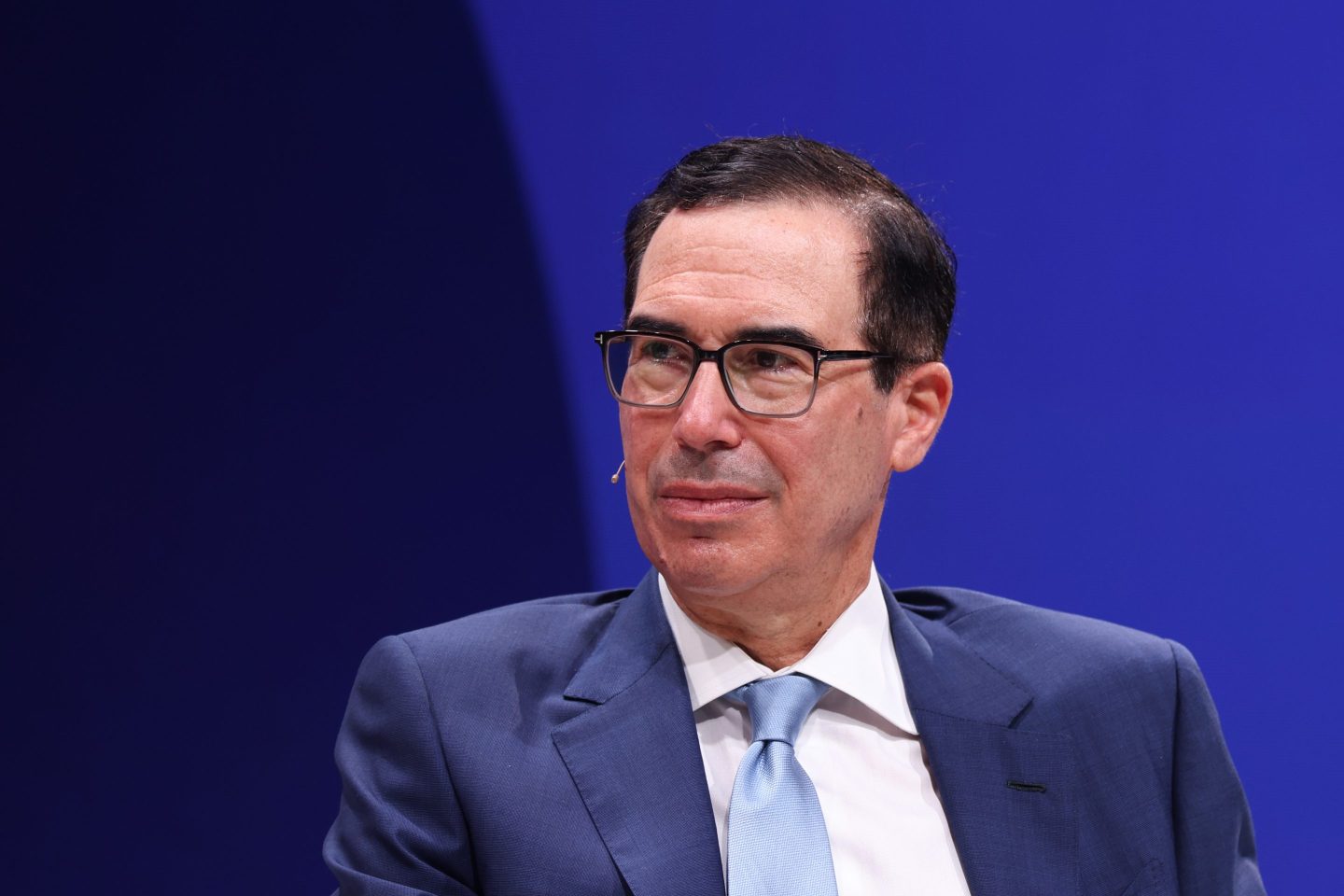
Steven Mnuchin, former U.S. Treasury secretary, in 2023.Christopher Pike—Bloomberg/Getty Images

It only takes a quick glance at the U.S. bond curve to realize something is off. One Treasury security — the 20-year — is detached from the rest of the market. It hovers at yields that are far higher than those on the bonds surrounding it — the 10-year and the 30-year.

Recommended Video

This isn’t just some minor aesthetic for traders to fret about. It costs the American taxpayer money. Since the Treasury re-introduced the 20-year bond in monthly auctions four years ago, their sale has tacked on roughly $2 billion a year in interest expenses on top of what the government would have otherwise paid, a simple back-of-the-envelope calculation shows. That’s some $40 billion over the life of the bonds.

This is, at some level, peanuts for a government that spends almost $7 trillion annually. And yet, $2 billion goes a long way. It’s the same amount the government spends each year to operate the national park system, and more than what goes to home-buying assistance for military veterans.

Raise the matter with most bond-market experts and they’ll hem and haw about whether to eliminate the 20-year bond to save money. It’s more complicated than it seems, they say. But one person — out of the roughly a dozen interviewed for this story — stated without hesitation or stipulation that it should be killed. That person, tellingly, is the very man who brought the bond back to life in 2020: Steven Mnuchin.

“I would not keep issuing them,” Mnuchin, who served as Treasury Secretary under then-President Donald Trump, said when contacted by Bloomberg News. The conceit — to create another maturity to help lock in low borrowing costs for decades — made sense at the time, he contends, but things simply haven’t worked out as planned. “It’s just costly to the taxpayer.”

Mnuchin’s about-face echoes, in some ways, the go-fast-and-break-things approach to policy making that Trump and his team preferred. The Biden administration, by contrast, is taking a more conventional approach and sticking with the 20-year bond — albeit at a scaled-back size — to ensure continuity and stability in the government’s debt sale program. (A spokesperson for the Treasury declined to comment.)

Whichever party takes the White House in November, the takeaway from the rollout of the 20-year is clear: Managing the government’s ballooning deficit is becoming increasingly tricky. At almost $2 trillion, it’s double the level of just five years ago. And investors aren’t necessarily going to eagerly snap up some new bond just because the Treasury dangles it in front of them.

This is simply the grim new reality of America’s finances, bond-market experts say. The country needs as many creditors willing to lend it money as possible. And for those experts who are hesitant to recommend a quick end to the 20-year auctions, that need is paramount — even if it means paying up to lure buyers to a new security in the market.

“Having another maturity point,” says Brian Sack, the head of macro strategy at multi-strategy hedge fund Balyasny Asset Management, “gives them some additional flexibility.”

The US resumed selling 20-year bonds in May 2020 following a more than three-decade hiatus.

There were signs from the beginning that the debt would be expensive. Bond-market advisers who gave the new maturity their blessing warned the Treasury not to overestimate demand. Yet initial auction sizes were significantly larger than recommended.

“We wanted to issue as much long-term debt as possible to extend our maturities and lock in the very low rates that existed at the time,” said Mnuchin, who now runs private equity firm Liberty Strategic Capital. He had even wanted to introduce super long-term debt — securities due in 50 or 100 years — but settled on 20 years when advisers discouraged that idea.

The 20-year bonds really began to falter following a series of auction size increases and soon became the highest-yielding US government security. Today, even after auctions have been reduced, it remains the most expensive form of financing beyond short-term T-bills. 

Analysts point to a variety of reasons why the 20-year bond continues to struggle. Prominent among them: it’s not as liquid as the 10-year and it offers less duration, or interest-rate risk, than the 30-year.

At 4.34%, the 20-year yield is currently 0.23 percentage point above the average of the 10- and 30-year securities. It can be difficult to measure alternative financing costs with precision because yields on 10- and 30-year bonds could be a tick higher today if the Treasury had sold more of them rather than issuing the 20-year notes. But that yield gap, when calculated at the time of issuance over the past four years, generates an added-cost estimate of $2 billion annually.

A more conservative calculation of the added cost, based on the gap between yields on Treasuries and interest-rate swaps, puts the figure at about half that amount.

“From the taxpayer perspective, the most important thing is, over time, can you minimize the cost of borrowing?” says Ed Al-Hussainy, a rates strategist at Columbia Threadneedle Investments in New York. “It’s not clear we got that.”

Al-Hussainy is one of the few in the market who shares Mnuchin’s view. The whole thing has been a “mistake,” he says. “There’s not much demand for these particular bonds. It doesn’t make sense.”

To try to better match supply with demand, the Treasury has dramatically scaled back issuance of the maturity in recent years. Quarterly sales of 20-year debt now stand at $42 billion, down from a peak of $75 billion.

“The Treasury has brought 20-year bonds to a more appropriate size,” Sack says. He used to sit on the Treasury Borrowing Advisory Committee, a panel of bond dealers and investors that advises the government on issuance strategy. In 2020, the committee supported the launch of the 20-year bond. “The market for that security is now in better balance than it was a few years ago.”

And Amar Reganti, a former deputy director of the Treasury’s Office of Debt Management, said the market will likely look even better in a few years. It can take a while, Reganti stressed, for new securities to draw the sort of consistent demand that other maturities attract.

While the four years since their debut seem “like a long period of time in capital markets,” said Reganti, who is now a fixed-income strategist at Hartford Funds, “it’s actually quite a short period of time from a debt management perspective.”

Not for Mnuchin. The market, he said, has had more than enough time to render a verdict.

Meanwhile, one group already has stopped selling 20-year bonds: corporate America. At first, CFOs across the country boosted sales of 20-year bonds when the Treasury reintroduced the maturity. This was one of the positive side effects that policymakers were seeking.

That pickup quickly faded, though, and today the market is all but dead. New offerings totaled just $3 billion through the first half of the year, down from $82 billion over the course of 2020. The maturity accounts for less than 1% of the combined sales of 10-year and 30-year bonds, down from about 10% previously, according to data compiled by Bloomberg.

“We always say that in the corporate market, supply follows demand and there’s just not a lot of demand for 20-year bonds in general,” said Winnie Cisar, global head of credit strategy at CreditSights. “It’s just a weird tenor.”

Join us at the Fortune Workplace Innovation Summit May 19–20, 2026, in Atlanta. The next era of workplace innovation is here—and the old playbook is being rewritten. At this exclusive, high-energy event, the world’s most innovative leaders will convene to explore how AI, humanity, and strategy converge to redefine, again, the future of work. Register now.
About the Authors
By Ye Xie
See full bioRight Arrow Button Icon
By Liz Capo McCormick
See full bioRight Arrow Button Icon
By Saleha Mohsin
See full bioRight Arrow Button Icon
By Bloomberg
See full bioRight Arrow Button Icon

Latest in Finance

Finance
Lorem ipsum dolor sit amet, consectetur adipiscing elit, sed do eiusmod tempor incididunt ut labore et dolore magna aliqua. Ut enim ad minim veniam
By Fortune Editors
October 20, 2025
Finance
Lorem ipsum dolor sit amet, consectetur adipiscing elit, sed do eiusmod tempor incididunt ut labore et dolore magna aliqua. Ut enim ad minim veniam
By Fortune Editors
October 20, 2025
Finance
Lorem ipsum dolor sit amet, consectetur adipiscing elit, sed do eiusmod tempor incididunt ut labore et dolore magna aliqua. Ut enim ad minim veniam
By Fortune Editors
October 20, 2025
Finance
Lorem ipsum dolor sit amet, consectetur adipiscing elit, sed do eiusmod tempor incididunt ut labore et dolore magna aliqua. Ut enim ad minim veniam
By Fortune Editors
October 20, 2025
Finance
Lorem ipsum dolor sit amet, consectetur adipiscing elit, sed do eiusmod tempor incididunt ut labore et dolore magna aliqua. Ut enim ad minim veniam
By Fortune Editors
October 20, 2025
Finance
Lorem ipsum dolor sit amet, consectetur adipiscing elit, sed do eiusmod tempor incididunt ut labore et dolore magna aliqua. Ut enim ad minim veniam
By Fortune Editors
October 20, 2025

Most Popular

Finance
Lorem ipsum dolor sit amet, consectetur adipiscing elit, sed do eiusmod tempor incididunt ut labore et dolore magna aliqua. Ut enim ad minim veniam
By Fortune Editors
October 20, 2025
Finance
Lorem ipsum dolor sit amet, consectetur adipiscing elit, sed do eiusmod tempor incididunt ut labore et dolore magna aliqua. Ut enim ad minim veniam
By Fortune Editors
October 20, 2025
Finance
Lorem ipsum dolor sit amet, consectetur adipiscing elit, sed do eiusmod tempor incididunt ut labore et dolore magna aliqua. Ut enim ad minim veniam
By Fortune Editors
October 20, 2025
Finance
Lorem ipsum dolor sit amet, consectetur adipiscing elit, sed do eiusmod tempor incididunt ut labore et dolore magna aliqua. Ut enim ad minim veniam
By Fortune Editors
October 20, 2025
Finance
Lorem ipsum dolor sit amet, consectetur adipiscing elit, sed do eiusmod tempor incididunt ut labore et dolore magna aliqua. Ut enim ad minim veniam
By Fortune Editors
October 20, 2025
Finance
Lorem ipsum dolor sit amet, consectetur adipiscing elit, sed do eiusmod tempor incididunt ut labore et dolore magna aliqua. Ut enim ad minim veniam
By Fortune Editors
October 20, 2025
Rankings
  • 100 Best Companies
  • Fortune 500
  • Global 500
  • Fortune 500 Europe
  • Most Powerful Women
  • Future 50
  • World’s Most Admired Companies
  • See All Rankings
Sections
  • Finance
  • Leadership
  • Success
  • Tech
  • Asia
  • Europe
  • Environment
  • Fortune Crypto
  • Health
  • Retail
  • Lifestyle
  • Politics
  • Newsletters
  • Magazine
  • Features
  • Commentary
  • Mpw
  • CEO Initiative
  • Conferences
  • Personal Finance
  • Education
Customer Support
  • Frequently Asked Questions
  • Customer Service Portal
  • Privacy Policy
  • Terms Of Use
  • Single Issues For Purchase
  • International Print
Commercial Services
  • Advertising
  • Fortune Brand Studio
  • Fortune Analytics
  • Fortune Conferences
  • Business Development
About Us
  • About Us
  • Editorial Calendar
  • Press Center
  • Work At Fortune
  • Diversity And Inclusion
  • Terms And Conditions
  • Site Map
  • Facebook icon
  • Twitter icon
  • LinkedIn icon
  • Instagram icon
  • Pinterest icon

Most Popular

placeholder alt text
Economy
Trump may have shot himself in the foot at the Fed, as Powell could stay on while Miran resigns from White House post
By Eleanor PringleFebruary 4, 2026
16 hours ago
placeholder alt text
Success
In 2026, many employers are ditching merit-based pay bumps in favor of ‘peanut butter raises’
By Emma BurleighFebruary 2, 2026
3 days ago
placeholder alt text
Investing
Tech stocks go into free fall as it dawns on traders that AI has the ability to cut revenues across the board
By Jim EdwardsFebruary 4, 2026
21 hours ago
placeholder alt text
Cybersecurity
Top AI leaders are begging people not to use Moltbook, a social media platform for AI agents: It’s a ‘disaster waiting to happen’
By Eva RoytburgFebruary 2, 2026
3 days ago
placeholder alt text
North America
Gates Foundation doubles down on foreign aid as U.S. government largely withdraws
By Thalia Beaty and The Associated PressFebruary 3, 2026
2 days ago
placeholder alt text
Politics
Peter Thiel warns the Antichrist and apocalypse are linked to the ‘end of modernity’ currently happening—and cites Greta Thunberg as a driving example
By Nick LichtenbergFebruary 4, 2026
12 hours ago

© 2026 Fortune Media IP Limited. All Rights Reserved. Use of this site constitutes acceptance of our Terms of Use and Privacy Policy | CA Notice at Collection and Privacy Notice | Do Not Sell/Share My Personal Information
FORTUNE is a trademark of Fortune Media IP Limited, registered in the U.S. and other countries. FORTUNE may receive compensation for some links to products and services on this website. Offers may be subject to change without notice.


Latest in Finance

Personal FinanceCertificates of Deposit (CDs)
Top CD rates today, Feb. 5, 2026: Lock in up to up to 4.18%
By Glen Luke FlanaganFebruary 5, 2026
18 minutes ago
Personal FinanceSavings accounts
Today’s top high-yield savings rates: Up to 5.00% on Feb. 5, 2026
By Glen Luke FlanaganFebruary 5, 2026
18 minutes ago
Lawhive's cofounders seated on a sofa.
Startups & VentureVenture Capital
Exclusive: Lawhive, a startup using AI to reimagine the general practice law firm, raises $60 million in new venture capital funding
By Jeremy KahnFebruary 5, 2026
19 minutes ago
A man in a suit wearing glasses.
Big TechAlphabet
Alphabet plans to double capex spending to a possible $185 billion—but it’s keeping CEO Sundar Pichai up at night
By Amanda GerutFebruary 4, 2026
7 hours ago
broker
InvestingMarkets
S&P rings up 5th loss in 6 days as tech stocks drag index down, led by AMD’s 17.3% drop
By Stan Choe and The Associated PressFebruary 4, 2026
10 hours ago
electricity
EnvironmentElectricity
Over a million people are losing power during a freezing snowstorm while data centers nearby guzzle electricity
By Nikki Luke, Conor Harrison and The ConversationFebruary 4, 2026
11 hours ago