
Job vacancies have stayed high or have been rising in various parts of the world, despite slower global growth and tighter credit markets. Countries around the world have taken measures to address these unusual worker shortages–but piecemeal solutions overlook the transformation of the global labor market, the fundamental ways it has changed since the pandemic, and the consequences of the demographic transition worldwide.
Global growth has slowed since 2022, as various shocks and conflicts have damaged and continue to threaten the global economy. With tighter credit conditions everywhere and businesses still reeling from inflation, unemployment is projected to rise steadily in the coming years.
Yet the number of job vacancies–unoccupied roles businesses are eager to fill–remains surprisingly high or even close to record highs in various parts of the world. Even in the markets where job vacancies have been trending down in recent months–such as in Australia, Canada, Denmark, Singapore, the U.K., and the U.S.–they remain unusually high and above their pre-pandemic average. Elsewhere, for example in Belgium, Cyprus, Germany, Greece, Latvia, Lithuania, and Spain, they have stayed high or have been rising.
The real number of vacancies could be even higher if we consider that firms may be discouraged from posting new vacancies, having previously failed to find qualified workers. In Germany, although the number of registered vacancies is about 700,000, the government estimates that the real number is closer to 2 million.
The mismatch between the skills that workers have and what employers need presents a significant barrier to filling job vacancies. The reality is stark: While the job market burgeons with opportunities, a mismatch in skills leaves many positions unfilled, even in the face of high or rising unemployment.
A skills shortage
In Ontario, Canada, the manufacturing sector is struggling to fill the roles, with over 18,900 vacant positions and an impending influx of more than 7,000 jobs in the electric vehicle sector looming over the next two years. At the end of 2022, Australia encountered a similar scenario, with job vacancies surpassing the count of unemployed individuals. In Singapore, the post-pandemic labor market is characterized by a mismatch between the jobs available and the skills of the workforce, resulting in 1.6 job vacancies for every unemployed individual. Across Europe, the longstanding struggle to find enough skilled workers in the construction sector has been exacerbated by a surge in demand following the pandemic, signaling a broader, global challenge.
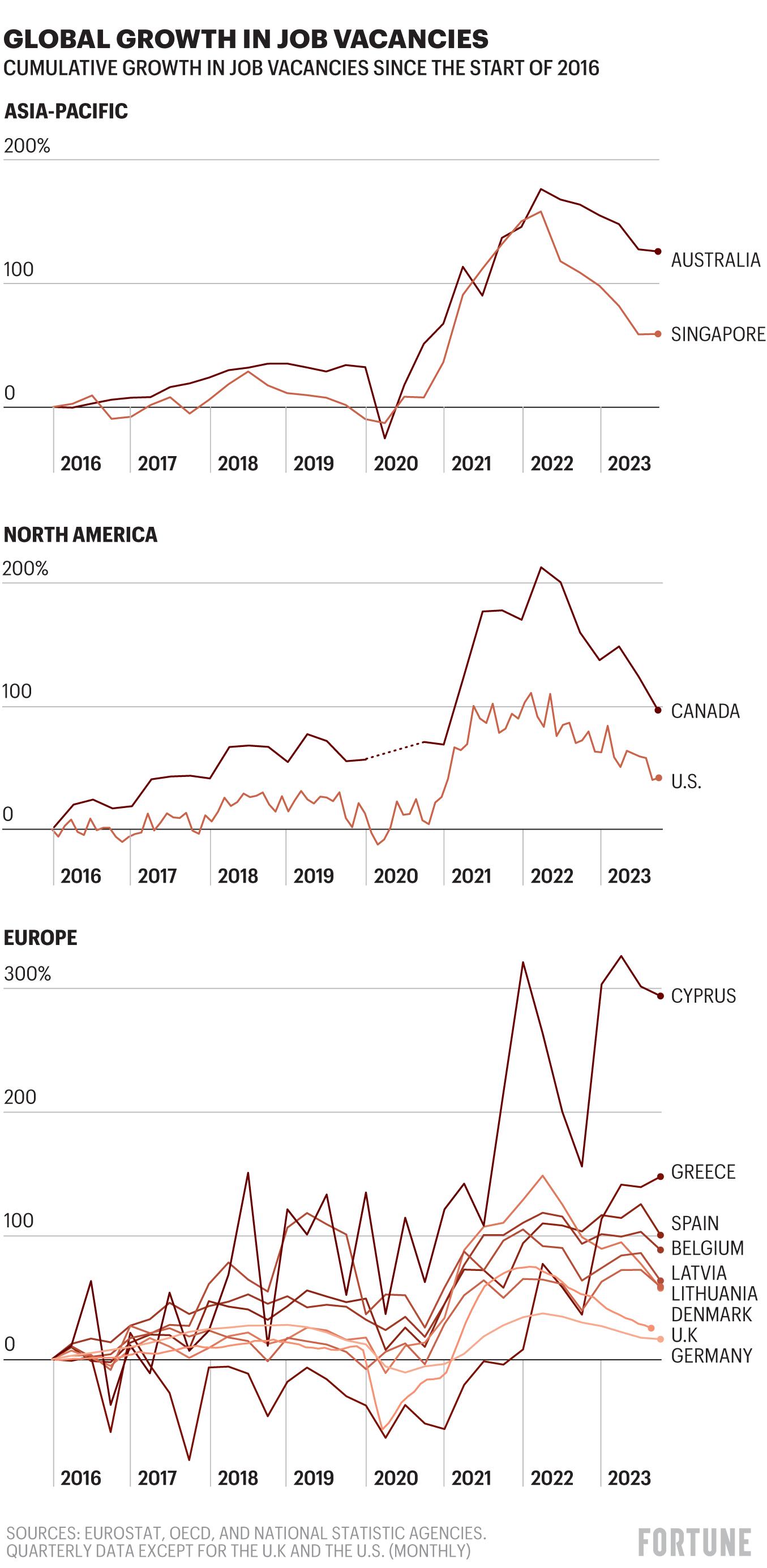
The acute shortage of skilled labor is now seen as a barrier to economic growth. In Germany, economic growth prospects are now at 0.7%–far below its long-term average of 2%–partly due to a worker shortage. Businesses eager to grow and capitalize on new market opportunities find themselves hamstrung by the difficulty of sourcing workers with the right skills. This gap between available jobs and the skills of job seekers not only underscores the inefficiencies in current workforce development strategies but also highlights an urgent need for educational and vocational training programs to pivot. Industry representatives across countries have argued such programs must now evolve swiftly to match the demands of a rapidly changing marketplace, one where the push for low-carbon technologies and the pace of digitalization are accelerating the demand for new, specialized skills.
The scramble for solutions
The rise in job vacancies and worker shortages reflects several underlying trends. After a downturn in 2020, the global economy saw a robust rebound, surging by 6.3% in 2021 and 3.4% in 2022, which, in turn, spurred an uptick in job postings. The second piece of the puzzle could be related to reduced immigration flows due to COVID-19. The pandemic prompted many workers to leave their host countries, while immigration systems grappled with delays in visa processing, creating worker gaps as a result. Third, wage stagnation has been a persistent issue. For instance, in Australia, even as wages have seen some increase, they have failed to match the rising cost of living. Finally, specific national circumstances also play a role, such as the U.K.’s labor market challenges post-Brexit.
In response, governments have started taking steps to recruit more immigrant workers or formalize their status. At the end of last year, Greece approved new legislation granting thousands of undocumented migrants residence rights, provided they secure employment. Top officials in Germany have gone so far as to admit that the country could not close its widening workforce gap without migrant labor. Berlin has implemented several legislative changes aimed at making Germany more appealing to migrant workers, including simplifying the path to citizenship, accelerating visa processing, and recognizing foreign qualifications in the job market. More countries may follow suit.
New work arrangements, such as a four-day workweek, are also being explored. In Germany, since February, dozens of companies have been piloting a four-day workweek. The idea is that a shorter workweek could ultimately make workers more motivated and productive, helping ease labor shortages in the process. Other European countries are running similar trials. Meanwhile, in at least one German city, public companies are hiring students to help alleviate the shortage of workers. Remarkably, some U.S. states have been considering easing child labor laws and allowing more teenagers to be hired by establishments because migration policy is thought to be more controversial.
A global demographic transition
In the meantime, an economic slowdown could temporarily conceal the underlying trend of increasing job vacancies. Take the U.K., where the ongoing economic contraction is simultaneously driving up unemployment rates and diminishing the number of available positions. Similarly, in Denmark, the recession towards the end of 2023 appears to have contributed to a decrease in job openings. As these economies eventually rebound, we are likely to see a resurgence of labor shortages and vacancies.
However, piecemeal measures alone will not solve the issue, as a longer-term demographic transition is unfolding worldwide. Across advanced economies, unfilled vacancies are set to rise due to aging populations. Official estimates suggest Germany’s aging society will be short seven million skilled workers by 2035. Japan’s working-age population peaked in 1998, and the numbers have been on a steady decline ever since. The U.S. stands on the precipice of a job surge, with forecasts promising 11.9 million new roles by 2030, yet the domestic labor force is on track to fall short by 3 million, even as the economy clamors for workers.
Populations worldwide are aging quickly, a trend not spared even among traditional labor-sending and lower-income countries, with Africa being the lone exception. This reality indicates that more open migration policies aimed at these traditional sending countries–a significant policy shift virtually unattainable in the current political landscape–would not suffice. Countries in Central America now have fertility rates below replacement, echoing the concern that many migrant countries of origin and lower-income countries will be “old before they get rich.” While facilitating access for African migrant workers to high-income labor markets will be important, equally vital is the investment in their education and training, ensuring that African workers make full use of opportunities overseas.
A workforce in crisis
In addition to an aging world, the Great Resignation was real, with many workers having left the workforce since the pandemic. In the U.S., an unprecedented 50 million workers stepped down in 2021 and 2022, reflecting a growing dissatisfaction with work following the COVID-19 pandemic. Although initially perceived as predominantly an American trend, the data suggest that this general dissatisfaction has spread to other parts of the world. France witnessed a record 2.7 million voluntary resignations in 2022, with similar trends observed across Europe, though Asia saw a decline in resignations. In Australia, there are growing signs of similar worker discontent. And even in the U.S. where quit rates have recently fallen, certain industries like personal care services continue to report higher-than-average resignation rates.
The labor shortages we observe can partly be traced back to the devastating impact of COVID-19, including the lingering effects of long COVID. In the U.S., the workforce has not only mourned the loss of over a quarter-million working-age individuals to the virus but has also seen a lasting reduction, with a figure more than twice as large across various age groups withdrawing from employment. Particularly affected were migrant communities, which suffered higher COVID-19 mortality rates, further exacerbating the decrease in available migrant labor.
Following the pandemic, a pronounced shift in work preferences has emerged, with a growing demand for reduced hours, enhanced flexibility, and better work-life balance. In the U.S., a substantial number of employees, for whom resignation isn’t a viable choice, have voiced a clear preference for more flexible working conditions, remote opportunities, and improved work-life balance–an enduring legacy of the pandemic’s impact on workplace norms. In Singapore, workers are willing to trade off pay for flexibility. As a result, this trend, particularly among younger workers, higher earners, and women, has led to a reduction in working hours in the U.S., further exacerbating labor shortages.
The surge in vacancies isn’t just an anomaly–it signals a profound transformation sweeping across global labor markets. This shift encompasses not only the demographic transition but also the changes in work preferences post-pandemic.
Existing solutions may offer brief relief, and economic downturns could hide these challenges temporarily, but ultimately, the resolution will require global coordination unlike we have seen before. It’s time for daring, creative approaches to mobilize diverse labor pools: harnessing Africa’s rapidly growing working-age population, tapping into the underutilized potential of older but still productive workers from lower-income countries, and re-engaging the retirees and dissatisfied younger workers of wealthier countries.
Recognizing the interconnectedness of the challenges before us is crucial. We are part of a singular, global labor market. The problems we face are shared, and so must be the solutions we will figure out, together.
Miglė Petrauskaitė is an ODI Fellow serving as Senior Economist at Uganda’s Ministry of Finance.
Erwin R. Tiongson is Professor of the Practice and Deputy Director of Georgetown University’s Global Human Development Program.
More must-read commentary published by Fortune:
- Glassdoor CEO: ‘Anonymous posts will always stay anonymous’
- We analyzed 46 years of consumer sentiment data–and found that today’s ‘vibecession’ is just men starting to feel as bad about the economy as women historically have
- 90% of homebuyers have historically opted to work with a real estate agent or broker. Here’s why that’s unlikely to change, according to the National Association of Realtors
- Intel CEO: ‘Our goal is to have at least 50% of the world’s advanced semiconductors produced in the U.S. and Europe by the end of the decade’
The opinions expressed in Fortune.com commentary pieces are solely the views of their authors and do not necessarily reflect the opinions and beliefs of Fortune.