
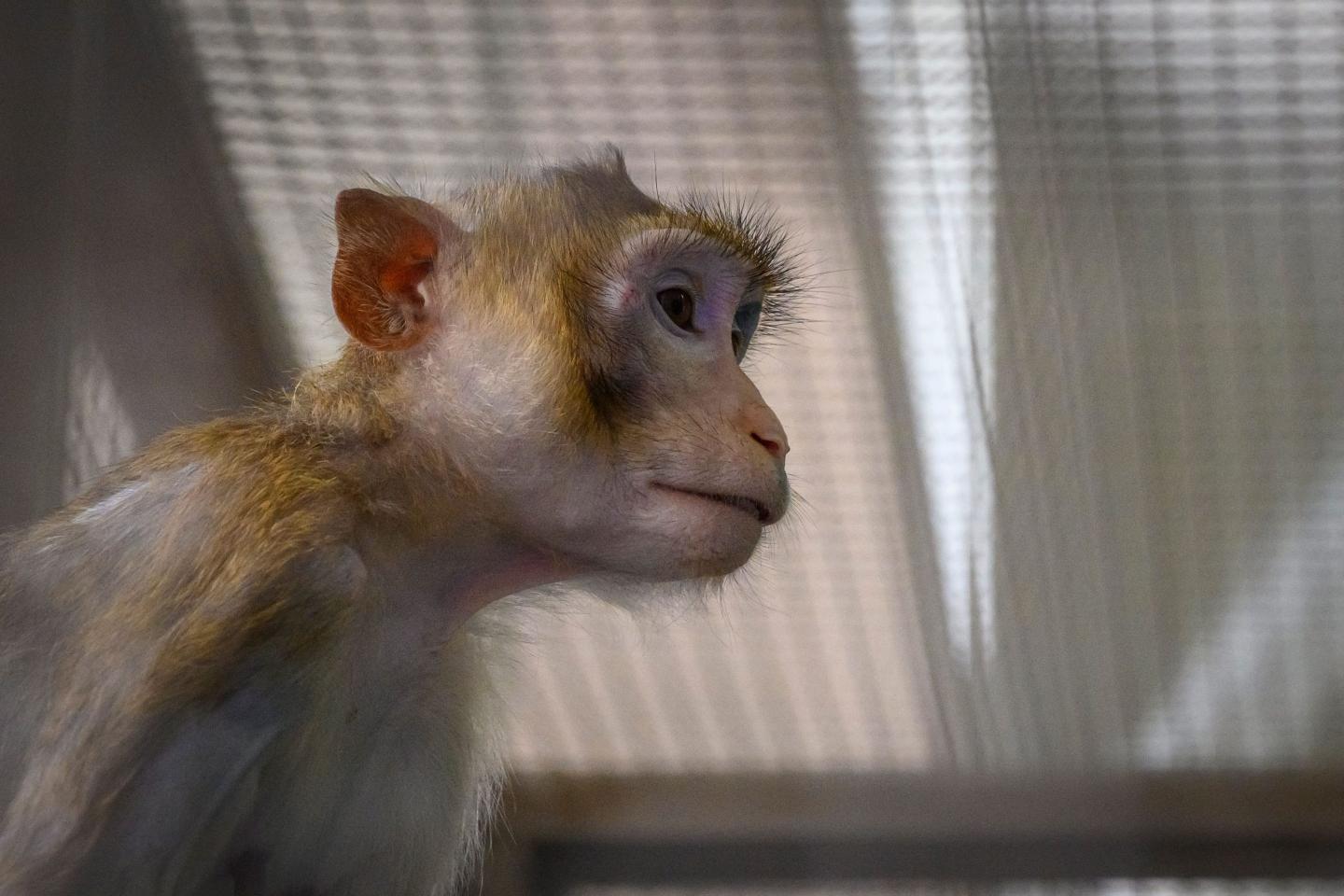
I love animals; I often feel more comfortable in their company than I do with humans. But I had always accepted the use of animals in research—for testing the safety of drugs and vaccines or exploring the pathways of disease—as an awful but necessary cost of scientific and medical progress. Being a person who supports science in a world that seems increasingly skeptical of its value, that stance felt almost like a duty.
But then I started working on a feature story about a crisis in America’s lab monkey supply chain, and was thrust into medical drama myself. Last fall, I lost vision in my right eye. I was close to finishing the article when quite suddenly, all I could see from that eye was an unsteady gray blur.
By the time I made my way to the hospital, I could barely make out the traces of the top-most letter—a large, solitary Z—on the eye chart, and I was experiencing the unsettling sensation that my head was disconnected from my body.
The good news was that doctors knew almost instantly what was wrong with me (optic neuritis, or inflammation of the optic nerve) and how to treat it (five days of intravenous steroids). They did not, however, know what had caused the condition. The question gave rise to a wide array of possibilities, some troubling and some benign. As I learned, optic neuritis is a rare medical condition that is most often a symptom of multiple sclerosis or another of the demyelinating diseases that eat away at one’s nerve coatings. But it can also be caused by a tick-borne illness such as Lyme’s Disease, or an autoimmune condition like lupus. Just as frequently, cases are also ‘idiopathic’—doctor-speak for an episode that cannot be explained.

I was wheeled around the hospital for a battery of tests, exams, and procedures (a work-up more thorough than Kim Kardashian’s full body MRI, I joked) to get to the bottom of my sudden vision loss. I was in no state to work, but I couldn’t stop myself from thinking about monkeys, and the long-tailed macaques at the core of my story. (I even have a faint, cringe-inducing memory of telling a team of neurologists all about those macaques while woozy from a combination of Ativan, steroids, sleeplessness and who knows what else.)
I wondered, as those neurologists applied the best of their medical knowledge to figure out my diagnosis: How much did I also owe an untold number of long-dead macaques? I knew from my reporting that nonhuman primates are often an important model for study of the human eye; did I have animals to thank for my quick diagnosis, the thorough understanding of my condition? Did lab monkeys play a role in the development of the steroids, or the MRI contrast, or the blood thinner, or any number of other drugs or tests that I’d be given over the course of my stay? From what I had come to understand, I imagined they probably had. (Read my Fortune feature on this here.)
But nonhuman primates have a complicated legacy in medicine and can sometimes mislead scientists, and I thought about that, too. Yes, compared to other animals, macaques are like humans—we shared a common ancestor only 20 million years ago and have more than 90% of our genetic material in common. But they’re not humans, and unappreciated differences can sometimes derail science as meaningfully as similarities can accelerate it. In one of the better-known examples, the rhesus macaque became the go-to model for polio researchers, but unlike humans, the animal was not orally susceptible to the virus; it only developed polio when injected with it, and that fact threw off scientists’ understanding of the disease’s pathway for years. During that time, they had been working under the theory that they were dealing with a neurological disease rather than a gastrointestinal one. (Read more about why Big Pharma can’t seem to quit animal research here.)
Even before those long days I spent laid up in the hospital, this story had tied me up in knots. I felt utterly conflicted. Before I started my reporting, I had put my faith in America’s elaborate, multi-agency regulation of research animals and in the scientific community’s stated commitment to using animals sparingly and humanely as possible. But it doesn’t take much looking at all to see this system of animal testing as rickety and wildly imperfect, or to find horrific incidents where monkeys bred for research have been victims of carelessness—overheated to death in transport, or in labs where thermostat settings have gone awry; fatally wounded by their “enrichment” toys or losing limbs to their cage washers. For such ghastly negligence, organizations typically face a fine of several thousand dollars. Those harms are of course on top of the dreary existence and many stresses that befall the average lab monkey.
What drew me to this story, in part, was the appalling charge at its heart—that monkeys were being captured from the wild and smuggled into this enterprise. I didn’t find anyone that defended that illegal practice (though a few made excuses for it). I also found surprisingly few in the industry that seemed particularly outraged or moved to comment at all—perhaps to distance the industry from the allegations, or perhaps, because only a few decades ago, taking monkeys from the wild for lab use was common practice.
Likewise, the industry’s response to the assertion that long-tailed macaques are now endangered struck me as odd in its guns-blazing defensiveness. Sarah Kite, a co-founder of Action for Primates, has researched the macaque trade for decades and contributed to a recent assessment that classified the species as endangered. She told me she has been taken aback by personal attacks targeting her efforts to protect the species: “I find it astonishing that you have these companies and research institutions that rather than show concern for the plight of long-tailed macaque and their conservation status, they seem to be more interested in actually attacking the credibility of the assessment and the people involved.” The industry’s reflexive defensiveness is a product of years of conflict with animal rights activists and a bitter us-vs-them dynamic that often stands in the way of honest and productive discussion about the field and its problems. (Read more about the thorny question of whether the long-tailed macaque is endangered here.)
Put simply, looking closely at the state of animal research is unsettling, most of all perhaps, because imperfect and morally fraught as it is, there isn’t yet an alternative. We still need it, says the National Institutes of Health, which funds much basic research in the U.S. The FDA, which approves new drugs, agrees.
While the conversation around the topic tends to be polarized and framed in black and white terms, I did find in my reporting a community of people who speak of the issue in with more nuance, and who focus on ways to improve animal research for however much longer it continues to exist. David DeGrazia, a bioethicist and a professor of philosophy at George Washington University urges scientists to do better. In 2019, he and a colleague developed an ethical framework—dubbed ”the six principles”—which asks researchers to go beyond simply minimizing harm to animals, to also interrogate whether the science justifies doing the research in the first place: “What is the expected payoff for humanity of doing this research? Is it promising enough to justify all the costs involved to humans, and the harms to the animals? And is there really no other way to get that knowledge?” Those can be hard questions to answer, of course, as many questions about human biology are.
Including my own, it turns out: By day five in the hospital, my vision was, miraculously, almost fully restored. But, as more tests came back, the uncertainty about the underlying cause seemed to have become only murkier. One result would tilt in favor of one diagnosis, only to be complicated by another. Maybe it was Lyme’s Disease? But then, probably, it wasn’t?
The various tests offered a mind-boggling profusion of data, but despite the incredibly sophisticated equipment and my highly trained and attentive medical teams, I left the hospital on day eight with a picture that was far from clear.
I have months, if not years, of medical follow-up ahead, in which the answer could reveal itself. But ambiguity, it turns out, may be the better outcome. As my doctor told me when she finally sent me home, “You’ll be lucky if you never know.” While we may expect science—and life—to give us clear, unequivocal answers, in reality we often have to accept complexity and uncertainty.
At the end of my reporting project, my feelings about the use of animals in research remain similarly complicated. But I do often think about a conversation I had with one primate researcher, who left me sure about one thing when it comes the many monkeys whose lives contributed to science: “We have to pay homage to these animals.”
See more coverage of Big Pharma's Great Lab Monkey Shortage.