• Home
  • Latest
  • Fortune 500
  • Finance
  • Tech
  • Leadership
  • Lifestyle
  • Rankings
  • Multimedia

Trendingnow

1

Now worth $200 million, Sarah Jessica Parker credits being ‘one of eight kids that struggled financially’ for her hunger, ambition, and work ethic

2

The Pentagon said Iran War costs $29 billion, but the real cost is closer to $200 billion—and counting

3

After forcing workers back to the office, Goldman Sachs and JPMorgan Chase are now letting their staff work remotely—but only for the World Cup

1

Now worth $200 million, Sarah Jessica Parker credits being ‘one of eight kids that struggled financially’ for her hunger, ambition, and work ethic

2

The Pentagon said Iran War costs $29 billion, but the real cost is closer to $200 billion—and counting

3

After forcing workers back to the office, Goldman Sachs and JPMorgan Chase are now letting their staff work remotely—but only for the World Cup
SuccessLabor

Over 300,000 workers have gone on strike this year, but don’t be fooled—Unions are still a dim shadow of the midcentury glory days

By
Judith Stepan-Norris
,
Jasmine Kerrissey
Jasmine Kerrissey
, and
The Conversation
The Conversation
Down Arrow Button Icon
By
Judith Stepan-Norris
,
Jasmine Kerrissey
Jasmine Kerrissey
, and
The Conversation
The Conversation
Down Arrow Button Icon
August 26, 2023, 6:00 AM ET
Add Fortune on Google for similar content.

More than 323,000 workers – including nurses, actors, screenwriters, hotel cleaners and restaurant servers – walked off their jobs during the first eight months of 2023. Hundreds of thousands of the employees of delivery giant UPS would have gone on strike, too, had they not reached a last-minute agreement. And nearly 150,000 autoworkers may go on a strike of historic proportions in mid-September if the United Autoworkers Union and General Motors, Ford and Stellantis – the company that includes Chrysler – don’t agree on a new contract soon.

Recommended Video

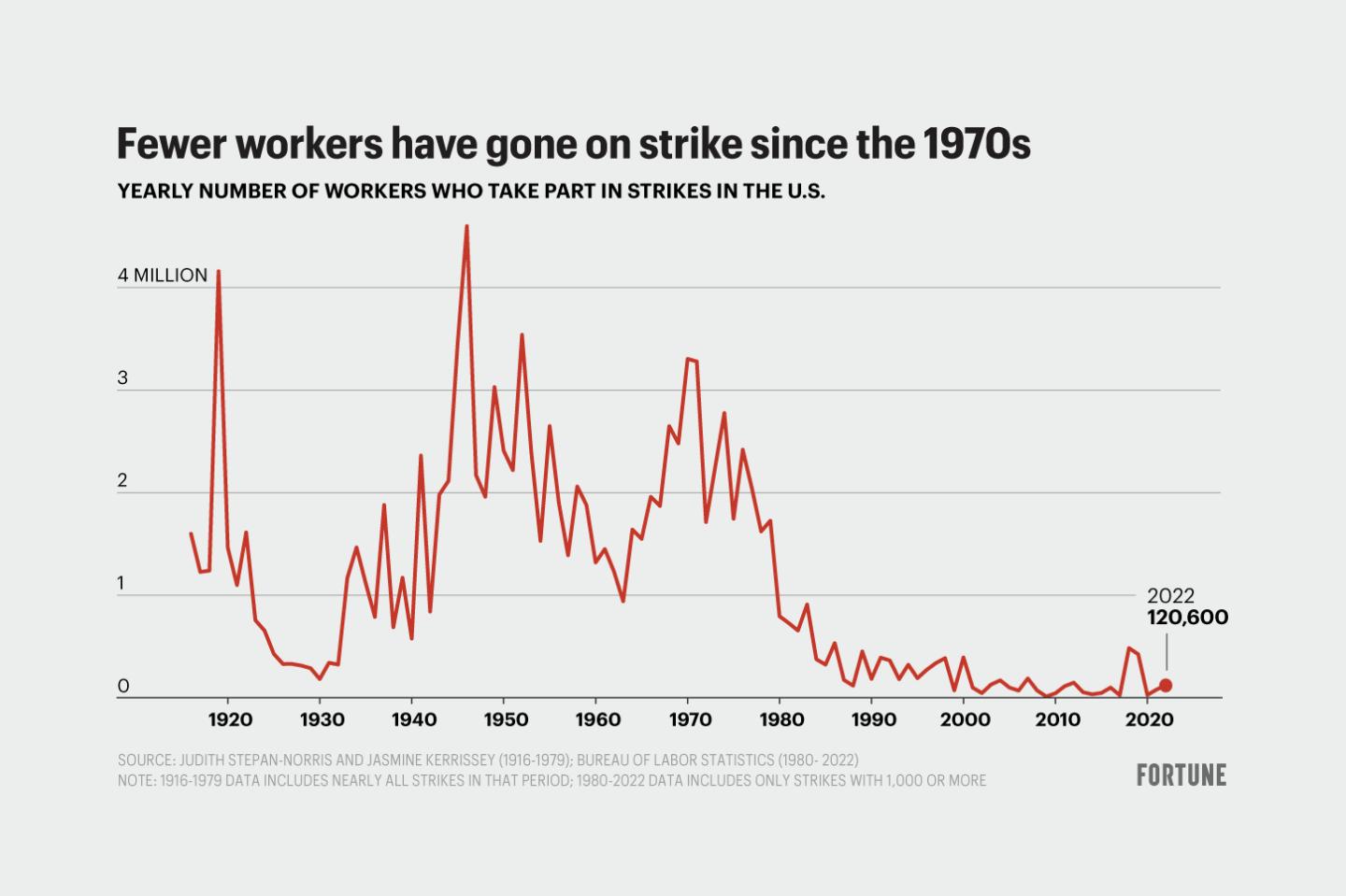
This crescendo of labor actions follows a relative lull in U.S. strikes and a decline in union membership that began in the 1970s. Today’s strikes may seem unprecedented, especially if you’re under 50. While this wave constitutes a significant change following decades of unions’ losing ground, it’s far from unprecedented.

We’re sociologists who study the history of U.S. labor movements. In our new book, “Union Booms and Busts,” we explore the reasons for swings in the share of working Americans in unions between 1900 and 2015.

We see the rising number of strikes today as a sign that the balance of power between workers and employers, which has been tilted toward employers for nearly a half-century, is beginning to shift.

Millions on strike

The number of U.S. workers who go on strike in a given year varies greatly but generally follows broader trends. After World War II ended, through 1981, between 1 million and 4 million Americans went on strike annually. By 1990, that number had plummeted. In some years, it fell below 100,000.

Workers by that point were clearly on the defensive for several reasons.

One dramatic turning point was the showdown between President Ronald Reagan and the country’s air traffic controllers, which culminated in a 1981 strike by their union – the Professional Air Traffic Controllers Organization. Like many public workers, air traffic controllers did not have the right to strike, but they called one anyway because of safety concerns and other reasons. Reagan depicted the union as disloyal and ordered that all of PATCO’s striking members be fired. The government turned to supervisors and military controllers as their replacements and decertified the union.

That episode sent a strong message to employers that permanently replacing striking workers in certain situations would be tolerated.

There were also many court rulings and new laws that favored big business over labor rights. These included the passage of so-called right-to-work laws that provide union representation to nonunion members in union workplaces – without requiring the payment of union dues. Many conservative states, like South Dakota and Mississippi, have these laws on the books, along with states with more liberal voters – such as Wisconsin.

As union membership plunged from 34.2% of the labor force in 1945 to around 10% in 2010, workers became less likely to go on strike.

Wages kept up with productivity gains when unions were stronger than they are today. Wages increased 91.3% as productivity grew by 96.7% between 1948 and 1973. That changed once union membership began to tumble. Wages stagnated from 1973 to 2013, rising only 9.2% even as productivity grew by 74.4%.

Prime conditions

In general, strikes grow more common when economic conditions change in ways that empower workers. That’s especially true with the tight labor markets and high inflation seen in the U.S. in recent years.

When there are fewer candidates available for every open job and prices are rising, workers become bolder in their demands for higher wages and benefits.

Political and legal factors can play a role, too.

In the 1930s, President Franklin D. Roosevelt’s New Deal enhanced unions’ ability to organize. During World War II, unions agreed to a no-strike pledge – although some workers continued to go on strike.

The number of U.S. workers who went on strike peaked in 1946, a year after the war ended. Conditions were ripe for labor actions at that point for several reasons. The economy was no longer so dedicated to supplying the military, pro-union New Deal legislation was still intact and wartime strike restrictions were lifted.

In contrast, Reagan’s crushing of the PATCO strike gave employers a green light to permanently replace striking workers in situations in which doing that was legal.

Likewise, as we describe in our book, employers can take many steps to discourage strikes. But labor organizers can sometimes overcome management’s resistance with creative strategies.

New economic equations

Between 1983 and 2022, the share of U.S. workers who belonged to unions fell by half, from 20.1% to 10.1%. The COVID-19 pandemic didn’t reverse that decline, but it did change the balance of power between employers and workers in other ways.

The “great resignation,” a surge in the number of workers quitting their jobs during the pandemic, now seems to be over, or at least cooling down. The number of unemployed people for every job opening reached 4.9 in April 2020, plummeted to 0.5 in December 2021, and has remained low ever since.

Meanwhile, many workers have become more dissatisfied with their wages. The strikes by teachers that ramped up in 2018 responded to that frustration. U.S. inflation, which soared to 8% in 2022, has eroded workers’ purchasing power while company profits and economic inequality have continued to soar.

Technological breakthroughs that leave workers behind are also contributing to today’s strikes, as they did in other periods.

We’ve studied the role technology played in the printers’ strikes of the 1890s following the introduction of the linotype machine, which reduced the need for skilled workers, and the longshoremen strike of 1971, which was spurred by a drastic workforce reduction brought about by the introduction of shipping containers to transport cargo.

Those are among countless precedents for what’s happening now with actors and screenwriters. Their strikes hinge on the financial implications of streaming in film and television and artificial intelligence in the production of movies and shows.

Working conditions, including health and safety concerns and time off, have also been at the root of many recent strikes.

Health care workers, for example, are going on strike over safe staffing levels. In 2022, rail workers voted to strike over sick days and time off, they but were blocked from walking off the job by a U.S. Senate vote and President Joe Biden’s signature.

Time and again, when the conditions have been right, U.S. workers have gone on strike and won. Sometimes more strikes have followed, in waves that can transform workers’ lives. But it’s too early to know how big this wave will become.

Judith Stepan-Norris is Professor Emerita of Sociology, University of California, Irvine and Jasmine Kerrissey is Associate Professor of Sociology; Director of the Labor Center, UMass Amherst.

This article is republished from The Conversation under a Creative Commons license. Read the original article.

The Fortune 500 Innovation Forum will convene Fortune 500 executives, U.S. policy officials, top founders, and thought leaders to help define what’s next for the American economy, Nov. 16-17 in Detroit. Apply here.
About the Authors
By Judith Stepan-Norris
See full bioRight Arrow Button Icon
By Jasmine Kerrissey
See full bioRight Arrow Button Icon
By The Conversation
See full bioRight Arrow Button Icon
Add Fortune on Google for similar content.

Latest in Success

Finance
Lorem ipsum dolor sit amet, consectetur adipiscing elit, sed do eiusmod tempor incididunt ut labore et dolore magna aliqua. Ut enim ad minim veniam
By Fortune Editors
October 20, 2025
Finance
Lorem ipsum dolor sit amet, consectetur adipiscing elit, sed do eiusmod tempor incididunt ut labore et dolore magna aliqua. Ut enim ad minim veniam
By Fortune Editors
October 20, 2025
Finance
Lorem ipsum dolor sit amet, consectetur adipiscing elit, sed do eiusmod tempor incididunt ut labore et dolore magna aliqua. Ut enim ad minim veniam
By Fortune Editors
October 20, 2025
Finance
Lorem ipsum dolor sit amet, consectetur adipiscing elit, sed do eiusmod tempor incididunt ut labore et dolore magna aliqua. Ut enim ad minim veniam
By Fortune Editors
October 20, 2025
Finance
Lorem ipsum dolor sit amet, consectetur adipiscing elit, sed do eiusmod tempor incididunt ut labore et dolore magna aliqua. Ut enim ad minim veniam
By Fortune Editors
October 20, 2025
Finance
Lorem ipsum dolor sit amet, consectetur adipiscing elit, sed do eiusmod tempor incididunt ut labore et dolore magna aliqua. Ut enim ad minim veniam
By Fortune Editors
October 20, 2025

Most Popular

Finance
Lorem ipsum dolor sit amet, consectetur adipiscing elit, sed do eiusmod tempor incididunt ut labore et dolore magna aliqua. Ut enim ad minim veniam
By Fortune Editors
October 20, 2025
Finance
Lorem ipsum dolor sit amet, consectetur adipiscing elit, sed do eiusmod tempor incididunt ut labore et dolore magna aliqua. Ut enim ad minim veniam
By Fortune Editors
October 20, 2025
Finance
Lorem ipsum dolor sit amet, consectetur adipiscing elit, sed do eiusmod tempor incididunt ut labore et dolore magna aliqua. Ut enim ad minim veniam
By Fortune Editors
October 20, 2025
Finance
Lorem ipsum dolor sit amet, consectetur adipiscing elit, sed do eiusmod tempor incididunt ut labore et dolore magna aliqua. Ut enim ad minim veniam
By Fortune Editors
October 20, 2025
Finance
Lorem ipsum dolor sit amet, consectetur adipiscing elit, sed do eiusmod tempor incididunt ut labore et dolore magna aliqua. Ut enim ad minim veniam
By Fortune Editors
October 20, 2025
Finance
Lorem ipsum dolor sit amet, consectetur adipiscing elit, sed do eiusmod tempor incididunt ut labore et dolore magna aliqua. Ut enim ad minim veniam
By Fortune Editors
October 20, 2025
Fortune Secondary Logo
Rankings
  • 100 Best Companies
  • Fortune 500
  • Global 500
  • Fortune 500 Europe
  • Most Powerful Women
  • World's Most Admired Companies
  • See All Rankings
  • Lists Calendar
Sections
  • Finance
  • Fortune Crypto
  • Features
  • Leadership
  • Health
  • Commentary
  • Success
  • Retail
  • Mpw
  • Tech
  • Lifestyle
  • CEO Initiative
  • Asia
  • Politics
  • Conferences
  • Europe
  • Newsletters
  • Personal Finance
  • Environment
  • Magazine
  • Education
Customer Support
  • Frequently Asked Questions
  • Customer Service Portal
  • Privacy Policy
  • Terms Of Use
  • Single Issues For Purchase
  • International Print
Commercial Services
  • Advertising
  • Fortune Brand Studio
  • Fortune Analytics
  • Fortune Conferences
  • Business Development
  • Group Subscriptions
About Us
  • About Us
  • Press Center
  • Work At Fortune
  • Terms And Conditions
  • Site Map
  • About Us
  • Press Center
  • Work At Fortune
  • Terms And Conditions
  • Site Map
  • Facebook icon
  • Twitter icon
  • LinkedIn icon
  • Instagram icon
  • Pinterest icon

Latest in Success

Ikea’s billionaire founder was so frugal that he bought clothes from flea markets and took free salt and pepper from restaurants
SuccessBillionaires
Ikea’s billionaire founder was so frugal that he bought clothes from flea markets and took free salt and pepper from restaurants
By Orianna Rosa RoyleJune 25, 2026
2 hours ago
MacKenzie Scott alone accounted for one-third of America’s $19.2 billion in megagifts last year
SuccessMacKenzie Scott
MacKenzie Scott alone accounted for one-third of America’s $19.2 billion in megagifts last year
By Sydney LakeJune 25, 2026
2 hours ago
Getting past the pilot: Why so many AI test projects have trouble scaling
SuccessBrainstorm Tech
Getting past the pilot: Why so many AI test projects have trouble scaling
By Alexei OreskovicJune 24, 2026
10 hours ago
How ‘Ozempic face’ is pushing Gen X, already the biggest Botox and filler consumers, to the facelift table a decade early
HealthGen X
How ‘Ozempic face’ is pushing Gen X, already the biggest Botox and filler consumers, to the facelift table a decade early
By Mia OsmonbekovJune 24, 2026
12 hours ago
Matt Garman
Successthe future of work
‘Wipe out and change are different’: Amazon exec slams AI job apocalypse fears as he hires thousands of Gen Z grads
By Preston ForeJune 24, 2026
18 hours ago
t
CommentaryWhite House
Trump mistakes the bully pulpit for bullying leadership — history’s villains were never heroes
By Jeffrey Sonnenfeld and Steven TianJune 24, 2026
21 hours ago

Most Popular

Now worth $200 million, Sarah Jessica Parker credits being ‘one of eight kids that struggled financially’ for her hunger, ambition, and work ethic
Success
Now worth $200 million, Sarah Jessica Parker credits being ‘one of eight kids that struggled financially’ for her hunger, ambition, and work ethic
By Orianna Rosa RoyleJune 24, 2026
1 day ago
The Pentagon said Iran War costs $29 billion, but the real cost is closer to $200 billion—and counting
Economy
The Pentagon said Iran War costs $29 billion, but the real cost is closer to $200 billion—and counting
By Jacqueline MunisJune 24, 2026
1 day ago
After forcing workers back to the office, Goldman Sachs and JPMorgan Chase are now letting their staff work remotely—but only for the World Cup
Success
After forcing workers back to the office, Goldman Sachs and JPMorgan Chase are now letting their staff work remotely—but only for the World Cup
By Orianna Rosa RoyleJune 23, 2026
2 days ago
Amazon's record Prime Day masks a darker truth: Americans are spending more and getting less
Retail
Amazon's record Prime Day masks a darker truth: Americans are spending more and getting less
By Nick LichtenbergJune 24, 2026
18 hours ago
Ray Dalio just finished a 10-day trip to China. He says global leaders know America ‘doesn’t have what it takes to fight to maintain its empire’
Asia
Ray Dalio just finished a 10-day trip to China. He says global leaders know America ‘doesn’t have what it takes to fight to maintain its empire’
By Nick LichtenbergJune 24, 2026
20 hours ago
Trump’s international student crackdown kicked off a domino effect that could shave nearly $500 billion off the economy
Economy
Trump’s international student crackdown kicked off a domino effect that could shave nearly $500 billion off the economy
By Tristan BoveJune 24, 2026
15 hours ago

© 2026 Fortune Media IP Limited. All Rights Reserved. Use of this site constitutes acceptance of our Terms of Use and Privacy Policy | CA Notice at Collection and Privacy Notice | Do Not Sell/Share My Personal Information
FORTUNE is a trademark of Fortune Media IP Limited, registered in the U.S. and other countries. FORTUNE may receive compensation for some links to products and services on this website. Offers may be subject to change without notice.