
• Home
  • Latest
  • Fortune 500
  • Finance
  • Tech
  • Leadership
  • Lifestyle
  • Rankings
  • Multimedia

Trendingnow

1

Now worth $200 million, Sarah Jessica Parker credits being ‘one of eight kids that struggled financially’ for her hunger, ambition, and work ethic

2

The Pentagon said Iran War costs $29 billion, but the real cost is closer to $200 billion—and counting

3

Amazon's record Prime Day masks a darker truth: Americans are spending more and getting less

1

Now worth $200 million, Sarah Jessica Parker credits being ‘one of eight kids that struggled financially’ for her hunger, ambition, and work ethic

2

The Pentagon said Iran War costs $29 billion, but the real cost is closer to $200 billion—and counting

3

Amazon's record Prime Day masks a darker truth: Americans are spending more and getting less
Financeclimate change

How America’s hotbed of progressive economics borrowed from Milton Friedman to pressure the ultrawealthy on climate change

Irina Ivanova
By
Irina Ivanova
Irina Ivanova
Deputy US News Editor
Down Arrow Button Icon
Irina Ivanova
By
Irina Ivanova
Irina Ivanova
Deputy US News Editor
Down Arrow Button Icon
August 22, 2023, 1:23 PM ET
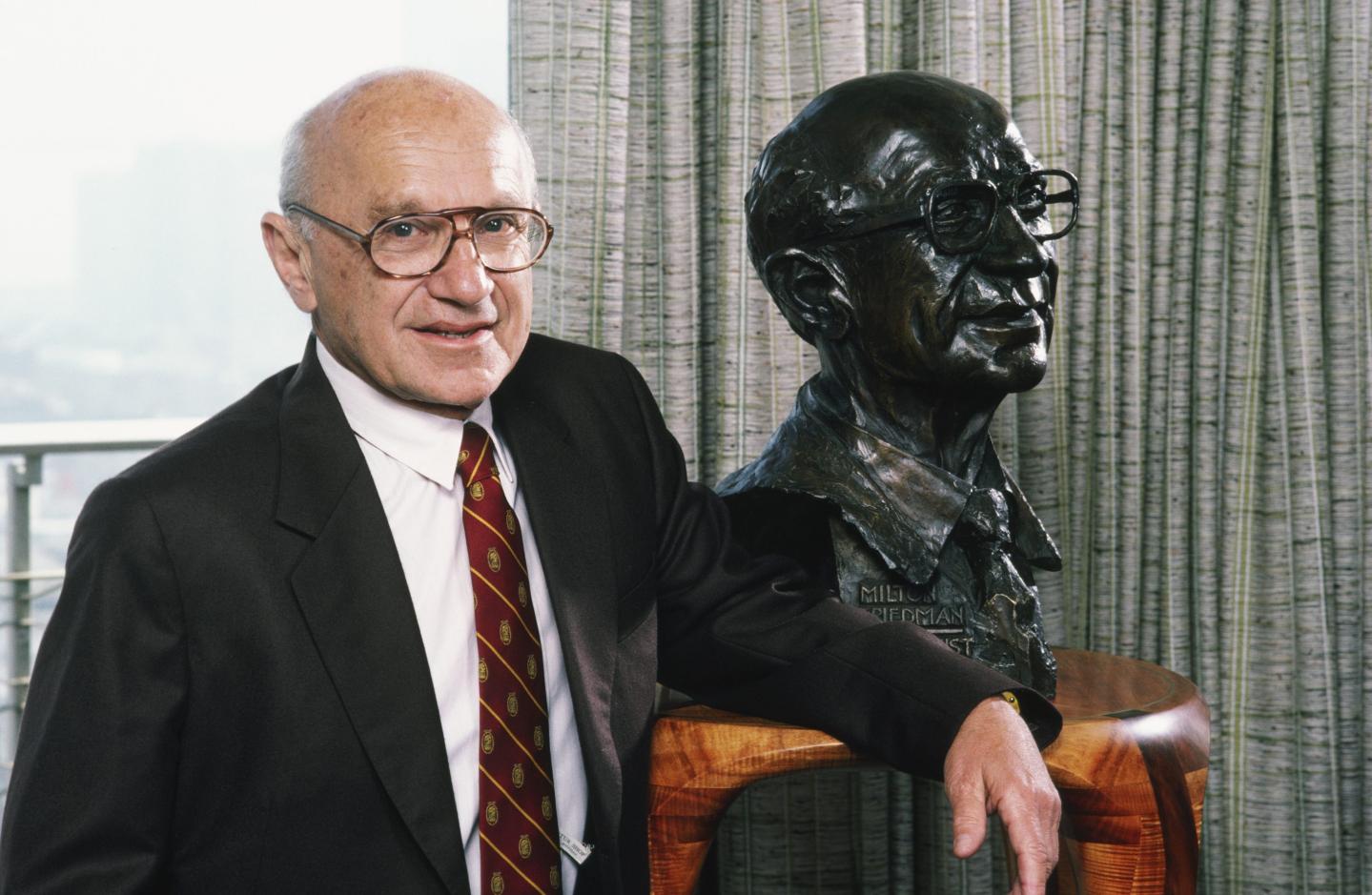
Milton Friedman poses next to a bust of himself
Economist Milton Friedman poses with a sculpture of himself in San Francisco in 1986. George Rose/Getty Images
Add Fortune on Google for similar content.

To paraphrase Al Gore, it’s an inconvenient reality in the climate debate that the wealthy nations and individuals who contribute most to climate change are the last to feel its effects. Floods, droughts, heatstroke, and wildfires are already ravaging Pacific Islanders and American outdoor workers, but the incentives to reshape capitalism in a greener direction are frankly tricky, as the status quo is extremely profitable. Now a state university in New England that is increasingly carving out a reputation as a hotbed of progressive research has a typically provocative argument about how to solve it: Use the economic theory of Milton Friedman.

Recommended Video

Not only do the rich consume much more carbon-intensively than the poor, given their means to engage in high-emitting activities like flying in private jets, owning multiple homes, and eating lots of meat, but they also disproportionately benefit from climate-destroying investments, the researchers find. The study, recently published in PLoS One, lays a major slice of emissions at the feet of the one percent, and suggests taxing the shareholder class as one way to curb the influence of fossil-fuel companies. 

“The top one percent is responsible for more emissions than the bottom half of the country,” said Jared Starr, a sustainability scientist at the University of Massachusetts–Amherst and the study’s lead author. “For the top households, over 50% of their emissions responsibility is coming from income flowing from their investments,” he told Fortune. “So if we want change, we have to look at this segment.”

Here’s how that breaks down in raw numbers. For the top 1% of households, a group whose average income is $1.5 million a year, roughly $600,000 of annual income can be tied to climate-destroying investments. For the top 0.1% of households, whose take averages $6.8 million a year, roughly $3.8 million in annual income can be tied to climate-destroying investments. This group also contains the so-called “super emitters,” about 21,000 households, each emitting the equivalent of 3,000 tons of carbon dioxide a year, or 300 times the emissions of a lower- or middle-class American. 

That doesn’t mean the ultrarich are piling money into oil companies, Starr noted—rather, the figure assumes a typical balanced portfolio of investments for each income level, and then calculates the carbon intensity based on overall figures for the U.S. economy. 

So here’s what it has to do with Milton Friedman, and how the lefty research at U. Mass leaned into the famously conservative economics of the Chicago School to make their case.

Blame the investors, not the customers 

The study flips recent research on emissions inequality by looking not at how people consume, but at where their money comes from. This is becoming a trademark for U. Mass–Amherst, whose economics department is known for being ahead of the curve on issues including the minimum wage, price controls, and health care. For instance, one of Starr’s coauthors, Michael Ash, has previously published research on corporate pollution and Medicare for All; and another colleague not involved in the paper, Arindrajit Dube, has been a leading researcher on the economic benefits of raising the minimum wage. 

Starr argues that any hope of bringing down carbon emissions requires targeting the ultrawealthy.

“Eventually, we have to stop creating carbon pollution. If we don’t, the planet will be uninhabitable,” he said. “The question is, how do we provide the right incentive for people on corporate boards and the executive C-suite and shareholders to shift their behavior?”

One proposal the study suggests is a tax on investment products directly tied to how polluting they are. For him, that’s a logical outgrowth of the idea of shareholder supremacy—the notion, first popularized by Milton Friedman in the 1970s, “that companies exist to create value for shareholders.”

Friedman first articulated this provocative take in a 1970 essay that boldly claimed: “There is one and only one social responsibility of business—to use its resources and engage in activities designed to increase its profits.” He mocked business leaders who claimed to pursue social good, and claimed that “the use of the cloak of social responsibility, and the nonsense spoken in its name by influential and prestigious businessmen, does clearly harm the foundations of a free society.” 

That idea, that businesses only need to concern themselves with making money, overturned decades of a gentler, more nationalistic management philosophy, under which corporate leaders had paid lip service to balancing the needs of many constituents—shareholders as well as customers, employees, and their communities. The shareholder-king theory ushered in decades where CEOs pursued high stock prices through increasingly questionable methods, including complex buyouts, layoffs, or selling off entire parts of the business, and eventually led to a wholesale backlash against corporations, with one 2003 documentary declaring the modern corporation pathological.

Shareholder value means shareholder responsibility

The UMass researchers embrace the shareholder-primacy theory to put responsibility for corporate activities squarely at the feet of the investor class.

“Why does economic activity happen?” Starr asked. “We have the perspective of the consumer that it exists for us, to make goods and services possible. In the U.S., though, there’s this idea that companies exist to create value for shareholders. They do that by creating goods and services for people, but the ultimate goal is to create value for shareholders—so shareholders are a large part of the reason these emissions are happening.” 

A tax on carbon-heavy investments would avoid the potential pitfalls of a broad-based carbon tax, which can penalize the poorest members of a society, and could be politically popular, the paper argues. “Because unearned investment income and asset ownership are heavily concentrated at the top of the income distribution, limiting a carbon tax to either of these items could further focus it on those reaping the most economic benefit from [greenhouse gas] emissions, increase public support, and reduce [greenhouse-gas]-intensive economic activity in a more direct way,” the paper says.

A positive side effect is that this sort of tax would likely send a clearer investment signal than current ESG rankings, which, apart from being mired in a political tug-of-war between the parties, have been criticized for being opaque and hard to follow. What’s more, for the one-percenter who’s interested in reducing their climate impact, an investment tax is relatively easy to avoid. 

“It’s a pretty low bar to say, Okay, I don’t have to invest in fossil-fuel companies,” Starr said. “I don’t have to change where I live, I don’t have to change my job. I just have to choose not to invest in companies that are destroying the climate.”

About the Author
Irina Ivanova
By Irina IvanovaDeputy US News Editor

Irina Ivanova is the former deputy U.S. news editor at Fortune.


See full bioRight Arrow Button Icon
Add Fortune on Google for similar content.

Latest in Finance

Finance
Lorem ipsum dolor sit amet, consectetur adipiscing elit, sed do eiusmod tempor incididunt ut labore et dolore magna aliqua. Ut enim ad minim veniam
By Fortune Editors
October 20, 2025
Finance
Lorem ipsum dolor sit amet, consectetur adipiscing elit, sed do eiusmod tempor incididunt ut labore et dolore magna aliqua. Ut enim ad minim veniam
By Fortune Editors
October 20, 2025
Finance
Lorem ipsum dolor sit amet, consectetur adipiscing elit, sed do eiusmod tempor incididunt ut labore et dolore magna aliqua. Ut enim ad minim veniam
By Fortune Editors
October 20, 2025
Finance
Lorem ipsum dolor sit amet, consectetur adipiscing elit, sed do eiusmod tempor incididunt ut labore et dolore magna aliqua. Ut enim ad minim veniam
By Fortune Editors
October 20, 2025
Finance
Lorem ipsum dolor sit amet, consectetur adipiscing elit, sed do eiusmod tempor incididunt ut labore et dolore magna aliqua. Ut enim ad minim veniam
By Fortune Editors
October 20, 2025
Finance
Lorem ipsum dolor sit amet, consectetur adipiscing elit, sed do eiusmod tempor incididunt ut labore et dolore magna aliqua. Ut enim ad minim veniam
By Fortune Editors
October 20, 2025

Most Popular

Finance
Lorem ipsum dolor sit amet, consectetur adipiscing elit, sed do eiusmod tempor incididunt ut labore et dolore magna aliqua. Ut enim ad minim veniam
By Fortune Editors
October 20, 2025
Finance
Lorem ipsum dolor sit amet, consectetur adipiscing elit, sed do eiusmod tempor incididunt ut labore et dolore magna aliqua. Ut enim ad minim veniam
By Fortune Editors
October 20, 2025
Finance
Lorem ipsum dolor sit amet, consectetur adipiscing elit, sed do eiusmod tempor incididunt ut labore et dolore magna aliqua. Ut enim ad minim veniam
By Fortune Editors
October 20, 2025
Finance
Lorem ipsum dolor sit amet, consectetur adipiscing elit, sed do eiusmod tempor incididunt ut labore et dolore magna aliqua. Ut enim ad minim veniam
By Fortune Editors
October 20, 2025
Finance
Lorem ipsum dolor sit amet, consectetur adipiscing elit, sed do eiusmod tempor incididunt ut labore et dolore magna aliqua. Ut enim ad minim veniam
By Fortune Editors
October 20, 2025
Finance
Lorem ipsum dolor sit amet, consectetur adipiscing elit, sed do eiusmod tempor incididunt ut labore et dolore magna aliqua. Ut enim ad minim veniam
By Fortune Editors
October 20, 2025
Fortune Secondary Logo
Rankings
  • 100 Best Companies
  • Fortune 500
  • Global 500
  • Fortune 500 Europe
  • Most Powerful Women
  • World's Most Admired Companies
  • See All Rankings
  • Lists Calendar
Sections
  • Finance
  • Fortune Crypto
  • Features
  • Leadership
  • Health
  • Commentary
  • Success
  • Retail
  • Mpw
  • Tech
  • Lifestyle
  • CEO Initiative
  • Asia
  • Politics
  • Conferences
  • Europe
  • Newsletters
  • Personal Finance
  • Environment
  • Magazine
  • Education
Customer Support
  • Frequently Asked Questions
  • Customer Service Portal
  • Privacy Policy
  • Terms Of Use
  • Single Issues For Purchase
  • International Print
Commercial Services
  • Advertising
  • Fortune Brand Studio
  • Fortune Analytics
  • Fortune Conferences
  • Business Development
  • Group Subscriptions
About Us
  • About Us
  • Press Center
  • Work At Fortune
  • Terms And Conditions
  • Site Map
  • About Us
  • Press Center
  • Work At Fortune
  • Terms And Conditions
  • Site Map
  • Facebook icon
  • Twitter icon
  • LinkedIn icon
  • Instagram icon
  • Pinterest icon

Latest in Finance

What bubble? JPMorgan says the $5.5 trillion AI capex explosion is profitable–for now
AIFinance
What bubble? JPMorgan says the $5.5 trillion AI capex explosion is profitable–for now
By Sheryl EstradaJune 25, 2026
2 hours ago
Man in a suit and tie
InvestingAmazon
Bill Ackman, David Tepper, and other billionaire fund managers are quietly piling into Amazon
By Amanda GerutJune 25, 2026
4 hours ago
Ikea’s billionaire founder was so frugal that he bought clothes from flea markets and took free salt and pepper from restaurants
SuccessBillionaires
Ikea’s billionaire founder was so frugal that he bought clothes from flea markets and took free salt and pepper from restaurants
By Orianna Rosa RoyleJune 25, 2026
4 hours ago
Current ARM mortgage rates report for June 25, 2026
Personal FinanceReal Estate
Current ARM mortgage rates report for June 25, 2026
By Glen Luke FlanaganJune 25, 2026
4 hours ago
Current refi mortgage rates report for June 25, 2026
Personal FinanceReal Estate
Current refi mortgage rates report for June 25, 2026
By Glen Luke FlanaganJune 25, 2026
4 hours ago
Mortgage rates today, June 25, 2026
Personal Financemortgages
Mortgage rates today, June 25, 2026
By Glen Luke FlanaganJune 25, 2026
4 hours ago

Most Popular

Now worth $200 million, Sarah Jessica Parker credits being ‘one of eight kids that struggled financially’ for her hunger, ambition, and work ethic
Success
Now worth $200 million, Sarah Jessica Parker credits being ‘one of eight kids that struggled financially’ for her hunger, ambition, and work ethic
By Orianna Rosa RoyleJune 24, 2026
1 day ago
The Pentagon said Iran War costs $29 billion, but the real cost is closer to $200 billion—and counting
Economy
The Pentagon said Iran War costs $29 billion, but the real cost is closer to $200 billion—and counting
By Jacqueline MunisJune 24, 2026
1 day ago
Amazon's record Prime Day masks a darker truth: Americans are spending more and getting less
Retail
Amazon's record Prime Day masks a darker truth: Americans are spending more and getting less
By Nick LichtenbergJune 24, 2026
21 hours ago
After forcing workers back to the office, Goldman Sachs and JPMorgan Chase are now letting their staff work remotely—but only for the World Cup
Success
After forcing workers back to the office, Goldman Sachs and JPMorgan Chase are now letting their staff work remotely—but only for the World Cup
By Orianna Rosa RoyleJune 23, 2026
2 days ago
Ray Dalio just finished a 10-day trip to China. He says global leaders know America ‘doesn’t have what it takes to fight to maintain its empire’
Asia
Ray Dalio just finished a 10-day trip to China. He says global leaders know America ‘doesn’t have what it takes to fight to maintain its empire’
By Nick LichtenbergJune 24, 2026
22 hours ago
Trump’s international student crackdown kicked off a domino effect that could shave nearly $500 billion off the economy
Economy
Trump’s international student crackdown kicked off a domino effect that could shave nearly $500 billion off the economy
By Tristan BoveJune 24, 2026
17 hours ago

© 2026 Fortune Media IP Limited. All Rights Reserved. Use of this site constitutes acceptance of our Terms of Use and Privacy Policy | CA Notice at Collection and Privacy Notice | Do Not Sell/Share My Personal Information
FORTUNE is a trademark of Fortune Media IP Limited, registered in the U.S. and other countries. FORTUNE may receive compensation for some links to products and services on this website. Offers may be subject to change without notice.