• Home
  • Latest
  • Fortune 500
  • Finance
  • Tech
  • Leadership
  • Lifestyle
  • Rankings
  • Multimedia
Environmentclimate change

The scientists who figured out exactly when Greenland was ice-free reveal what it shows about our warming planet

By
Paul Bierman
Paul Bierman
,
Tammy Rittenour
Tammy Rittenour
, and
The Conversation
The Conversation
Down Arrow Button Icon
By
Paul Bierman
Paul Bierman
,
Tammy Rittenour
Tammy Rittenour
, and
The Conversation
The Conversation
Down Arrow Button Icon
July 24, 2023, 3:00 PM ET
Greenland ice sheet
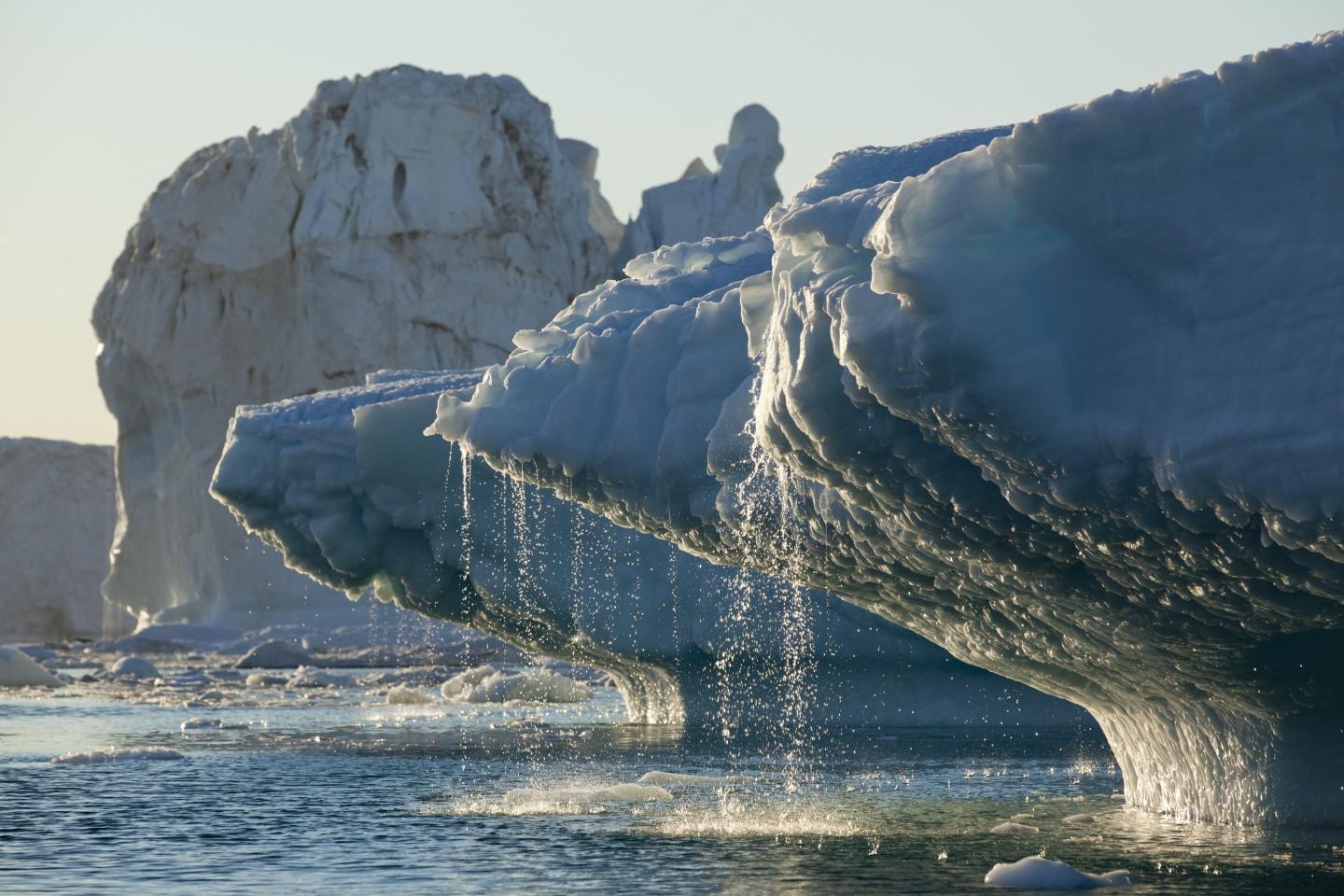
Greenland is losing its ice—again.Getty Images

About 400,000 years ago, large parts of Greenland were ice-free. Scrubby tundra basked in the Sun’s rays on the island’s northwest highlands. Evidence suggests that a forest of spruce trees, buzzing with insects, covered the southern part of Greenland. Global sea level was much higher then, between 20 and 40 feet above today’s levels. Around the world, land that today is home to hundreds of millions of people was under water.

Recommended Video

Scientists have known for awhile that the Greenland ice sheet had mostly disappeared at some point in the past million years, but not precisely when.

In a new study in the journal Science, we determined the date, using frozen soil extracted during the Cold War from beneath a nearly mile-thick section of the Greenland ice sheet.

The timing – about 416,000 years ago, with largely ice-free conditions lasting for as much as 14,000 years – is important. At that time, Earth and its early humans were going through one of the longest interglacial periods since ice sheets first covered the high latitudes 2.5 million years ago.

The length, magnitude and effects of that natural warming can help us understand the Earth that modern humans are now creating for the future.

A world preserved under the ice

In July 1966, American scientists and U.S. Army engineers completed a six-year effort to drill through the Greenland ice sheet. The drilling took place at Camp Century, one of the military’s most unusual bases – it was nuclear powered and made up of a series of tunnels dug into the Greenland ice sheet.

The drill site in northwest Greenland was 138 miles from the coast and underlain by 4,560 feet of ice. Once they reached the bottom of the ice, the team kept drilling 12 more feet into the frozen, rocky soil below.

In 1969, geophysicist Willi Dansgaard’s analysis of the ice core from Camp Century revealed for the first time the details of how Earth’s climate had changed dramatically over the last 125,000 years. Extended cold glacial periods when the ice expanded quickly gave way to warm interglacial periods when the ice melted and sea level rose, flooding coastal areas around the world.

For nearly 30 years, scientists paid little attention to the 12 feet of frozen soil from Camp Century. One study analyzed the pebbles to understand the bedrock beneath the ice sheet. Another suggested intriguingly that the frozen soil preserved evidence of a time warmer than today. But with no way to date the material, few people paid attention to these studies. By the 1990s, the frozen soil core had vanished.

Several years ago, our Danish colleagues found the lost soil buried deep in a Copenhagen freezer, and we formed an international team to analyze this unique frozen climate archive.

In the uppermost sample, we found perfectly preserved fossil plants – proof positive that the land far below Camp Century had been ice-free some time in the past – but when?

Dating ancient rock, twigs and dirt

Using samples cut from the center of the sediment core and prepared and analyzed in the dark so that the material retained an accurate memory of its last exposure to sunlight, we now know that the ice sheet covering northwest Greenland – nearly a mile thick today – vanished during the extended natural warm period known to climate scientists as MIS 11, between 424,000 and 374,000 years ago.

To determine more precisely when the ice sheet melted away, one of us, Tammy Rittenour, used a technique known as luminescence dating.

Over time, minerals accumulate energy as radioactive elements like uranium, thorium, and potassium decay and release radiation. The longer the sediment is buried, the more radiation accumulates as trapped electrons.

In the lab, specialized instruments measure tiny bits of energy, released as light from those minerals. That signal can be used to calculate how long the grains were buried, since the last exposure to sunlight would have released the trapped energy.

Paul Bierman’s laboratory at the University of Vermont dated the sample’s last time near the surface in a different way, using rare radioactive isotopes of aluminum and beryllium.

These isotopes form when cosmic rays, originating far from our solar system, slam into the rocks on Earth. Each isotope has a different half-life, meaning it decays at a different rate when buried.

By measuring both isotopes in the same sample, glacial geologist Drew Christ was able to determine that melting ice had exposed the sediment at the land surface for less than 14,000 years.

Ice sheet models run by Benjamin Keisling, now incorporating our new knowledge that Camp Century was ice-free 416,000 years ago, show that Greenland’s ice sheet must have shrunk significantly then.

At minimum, the edge of the ice retreated tens to hundreds of miles around much of the island during that period. Water from that melting ice raised global sea level at least 5 feet and perhaps as much as 20 feet compared to today.

Warnings for the future

The ancient frozen soil from beneath Greenland’s ice sheet warns of trouble ahead.

During the MIS 11 interglacial, Earth was warm and ice sheets were restricted to the high latitudes, a lot like today. Carbon dioxide levels in the atmosphere remained between 265 and 280 parts per million for about 30,000 years. MIS 11 lasted longer than most interglacials because of the impact of the shape of Earth’s orbit around the sun on solar radiation reaching the Arctic. Over these 30 millennia, that level of carbon dioxide triggered enough warming to melt much of the Greenland’s ice.

Today, our atmosphere contains 1.5 times more carbon dioxide than it did at MIS 11, around 420 parts per million, a concentration that has risen each year. Carbon dioxide traps heat, warming the planet. Too much of it in the atmosphere raises the global temperature, as the world is seeing now.

Over the past decade, as greenhouse gas emissions continued to rise, humans experienced the eight warmest years on record. July 2023 saw the hottest week on record, based on preliminary data. Such heat melts ice sheets, and the loss of ice further warms the planet as dark rock soaks up sunlight that bright white ice and snow once reflected.

Even if everyone stopped burning fossil fuels tomorrow, carbon dioxide levels in the atmosphere would remain elevated for thousands to tens of thousands of years. That’s because it takes a long time for carbon dioxide to move into soils, plants, the ocean and rocks. We are creating conditions conducive to a very long period of warmth, just like MIS 11.

Unless people dramatically lower the concentration of carbon dioxide in the atmosphere, evidence we found of Greenland’s past suggests a largely ice-free future for the island.

Everything we can do to reduce carbon emissions and sequester carbon that is already in the atmosphere will increase the chances that more of Greenland’s ice survives.

The alternative is a world that could look a lot like MIS 11 – or even more extreme: a warm Earth, shrinking ice sheets, rising sea level, and waves rolling over Miami, Mumbai, India and Venice, Italy.

Paul Bierman is Fellow of the Gund Institute for Environment, Professor of Natural Resources and Environmental Science, University of Vermont and Tammy Rittenour is Professor of Geosciences and Director of Luminescence Lab, Utah State University.

This article is republished from The Conversation under a Creative Commons license. Read the original article.

Subscribe to Fortune Gulf Brief. Every Tuesday, this new newsletter will deliver clear-eyed, authoritative intelligence on the deals, decisions, policies, and power shifts shaping one of the world’s most consequential regions, written for the people who need to act on it. Sign up here.
About the Authors
By Paul Bierman
See full bioRight Arrow Button Icon
By Tammy Rittenour
See full bioRight Arrow Button Icon
By The Conversation
See full bioRight Arrow Button Icon

Latest in Environment

Finance
Lorem ipsum dolor sit amet, consectetur adipiscing elit, sed do eiusmod tempor incididunt ut labore et dolore magna aliqua. Ut enim ad minim veniam
By Fortune Editors
October 20, 2025
Finance
Lorem ipsum dolor sit amet, consectetur adipiscing elit, sed do eiusmod tempor incididunt ut labore et dolore magna aliqua. Ut enim ad minim veniam
By Fortune Editors
October 20, 2025
Finance
Lorem ipsum dolor sit amet, consectetur adipiscing elit, sed do eiusmod tempor incididunt ut labore et dolore magna aliqua. Ut enim ad minim veniam
By Fortune Editors
October 20, 2025
Finance
Lorem ipsum dolor sit amet, consectetur adipiscing elit, sed do eiusmod tempor incididunt ut labore et dolore magna aliqua. Ut enim ad minim veniam
By Fortune Editors
October 20, 2025
Finance
Lorem ipsum dolor sit amet, consectetur adipiscing elit, sed do eiusmod tempor incididunt ut labore et dolore magna aliqua. Ut enim ad minim veniam
By Fortune Editors
October 20, 2025
Finance
Lorem ipsum dolor sit amet, consectetur adipiscing elit, sed do eiusmod tempor incididunt ut labore et dolore magna aliqua. Ut enim ad minim veniam
By Fortune Editors
October 20, 2025

Most Popular

Finance
Lorem ipsum dolor sit amet, consectetur adipiscing elit, sed do eiusmod tempor incididunt ut labore et dolore magna aliqua. Ut enim ad minim veniam
By Fortune Editors
October 20, 2025
Finance
Lorem ipsum dolor sit amet, consectetur adipiscing elit, sed do eiusmod tempor incididunt ut labore et dolore magna aliqua. Ut enim ad minim veniam
By Fortune Editors
October 20, 2025
Finance
Lorem ipsum dolor sit amet, consectetur adipiscing elit, sed do eiusmod tempor incididunt ut labore et dolore magna aliqua. Ut enim ad minim veniam
By Fortune Editors
October 20, 2025
Finance
Lorem ipsum dolor sit amet, consectetur adipiscing elit, sed do eiusmod tempor incididunt ut labore et dolore magna aliqua. Ut enim ad minim veniam
By Fortune Editors
October 20, 2025
Finance
Lorem ipsum dolor sit amet, consectetur adipiscing elit, sed do eiusmod tempor incididunt ut labore et dolore magna aliqua. Ut enim ad minim veniam
By Fortune Editors
October 20, 2025
Finance
Lorem ipsum dolor sit amet, consectetur adipiscing elit, sed do eiusmod tempor incididunt ut labore et dolore magna aliqua. Ut enim ad minim veniam
By Fortune Editors
October 20, 2025
Fortune Secondary Logo
Rankings
  • 100 Best Companies
  • Fortune 500
  • Global 500
  • Fortune 500 Europe
  • Most Powerful Women
  • World's Most Admired Companies
  • See All Rankings
  • Lists Calendar
Sections
  • Finance
  • Fortune Crypto
  • Features
  • Leadership
  • Health
  • Commentary
  • Success
  • Retail
  • Mpw
  • Tech
  • Lifestyle
  • CEO Initiative
  • Asia
  • Politics
  • Conferences
  • Europe
  • Newsletters
  • Personal Finance
  • Environment
  • Magazine
  • Education
Customer Support
  • Frequently Asked Questions
  • Customer Service Portal
  • Privacy Policy
  • Terms Of Use
  • Single Issues For Purchase
  • International Print
Commercial Services
  • Advertising
  • Fortune Brand Studio
  • Fortune Analytics
  • Fortune Conferences
  • Business Development
  • Group Subscriptions
About Us
  • About Us
  • Press Center
  • Work At Fortune
  • Terms And Conditions
  • Site Map
  • About Us
  • Press Center
  • Work At Fortune
  • Terms And Conditions
  • Site Map
  • Facebook icon
  • Twitter icon
  • LinkedIn icon
  • Instagram icon
  • Pinterest icon

Latest in Environment

A large oil-exporting hub will be built in the deepwater Gulf of Mexico amid the Iran war—but only because Japan and the White House are paying for it
Energycrude oil
A large oil-exporting hub will be built in the deepwater Gulf of Mexico amid the Iran war—but only because Japan and the White House are paying for it
By Jordan BlumMay 8, 2026
2 days ago
An almond farmer inspects a fruit on a tree.
North AmericaAgriculture
California farmers must destroy 420,000 peach trees after Del Monte closes its canneries and cancels more than $550 million in long-term contracts
By Sasha RogelbergMay 7, 2026
2 days ago
bears
EnvironmentAlaska
Judge allows Alaska wildlife agents to resume shooting bears from helicopters to protect recovering caribou herd
By Becky Bohrer and The Associated PressMay 7, 2026
2 days ago
Debris from the White House East Wing demolition was dumped at a nearby public golf course and contains toxic metals, National Park report finds
PoliticsWhite House
Debris from the White House East Wing demolition was dumped at a nearby public golf course and contains toxic metals, National Park report finds
By Sasha RogelbergMay 7, 2026
3 days ago
ben
CommentaryFood and drink
Magnum owns Ben & Jerry’s. Now it’s destroying what made the brand worth buying
By David Bronner, Michael Bronner and Ryan GellertMay 7, 2026
3 days ago
At 75, Ted Turner told Fortune he gave himself 5 more years. He got 12—and spent them warning the world was ending
C-SuiteMedia
At 75, Ted Turner told Fortune he gave himself 5 more years. He got 12—and spent them warning the world was ending
By Ashley LutzMay 6, 2026
3 days ago

Most Popular

California farmers must destroy 420,000 peach trees after Del Monte closes its canneries and cancels more than $550 million in long-term contracts
North America
California farmers must destroy 420,000 peach trees after Del Monte closes its canneries and cancels more than $550 million in long-term contracts
By Sasha RogelbergMay 7, 2026
2 days ago
A Michigan farm town voted down plans for a giant OpenAI-Oracle data center. Weeks later, construction began
Magazine
A Michigan farm town voted down plans for a giant OpenAI-Oracle data center. Weeks later, construction began
By Sharon GoldmanMay 6, 2026
4 days ago
'Blue dot fever' plagues musicians like Post Malone, Meghan Trainor, and Zayn as a growing list of artists cancel tours due to lagging ticket sales
Arts & Entertainment
'Blue dot fever' plagues musicians like Post Malone, Meghan Trainor, and Zayn as a growing list of artists cancel tours due to lagging ticket sales
By Dave Lozo and Morning BrewMay 7, 2026
2 days ago
The CEO of Maersk, which ships 14% of everything you buy, said the Iran war is adding $500 million in monthly costs it's trying not to pass down
Energy
The CEO of Maersk, which ships 14% of everything you buy, said the Iran war is adding $500 million in monthly costs it's trying not to pass down
By Sasha RogelbergMay 8, 2026
1 day ago
Current price of oil as of May 8, 2026
Personal Finance
Current price of oil as of May 8, 2026
By Joseph HostetlerMay 8, 2026
1 day ago
You're probably safe from the Hantavirus outbreak, but here's what you absolutely must not do, experts say
Politics
You're probably safe from the Hantavirus outbreak, but here's what you absolutely must not do, experts say
By Catherina GioinoMay 8, 2026
23 hours ago

© 2026 Fortune Media IP Limited. All Rights Reserved. Use of this site constitutes acceptance of our Terms of Use and Privacy Policy | CA Notice at Collection and Privacy Notice | Do Not Sell/Share My Personal Information
FORTUNE is a trademark of Fortune Media IP Limited, registered in the U.S. and other countries. FORTUNE may receive compensation for some links to products and services on this website. Offers may be subject to change without notice.