On some level, Carol Glaser thought, the idea was almost too obvious not to work. For decades, localities and governments around the world had employed dogs to sniff for illicit drugs, explosives, landmines, and missing people–even for disease. Why not COVID?
After all, with as many as 300 million olfactory receptors, a dog’s ability to scent or smell something “is about a hundred thousand times what ours is,” Glaser told me recently. “There’s an analogy I’ve seen: You could take a teaspoon of something and put it in a body of water the size of 20 Olympic swimming pools, and a dog could detect it.”
It made for a great theory: dogs as a sort of frontline COVID detective agency. But Glaser is no mere theorist.
As the medical officer for the Center for Laboratory Sciences at the California Department of Public Health (CDPH), Glaser was able to martial both resources and funding (via the CDC Foundation) to road-test the idea. Although it’s still early, the results are promising enough that they may alter the way the U.S. gets in front of outbreaks of several viruses, not just Covid, in the years to come.
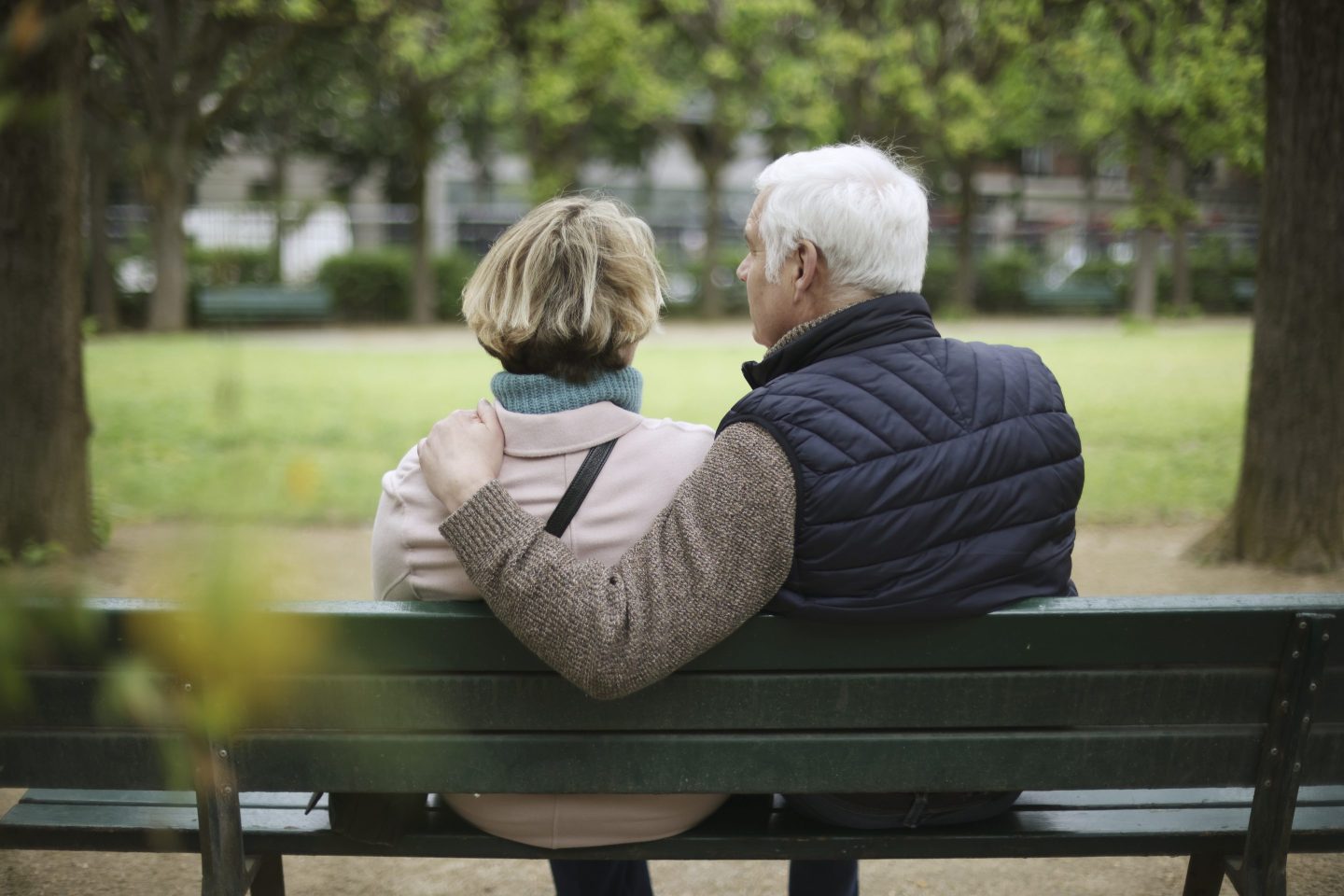
And while the first tests were conducted in schools, Glaser and those working with her now are moving the process to the place where it could have the greatest impact: California’s skilled nursing facilities, home to some of the state’s worst infection and mortality rates during the first two years of the coronavirus.
“There is a huge need in our nursing homes,” Glaser says. “Nursing homes and other skilled facilities continue to experience outbreaks all the time–and, of course, they are the most vulnerable population. We’re making a big shift into nursing homes.”
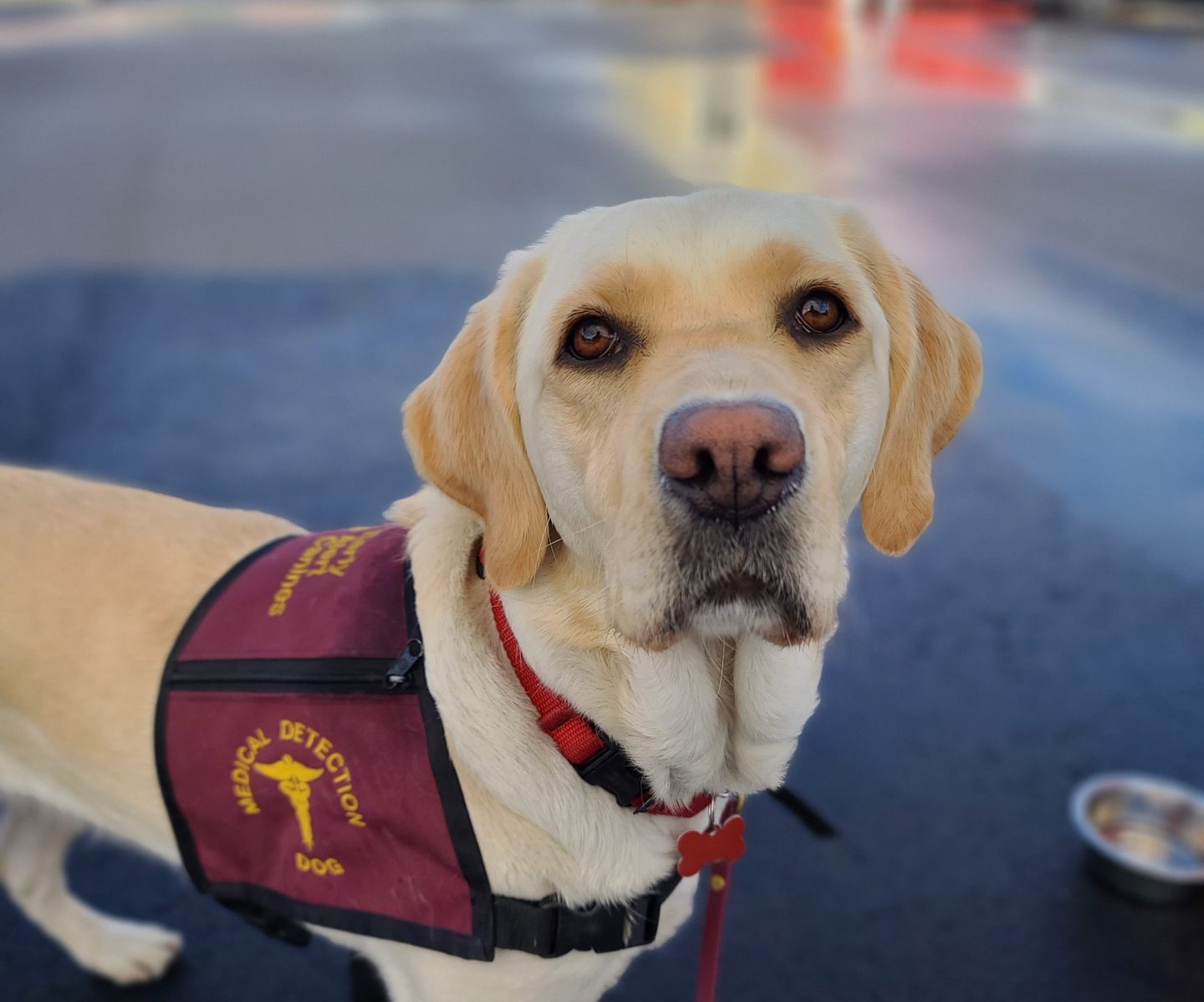
The canines are soothing to the residents, and therefore welcomed. They work fast, needing only seconds to sniff a person. And several primarily laboratory–based studies have shown that medical detection dogs are quite accurate at identifying samples from COVID-infected people, suggesting that they could serve a valuable, mobile screening role going forward.
In short, they’re good dogs.
The genesis of the project, the details of which recently appeared in a research letter published in JAMA Pediatrics, was CDPH’s experience with antigen tests in its public school system. Though that program eventually received solid buy-in, Glaser said regulatory requirements necessitated lots of training of school staff, which took teachers and administrators away from their core duties, “and the kids were getting a little sick of those swabs.”
Enter the doggos. Glaser was already familiar with reports that dogs were being trialed to detect COVID at airports in Finland, Saudi Arabia, and the United Arab Emirates, as well as some sports facilities. She reached out to Carol Edwards, executive director of the Northern California-based Early Alert Canines (EAC), which for more than 20 years has been training “sugar alert” dogs to warn insulin-dependent diabetics when they’re about to experience a significant swing in their blood sugar level.
Glaser wanted to know if Edwards could train dogs for Covid detection. “I said, ‘Sure. Let’s do it,’ and then I had a panic,” Edwards says with a laugh. “But it’s similar scent training to what the diabetic-alert dogs do. It was just a matter of getting COVID samples and training the dogs on that.”
The science involved is remarkably straightforward. As a result of metabolic processes, people infected with COVID emit volatile organic compounds (VOCs). These gas molecules can have a unique odor, which the dogs–in this case, yellow labs named Rizzo and Scarlett–are able to discern after rigorous training. “That’s what the dogs are actually smelling,” says Edwards, who co-authored the JAMA study. “They are not smelling the virus itself.”
The CDPH’s Glaser set about gathering worn socks from people who were infected with COVID, the better to preserve the VOCs that collected there as a result of sweat forming. Edwards, at the EAC, then placed socks on a scent-detection wheel through which she trained Rizzo and Scarlett to distinguish the Covid-related compounds from other odors, rewarding them with Cheerios or a small liver treat each time they did–the same general regimen dogs undergo as they learn to sniff for any particular scent or substance.
It is certainly not a new technology. Beyond the aforementioned uses, “dogs have been found to be able to detect melanoma cells and other tumor types such as lung, ovary, bladder, and large intestine,” says Molly McAllister, chief medical officer of Mars Veterinary Health, a global network of more than 2,500 vet hospitals and clinics. “They can be used to distinguish patients with malaria, and have also been found to be able to detect hypoglycemia, impending seizures, and narcoleptic episodes.”
In the controlled setting of the lab, results for Rizzo and Scarlett were excellent, with the dogs “getting it like 98%, 99% of the time. They found the positive socks and ignored everything else,” Glaser says. In a pilot program in live school settings with more than 3,500 screenings last year, the overall accuracy numbers dropped to 90% with the dogs correctly identifying 85 infections and ruling out 3,411 infections. They inaccurately signaled infection in 383 cases and missed 18 infections, yielding a sensitivity of 83% and specificity of 90%.
Glaser suspects the performance drop in the field was due in part to a comparatively chaotic environment, including things like wind, noise, and multiple other smells on the participants, including a burrito in one child’s backpack. Further study is needed to know more about those factors and whether they might be mitigated as the dogs become more familiar with their surroundings.
The process was decidedly old-school. “We’d have the kids line up outside for us, and the dogs would walk along and sniff their ankles,” says Edwards. “If they encountered the VOCs they would sit. To them, it was just another scent. They’d get a treat.” All the children and staff in the study also underwent a rapid antigen test for purposes of comparison.
The advantages over swab testing are numerous, including time savings (dogs can sniff potentially hundreds of subjects in an hour), convenience, and the potential to reduce by 80% the number of swab test kits since swabs would only be used as a follow-up for those whom the dogs have alerted as infected. And while the dogs must be trained, fed, and kept, they may be the most affordable front-line protection against the virus yet considered.
There’s another consideration–and it’s particularly compelling when applied to a skilled nursing setting: The residents enjoy the interaction. The dogs have been in 10 to 12 nursing homes in Northern California so far, some several times, and they’ve been warmly embraced, just as they were in the schools. “There are some people who literally try to follow the dogs around videotaping them, and they want pictures,” says Glaser. She and Edwards have considered adding a third, social dog “that would come in after the other dogs have done their work,” just to be petted and played with to help streamline the process.
It sounds like a feel-good development because it is–but the business at hand is serious. “I really think this is the tip of the iceberg,” says Edwards. “We’re going into the skilled nursing homes now because that’s where the outbreaks are.” And a potential next step is also significant: learning whether the dogs can successfully identify two strains of influenza, another important cause of illness and death in nursing homes.
Edwards, who has trained so many canines for special scent detection, is cautiously optimistic. “I’ve seen cardiac-alert dogs, seizure dogs…The dogs’ noses are phenomenal, and we’re just tapping into that. Everything they’re smelling, they’ve always smelled. We just put a purpose to it.”
Just as Edwards’ dogs have sometimes alerted diabetes patients to a change in their sugar level before it actually bottoms out, the hope is that canines like Rizzo and Scarlett might eventually be able to ward off viral outbreaks of COVID or influenza by quickly determining how many nursing home residents or staff are harboring an infection. To Glaser, the fact that the dogs are charming is simply a bonus.
“We’ve still got things to sort out, so I’m very cautious, but I want people to take the dogs seriously,” she says. “Most people say, ‘Aren’t they cute?’, which is fine. I think they’re cute, too–but I’m really about trying to ensure that we do this the same way as any rigorous study.”
Carolyn Barber, M.D. has been an emergency department physician for 25 years. Author of the book Runaway Medicine: What You Don’t Know May Kill You, she has written extensively about COVID-19 for national publications, including Fortune. Barber is co-founder of the California-based homeless work program Wheels of Change.
The opinions expressed in Fortune.com commentary pieces are solely the views of their authors and do not necessarily reflect the opinions and beliefs of Fortune.
More must-read commentary published by Fortune:
- IBM CEO: ‘Today’s workforce should prepare to work hand in hand with A.I.’
- Is it smart to be a ‘stupid genius’ like Elon Musk?
- Credit scoring is pseudoscience–and it perpetuates the consequences of slavery and segregation
- America’s ‘disease burden’ is getting heavier by the day–and it’s unevenly distributed across states