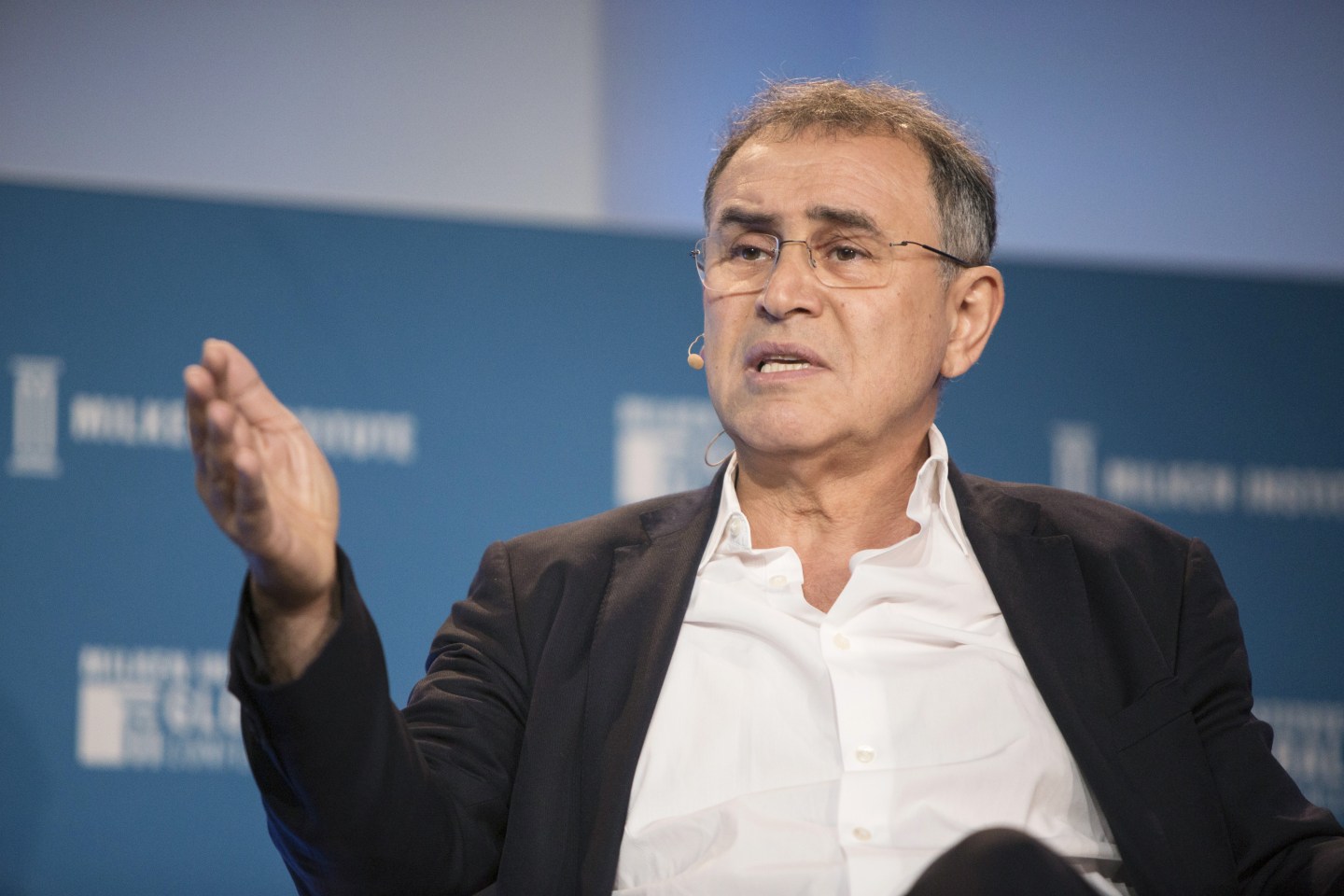
Interviewing Nouriel Roubini as a young journalist can be intimidating, to say the least.
The veteran economist has developed quite the reputation on Wall Street for dishing out apocalyptic, and often prophetic, economic forecasts over the past few decades, so much so that he’s now stuck with the moniker “Dr. Doom”—even if he’d prefer something more like “Dr. Realist.”
I woke up early on Tuesday to prepare for my video chat with Roubini, professor emeritus at New York University’s Stern School of Business and the CEO of Roubini Macro Associates.
Our Zoom call was a far cry from the book-lined living room of Larry Summers’ three-story Brookline home, where my colleague Shawn Tully spoke with the former Treasury secretary just months ago, but I was thrilled to get the chance to pick the brain of a modern legend of economics nonetheless.
The interview didn’t disappoint. Roubini has a way of breaking down complex concepts in an illuminating, yet utterly terrifying manner.
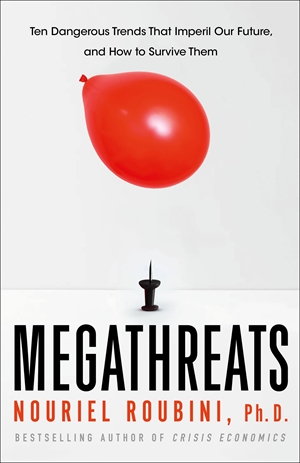
He’s a cerebral, austere, and guarded character, but I did manage to get him to crack a smile a few times. Don’t expect many laughs while reading Roubini’s new book, MegaThreats: 10 Dangerous Trends That Imperil Our Future, and How to Survive Them, however.
In the book, Roubini argues that “calamity seems near certain” and we should “expect many dark days” as he lays out how the world is facing a series of simultaneous and interconnected “MegaThreats,” which he told me are much like Columbia professor Adam Tooze’s “polycrisis.”
It isn’t just one threat or crisis we are facing, they both maintain. Supply shocks created by climate change and war, coupled with rising geopolitical tensions between the world’s superpowers and mountains of private and public debt are leading to only one thing, Roubini argues: a “Great Stagflationary Debt Crisis.”
Some readers will undoubtedly write off Roubini’s predictions as nothing more than the ramblings of a “permabear.” If you’re in that camp, I would remind you that’s exactly what his peers said before the Great Financial Crisis of 2008, and how did that turn out?
“He sounded like a madman in 2006,” IMF economist Prakash Loungani told the New York Times in 2008. “He was a prophet when he returned.”
Below is a lightly edited and condensed transcript of my calmly terrifying interview with Dr. Doom himself, where we discussed everything from the fate of stock market to the repercussions of the rise of artificial intelligence.
Fortune: You seem to believe a U.S. recession is inevitable and that the Federal Reserve is essentially stuck between a rock [persistent inflation] and a hard place [a severe recession]. So I wonder, if we have a recession, what will it look like? Will it be worse than the Great Financial Crisis [GFC] of 2008?
Roubini: In U.S. history, over the last 60 years, there has never been an episode where inflation was above 5% and unemployment was below 5% [when] the Fed started raising rates and avoided a hard landing. So history suggests it’s going to be near mission impossible to avoid a hard landing.
The reality is that whenever you have negative supply shocks, it becomes very hard to avoid a hard landing, because you have lower growth and higher inflation. So to fight inflation, you have to raise rates more and you cause a hard landing. And if you want to avoid the hard landing, then you risk de-anchoring inflation expectations and a wage price spiral. So, yes, it’s “damned if you do, damned if you don’t.” And today, on top of this tradeoff, if you raise interest rates, you can also have a crash of equity markets, bond markets, credit markets, and asset prices in general that causes further financial and economic damage.
I think the debate right now is not soft versus hard landing, but whether there’s going to be just a short and shallow, mild recession or whether it’s going to be severe and more protracted. I’ve made the argument, and this is not the conventional wisdom, that the recession is not going to be short and shallow…I think you’re going to get not only inflation, not only a recession, but what I call the “Great Stagflationary Debt Crisis.” So it’s much worse than the ‘70s, and it’s probably as bad as during the GFC.
Fortune: What does “as bad as during the GFC” mean for stock prices?
Roubini: Even in a typical short and shallow recession the S&P 500 usually goes down by at least 30%. Right now, it’s down more like 20%, depending on the day. In the GFC, the S&P 500 fell cumulatively by about 50%. So, even if it was a short and shallow recession, the market should go down by another 10%. And if it is as bad as the GFC, then by another 30%.
Fortune: What do you think of a guy like Stanley Druckenmiller arguing that stocks could be “flat” for the next decade?
Roubini: I think, first of all, stocks have to go much lower than the current level before they flatten out. And then the rally that occurred after the GFC and after the COVID crisis may not occur. We might be closer to a period like we saw between 1973 and 1982, where stocks dropped and stayed very, very low for a long time. And P/E ratios were much lower then, compared to today.
If the kind of MegaThreats that I talk about in my book were to materialize, then you could have stocks dropping and staying low. I don’t think that we can even rule out something of a variant of another Great Depression.
So yes, we could have a long-term crash. But you know, in some sense, who cares about stocks? I mean, with due respect, 80% of all equity in the U.S. is held by the top 10%, and about 50% of it by the top 1%, while the bottom 80% doesn’t hold almost any equity. So the least of the problems for the average person is whether the stock market falls by 10%, 20%, or even 50%.
Fortune: What would your advice be for retirees who want to preserve their wealth?
Roubini: If a retiree had the typical 60-40 portfolio, so far this year they’ve lost 20% to 25% on the equity and 25% plus on the bonds. And in my view, even in a mild recession, the stock market has to fall by 30%, so another 10% down, let alone if it’s a more severe recession. So although you lost money, it’s not too late to go into something that’s going to save your wealth.
Short-duration bonds are one option. A one year Treasury gives you roughly 4%. Then there’s TIPS [Treasury Inflation-Protected Securities], where if inflation is higher you get a higher positive real return.
Gold does well when there is inflation. So far this year it hasn’t done great, but that’s only because the dollar is strong and the Fed is raising rates in real terms. But once the Fed wimps out and blinks [stops raising interest rates or pivots to rate cuts], gold is a hedge. Some other precious metals and maybe some commodities can be held as a hedge, too, and real estate, as it tends to be in limited supply in the short run.
Fortune: I recently spoke with Barry Sternlicht [CEO of Starwood Capital], and he told me that he worries that the coming recession could be a threat to democracy and a threat to capitalism. His fear is that people will say, “Enough is enough. This system didn’t work for me. I lost my job and I’m still having to deal with inflation.” Do you agree? Are these MegaThreats—plus the Fed’s actions and the coming recession—an existential threat to capitalism, or to democracy?
Roubini: In the book I extensively discuss the threat to liberal democracies coming from a backlash against trade, against technology, and against our social and political institutions. Part of that backlash comes from the fact that there are many people left behind because of the economic and financial and political power of the elites. And they blame the elites for the fact that they are left behind and their children are left behind. And they feel helpless, hopeless, skill-less, jobless, incomeless, wealthless; they’re desperate. They’re voting to the extreme right or extreme left, and it is a phenomenon across the world…So we have to worry about this, absolutely, it’s a material risk. Our liberal democracies are at threat.
Fortune: Something that struck me in your book was when you talked about how Generation X, millennials, and Gen Z may not receive their pension or Social Security benefits because they’re underfunded. Do you think past generations have essentially kicked the can down the road with things like near-zero interest rates, quantitative easing, excessive borrowing, and these underfunded programs? Do you put any blame on the past couple of generations for putting the burden of funding these programs on their children or grandchildren?
Roubini: There is an intergenerational conflict between the young and the old. Some of it has to do with these unfunded liabilities of Social Security and Medicare, this is implicit debt…Then you have explicit debt, seen in rising GDP ratios, which is a burden for future generations because current generations were overspending and didn’t want to raise taxes or cut spending.
Current generations have essentially screwed the young. Look at climate change, they created a disaster, and they’re not going to be around to deal with it after the next 30 years.
Whether it’s millennials or Gen X or Gen Z, their prospects are not as good as their parents’. This is maybe the first few generations where the children are going to be worse off than their parents in terms of their income, in terms of their jobs, in terms of their benefits, in terms of their economic and wealth security, in terms of even, you know, that they could be destroyed either by nuclear war, or climate change, or by A.I., or another nasty pandemic. So this is the mess that they have to face.
There is a massive intergenerational problem and conflict here. Unfortunately, the young don’t tend to vote as much as the elderly, and the old vote for policies that help themselves and not future generations. We have this mess where we don’t want to pay the costs in the present to have a better future for our children and for our grandchildren.
Fortune: It sounds like you think one of the main solutions for the rise of artificial intelligence and the displacement of jobs could be universal basic income [UBI]. Can you elaborate on that topic? Do you think universal basic income or something like it is inevitable, given the path we’re headed down with A.I.?
Roubini: If A.I. is going to destroy most routine, cognitive, and even creative jobs, eventually you’ll have a problem. Massive technological unemployment is permanent for people, and it’s not their fault. This is not because they didn’t study hard enough; it’s not that they were lazy and didn’t want to work, they’re just having bad luck. Their job, their income, their sector, their firm, even their whole industry could essentially be replaced by A.I. machine learning.
That will cause massive inequality because the owners of capital and highly skilled labor will win, while everybody else loses. Then, unless you want to have a revolution—and in the past every time there was this level of inequality it led to civil war and revolution—we’re going to have to tax, progressively, the winners—whether it’s because they had good luck, or they did their own hard work, it doesn’t matter—and transfer income to those who are left behind. So that’s universal basic income.
Fortune: Would universal basic income work today?
Roubini: Today, it’s impossible. The U.S. would have to spend literally 20% of GDP to provide only $1,000 per month to every American. That’s nothing, it’s like $12,000.
The problem is that people don’t want a welfare check for the rest of their lives, because then they feel like they’re socially and economically unproductive. And they feel like, eventually, they’re parasites, right? And therefore they want the dignity of work. So income-wise, UBI is a solution, but whether it is politically feasible for both those left behind and for the winners is to be seen. I’m not sure it is.
I mean, it’s a very dystopian world in which people don’t have jobs, they don’t have skills, they don’t have income. What do they do all day long? They play video games, they are incels because they can’t even find a mate, and they do drugs, and then they die. It’s happening already now.