IT WAS MAY 5—day 71 of Europe’s biggest military conflict since the Second World War. At a flash point on the front line in eastern Ukraine, “the enemy was really close,” recalls Oleksandr, a Ukrainian Special Forces lieutenant whose last name and exact location are being withheld for security reasons. Oleksandr’s fighters urgently needed to relay details about Russian troop numbers and weapons back to their base.
Then their comms line cut out. Russian forces had launched a barrage of missiles along the front, and the strike had severed a strategically vital mobile network.
But the line wasn’t down for long. Oleksandr’s unit scrambled to rig up gear that they had carried to the front: a portable Starlink satellite receiver and transmitter, not much bigger than a desktop computer monitor. “We connected the Starlink on a battery,” Oleksandr recalls. “Two minutes was enough to get it started.” The soldiers’ link was restored—along with their battlefield edge.
Starlink, a fledgling satellite internet network, is another brainchild of Elon Musk, and Ukraine has become its proving ground—a real-life test of new technology under the most extreme circumstances. During a reporter’s week of travel through the war-torn country, numerous Ukrainians described how their ability to tap into the system at a moment’s notice has proved crucial to their prospects in the brutal conflict.
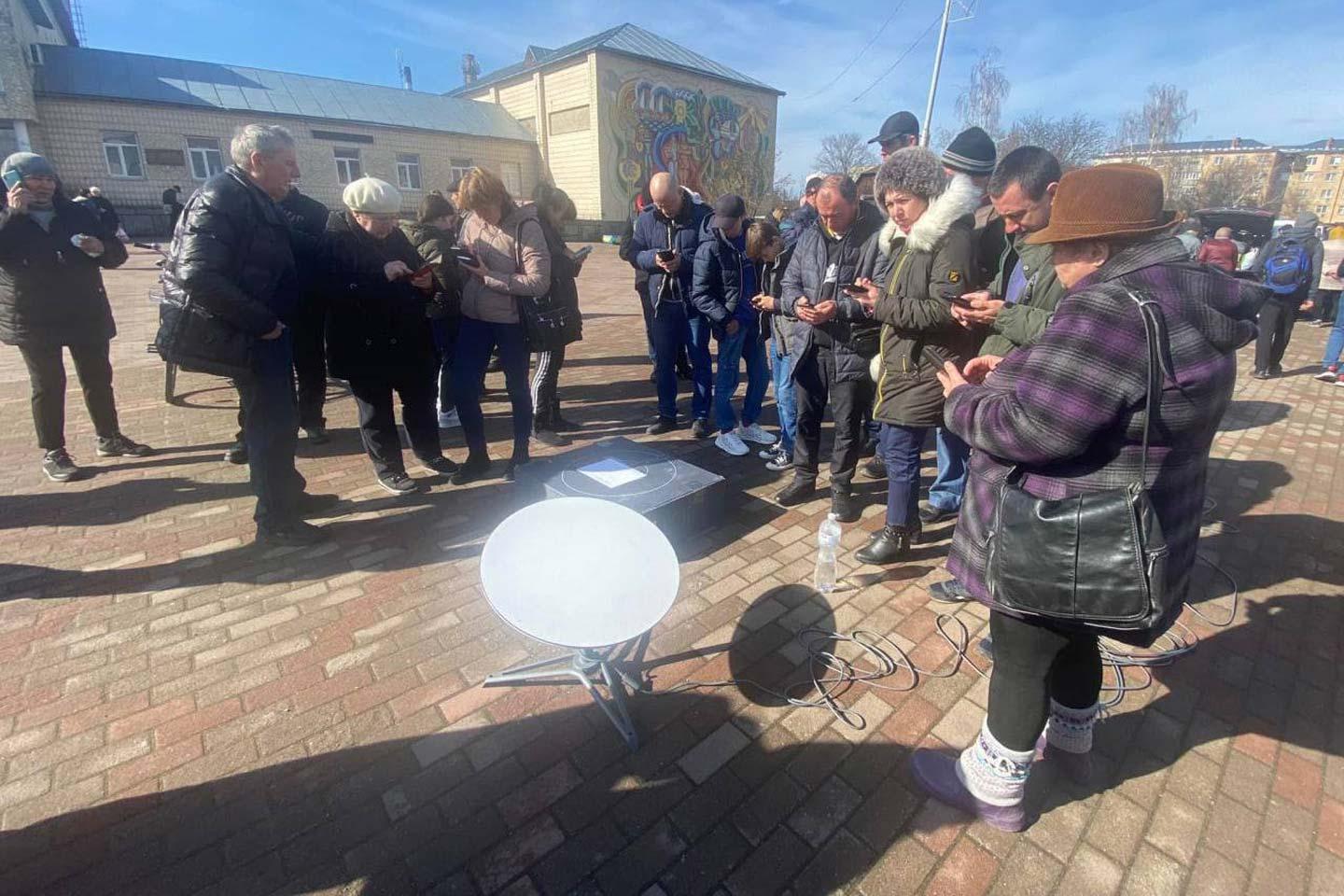
Mobile and light, the Starlink terminals have been carried by soldiers and civilians from one battle zone to another, and between bomb-blasted towns, across a territory the size of Texas. They’re not only benefiting combat forces, but also allowing doctors to resume treating patients, helping officials administer services, and enabling those who stayed to call loved ones who have fled the country.
When Vladimir Putin’s forces invaded Ukraine on Feb. 24, many Westerners and Putin himself predicted Russia would easily prevail. Instead, Ukrainian soldiers and civilians have mobilized a nimble resistance, often improvised and so far successful.
One pivotal early maneuver was made not on the battlefield but on Twitter. On Feb. 26, day three of the war, Ukraine’s 31-year-old digital transformation minister Mykhailo Fedorov tweeted at Musk. “While your rockets successfully land from space, Russian rockets attack Ukrainian civil people!” wrote Fedorov. “We ask you to provide Ukraine with Starlink stations.”
“We started to call everyone who knows Elon, or might know, to tell him,” says Fedorov’s deputy minister, Alex Bornyakov. Musk needed little persuasion. Within hours, SpaceX, of which Starlink is part, switched on satellite service above Ukraine, with Musk telling Fedorov on Twitter: “More terminals en route.” About 300 receivers reached Ukraine days later. As of mid-May, the government had received about 11,000, according to Bornyakov, distributing them to military commanders and to towns with shattered infrastructure; Ukrainian businesses have brought in several hundred more.
Once connected to SpaceX signals, the Starlink terminals act much like regular internet routers. Their range is modest, at about 300 feet, but in the war, that is a lifeline. Users download Starlink’s app and are then able to make voice calls or send messages via platforms like WhatsApp or Skype.
The receivers are also easy to deploy. Packed in slate-gray boxes, many have simply been ferried into Ukraine by car, by volunteers like Oksana Perimova. Perimova fled her home in Irpin, just west of Kyiv, in February, with her 11-year-old daughter, Nadiia. From their refuge in Poland, mother and daughter began driving Starlinks back across the border.
In May, I joined Perimova and Nadiia on one of their runs—a 10-hour journey through the mountains of Poland and Slovakia, and into Ukraine. Our destination: a base in Mukachevo, where Perimova’s husband, Roman Perimov, a tech consultant, had joined a volunteer unit composed entirely of tech engineers and executives. “I wanted to do something, and this is what I could do,” Perimova says.
Satellite coverage “can be incredibly important in areas where liberty is under attack.”
Craig Moffett, Satellite-industry analyst
From there I traveled to the shattered towns west of Kyiv, where Ukrainians repulsed the Russian military’s drive to seize the capital. There, the scale of destruction is jaw-dropping. Thousands of buildings have been reduced to charred husks, many bearing hand-painted warnings about unexploded ordnance still inside. In Irpin, roughly 50% of infrastructure was in ruins when I arrived. In the town square, residents filled water bottles at a tank, since pipes remained badly damaged.
In a nearby building, town councillors showed me a Starlink dish perched on their office windowsill—a link to the outside world. “Until two weeks ago, there was absolutely no internet and very limited cell phone network,” says Georgiy Serdechniy, the only doctor who remained in Irpin during a monthslong Russian siege. To appeal for medical help, wounded soldiers shot flares into the air. Starlink receivers finally arrived in mid-March, enabling health workers to field calls from patients, whom they tend to in the one intact section of the hospital. Starlinks, Serdechniy says, “are really saving lives.”

WELL BEFORE WAR broke out, Musk had planned a huge Starlink ramp-up, with SpaceX aiming to deploy 12,000 low-Earth-orbit satellites over the next five years—about six times the current number—to support it. In a speech in March, SpaceX president Gwynne Shotwell described the network as increasingly pivotal to her business’s growth, saying, “The value of this particular company is driven now by Starlink.” Eventually, she said, there could be 30,000 Starlink satellites in space.
To reach that figure, SpaceX will need to launch a rocket every six days, at about $30 million per shot, says Craig Moffett, satellite-industry analyst and partner at MoffettNathanson. Since low-Earth-orbit satellites burn up more quickly than those in outer space, sustaining the network could cost SpaceX $5 billion a year—“staggering numbers,” Moffett says. To profit, Starlink will need to build a global market in remote areas with poor internet connections—or, as in Ukraine, where infrastructure is destroyed. Taken together, Moffett says, “that may not add up to a large revenue opportunity, but it can be incredibly important in areas where liberty is under attack.”
The war has given the effort a tragic kick-start. All the receivers deployed so far were provided for free, through U.S. and European Union aid programs or by SpaceX itself. SpaceX in March estimated that Starlink had 250,000 subscribers worldwide, but data firm Apptopia estimates that Starlink’s app has been downloaded almost 800,000 times globally since the Russian invasion, with more than half occurring in Ukraine.
Telecom hubs and cell towers make easy targets; Starlink’s receivers have eluded deliberate attack. Russian forces are keenly aware of their value to the Ukrainians but appear to lack the technology to jam them. The bigger potential threat comes from the receivers’ bright white dishes, which can easily be spotted by drones. Perimov, the entrepreneur turned volunteer, recently commissioned a company to sew camouflage covers for them.
Meanwhile, the receivers keep proving their worth. On April 26, Russian troops fired rockets into the Kryvorizka thermal power plant in the Dnipropetrovsk region. The bombardment severed the signal between the plant, owned by DTEK, Ukraine’s biggest private power company, and the national grid, putting tens of thousands of people at risk of losing power. But DTEK was prepared, having obtained 250 Starlink receivers early in the war. Within minutes of the strike, the plant was back in communication with the grid. “We need to be in touch, in constant connection,” says Dmytro Sakharuk, DTEK’s executive director. In many instances, Starlink is keeping those connections alive.
Big business backs up Ukraine
Nearly 1,000 U.S. and European companies have pulled their operations out of Russia since its forces invaded Ukraine in February. Some have also deployed their assets in innovative ways to support Ukrainians directly. Among them:
Airbnb offered temporary housing for up to 100,000 Ukrainians who have fled their homeland, linking hosts with refugees through nongovernmental organizations. By late May, about 25,000 Ukrainian refugees had found free Airbnb accommodations in the U.S. and Europe.
European mobile service providers including Britain’s Vodafone, France’s Orange, and Germany’s Deutsche Telekom have distributed millions of free SIM cards to Ukrainian refugees, with free data andWi-Fi throughout the European Union and no roaming charges for them to call home.
Epic Games donated two weeks’ proceeds from its blockbuster product Fortnite to Unicef and other organizations helping Ukrainians in the war—a sum that amounted to $144 million.
FedEx has shipped medical supplies, water treatment equipment, and other supplies to Poland and Romania, as part of a $1.8 mil- lion commitment to relief efforts.
With Violetta Pedorych
This article appears in the June/July 2022 issue of Fortune with the headline, “SpaceX’s satellite lifeline to Ukraine”
Sign up for the Fortune Features email list so you don’t miss our biggest features, exclusive interviews, and investigations.