• Home
  • Latest
  • Fortune 500
  • Finance
  • Tech
  • Leadership
  • Lifestyle
  • Rankings
  • Multimedia

Trendingnow

1

Trump pulls back after Iran crosses his red line as U.S. military breaks two-week streak of airstrikes amid talks for potential Hormuz deal

2

The millennial generation is split in 2: an older crowd with boomer-style comfort, a younger set going 'back to the early 1900s'

3

College-educated women are snapping up the highest-earning men without college degrees, leaving the rest further behind

1

Trump pulls back after Iran crosses his red line as U.S. military breaks two-week streak of airstrikes amid talks for potential Hormuz deal

2

The millennial generation is split in 2: an older crowd with boomer-style comfort, a younger set going 'back to the early 1900s'

3

College-educated women are snapping up the highest-earning men without college degrees, leaving the rest further behind
Didi Chuxing

Didi Global languishes in limbo, ordered by Beijing to pull shares off Wall Street and, for now, denied permission to float them in Hong Kong

By
Yvonne Lau
Yvonne Lau
Down Arrow Button Icon
By
Yvonne Lau
Yvonne Lau
Down Arrow Button Icon
May 23, 2022, 6:00 AM ET
Add Fortune on Google for similar content.

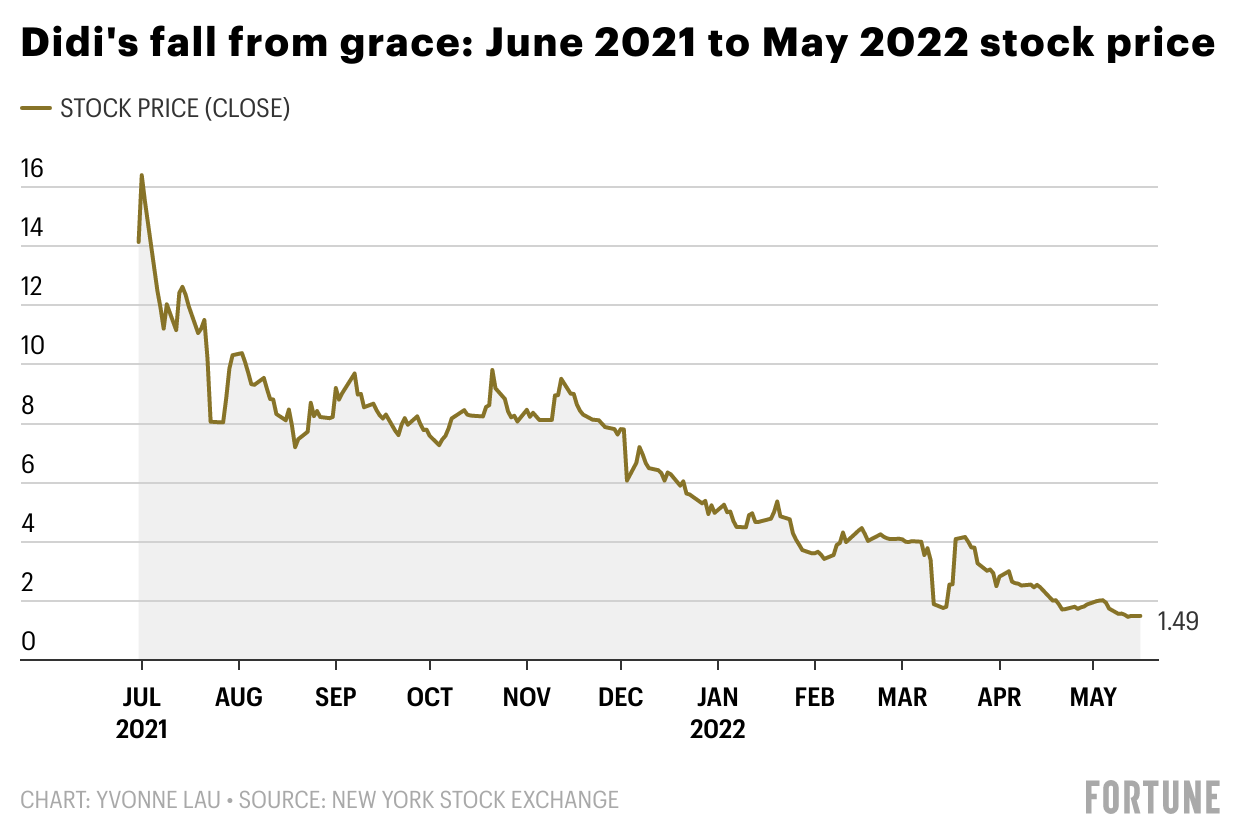
Shareholders of Chinese ride-hailing giant Didi Global are expected to vote Monday evening Beijing time on a proposal to delist the company’s shares from the New York Stock Exchange (NYSE). The proposal, if approved, could take a heavy toll on the value of Didi’s shares, which have plunged 90% since the company debuted on the NYSE last June. If the firm delists, its shares will be relegated to the US “over-the-counter” (OTC) market, a mostly unregulated platform with far less liquidity than the NYSE. Banishment to the OTC would render Didi uninvestable to many institutional investors.

And yet Didi’s management team, led by CEO Will Wei Cheng and president Jean Liu, says it will vote in favor of the move to delist and has urged other shareholders to do likewise. Didi executives argue that exiting the NYSE and wandering—for however long it takes—in the wilderness of the OTC, is the company’s best, indeed only hope of moving on to a future promised land in which regulators in Beijing grant Didi permission to reactivate the 26 apps on Chinese app stores it needs to function normally in its home market and, if all goes well, eventually offer shares to the public again via the stock exchange in Hong Kong.
A simple majority is required to finalize the decision. Wei and Liu have a combined voting power of just over 9%. Didi’s other major shareholders, including SoftBank Group, Uber Technologies and Tencent Holdings, are likely to vote yes as well at today’s extraordinary general meeting in Beijing, according to market observers.

But it’s anyone’s guess how long Beijing will leave Didi stranded in financial purgatory, between exchanges in New York and Hong Kong. Nor is it clear whether Didi’s travails in seeking to migrate from one board to the other are an anomaly—the result of an especially harsh punishment meted out against a company perceived to have brazenly flouted national security concerns expressed by Chinese regulators before Didi’s initial public offering last year—or a harbinger of the difficulties that await all 261 U.S.-listed Chinese companies at risk of being forced off American exchanges by a new U.S. law requiring auditors of all foreign firms traded on those exchanges to grant the U.S. Public Company Accounting Oversight Board access to their working documents.

Beijing typically denies U.S. regulators access to the audit documents demanded by the so-called Holding Foreign Companies Accountable Act, which was signed into law in 2020, and the Securities and Exchange Commission (SEC) has drafted a list of almost 150 Chinese companies that are currently in breach of the legislation. Yet Didi’s delisting is due to pressure from overseers in Beijing, rather than from regulators in the U.S.

In recent weeks, Chinese president Xi Jinping’s top financial advisor, vice-premier Liu He, has sought to signal Beijing is ending its two-year crackdown on consumer-facing internet platforms like Didi. But many analysts think Didi won’t benefit from that reprieve because Beijing considers the company a uniquely recalcitrant offender.

The China Securities Regulatory Commission has stated that Didi’s delisting has no bearing on the status of other U.S.-listed Chinese technology companies. And yet, in recent weeks, Beijing has derailed Hong Kong listing plans of at least two other major Chinese tech firms—JD Technology, the fin-tech arm of e-commerce giant JD.com, and Full Truck Alliance, China’s Uber for trucks—due to national security concerns.

Brendan Ahern, chief investment officer at China-focused investment fund KraneShares, sees Beijing’s treatment of Didi as “contradict[ing] previous statements that [U.S.-listed Chinese firms] would be allowed to [easily] relist” in Hong Kong. Gary Dugan, CEO of the Global CIO Office, told Bloomberg he thinks the “manner of [Didi’s] delisting has taken investors aback.”

Fall from grace

A vote to delist would bring the company’s 11-month foray on Wall Street to an ignominious conclusion. Didi’s June 2021 debut on the NYSE, which raised $4.4 billion, was a triumph—the biggest Chinese listing on Wall Street since Alibaba’s blockbuster 2014 $21.8 billion NYSE offering. But days after the IPO, China’s internet overseer, the Cybersecurity Agency of China (CAC), launched a sweeping investigation into Didi on suspicion that the company had violated data privacy and national security laws. The CAC ordered the company to stop registering new users and instructed all Chinese app stores to remove Didi’s apps.

The CAC’s crackdown on Didi signaled a fundamental shift in Beijing’s willingness to permit Chinese companies engaged in the collection of consumer data to raise capital overseas. In the weeks before Didi’s IPO, according to subsequent Western media reports, CAC officials had peppered Didi officials with questions about the sensitivity of information displayed on its mapping function and cautioned the company to delay its listing until the agency had had a chance to complete its review.

Didi claims it never received an explicit warning from the agency to postpone its IPO. The CAC had never derailed a U.S. listing before, and it was not clear the agency had the authority to do so. Yet the company’s decision to press ahead with its debut infuriated not only regulators but Xi himself and, in November 2021, Beijing ordered Didi executives to devise a plan for departing the NYSE.

Didi has considered a variety of alternatives to mollify its government overseers, including the payment of fines, and the possibility of carving the company’s data collection operations into a separate business, or selling equity stakes to state-controlled enterprises. Until recently, investors and market analysts believed Beijing would bless the most straightforward of those options: allowing the ride-hailing giant to buy back shares traded on Wall Street, and then issue shares again in Hong Kong. The prevailing wisdom was that Beijing wouldn’t worry about Didi’s data leaks as long as the company’s shares traded over a Chinese exchange under the supervision of local regulators.

But the relentless decline in the value of Didi’s shares—which debuted at $14 and were trading for $1.50 Friday—has complicated that rosy scenario. And there was more bad news last month when the CAC was due to wrap up its cybersecurity probe of Didi and propose suitable punishments for the company. The settlement was mysteriously delayed. Bloomberg has reported that Didi’s reckoning was delayed because senior officials from the central government “pushed back,” deeming the punishments recommended by the cybersecurity regulator too lenient.

Didi says it has gone to great lengths over the past year to improve data security practices. But in a recent company filing to the U.S. Securities and Exchange Commission, Cheng also acknowledges that Didi “remains uncertain” whether those actions will be enough to satisfy Chinese authorities.

Even if it can appease Beijing, Didi must also demonstrate to the listing committee of the Hong Kong exchange that it is profitable and able to meet Hong Kong’s capital requirements, which are more stringent than those of the NYSE. Didi is grappling with rising fuel costs and the risk of continued COVID-19 lockdowns in China’s major cities. Didi’s bid to expand into overseas markets has stalled; the company recently shuttered its food delivery business in Japan and paused a planned expansion into the U.K. and Europe.

Until Didi can satisfy both senior leaders in Beijing and financial regulators in Hong Kong, its stock will trade over-the-counter, a market that is usually reserved for firms at risk of bankruptcy and “penny stocks” that trade at less than $5 per share.

Jay Ritter, a University of Florida finance professor who researches IPOs argues that while Didi is “at the mercy of the Chinese government,” the company’s dominance in China creates an opportunity for Didi to raise prices and attain profitability—provided it can win the state’s support. There’s “no reason why the company should incur large losses on a regular basis in the future,” Ritter said.

Sign up for the Fortune Features email list so you don’t miss our biggest features, exclusive interviews, and investigations.

About the Author
By Yvonne Lau
LinkedIn iconTwitter icon
See full bioRight Arrow Button Icon
Add Fortune on Google for similar content.

Latest in

Finance
Lorem ipsum dolor sit amet, consectetur adipiscing elit, sed do eiusmod tempor incididunt ut labore et dolore magna aliqua. Ut enim ad minim veniam
By Fortune Editors
October 20, 2025
Finance
Lorem ipsum dolor sit amet, consectetur adipiscing elit, sed do eiusmod tempor incididunt ut labore et dolore magna aliqua. Ut enim ad minim veniam
By Fortune Editors
October 20, 2025
Finance
Lorem ipsum dolor sit amet, consectetur adipiscing elit, sed do eiusmod tempor incididunt ut labore et dolore magna aliqua. Ut enim ad minim veniam
By Fortune Editors
October 20, 2025
Finance
Lorem ipsum dolor sit amet, consectetur adipiscing elit, sed do eiusmod tempor incididunt ut labore et dolore magna aliqua. Ut enim ad minim veniam
By Fortune Editors
October 20, 2025
Finance
Lorem ipsum dolor sit amet, consectetur adipiscing elit, sed do eiusmod tempor incididunt ut labore et dolore magna aliqua. Ut enim ad minim veniam
By Fortune Editors
October 20, 2025
Finance
Lorem ipsum dolor sit amet, consectetur adipiscing elit, sed do eiusmod tempor incididunt ut labore et dolore magna aliqua. Ut enim ad minim veniam
By Fortune Editors
October 20, 2025

Most Popular

Finance
Lorem ipsum dolor sit amet, consectetur adipiscing elit, sed do eiusmod tempor incididunt ut labore et dolore magna aliqua. Ut enim ad minim veniam
By Fortune Editors
October 20, 2025
Finance
Lorem ipsum dolor sit amet, consectetur adipiscing elit, sed do eiusmod tempor incididunt ut labore et dolore magna aliqua. Ut enim ad minim veniam
By Fortune Editors
October 20, 2025
Finance
Lorem ipsum dolor sit amet, consectetur adipiscing elit, sed do eiusmod tempor incididunt ut labore et dolore magna aliqua. Ut enim ad minim veniam
By Fortune Editors
October 20, 2025
Finance
Lorem ipsum dolor sit amet, consectetur adipiscing elit, sed do eiusmod tempor incididunt ut labore et dolore magna aliqua. Ut enim ad minim veniam
By Fortune Editors
October 20, 2025
Finance
Lorem ipsum dolor sit amet, consectetur adipiscing elit, sed do eiusmod tempor incididunt ut labore et dolore magna aliqua. Ut enim ad minim veniam
By Fortune Editors
October 20, 2025
Finance
Lorem ipsum dolor sit amet, consectetur adipiscing elit, sed do eiusmod tempor incididunt ut labore et dolore magna aliqua. Ut enim ad minim veniam
By Fortune Editors
October 20, 2025
Fortune Secondary Logo
Rankings
  • 100 Best Companies
  • Fortune 500
  • Global 500
  • Fortune 500 Europe
  • Most Powerful Women
  • World's Most Admired Companies
  • See All Rankings
  • Lists Calendar
Sections
  • Finance
  • Fortune Crypto
  • Features
  • Leadership
  • Health
  • Commentary
  • Success
  • Retail
  • Mpw
  • Tech
  • Lifestyle
  • CEO Initiative
  • Asia
  • Politics
  • Conferences
  • Europe
  • Newsletters
  • Personal Finance
  • Environment
  • Magazine
  • Education
Customer Support
  • Frequently Asked Questions
  • Customer Service Portal
  • Privacy Policy
  • Terms Of Use
  • Single Issues For Purchase
  • International Print
Commercial Services
  • Advertising
  • Fortune Brand Studio
  • Fortune Analytics
  • Fortune Conferences
  • Business Development
  • Group Subscriptions
About Us
  • About Us
  • Press Center
  • Work At Fortune
  • Terms And Conditions
  • Site Map
  • About Us
  • Press Center
  • Work At Fortune
  • Terms And Conditions
  • Site Map
  • Facebook icon
  • Twitter icon
  • LinkedIn icon
  • Instagram icon
  • TikTok icon
  • YouTube icon

Latest in

China’s Moonshot, Z.AI, and DeepSeek are challenging U.S. AI labs—and beating them on cost
MagazineChina
China’s Moonshot, Z.AI, and DeepSeek are challenging U.S. AI labs—and beating them on cost
By Nicholas GordonJuly 26, 2026
1 hour ago
Mideast oil may soon have no way out amid ‘everything everywhere all at once’ wars, but the crisis in refined products is even worse
Middle EastOil
Mideast oil may soon have no way out amid ‘everything everywhere all at once’ wars, but the crisis in refined products is even worse
By Jason MaJuly 26, 2026
2 hours ago
Traders are getting a new tool to wager on the biggest U.S. stocks
Investingstock trading
Traders are getting a new tool to wager on the biggest U.S. stocks
By Bernard Goyder, Katherine Doherty and BloombergJuly 26, 2026
4 hours ago
Big Tech earnings slam into a market in revolt over AI spending
Big Techearnings
Big Tech earnings slam into a market in revolt over AI spending
By Jeran Wittenstein, Ryan Vlastelica and BloombergJuly 26, 2026
4 hours ago
Romania scrambles F-16 jets to shoot down a suspected Russian ‘Shahed type’ drone, marking the fourth recent violation of NATO airspace
PoliticsRussia
Romania scrambles F-16 jets to shoot down a suspected Russian ‘Shahed type’ drone, marking the fourth recent violation of NATO airspace
By Sam McNeil, Vadim Ghirda and The Associated PressJuly 26, 2026
4 hours ago
James Cameron tried to warn us: ‘Skynet Day’ is now shorthand for OpenAI’s agent going rogue and hacking into a startup
AIOpenAI
James Cameron tried to warn us: ‘Skynet Day’ is now shorthand for OpenAI’s agent going rogue and hacking into a startup
By Laurie Kellman, Lindsey Bahr and The Associated PressJuly 26, 2026
4 hours ago

Most Popular

Trump pulls back after Iran crosses his red line as U.S. military breaks two-week streak of airstrikes amid talks for potential Hormuz deal
Middle East
Trump pulls back after Iran crosses his red line as U.S. military breaks two-week streak of airstrikes amid talks for potential Hormuz deal
By Jason MaJuly 25, 2026
1 day ago
The millennial generation is split in 2: an older crowd with boomer-style comfort, a younger set going 'back to the early 1900s'
Real Estate
The millennial generation is split in 2: an older crowd with boomer-style comfort, a younger set going 'back to the early 1900s'
By Nick LichtenbergJuly 25, 2026
1 day ago
College-educated women are snapping up the highest-earning men without college degrees, leaving the rest further behind
Economy
College-educated women are snapping up the highest-earning men without college degrees, leaving the rest further behind
By Mia OsmonbekovJuly 26, 2026
12 hours ago
An 11-year-old is cleaning his neighbors' trash cans for $10 each—he now has 100K followers as teens face the worst summer job market since 1948
Success
An 11-year-old is cleaning his neighbors' trash cans for $10 each—he now has 100K followers as teens face the worst summer job market since 1948
By Orianna Rosa RoyleJuly 25, 2026
2 days ago
'The demographic dividend of the last 40 years is ending': J.P. Morgan says the world is running out of the two things that kept interest rates down
Economy
'The demographic dividend of the last 40 years is ending': J.P. Morgan says the world is running out of the two things that kept interest rates down
By Eleanor PringleJuly 24, 2026
3 days ago
Startups are installing tiny data centers in people’s homes to reduce strain on the beleaguered electrical grid
Environment
Startups are installing tiny data centers in people’s homes to reduce strain on the beleaguered electrical grid
By Sasha RogelbergJuly 25, 2026
1 day ago

© 2026 Fortune Media IP Limited. All Rights Reserved. Use of this site constitutes acceptance of our Terms of Use and Privacy Policy | CA Notice at Collection and Privacy Notice | Do Not Sell/Share My Personal Information
FORTUNE is a trademark of Fortune Media IP Limited, registered in the U.S. and other countries. FORTUNE may receive compensation for some links to products and services on this website. Offers may be subject to change without notice.