• Home
  • Latest
  • Fortune 500
  • Finance
  • Tech
  • Leadership
  • Lifestyle
  • Rankings
  • Multimedia

Trendingnow

1

Now worth $200 million, Sarah Jessica Parker credits being ‘one of eight kids that struggled financially’ for her hunger, ambition, and work ethic

2

The Pentagon said Iran War costs $29 billion, but the real cost is closer to $200 billion—and counting

3

Amazon's record Prime Day masks a darker truth: Americans are spending more and getting less

1

Now worth $200 million, Sarah Jessica Parker credits being ‘one of eight kids that struggled financially’ for her hunger, ambition, and work ethic

2

The Pentagon said Iran War costs $29 billion, but the real cost is closer to $200 billion—and counting

3

Amazon's record Prime Day masks a darker truth: Americans are spending more and getting less
Finance

‘Falling down a bottomless pit was among the possibilities’: Russia’s stock market prepares to finally reopen. Here’s how bad the sell-off was the last time traders faced such a historic shutdown

By
Stelios Bouras
Stelios Bouras
Down Arrow Button Icon
By
Stelios Bouras
Stelios Bouras
Down Arrow Button Icon
March 23, 2022, 12:27 PM ET
Add Fortune on Google for similar content.

Sokratis Lazaridis, CEO of the Athens Stock Exchange group, arrived early at his fifth floor office on Monday Aug. 3, 2015, bracing for the worst.

After being closed for five weeks, Greece’s main bourse was finally due to reopen on that steamy day in August, ending one of the longest shutdowns of equities trading in recent memory.

Some traders thought the Russians would claim the record this year after officials there shut down the Moscow Stock Exchange following a volatile day of trading on Feb. 25, day two of Vladimir Putin’s invasion of Ukraine.

The MOEX though is expected to go live again tomorrow with very limited trading, the Wall Street Journal reports.

If the Athens experience is any indicator, the Russians, faced with an even bigger stocks- and currency-meltdown, could be in for one rocky ride once things reopen.

Screens go red

Back in August, 2015, the Athens Stock Exchange boss, Lazaridis, got to work early, in part to keep order—a tall task.

By that point, Greece was more than five years into the country’s worst economic crisis since World War Two. There were real and constant fears that Greece would be dumped from the euro zone as anti-austerity protests turned the capital into the scene of fiery protests.
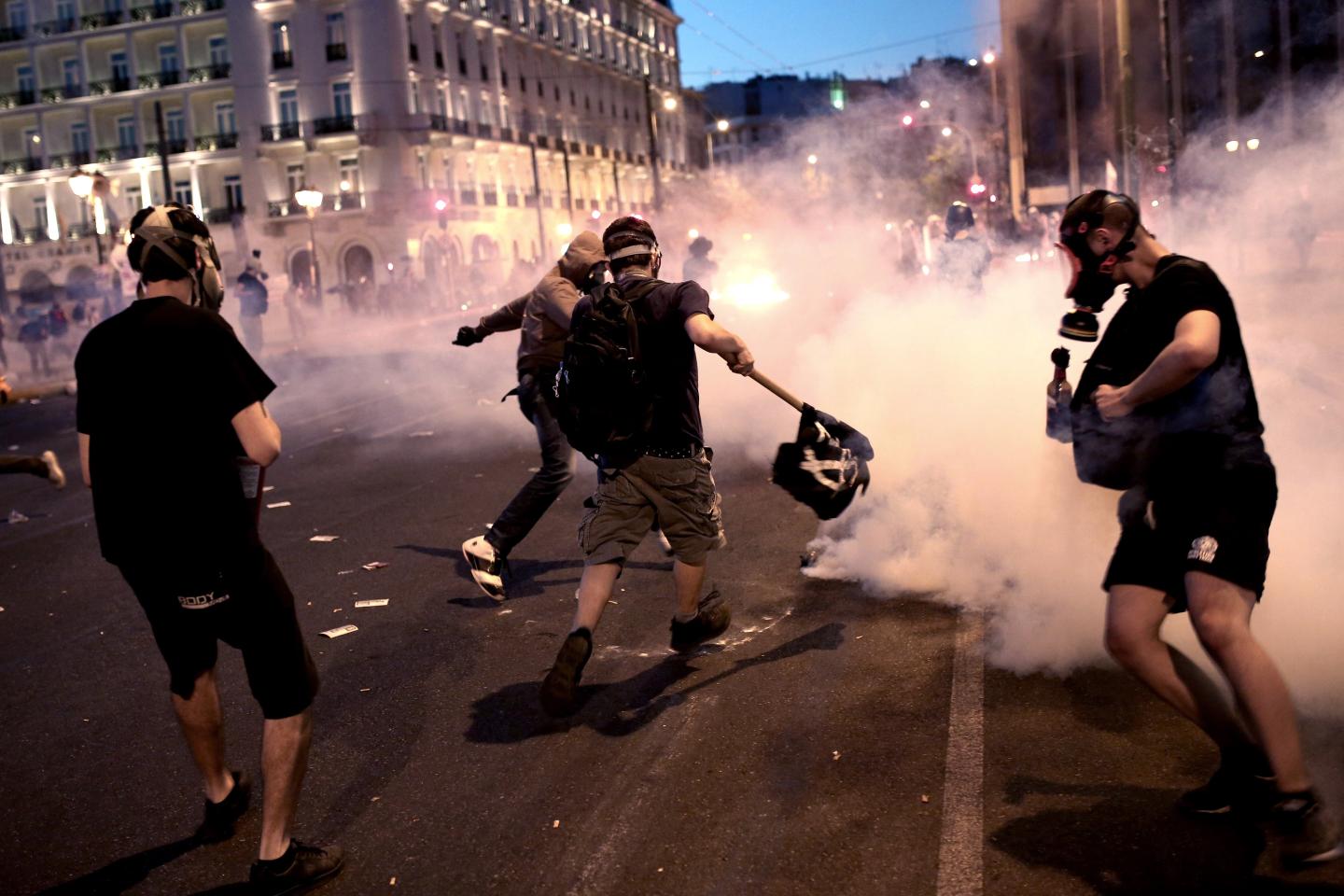
Protesters clash with riot police in front of the Greek Parliament in Athens on July 15, 2015.
Angelos Tzortzinis—AFP/Getty Images

As is the case in Russia today, Greeks were hit then with crippling capital controls, which was supposed to keep a lid on big trading volumes and prevent a market meltdown—or so it was hoped.

At 10:30 a.m. that Monday morning, trade resumed on the ASE.

Phones sitting idly on brokers’ desks sprang back to life, and trading screens turned a deep shade of red.

At the start, the general index plummeted by nearly 23%. Bank stocks locked in at the the 30% down-limit as wave after wave of sell orders filled the system. There were no buyers in sight.

In Athens, Lazaridis said that a lot of planning went into the resumption of trading, with both Greek and EU officials working together to limit the fallout of a chaotic resumption of trade.

Still, uncertainty was high as the country teetered on the brink of bankruptcy, and capital controls had been put in place to prevent a collapse of the banking system.

“We did fear how the day would go,” Lazaridis tells Fortune. “Falling down a bottomless pit was among the possibilities. It wasn’t our baseline scenario but it was a scenario,” he said.

Investor confidence shattered

Investor confidence in Greece had been shattered by a leftist government that had entered a stand-off with international creditors over funding terms even though government coffers were running dry.

After a bank run that saw €50 billion worth of deposits flee the Greek financial system, the country’s loss-making banks were severely weakened and needed more capital as the economy dipped back into recession.

In order to prepare the trading system for an unpredictable volley of trading on that day, Athens bourse officials had introduced a series of rules-changes that acted as a kind of circuit-breaker, such as a reduction in thresholds that trigger a temporary trading suspension.

“The mood of the day was ‘Get the hell out’, especially in financials,” said a senior official from a large Athens brokerage.

Half way through the day, however, selling pressure somewhat eased.

The session ended with the general index down 16.2%—a bloody day, but not the Armageddon some had been expecting. Some buying had even materialized in non-bank shares.

In the days that followed, losses in banks shares remained steep. But the broader market steadied, with the general index sliding by about 2-3%.

“We had introduced two measures which made the difference,” said Lazaridis. 

“Firstly, when the bourse closed abruptly five weeks earlier, we managed to cooperate with our custodians and their international network, and ensured the timely settlement of all trades, meaning that all sellers received their money and all buyers received their shares, so there were no disgruntled investors,” he said.

And secondly, Lazaridis added, that it was crucial for the market’s reputation that the Bank of Greece and European Central Bank accept our proposal to exempt foreign investors from the imposition of capital controls, which they did.

Moscow 2022

The plunge in Athens that day looks like a walk in the park, when compared to what is likely to happen when trading resumes in Moscow.

With an economy about 13% the size of Russia’s, Greece did not experience a stampede of foreign companies leaving the country.

Another difference: The Greek crisis ran over a 10-year period, starting in 2009, which means that key foreign players, such as French lenders Credit Agricole and Societe Generale, had gradually pulled out of the country well before the summer of 2015.

Furthermore, a series of political changes helped cushion the drop in equities that August day.

During the shutdown period, Greece had reached an initial agreement with its troika of lenders (the European Union, European Central Bank, and the International Monetary Fund) on securing aid that ultimately prevented a sovereign collapse as Prime Minister Alexis Tsipras broke with his party’s leftist hardliners, indicating the adoption of a more pro-European stance.

History shows that ceasing equities trading for a lengthy period often proves to be a good tactic for countries in dire economic trouble, as was the case in Egypt in 2011, where the market was closed for two months.

“These bourse-closures allow for political change that markets view more positively,” political analyst David Lea tells Fortune. “It will take a very significant political shift for Russia to restore its place in global markets, or a climb down by Putin from his positions, neither of which look likely right now.”

As the war in Ukraine continues, sanctions, partial capital controls and the crumbling ruble have already taken an enormous toll on the Russian economy.

One casualty of all that: direct foreign investment in Russia is on life-support as sanctions put acute pressure on its financial system and asset prices.

“The mass exodus of multinationals is set to lead to structurally higher unemployment and lower output. Investment will suffer amid the uncertainty, whilst technology restrictions will force it to become more self-sufficient,” according to asset manager Schroders.

It’s not as if investors are going into the reopening of Russian trading flying completely blind.

London-listed Russian stocks have, as of Monday, had lost more than 90% of their value, and the ruble has collapsed some 25% since the Feb. 24 invasion.

Comparatively, though, the sheer size of the Russian companies could help them recover more quickly than what they did in Greece, some experts say.

It took some two years for the Athens bourse to regain trading levels seen prior to the bourse shutdown. And, by 2019, Greece’s main stock exchange rose more than 40% for the year, making it Europe’s top performing bourse.

And that was without the benefit of corporate giants like Gazprom. The Russian energy company is still, despite its troubles, a household name in Europe, points out Lea. 

“Russian companies also have access to capital from places like China, whereas the Greeks had no alternatives,” he adds.

Never miss a story: Follow your favorite topics and authors to get a personalized email with the journalism that matters most to you.

About the Author
By Stelios Bouras
See full bioRight Arrow Button Icon
Add Fortune on Google for similar content.

Latest in Finance

Finance
Lorem ipsum dolor sit amet, consectetur adipiscing elit, sed do eiusmod tempor incididunt ut labore et dolore magna aliqua. Ut enim ad minim veniam
By Fortune Editors
October 20, 2025
Finance
Lorem ipsum dolor sit amet, consectetur adipiscing elit, sed do eiusmod tempor incididunt ut labore et dolore magna aliqua. Ut enim ad minim veniam
By Fortune Editors
October 20, 2025
Finance
Lorem ipsum dolor sit amet, consectetur adipiscing elit, sed do eiusmod tempor incididunt ut labore et dolore magna aliqua. Ut enim ad minim veniam
By Fortune Editors
October 20, 2025
Finance
Lorem ipsum dolor sit amet, consectetur adipiscing elit, sed do eiusmod tempor incididunt ut labore et dolore magna aliqua. Ut enim ad minim veniam
By Fortune Editors
October 20, 2025
Finance
Lorem ipsum dolor sit amet, consectetur adipiscing elit, sed do eiusmod tempor incididunt ut labore et dolore magna aliqua. Ut enim ad minim veniam
By Fortune Editors
October 20, 2025
Finance
Lorem ipsum dolor sit amet, consectetur adipiscing elit, sed do eiusmod tempor incididunt ut labore et dolore magna aliqua. Ut enim ad minim veniam
By Fortune Editors
October 20, 2025

Most Popular

Finance
Lorem ipsum dolor sit amet, consectetur adipiscing elit, sed do eiusmod tempor incididunt ut labore et dolore magna aliqua. Ut enim ad minim veniam
By Fortune Editors
October 20, 2025
Finance
Lorem ipsum dolor sit amet, consectetur adipiscing elit, sed do eiusmod tempor incididunt ut labore et dolore magna aliqua. Ut enim ad minim veniam
By Fortune Editors
October 20, 2025
Finance
Lorem ipsum dolor sit amet, consectetur adipiscing elit, sed do eiusmod tempor incididunt ut labore et dolore magna aliqua. Ut enim ad minim veniam
By Fortune Editors
October 20, 2025
Finance
Lorem ipsum dolor sit amet, consectetur adipiscing elit, sed do eiusmod tempor incididunt ut labore et dolore magna aliqua. Ut enim ad minim veniam
By Fortune Editors
October 20, 2025
Finance
Lorem ipsum dolor sit amet, consectetur adipiscing elit, sed do eiusmod tempor incididunt ut labore et dolore magna aliqua. Ut enim ad minim veniam
By Fortune Editors
October 20, 2025
Finance
Lorem ipsum dolor sit amet, consectetur adipiscing elit, sed do eiusmod tempor incididunt ut labore et dolore magna aliqua. Ut enim ad minim veniam
By Fortune Editors
October 20, 2025
Fortune Secondary Logo
Rankings
  • 100 Best Companies
  • Fortune 500
  • Global 500
  • Fortune 500 Europe
  • Most Powerful Women
  • World's Most Admired Companies
  • See All Rankings
  • Lists Calendar
Sections
  • Finance
  • Fortune Crypto
  • Features
  • Leadership
  • Health
  • Commentary
  • Success
  • Retail
  • Mpw
  • Tech
  • Lifestyle
  • CEO Initiative
  • Asia
  • Politics
  • Conferences
  • Europe
  • Newsletters
  • Personal Finance
  • Environment
  • Magazine
  • Education
Customer Support
  • Frequently Asked Questions
  • Customer Service Portal
  • Privacy Policy
  • Terms Of Use
  • Single Issues For Purchase
  • International Print
Commercial Services
  • Advertising
  • Fortune Brand Studio
  • Fortune Analytics
  • Fortune Conferences
  • Business Development
  • Group Subscriptions
About Us
  • About Us
  • Press Center
  • Work At Fortune
  • Terms And Conditions
  • Site Map
  • About Us
  • Press Center
  • Work At Fortune
  • Terms And Conditions
  • Site Map
  • Facebook icon
  • Twitter icon
  • LinkedIn icon
  • Instagram icon
  • Pinterest icon

Latest in Finance

What bubble? JPMorgan says the $5.5 trillion AI capex explosion is profitable–for now
AIFinance
What bubble? JPMorgan says the $5.5 trillion AI capex explosion is profitable–for now
By Sheryl EstradaJune 25, 2026
2 hours ago
Man in a suit and tie
InvestingAmazon
Bill Ackman, David Tepper, and other billionaire fund managers are quietly piling into Amazon
By Amanda GerutJune 25, 2026
4 hours ago
Ikea’s billionaire founder was so frugal that he bought clothes from flea markets and took free salt and pepper from restaurants
SuccessBillionaires
Ikea’s billionaire founder was so frugal that he bought clothes from flea markets and took free salt and pepper from restaurants
By Orianna Rosa RoyleJune 25, 2026
4 hours ago
Current ARM mortgage rates report for June 25, 2026
Personal FinanceReal Estate
Current ARM mortgage rates report for June 25, 2026
By Glen Luke FlanaganJune 25, 2026
4 hours ago
Current refi mortgage rates report for June 25, 2026
Personal FinanceReal Estate
Current refi mortgage rates report for June 25, 2026
By Glen Luke FlanaganJune 25, 2026
4 hours ago
Mortgage rates today, June 25, 2026
Personal Financemortgages
Mortgage rates today, June 25, 2026
By Glen Luke FlanaganJune 25, 2026
4 hours ago

Most Popular

Now worth $200 million, Sarah Jessica Parker credits being ‘one of eight kids that struggled financially’ for her hunger, ambition, and work ethic
Success
Now worth $200 million, Sarah Jessica Parker credits being ‘one of eight kids that struggled financially’ for her hunger, ambition, and work ethic
By Orianna Rosa RoyleJune 24, 2026
1 day ago
The Pentagon said Iran War costs $29 billion, but the real cost is closer to $200 billion—and counting
Economy
The Pentagon said Iran War costs $29 billion, but the real cost is closer to $200 billion—and counting
By Jacqueline MunisJune 24, 2026
1 day ago
Amazon's record Prime Day masks a darker truth: Americans are spending more and getting less
Retail
Amazon's record Prime Day masks a darker truth: Americans are spending more and getting less
By Nick LichtenbergJune 24, 2026
21 hours ago
After forcing workers back to the office, Goldman Sachs and JPMorgan Chase are now letting their staff work remotely—but only for the World Cup
Success
After forcing workers back to the office, Goldman Sachs and JPMorgan Chase are now letting their staff work remotely—but only for the World Cup
By Orianna Rosa RoyleJune 23, 2026
2 days ago
Ray Dalio just finished a 10-day trip to China. He says global leaders know America ‘doesn’t have what it takes to fight to maintain its empire’
Asia
Ray Dalio just finished a 10-day trip to China. He says global leaders know America ‘doesn’t have what it takes to fight to maintain its empire’
By Nick LichtenbergJune 24, 2026
22 hours ago
Trump’s international student crackdown kicked off a domino effect that could shave nearly $500 billion off the economy
Economy
Trump’s international student crackdown kicked off a domino effect that could shave nearly $500 billion off the economy
By Tristan BoveJune 24, 2026
17 hours ago

© 2026 Fortune Media IP Limited. All Rights Reserved. Use of this site constitutes acceptance of our Terms of Use and Privacy Policy | CA Notice at Collection and Privacy Notice | Do Not Sell/Share My Personal Information
FORTUNE is a trademark of Fortune Media IP Limited, registered in the U.S. and other countries. FORTUNE may receive compensation for some links to products and services on this website. Offers may be subject to change without notice.