
• Home
  • Latest
  • Fortune 500
  • Finance
  • Tech
  • Leadership
  • Lifestyle
  • Rankings
  • Multimedia
PoliticsAfghanistan

The cost of wars in Afghanistan and Iraq could be trillions more than people think

By
Vivienne Walt
Vivienne Walt
Correspondent, Paris
Down Arrow Button Icon
By
Vivienne Walt
Vivienne Walt
Correspondent, Paris
Down Arrow Button Icon
September 1, 2021, 12:00 AM ET
Video Poster

When the last U.S. military aircraft lifted off from Kabul Airport a minute before midnight in Afghanistan on Monday—7,267 days after dropping the first bombs there in October 2001—America seemingly shut the door on the 20-year war, and moved on. “We will lead with our diplomacy,” Secretary of State Antony Blinken said in a speech in Washington, to mark the moment. “The military mission is over.”

“Over,” perhaps—though not wrapped up. Left behind is the war’s mammoth expense, the bulk of it financed with borrowed money and whose financial impact could be felt for decades.

In two reports out on Wednesday, economists and social scientists unpacking the costs of the Afghanistan and Iraq wars, and far smaller engagements in Syria and Yemen, put the final tab at more than $8 trillion, well above previous estimates. About $2 trillion, they calculate, was spent on the Afghanistan war alone—double what President Joe Biden stated on Aug. 16, when he defended the tumultuous withdrawal from Afghanistan, in part by saying, “We spent over a trillion dollars.”

Biden was correct in one respect: The trillion-dollar sum comprises all military appropriations by the Pentagon for the Afghanistan war since 2001. But the figure did not include the interest payments on money the U.S. borrowed to fight the war. Nor did it include death benefits of about $704 million paid so far to the survivors of more than 7,000 U.S. soldiers killed in Afghanistan and Iraq, about 2,461 of them in Afghanistan. That figure is among several revealed in one of the new reports, The U.S. Budgetary Costs of the Post-9/11 Wars, published by the Costs of War project at Brown University’s Watson Institute and Boston University’s Frederick S. Pardee Center.
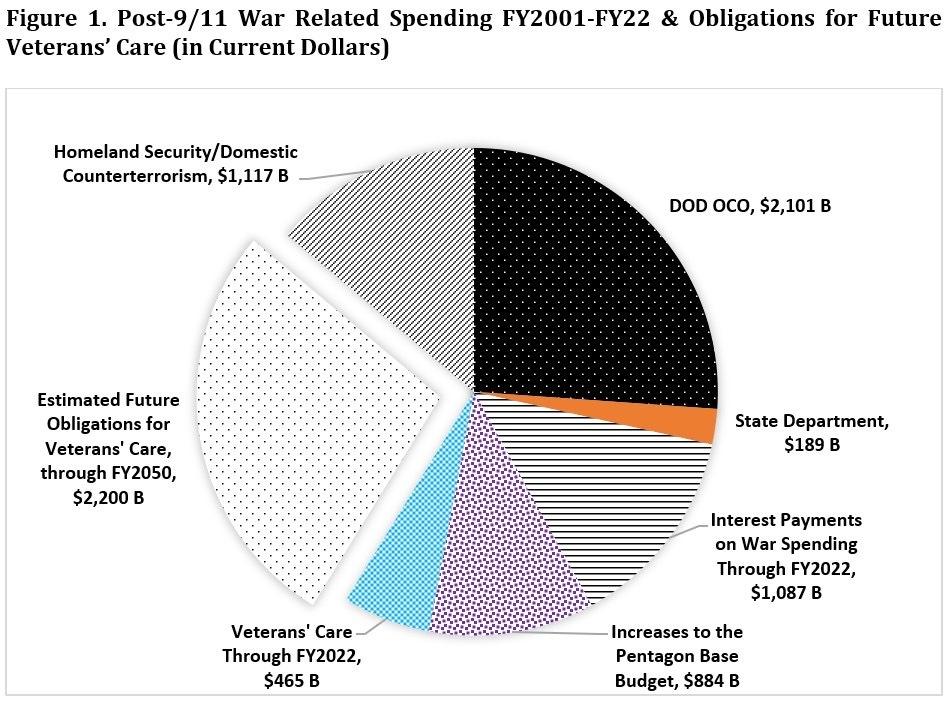
Source: “The U.S. Budgetary Costs of the Post-9/11 Wars,” published by the “Costs of War” project at Brown University’s Watson Institute and Boston University’s Frederick S. Pardee Center

But the biggest-ticket item of all will far outlast the chaotic U.S. withdrawal: The medical benefits for wounded veterans, which the report estimates could reach about $2.3 trillion by 2050. That figure, say the researchers, is among the least-known financial burdens from the past two decades of war.

“What has consistently surprised me is how much veterans’ care has cost and will cost,” said the author of the report Neta C. Crawford, political science professor at Boston University and codirector of the Costs of War project. “These vets are sicker, and more injured, than in previous wars,” she said. The costs include long-term treatment for post-traumatic stress disorders and traumatic brain injuries—conditions that went undiagnosed among the vets who returned home from the Vietnam War in the 1970s. About 50,000 U.S. soldiers were wounded in Afghanistan and Iraq.

Despite the dizzying sums, few Americans have felt the financial burden from decades of war, especially since their federal taxes have gone down even while military costs have ballooned. Almost the entire cost of the Afghan and Iraq wars has come from borrowed money, much of which has yet to be repaid.

“It is difficult to image the scale of what we are talking about into the future,” Crawford told Fortune. “Million, billion, trillion—it all rhymes, but you’re looking at 1,000 times more with each increment,” she says. “When you look at how we’ll upgrade all the infrastructure in the U.S., it could all be done with a trillion dollars.”

Indeed, a second report, also out on Wednesday, calculates what the U.S. might have spent those trillions on, had it not launched wars in Afghanistan and Iraq. The Washington-based Institute of Policy Studies, or IPS, says the money spent on military combat could have solved multiple problems in the U.S., like erasing all student debt for $1.7 trillion, decarbonizing the entire electricity grid for $4.5 trillion, or providing COVID-19 vaccines to all low-income countries for just $25 billion—only slightly higher than the $20 billion the Pentagon budgeted in 2020 for the final year of the Afghan War.

“It really does come down to tradeoffs,” said Lindsay Koshgarian, who wrote the institute’s report, State of Insecurity: The Cost of Militarization Since 9/11. As she told Fortune, “The more we are spending on one thing, the less we are spending on other things.”

Those tradeoffs have also skewed military strategy, according to some analysts, who argue that the Pentagon’s intense focus on Afghanistan and Iraq has come at the expense of dealing with other conflicts that steadily emerged during the past 20 years.

“Beijing was busy building a military to fight and defeat a peer-level competitor,” Elliot Ackerman, a former U.S. Marine and intelligence officer who fought in Afghanistan, writes in the current issue of Foreign Affairs magazine. “Russia has expanded its territory into Crimea and backed separatists in Ukraine; Iran has backed proxies in Afghanistan, Iraq, and Syria; and North Korea has acquired nuclear weapons.”

Koshgarian, who heads the National Priorities Project at IPS, believes many Americans would support cuts in the military budget if the money was reallocated to health care and education. But last year two separate proposals for a 10% cut failed to pass in Congress. Now politicians are bitterly divided over whether to approve Biden’s request for $715 billion in military spending for the coming year or whether to cut the budget, now that the Afghan War has ended.

In the end Americans might not feel the military cost—just as they did not feel the pinch during the past 20 years. With the last U.S. soldier out of Afghanistan, the hundreds of billions could seem increasingly abstract.

Still, Koshgarian believes most would support cutting military spending in order to boost health care, education, and infrastructure. “There is a big divide between what Americans want and what our representatives in Washington are giving us,” she said. “National security and foreign policy are not top of the list when Americans go vote.”

Subscribe to Fortune Daily to get essential business stories straight to your inbox each morning.

About the Author
By Vivienne WaltCorrespondent, Paris

Vivienne Walt is a Paris-based correspondent at Fortune.

See full bioRight Arrow Button Icon

Latest in Politics

Finance
Lorem ipsum dolor sit amet, consectetur adipiscing elit, sed do eiusmod tempor incididunt ut labore et dolore magna aliqua. Ut enim ad minim veniam
By Fortune Editors
October 20, 2025
Finance
Lorem ipsum dolor sit amet, consectetur adipiscing elit, sed do eiusmod tempor incididunt ut labore et dolore magna aliqua. Ut enim ad minim veniam
By Fortune Editors
October 20, 2025
Finance
Lorem ipsum dolor sit amet, consectetur adipiscing elit, sed do eiusmod tempor incididunt ut labore et dolore magna aliqua. Ut enim ad minim veniam
By Fortune Editors
October 20, 2025
Finance
Lorem ipsum dolor sit amet, consectetur adipiscing elit, sed do eiusmod tempor incididunt ut labore et dolore magna aliqua. Ut enim ad minim veniam
By Fortune Editors
October 20, 2025
Finance
Lorem ipsum dolor sit amet, consectetur adipiscing elit, sed do eiusmod tempor incididunt ut labore et dolore magna aliqua. Ut enim ad minim veniam
By Fortune Editors
October 20, 2025
Finance
Lorem ipsum dolor sit amet, consectetur adipiscing elit, sed do eiusmod tempor incididunt ut labore et dolore magna aliqua. Ut enim ad minim veniam
By Fortune Editors
October 20, 2025

Most Popular

Finance
Lorem ipsum dolor sit amet, consectetur adipiscing elit, sed do eiusmod tempor incididunt ut labore et dolore magna aliqua. Ut enim ad minim veniam
By Fortune Editors
October 20, 2025
Finance
Lorem ipsum dolor sit amet, consectetur adipiscing elit, sed do eiusmod tempor incididunt ut labore et dolore magna aliqua. Ut enim ad minim veniam
By Fortune Editors
October 20, 2025
Finance
Lorem ipsum dolor sit amet, consectetur adipiscing elit, sed do eiusmod tempor incididunt ut labore et dolore magna aliqua. Ut enim ad minim veniam
By Fortune Editors
October 20, 2025
Finance
Lorem ipsum dolor sit amet, consectetur adipiscing elit, sed do eiusmod tempor incididunt ut labore et dolore magna aliqua. Ut enim ad minim veniam
By Fortune Editors
October 20, 2025
Finance
Lorem ipsum dolor sit amet, consectetur adipiscing elit, sed do eiusmod tempor incididunt ut labore et dolore magna aliqua. Ut enim ad minim veniam
By Fortune Editors
October 20, 2025
Finance
Lorem ipsum dolor sit amet, consectetur adipiscing elit, sed do eiusmod tempor incididunt ut labore et dolore magna aliqua. Ut enim ad minim veniam
By Fortune Editors
October 20, 2025
Fortune Secondary Logo
Rankings
  • 100 Best Companies
  • Fortune 500
  • Global 500
  • Fortune 500 Europe
  • Most Powerful Women
  • World's Most Admired Companies
  • See All Rankings
  • Lists Calendar
Sections
  • Finance
  • Fortune Crypto
  • Features
  • Leadership
  • Health
  • Commentary
  • Success
  • Retail
  • Mpw
  • Tech
  • Lifestyle
  • CEO Initiative
  • Asia
  • Politics
  • Conferences
  • Europe
  • Newsletters
  • Personal Finance
  • Environment
  • Magazine
  • Education
Customer Support
  • Frequently Asked Questions
  • Customer Service Portal
  • Privacy Policy
  • Terms Of Use
  • Single Issues For Purchase
  • International Print
Commercial Services
  • Advertising
  • Fortune Brand Studio
  • Fortune Analytics
  • Fortune Conferences
  • Business Development
  • Group Subscriptions
About Us
  • About Us
  • Press Center
  • Work At Fortune
  • Terms And Conditions
  • Site Map
  • About Us
  • Press Center
  • Work At Fortune
  • Terms And Conditions
  • Site Map
  • Facebook icon
  • Twitter icon
  • LinkedIn icon
  • Instagram icon
  • Pinterest icon

Latest in Politics

‘As long as the Strait of Hormuz stays closed, markets remain on a knife-edge,’ Deutsche Bank warns
PoliticsMarkets
‘As long as the Strait of Hormuz stays closed, markets remain on a knife-edge,’ Deutsche Bank warns
By Jim EdwardsMay 11, 2026
4 hours ago
voters in line
EconomyElections
Forget the Rust Belt or the Sun Belt. The ‘Wired Belt’ may be the next frontier of American political power
By Jake AngeloMay 11, 2026
8 hours ago
Markets sell off as U.S.-Iran ceasefire plans go nowhere, leaving Trump with military options to reopen the Strait of Hormuz
EnergyIran
Markets sell off as U.S.-Iran ceasefire plans go nowhere, leaving Trump with military options to reopen the Strait of Hormuz
By Jason MaMay 10, 2026
16 hours ago
Mexican cartel armed with explosives launched from drones attacks rural communities, forcing 800-1,000 families to flee
North AmericaMexico
Mexican cartel armed with explosives launched from drones attacks rural communities, forcing 800-1,000 families to flee
By Megan Janetsky and The Associated PressMay 10, 2026
17 hours ago
Trump quickly blasts Iran’s response to U.S. ceasefire proposal as ‘totally unacceptable’ after warning Tehran ‘will be laughing no longer’
PoliticsIran
Trump quickly blasts Iran’s response to U.S. ceasefire proposal as ‘totally unacceptable’ after warning Tehran ‘will be laughing no longer’
By Jon Gambrell, Samy Magdy and The Associated PressMay 10, 2026
17 hours ago
Netanyahu says war with Iran isn’t over, need to secure uranium
PoliticsIran
Netanyahu says war with Iran isn’t over, need to secure uranium
By Yash Roy and BloombergMay 10, 2026
20 hours ago

Most Popular

‘This is the way’: Elon Musk endorses Warren Buffett’s famed 5-minute plan to fix the national debt
Economy
‘This is the way’: Elon Musk endorses Warren Buffett’s famed 5-minute plan to fix the national debt
By Jacqueline MunisMay 10, 2026
1 day ago
OpenAI CEO Sam Altman says Gen Z and millennials are using ChatGPT like a 'life advisor'—but college students might be one step ahead
Tech
OpenAI CEO Sam Altman says Gen Z and millennials are using ChatGPT like a 'life advisor'—but college students might be one step ahead
By Sydney LakeMay 10, 2026
1 day ago
'Employers are increasingly turning to degree and GPA' in hiring: Recruiters retreat from ‘talent is everywhere,’ double down on top colleges
Future of Work
'Employers are increasingly turning to degree and GPA' in hiring: Recruiters retreat from ‘talent is everywhere,’ double down on top colleges
By Jake AngeloMay 9, 2026
2 days ago
Red flag test: former CEO explains why he rejects job candidates who say they can start right away
Success
Red flag test: former CEO explains why he rejects job candidates who say they can start right away
By Orianna Rosa RoyleMay 9, 2026
2 days ago
Trump thinks he's flying to Beijing with leverage. China spent 6 years making sure he doesn't have any
Commentary
Trump thinks he's flying to Beijing with leverage. China spent 6 years making sure he doesn't have any
By Steve H. HankeMay 10, 2026
1 day ago
Ted Cruz says the quiet part out loud: Trump accounts are Social Security personal accounts as GOP senator reveals 'dirty little secret'
Politics
Ted Cruz says the quiet part out loud: Trump accounts are Social Security personal accounts as GOP senator reveals 'dirty little secret'
By Jason MaMay 9, 2026
2 days ago

© 2026 Fortune Media IP Limited. All Rights Reserved. Use of this site constitutes acceptance of our Terms of Use and Privacy Policy | CA Notice at Collection and Privacy Notice | Do Not Sell/Share My Personal Information
FORTUNE is a trademark of Fortune Media IP Limited, registered in the U.S. and other countries. FORTUNE may receive compensation for some links to products and services on this website. Offers may be subject to change without notice.