
This story is part of The Path to Zero, a series of special reports on how business can lead the fight against climate change. This quarter’s stories go in-depth on sustainability in supply chains.
Months after the coronavirus pandemic had shut down cities across the world, something amazing started to happen. Residents in various densely populated urban areas reported a sight they hadn’t seen in years: a bright, blue sky without the typical pollution haze. For ride-hailing companies Uber and Lyft, this shared experience of many served as a moment of clarity.
“Why did it take a pandemic for us to see this?” said Adam Gromis, Uber’s global head of sustainability. “We’re fundamentally an efficiency-driving tech machine. We have to be part of that movement to enable more blue skies.”
The ride-hailing companies have for years touted their services as alternatives to car ownership that could help reduce traffic, car accidents, and emissions. But as the popularity of the services grew, the companies instead worsened congestion in many cities, in some cases accounting for more than 13% of vehicle miles traveled, according to a 2018 study commissioned by the companies. With a large majority of drivers using gas-powered cars, more vehicle miles traveled means more greenhouse gas emissions.
But after the pandemic slowed Uber’s and Lyft’s ride-hailing businesses—which were losing millions of dollars a year pre-pandemic—to nearly a complete stop, the companies were forced to regroup. They realized they needed not only to rethink how they viewed transportation but to reconsider their sustainability efforts.
As a result, the two companies doubled down on their multimodal transportation strategies: The pandemic had fueled people’s dependence on bikes, scooters, and public transit—all areas in which they were already investing. But they also announced lofty electric vehicle adoption goals.
In June of last year, Lyft announced plans to be fully dependent on electric vehicles by 2030. Uber rolled out a similar announcement in September, saying it aims to offer 100% of rides in the U.S., Canada, and Europe in electric vehicles by 2030.
“We wanted to emerge from the crisis stronger, better, and more sustainable,” said Paul Augustine, senior manager of sustainability at Lyft. “We wanted to be a catalyst for change.”
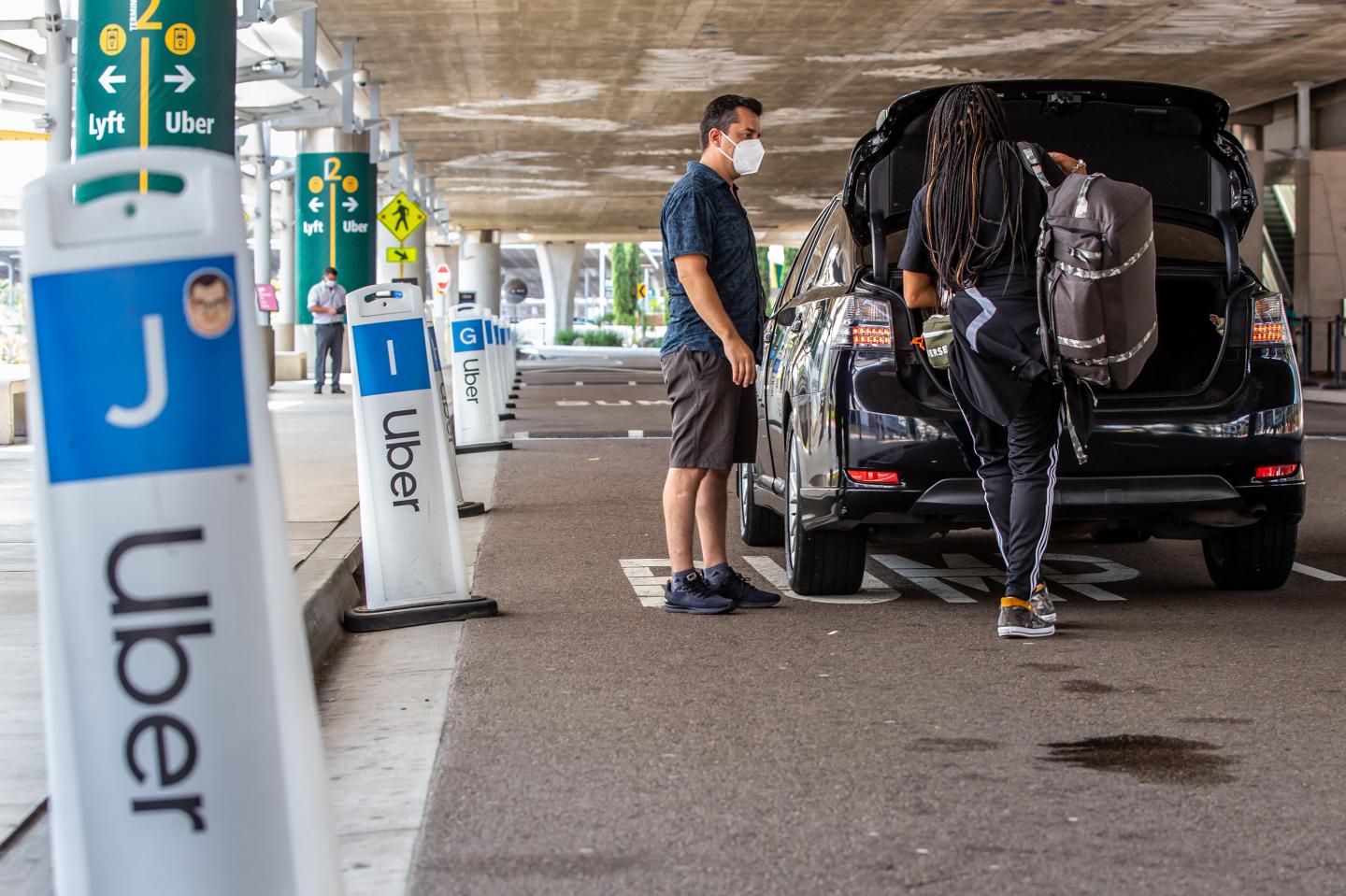
Though the companies hope making a bold commitment to the environment will create a ripple effect in the transportation industry, they also face massive challenges—some of which the companies will have little to no control over.
For example, policy hurdles make it harder to incentivize drivers to make the switch to electric vehicles. Current infrastructure in cities across the U.S. would need a major upgrade to provide enough charging stations for commercial drivers using EVs. And the companies will have to incentivize drivers to offset the cost of purchasing EVs as well as battle some common fears—like the prospect of running out of power before reaching a destination—that keep people from buying.
“It looks like people are surprisingly unenthusiastic about EVs,” said Jon Krosnick, a Stanford University professor and social psychologist who coauthored a survey on EVs last year. “If Uber and Lyft want to encourage their drivers to move over to all EVs, they have to overcome all of [these challenges].”
Uber’s and Lyft’s electric vehicle goals may be the most challenging piece of the ride-hailing companies’ sustainability plans because of the number of stakeholders critical to helping them meet the timeline. So the two are working with city and state policymakers, rolling out financial incentives for drivers who want to get into an EV, and partnering with automakers and rental services to give drivers more access to EVs.
“We know we can’t reach this on our own,” Augustine said. “It’s going to take collective action from the industry, government, and nonprofits to make this reachable.”
In September, Uber committed $800 million to help drivers transition to EVs. Part of that money includes paying an additional 50¢ per ride to drivers who use hybrids and EVs and $1.50 to those who use a battery EV. The funds are also expected to enable driver discounts at charging stations as well as price cuts in the rental or purchase of EVs, which cost around $40,000 to buy.
Uber also expanded its EV and hybrid ride option, called Uber Green, to more than 1,400 U.S. cities and towns this year, bringing its global total to 1,500 cities. And the company is offering drivers three times the amount of Uber Rewards points, which can be exchanged for things like free Starbucks coffee and UberEats orders, for every Uber Green trip completed.
“EVs don’t make sense to most drivers today, and that’s why they don’t switch,” Gromis said. “We recognize it’s fundamentally a value proposition we have to make.”
Lyft, meanwhile, has been expanding the availability of EVs within its car-rental program for drivers called Express Drive. So far, the program offers EV options in Seattle, Denver, and Atlanta. It’s also working with policymakers in states including Colorado, Maryland, and Oregon to help advance the adoption of EVs. The company says it considers new mandates in California and Massachusetts as policy victories that came out of some of these discussions.
In Los Angeles, discussions with Lyft and Uber began in late 2018, when the city created a working group focused on the issue of EVs. Together, they have been discussing how they can collectively encourage more drivers to use EVs. One goal is to expand the benefits of California’s Clean Vehicle Rebate Project, which offers up to $7,000 in rebates on the lease or purchase of an EV, to include commercial fleets. The city said the companies have been collaborative in much of its work.
Meanwhile, both companies are expanding their partnerships with city and county transit agencies, aiming to increase the number of passengers on trains and buses by offering special deals or detailing how to connect to the services within their ride-hailing apps. They are also investing in more electric bikes and scooters, to offer micro-mobility options for shorter trips.
Uber’s and Lyft’s new goals may suggest the companies are serious enough about their sustainability targets, even if changes aren’t entirely dependent on them. But the companies won’t be held accountable solely by their own goals. Policymakers are rolling out new requirements that would make some of their progress mandatory.
For example, Senate Bill 1014, authored by California State Sen. Nancy Skinner and passed in 2018, will require ride-hailing companies to increase the number of EVs its drivers use as well as reduce greenhouse gas emissions per mile traveled (Uber and Lyft drivers often drive for miles before and after a passenger trip is completed). In accordance with the bill, in May the California Air Resources Board announced a regulation that requires the companies to “achieve a level of zero greenhouse gas emissions and to ensure 90% of their vehicle miles are fully electric” by 2030—the same year tied to Uber’s and Lyft’s EV goals.
“These conversations were happening [at the ride-hailing companies] prior to SB 1014,” said Susan Shaheen, codirector of the Transportation Sustainability Research Center at the University of California, Berkeley. “But also now they have to do it.”
Gromis said the top three barriers that keep drivers from purchasing an EV are the cost, the quality of the vehicle (including the travel distance range and trunk space), and sparse charging infrastructure. That aligns with results from the survey coauthored by Stanford’s Krosnick showing that 78% of Americans think finding a charging station is at least moderately difficult, while 29% believe that it’s costlier to maintain an EV than a gas-powered car.
But Ethan Elkind, director of the Climate Program at UC–Berkeley’s Center for Law, Energy, and the Environment, said that EV technology and education are changing every day. Already the price of lithium-ion batteries, which power most EVs, has dropped almost 90% in the past 10 years, he noted. And they are expected to only get cheaper, lowering the cost of the vehicle.
“We’re really close to it being economically the no-brainer option,” he said.
He also said Uber’s and Lyft’s 2030 EV goals are “feasible,” given their progress overall, and noted that companies often make big goals public like this only when they know they can reach them.
But the companies say the goals are much more than lip service. The pandemic forced executives to focus on keeping the wheels from falling off their businesses. But it also gave them the chance to slow down and take a closer look at what they were and perhaps weren’t doing.
“It was a good time to take a beat and reflect,” Lyft’s Augustine said. “We knew this pandemic was happening and impacting our business, but we knew this commitment was the right thing to do.”
Subscribe to Fortune Daily to get essential business stories straight to your inbox each morning.