• Home
  • Latest
  • Fortune 500
  • Finance
  • Tech
  • Leadership
  • Lifestyle
  • Rankings
  • Multimedia
Commentary

A proposed California law could transform fast-food work

By
David Madland
David Madland
Down Arrow Button Icon
By
David Madland
David Madland
Down Arrow Button Icon
May 21, 2021, 12:30 PM ET
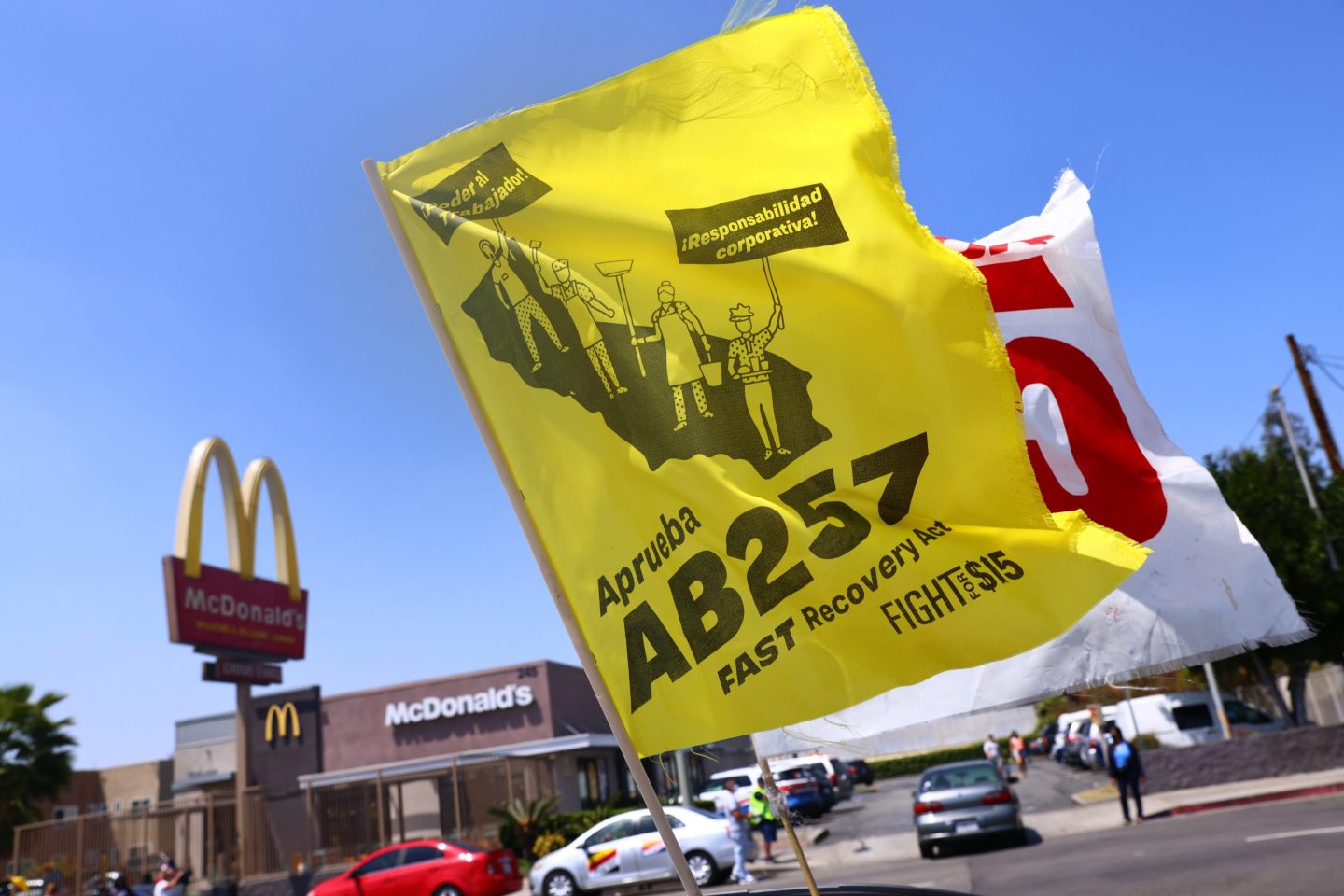
A banner advocating for California's FAST Recovery Act at a rally of fast food workers in Los Angeles in April, 2021. Elements of that bill "could form the backbone of fundamental change in the industry," writes David Madland.
A banner advocating for California's FAST Recovery Act at a rally of fast food workers in Los Angeles in April, 2021. Elements of that bill "could form the backbone of fundamental change in the industry," writes David Madland.Mario Tama—Getty Images

A new policy strategy emerging in California holds the potential to transform fast-food work from some of the lowest-paying jobs in the state into good jobs, with solid wages, benefits, and a voice at work. Workers, employers, and policymakers in the state and around the country should pay close attention to this model, because setting and enforcing high standards in the fast-food industry is notoriously challenging—due to the industry’s franchising model, its numerous small employers with little ability to profitably raise standards, and its largely non-union workforce.

Fast food workers earn some of the lowest wages in California—$13.27 an hour, according to the Bureau of Labor Statistics—with only farm workers earning less in the state. Benefits are also meager: Researchers have estimated that just 13% of fast-food workers receive health benefits through their employer. A 2021 study found that more than two-thirds of the families of fast-food workers in California were enrolled in at least one public-safety net program, such as the Supplemental Nutrition Assistance Program (SNAP) or Medicaid, at a public cost of $4 billion a year.

Compounding these problems is that nearly 9 in 10 fast food-workers, say they are subject to illegal working conditions—refused overtime pay, forced to do off-the-clock work, denied breaks, or placed in unsafe situations.

At the heart of the strategy to improve conditions for fast food workers in California is a “sectoral council,” which would bring together representatives of workers, employers, and public-sector regulators to make recommendations regarding minimum compensation, safety, scheduling stability, and training standards for the industry.  A hearing on the FAST Recovery Act—a bill that would establish the sectoral council—was held on April 22, and some think the bill could pass this year.

Sectoral councils and similar bodies have succeeded in helping raise working standards in a number of industries and regions. The state of New York used a wage board to bring together representatives of workers, employers, and the public to raise wages for fast-food workers;  the city of Seattle Domestic Workers Standards Board provides a forum for domestic workers, employers, private households, worker organizations, and the public to improve conditions for that sector; and a number of countries, including Australia and Britain, have used similar bodies in labor relations.

A fast-food sectoral council could form the backbone of fundamental change in the industry: It could not only raise standards for workers but also provide a way for workers as well employers—both franchisees and franchisors—to have a strong voice on the standards in their industry, while helping ensure standards are actually implemented and complied with.  These features are critical, because the structure of the fast-food industry makes it difficult to improve working conditions with traditional measures that have succeeded in other industries, such as actions by high-road employers that want to provide good compensation, the push of collective bargaining, or stand-alone legislated standards.

A handful of large, profitable franchisors dominate the fast-food industry, but most of the firms that actually run fast-food restaurants and employ fast-food workers are smaller franchisees with low profit margins. These employers have little ability to improve compensation on their own, and the payments they owe to their franchisors restrict their economic flexibility. As law professor Catherine Fisk has argued, “A franchisee who believes employees should be paid more cannot make a profit under the [franchise] formula if he raises wages, and he will lose his franchise if he cannot make the payments required under the agreement.”

Collective bargaining also faces steep challenges in the industry.  Inadequate federal labor laws, which states cannot legally change, fail to guarantee workers basic rights and make joining a union unnecessarily difficult—and nearly impossible in an industry like fast food with very high worker turnover and thousands of franchisees. Not surprisingly, just one percent of workers at food service and drinking places overall are members of unions (and within fast food, union density is likely even lower).

Raising the minimum wage and other standards for all workers through legislation could help. But such legislation misses an opportunity to create a forum for workers and employers to discuss inter-related fast-food industry issues. It also fails to sufficiently involve workers in the process of setting and enforcing standards. And engaged and organized workers are critical to effectively policing minimum standards and ensuring workers can come forward and assert their rights.

As I highlight in my new book Re-Union: How Bold Labor Reforms Can Repair, Revitalize, and Reunite the United States, sectoral councils are well suited to addressing these challenges. They can raise standards for all workers no matter whether they are directly employed by a lead firm or a franchisee; they can enable employers to compete on a level playing field; they can provide a forum for franchisees and franchisors to influence standards; and they can help build the worker engagement necessary to promote high standards and ensure they are complied with.  

By moving ahead with this model of stakeholder involvement and standard-setting in the fast-food industry, California may be showing the way forward for other states and the country. 

David Madland is the author of Re-Union: How Bold Labor Reforms Can Repair, Revitalize, and Reunite the United States and is a senior fellow at the Center for American Progress.

Our mission to make business better is fueled by readers like you. To enjoy unlimited access to our journalism, subscribe today.
About the Author
By David Madland
See full bioRight Arrow Button Icon

Latest in Commentary

Finance
Lorem ipsum dolor sit amet, consectetur adipiscing elit, sed do eiusmod tempor incididunt ut labore et dolore magna aliqua. Ut enim ad minim veniam
By Fortune Editors
October 20, 2025
Finance
Lorem ipsum dolor sit amet, consectetur adipiscing elit, sed do eiusmod tempor incididunt ut labore et dolore magna aliqua. Ut enim ad minim veniam
By Fortune Editors
October 20, 2025
Finance
Lorem ipsum dolor sit amet, consectetur adipiscing elit, sed do eiusmod tempor incididunt ut labore et dolore magna aliqua. Ut enim ad minim veniam
By Fortune Editors
October 20, 2025
Finance
Lorem ipsum dolor sit amet, consectetur adipiscing elit, sed do eiusmod tempor incididunt ut labore et dolore magna aliqua. Ut enim ad minim veniam
By Fortune Editors
October 20, 2025
Finance
Lorem ipsum dolor sit amet, consectetur adipiscing elit, sed do eiusmod tempor incididunt ut labore et dolore magna aliqua. Ut enim ad minim veniam
By Fortune Editors
October 20, 2025
Finance
Lorem ipsum dolor sit amet, consectetur adipiscing elit, sed do eiusmod tempor incididunt ut labore et dolore magna aliqua. Ut enim ad minim veniam
By Fortune Editors
October 20, 2025

Most Popular

Finance
Lorem ipsum dolor sit amet, consectetur adipiscing elit, sed do eiusmod tempor incididunt ut labore et dolore magna aliqua. Ut enim ad minim veniam
By Fortune Editors
October 20, 2025
Finance
Lorem ipsum dolor sit amet, consectetur adipiscing elit, sed do eiusmod tempor incididunt ut labore et dolore magna aliqua. Ut enim ad minim veniam
By Fortune Editors
October 20, 2025
Finance
Lorem ipsum dolor sit amet, consectetur adipiscing elit, sed do eiusmod tempor incididunt ut labore et dolore magna aliqua. Ut enim ad minim veniam
By Fortune Editors
October 20, 2025
Finance
Lorem ipsum dolor sit amet, consectetur adipiscing elit, sed do eiusmod tempor incididunt ut labore et dolore magna aliqua. Ut enim ad minim veniam
By Fortune Editors
October 20, 2025
Finance
Lorem ipsum dolor sit amet, consectetur adipiscing elit, sed do eiusmod tempor incididunt ut labore et dolore magna aliqua. Ut enim ad minim veniam
By Fortune Editors
October 20, 2025
Finance
Lorem ipsum dolor sit amet, consectetur adipiscing elit, sed do eiusmod tempor incididunt ut labore et dolore magna aliqua. Ut enim ad minim veniam
By Fortune Editors
October 20, 2025
Rankings
  • 100 Best Companies
  • Fortune 500
  • Global 500
  • Fortune 500 Europe
  • Most Powerful Women
  • Future 50
  • World’s Most Admired Companies
  • See All Rankings
Sections
  • Finance
  • Leadership
  • Success
  • Tech
  • Asia
  • Europe
  • Environment
  • Fortune Crypto
  • Health
  • Retail
  • Lifestyle
  • Politics
  • Newsletters
  • Magazine
  • Features
  • Commentary
  • Mpw
  • CEO Initiative
  • Conferences
  • Personal Finance
  • Education
Customer Support
  • Frequently Asked Questions
  • Customer Service Portal
  • Privacy Policy
  • Terms Of Use
  • Single Issues For Purchase
  • International Print
Commercial Services
  • Advertising
  • Fortune Brand Studio
  • Fortune Analytics
  • Fortune Conferences
  • Business Development
About Us
  • About Us
  • Editorial Calendar
  • Press Center
  • Work At Fortune
  • Diversity And Inclusion
  • Terms And Conditions
  • Site Map
  • Facebook icon
  • Twitter icon
  • LinkedIn icon
  • Instagram icon
  • Pinterest icon

© 2026 Fortune Media IP Limited. All Rights Reserved. Use of this site constitutes acceptance of our Terms of Use and Privacy Policy | CA Notice at Collection and Privacy Notice | Do Not Sell/Share My Personal Information
FORTUNE is a trademark of Fortune Media IP Limited, registered in the U.S. and other countries. FORTUNE may receive compensation for some links to products and services on this website. Offers may be subject to change without notice.


Most Popular

placeholder alt text
Economy
Trump may have shot himself in the foot at the Fed, as Powell could stay on while Miran resigns from White House post
By Eleanor PringleFebruary 4, 2026
1 day ago
placeholder alt text
Politics
Peter Thiel warns the Antichrist and apocalypse are linked to the ‘end of modernity’ currently happening—and cites Greta Thunberg as a driving example
By Nick LichtenbergFebruary 4, 2026
22 hours ago
placeholder alt text
Investing
Tech stocks go into free fall as it dawns on traders that AI has the ability to cut revenues across the board
By Jim EdwardsFebruary 4, 2026
1 day ago
placeholder alt text
Success
After decades in the music industry, Pharrell Williams admits he never stops working: ‘If you do what you love everyday, you’ll get paid for free'
By Emma BurleighFebruary 3, 2026
2 days ago
placeholder alt text
Success
In 2026, many employers are ditching merit-based pay bumps in favor of ‘peanut butter raises’
By Emma BurleighFebruary 2, 2026
3 days ago
placeholder alt text
Commentary
I've studied nonviolent resistance in war zones for 20 years and Minnesota reminds me of Colombia, the Philippines and Syria
By Oliver Kaplan and The ConversationFebruary 3, 2026
2 days ago

Latest in Commentary

desantis
CommentaryLeadership
Understanding corporate leaders’ muted Minnesota response: the example of Disney, Florida and conservative retaliation
By Alessandro Piazza and The ConversationFebruary 5, 2026
45 minutes ago
grace
CommentaryRobotics
I’m a 25-year-old founder who loves robots but too many humanoids are militant and creepy-looking. Things need to change—just look at Elon Musk
By Grace BrownFebruary 5, 2026
3 hours ago
sam wolf
Commentaryactivist investing
Activist investors are more dangerous to CEOs than ever. Here are 3 ways to safeguard your leadership
By Sam WolfFebruary 5, 2026
5 hours ago
warsh
CommentaryFederal Reserve
Kevin Warsh’s Fed criticisms make sense, but he’s got a ‘cleanest dirty shirt’ problem. Here’s the triple dilemma he faces
By Daniel J. ArbessFebruary 5, 2026
5 hours ago
disney
CommentaryDisney
Disney’s new D’Amaro-land:  a dream team succession saga comes to life
By Jeffrey Sonnenfeld and Stephen HenriquesFebruary 4, 2026
1 day ago
minnesota
CommentaryMinnesota
I’ve studied nonviolent resistance in war zones for 20 years and Minnesota reminds me of Colombia, the Philippines and Syria
By Oliver Kaplan and The ConversationFebruary 3, 2026
2 days ago