
January was certainly a month for the history books.
Markets started 2021 on a high note on the back of a sensational year (after stocks plunged over 30% in March they recovered to new highs by December). But just a few weeks into January, so-called “Reddit stocks,” those pumped up by retail traders on online message board Reddit, took the markets on a wild ride: Names like GameStop soared triple digits, while benchmark indexes slumped.
Part of that broader selloff may have been due to hedge funds who were short names like GameStop being forced to raise cash and cover their positions. But whatever the culprit, the bout of volatility sunk the S&P 500 1.1% lower for the month.
For some market watchers, “I think investors were looking for a reason to sell off, bring the market back down a degree,” suggests Lindsey Bell, chief investment strategist for Ally Invest.
And according to history, the January selloff doesn’t bode well for the rest of the year.
“The old Wall Street adage of ‘as goes January, so goes the year’ comes to mind,” notes Bank of America technical research strategist Stephen Suttmeier. Going back to 1928, “When January is down, the [S&P 500] tends to be weaker and the year is up only 45.7% of the time with an average return of -0.97% … and the rest of the year is up 60% of the time with an average return of 2.89%,” he wrote in a Tuesday report (see BofA’s chart).
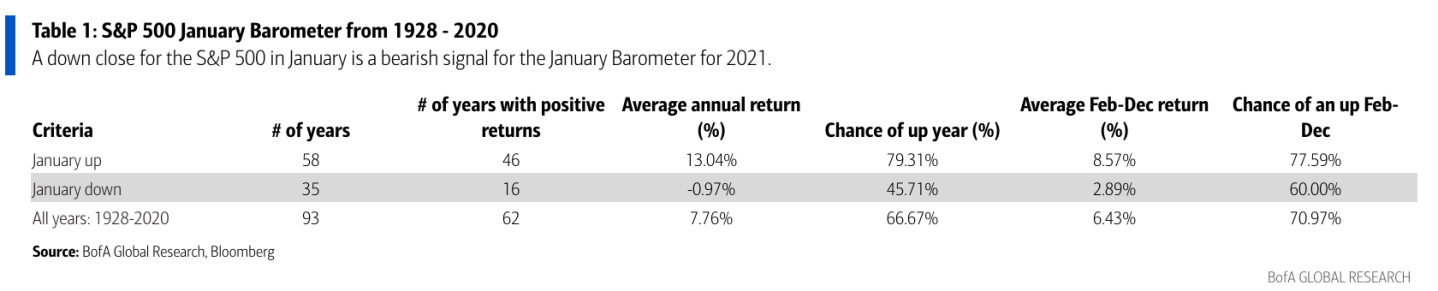
Add to that how stocks historically perform during the first year of a new presidency: “When January is down in a Presidential Cycle Year 1, the year is up only 22.2% of the time with an average return of -6.92% … and February-December is also up 22.2% of the time with an average return of -3.14%,” Suttmeier wrote.
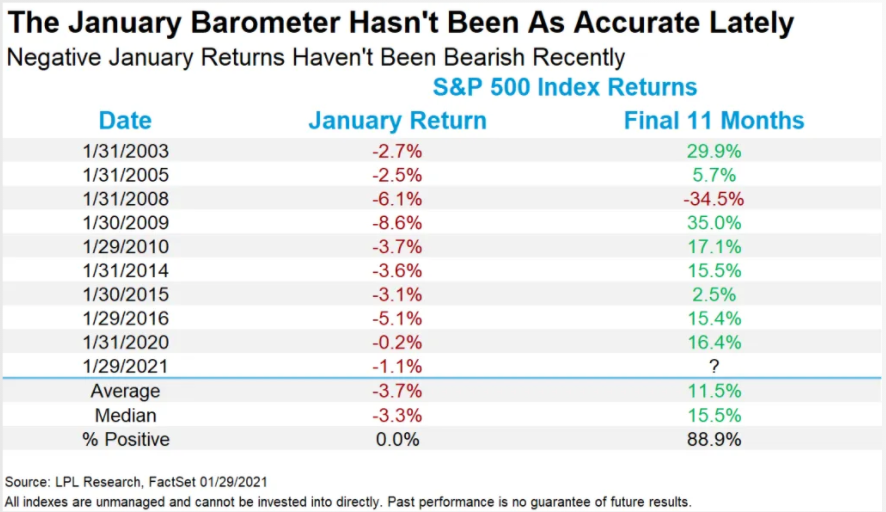
But the good news? That January barometer has “become less reliable in recent years,” BofA’s Suttmeier notes. In fact, since the early 2000s, stocks have been up eight out of the past nine times stocks were lower in January, with an average return of 11.5%, analysts at LPL Financial wrote Monday (see chart).
So far markets have seen a boost to kick off February. The S&P 500 rose 1.4% while the Dow closed up nearly 1.6% on Tuesday. Indeed, Ally’s Bell suggests “Clearly the market is reacting to the action in those [speculative] stocks overall, and it seems like right now, the read-through is that, ‘Okay, these speculative trades are winding down and the natural market forces are returning’,” she suggests to Fortune.
In terms of that January barometer, “It’s good to look at history, but there are a lot of different things fundamentally that can drive the market higher,” she says.
Indeed, strategists at UBS note they “don’t think the modest selloff in the S&P 500 is indicative of a fundamental shift in the outlook for the economy and corporate profits,” Solita Marcelli, CIO of Americas at UBS Global Wealth Management and David Lefkowitz, head of Americas equities, wrote in a Monday note. “After the recent sell-off, the risk/reward for US equities is looking a bit more appealing.” They believe stocks will ultimately trade higher due to the vaccine rollout, strong corporate profits, and continued Fed and fiscal spending support.
But as the past few weeks have shown us, it may be a bumpy ride. “Ultimately, we could still continue to see choppiness here in the near term for the next month or two,” Ally’s Bell says. “But I look forward to the latter part of the year to drive market returns.”