
• Home
  • Latest
  • Fortune 500
  • Finance
  • Tech
  • Leadership
  • Lifestyle
  • Rankings
  • Multimedia
MagazineMost Powerful Women

The pandemic has derailed women’s careers and livelihoods. Is America giving up on them?

By
Maria Aspan
Maria Aspan
and
Emma Hinchliffe
Emma Hinchliffe
Down Arrow Button Icon
By
Maria Aspan
Maria Aspan
and
Emma Hinchliffe
Emma Hinchliffe
Down Arrow Button Icon
January 29, 2021, 6:30 AM ET
Photo-Illustration by Selman Design

In early 2020, just before the first U.S. patient was diagnosed with COVID-19, women crossed a major employment milestone. The labor market was booming. Health care, education, and other service sectors largely staffed by female workers were racing to hire more people. And for a few shining months in early 2020, government data showed that women outnumbered men in the U.S. paid workforce.

Then “the whole house burned down,” says Michael Madowitz, a labor economist at the Center for American Progress.

It’s been almost a year since COVID-19 closed the schools and day cares working mothers rely on for childcare, and battered many of the service-oriented businesses with majority female workforces. And in that time, the pandemic has set working women back by more than three decades—to levels of labor force participation last seen in 1988. The resulting employment conflagration has spread across race, age, and industry, from low-paid essential workers to “knowledge” employees in remote-friendly corporate roles—although it has, predictably and awfully, done the most damage to the Black and Latina women who were already the most economically vulnerable. 

“We’ve lost so much ground. It’s astronomical,” says C. Nicole Mason, president and CEO of the Institute for Women’s Policy Research. 

The numbers are shocking: 5.4 million women’s jobs gone since last February—55% of all net U.S. job losses in that time period. Almost 2.1 million women vanished from the paid labor force entirely. By September, three working mothers were unemployed for every father who had lost his job.  
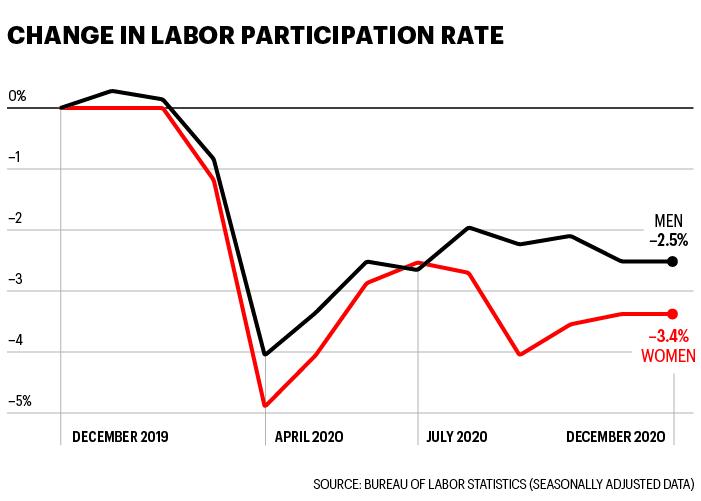
Then, early this year came perhaps the bleakest statistic yet: In December, the U.S. economy shed a net 140,000 jobs, the first such downturn since April. Jobs lost by women account for the entirety of that number. While individual men became unemployed during that period, men as a group gained 16,000 jobs for the month. But women as a group—especially women of color—lost 156,000. 

The damage to women’s employment is likely to endure beyond the pandemic’s eventual end. Women who have lost jobs or left the labor force are missing out on future retirement and Social Security income as well as current wages and savings. Ultimately, some economists predict, the crisis will increase the gender wage gap by five percentage points. And women who try to return to the labor force in the future will do so with a yawning hole in their résumés. 

“Whether women regain their footing in the post-pandemic economy depends on whether employers recognize the reason for those gaps or penalize women for a reality they had no control over,” says philanthropist Melinda Gates, whose Pivotal Ventures fund focuses on gender equity.

Newsletter-Red-Line-15

“There have definitely been days where I’m like, ‘Maybe I should give up,’ ” says Julia Pollak, labor economist for online job marketplace ZipRecruiter and a mother of two young children. Their schools have been remote since March, so Pollak is scheduling her paid work around the kids’ Zoom calendars. But at least her job’s flexibility allows her to “make up for lost time during the day” by working 8 p.m. to midnight, when the kids are in bed. 

“It’s lower-wage women, who have to leave the house to go to a grocery store or a warehouse, who have no choice but to leave the labor force entirely,” Pollak says. “It really is mothers who are bearing the brunt of the crisis.”

The fact that moms—rather than dads—are shouldering the bulk of family obligations became vividly obvious in September, when schools resumed. With classrooms remote, “hybrid,” or some unpredictable mix, 865,000 women dropped out of the labor force in that month alone—four times the number of men who left. 

100%

Women’s share of the 140,000 U.S. jobs lost in December

“Bringing everyone back into the house exposed the wound of gender inequality,” says Misty Heggeness, a principal economist with the U.S. Census Bureau. “For women with children in their households, the struggle has been real in a way that women haven’t experienced for decades.”

Heggeness points out that men—as fathers and business leaders—could do “a lot more” to take on childcare responsibilities and “to actively encourage change in other men’s behavior.” But any systemic fixes will require federal policy, including legislation that centers on mothers and the affordable childcare infrastructure that would enable more women to remain in the workforce. 

President Joe Biden’s proposed $1.9 trillion COVID-19 relief plan would be a good start, several economists and policy experts tell Fortune; it includes child tax credits for low-income families and $25 billion to support the country’s floundering childcare providers. The Biden administration proposals also include an expansion of paid leave; an increase in vaccine rollouts, which could help schools and day-care centers reopen more quickly; and a federal minimum wage of $15 per hour, an increase that advocates say would directly benefit the women of color disproportionately working in low-wage service jobs.

WOM.03.21.Job Losses-Women-School
ONLINE ED: When schools started up in September, women dropped out of the workforce at four times the rate of men.
Al Seib—Los Angeles Times/Getty Images

All of these policies are expensive, of course, and the Democrats’ razor-thin hold on Congress will complicate President Biden’s efforts to enact them. In the interim, some private employers are trying to make a significant, if nonsystemic, difference.

“The lasting impacts of this are going to be far-reaching,” warns Nickle LaMoreaux, chief HR officer for IBM. Beyond expanding some employee benefits, the enterprise-tech giant is widening eligibility for a “returnship” program that hires and trains women who have taken a break from the workforce. “This is not a sprint,” she says. “This is going to be a marathon for female employees—and for their employers.”

But while tech companies are known for their rich benefits, the industry writ large has a shoddy track record of hiring women. Instead, some of the biggest private employers of women are retail companies, which largely rely on their workers showing up in person. When Fortune asked eight of the largest brick-and-mortar retailers about how they are supporting their female workers, the response was mixed. Some said they haven’t seen women struggle to stay in their workforces. Others said they have expanded paid leave or pandemic-era bonus pay. Target offered the most concrete plan, saying it is providing all U.S. employees with unlimited company-paid in-home or day-care “backup care” through May. 

Telecom titan Verizon offers another potential example of how to support essential workers with childcare obligations. When lockdowns closed 70% of Verizon’s stores, the company retrained the 8,000 affected workers—including many women—to do at-home tele-sales or other remote jobs. Verizon allowed some of those workers to remain remote or go part-time even as stores reopened—and expanded its paid childcare benefits for all employees, offering to reimburse up to $15 per hour and $100 per day. 

“For a lot of parents, this broke their work/life infrastructure,” says Christy Pambianchi, the company’s chief HR officer. She credits these expanded benefits with a lower-than-normal turnover at Verizon last year—and says the not-insignificant price was worth it. 

“It is expensive,” Pambianchi says, though she declines to share the exact cost of Verizon’s programs. “But on the other hand, turnover has a high expense. And we think it’s really important that our employees know, and society knows, that we’re here for them.”

This article appears in the February/March 2021 issue of Fortune with the headline, “Is America giving up on working women?”

About the Authors
By Maria Aspan
LinkedIn iconTwitter icon

Maria Aspan is a former senior writer at Fortune, where she wrote features primarily focusing on gender, finance, and the intersection of business and government policy.

See full bioRight Arrow Button Icon
Emma Hinchliffe
By Emma HinchliffeMost Powerful Women Editor
LinkedIn iconTwitter icon

Emma Hinchliffe is Fortune’s Most Powerful Women editor, overseeing editorial for the longstanding franchise. As a senior writer at Fortune, Emma has covered women in business and gender-lens news across business, politics, and culture. She is the lead author of the Most Powerful Women Daily newsletter (formerly the Broadsheet), Fortune’s daily missive for and about the women leading the business world.

See full bioRight Arrow Button Icon

Latest from the Magazine

Finance
Lorem ipsum dolor sit amet, consectetur adipiscing elit, sed do eiusmod tempor incididunt ut labore et dolore magna aliqua. Ut enim ad minim veniam
By Fortune Editors
October 20, 2025
Finance
Lorem ipsum dolor sit amet, consectetur adipiscing elit, sed do eiusmod tempor incididunt ut labore et dolore magna aliqua. Ut enim ad minim veniam
By Fortune Editors
October 20, 2025
Finance
Lorem ipsum dolor sit amet, consectetur adipiscing elit, sed do eiusmod tempor incididunt ut labore et dolore magna aliqua. Ut enim ad minim veniam
By Fortune Editors
October 20, 2025
Finance
Lorem ipsum dolor sit amet, consectetur adipiscing elit, sed do eiusmod tempor incididunt ut labore et dolore magna aliqua. Ut enim ad minim veniam
By Fortune Editors
October 20, 2025
Finance
Lorem ipsum dolor sit amet, consectetur adipiscing elit, sed do eiusmod tempor incididunt ut labore et dolore magna aliqua. Ut enim ad minim veniam
By Fortune Editors
October 20, 2025
Finance
Lorem ipsum dolor sit amet, consectetur adipiscing elit, sed do eiusmod tempor incididunt ut labore et dolore magna aliqua. Ut enim ad minim veniam
By Fortune Editors
October 20, 2025

Most Popular

Finance
Lorem ipsum dolor sit amet, consectetur adipiscing elit, sed do eiusmod tempor incididunt ut labore et dolore magna aliqua. Ut enim ad minim veniam
By Fortune Editors
October 20, 2025
Finance
Lorem ipsum dolor sit amet, consectetur adipiscing elit, sed do eiusmod tempor incididunt ut labore et dolore magna aliqua. Ut enim ad minim veniam
By Fortune Editors
October 20, 2025
Finance
Lorem ipsum dolor sit amet, consectetur adipiscing elit, sed do eiusmod tempor incididunt ut labore et dolore magna aliqua. Ut enim ad minim veniam
By Fortune Editors
October 20, 2025
Finance
Lorem ipsum dolor sit amet, consectetur adipiscing elit, sed do eiusmod tempor incididunt ut labore et dolore magna aliqua. Ut enim ad minim veniam
By Fortune Editors
October 20, 2025
Finance
Lorem ipsum dolor sit amet, consectetur adipiscing elit, sed do eiusmod tempor incididunt ut labore et dolore magna aliqua. Ut enim ad minim veniam
By Fortune Editors
October 20, 2025
Finance
Lorem ipsum dolor sit amet, consectetur adipiscing elit, sed do eiusmod tempor incididunt ut labore et dolore magna aliqua. Ut enim ad minim veniam
By Fortune Editors
October 20, 2025
Fortune Secondary Logo
Rankings
  • 100 Best Companies
  • Fortune 500
  • Global 500
  • Fortune 500 Europe
  • Most Powerful Women
  • World's Most Admired Companies
  • See All Rankings
  • Lists Calendar
Sections
  • Finance
  • Fortune Crypto
  • Features
  • Leadership
  • Health
  • Commentary
  • Success
  • Retail
  • Mpw
  • Tech
  • Lifestyle
  • CEO Initiative
  • Asia
  • Politics
  • Conferences
  • Europe
  • Newsletters
  • Personal Finance
  • Environment
  • Magazine
  • Education
Customer Support
  • Frequently Asked Questions
  • Customer Service Portal
  • Privacy Policy
  • Terms Of Use
  • Single Issues For Purchase
  • International Print
Commercial Services
  • Advertising
  • Fortune Brand Studio
  • Fortune Analytics
  • Fortune Conferences
  • Business Development
  • Group Subscriptions
About Us
  • About Us
  • Press Center
  • Work At Fortune
  • Terms And Conditions
  • Site Map
  • About Us
  • Press Center
  • Work At Fortune
  • Terms And Conditions
  • Site Map
  • Facebook icon
  • Twitter icon
  • LinkedIn icon
  • Instagram icon
  • Pinterest icon

Latest from the Magazine

Anduril CEO Brian Schimpf
MagazineDefense
Inside Anduril: Meet the quiet engineer-CEO building America’s $31 billion weapons startup
By Allie GarfinkleMay 6, 2026
3 days ago
A Michigan farm town voted down plans for a giant OpenAI-Oracle data center. Weeks later, construction began
MagazineData centers
A Michigan farm town voted down plans for a giant OpenAI-Oracle data center. Weeks later, construction began
By Sharon GoldmanMay 6, 2026
3 days ago
The American Express CEO defied haters who said he’d never have the top job—winning with millennials and Gen Z and trouncing the competition
MagazineAmerican Express
The American Express CEO defied haters who said he’d never have the top job—winning with millennials and Gen Z and trouncing the competition
By Shawn TullyMay 6, 2026
3 days ago
Photo of Marc Benioff
Magazinecommunication
Salesforce CEO Marc Benioff turned his earnings call into a vodcast. Why other Fortune 500 CEOs might follow
By Rachel VentrescaMay 6, 2026
3 days ago
Who’s really in control as AI and Big Tech race ahead?
MagazineEurope
Who’s really in control as AI and Big Tech race ahead?
By Francesca CassidyApril 10, 2026
29 days ago
Who owns ideas in the AI age?
MagazinePublishing
Who owns ideas in the AI age?
By Francesca CassidyApril 8, 2026
1 month ago

Most Popular

California farmers must destroy 420,000 peach trees after Del Monte closes its canneries and cancels more than $550 million in long-term contracts
North America
California farmers must destroy 420,000 peach trees after Del Monte closes its canneries and cancels more than $550 million in long-term contracts
By Sasha RogelbergMay 7, 2026
1 day ago
'Blue dot fever' plagues musicians like Post Malone, Meghan Trainor, and Zayn as a growing list of artists cancel tours due to lagging ticket sales
Arts & Entertainment
'Blue dot fever' plagues musicians like Post Malone, Meghan Trainor, and Zayn as a growing list of artists cancel tours due to lagging ticket sales
By Dave Lozo and Morning BrewMay 7, 2026
1 day ago
A Michigan farm town voted down plans for a giant OpenAI-Oracle data center. Weeks later, construction began
Magazine
A Michigan farm town voted down plans for a giant OpenAI-Oracle data center. Weeks later, construction began
By Sharon GoldmanMay 6, 2026
3 days ago
U.S. Treasury will have to borrow $2 trillion this year just to continue functioning—more than $166 billion every month
Economy
U.S. Treasury will have to borrow $2 trillion this year just to continue functioning—more than $166 billion every month
By Eleanor PringleMay 7, 2026
2 days ago
Airbnb CEO Brian Chesky warns two types of people won’t survive the AI era: ‘pure people managers’ and workers who resist change
Success
Airbnb CEO Brian Chesky warns two types of people won’t survive the AI era: ‘pure people managers’ and workers who resist change
By Emma BurleighMay 7, 2026
2 days ago
Current price of oil as of May 8, 2026
Personal Finance
Current price of oil as of May 8, 2026
By Joseph HostetlerMay 8, 2026
17 hours ago

© 2026 Fortune Media IP Limited. All Rights Reserved. Use of this site constitutes acceptance of our Terms of Use and Privacy Policy | CA Notice at Collection and Privacy Notice | Do Not Sell/Share My Personal Information
FORTUNE is a trademark of Fortune Media IP Limited, registered in the U.S. and other countries. FORTUNE may receive compensation for some links to products and services on this website. Offers may be subject to change without notice.