This is the web version of Business x Design, a newsletter on the power of design. Sign up here to get it in your inbox.
My son celebrated his 14th birthday this month by inviting friends to a trampoline park followed by dinner at a nearby pizza joint. We snapped the obligatory photos of cake and candles. But for me, the evening’s most memorable (and disturbing) image was of eight teenage boys seated shoulder-to-shoulder, each with a slice of pizza in one hand and a mobile phone in the other.
I am always bugging my kids about spending too much time on screens, though I am guilty of the same addiction. And so one of the first books on my 2020 reading list was Indistractable: How to Control Your Attention and Choose Your Life, by investor, entrepreneur, and product design consultant Nir Eyal.
Eyal spent much of his career in the video gaming and advertising industries and has become a popular lecturer at Stanford’s graduate schools of business and design. He’s best known for writing Hooked: How to Build Habit-Forming Products, which catalogues the techniques employed by app developers and web designers to get us addicted to their products. Published in 2014, Hooked was a huge hit in Silicon Valley; the four steps of the “Hook Model” (trigger, action, variable rewards, commitment) are practically UX sutras.
Eyal says Hooked aimed to help startups and socially-conscious companies, “design new ways of helping people to build better habits”—to exercise more, to eat less, to live better lives. He now concedes spreading awareness of those techniques may have had a “dark side.” It turns out the features that make some products engaging, “can also make them distracting.”
In Indistractable, Eyal seems to offer remedies meant to break the design spells Hooked helped popularize. Some reviewers have found the new potions hard to swallow.
One complaint is that Eyal’s definition of distraction—anything that prevents us from taking actions that will move us closer to achieving professional and personal goals—is maddeningly circular.
A second is that Hooked and Indistractable advance contradictory arguments: The former asserts “it will be years, perhaps generations, before society develops the mental antibodies to control new habits”; the latter declares individuals “much more powerful than any of the tech giants” while assuring readers “the good news is we have the unique ability to adapt to such threats” and “can take the steps right now to retrain and regain our brains.”
A fundamental message of Indistractable is that it’s not enough to recognize the beeps, pings, and other external triggers that prompt us to check e-mail, look at a news alert, or re-open Candy Crush. We must also get to grips with the “root causes” of our distraction. Is your Instagram itch born of boredom? Or is it something deeper: fear, loneliness, feelings of inadequacy?
Eyal advocates “timeboxing” to map out in advance how you intend to achieve your goals, and then setting aside a specific time to do it; Kondo-izing your devices to eliminate the apps that you don’t need; communicating your goals and timeboxes to family and colleagues to align their expectations; and make anti-distraction pacts with others to help yourself to stick to your commitments.
As James Williams notes in The Guardian, there’s a self-help flavor to most of these coping strategies. They see the inability to resist the dark arts of addictive design as a matter of individual character weakness while letting purveyors of the Hooked Model—designers, behavioral engineers, and the big tech companies who employ them—off the hook.
More design news below.
Clay Chandler
@ClayChandler
Clay.Chandler@Fortune.com
VISION, EMPATHY, SCALE
This edition of Business x Design was curated by Margaret Rhodes.
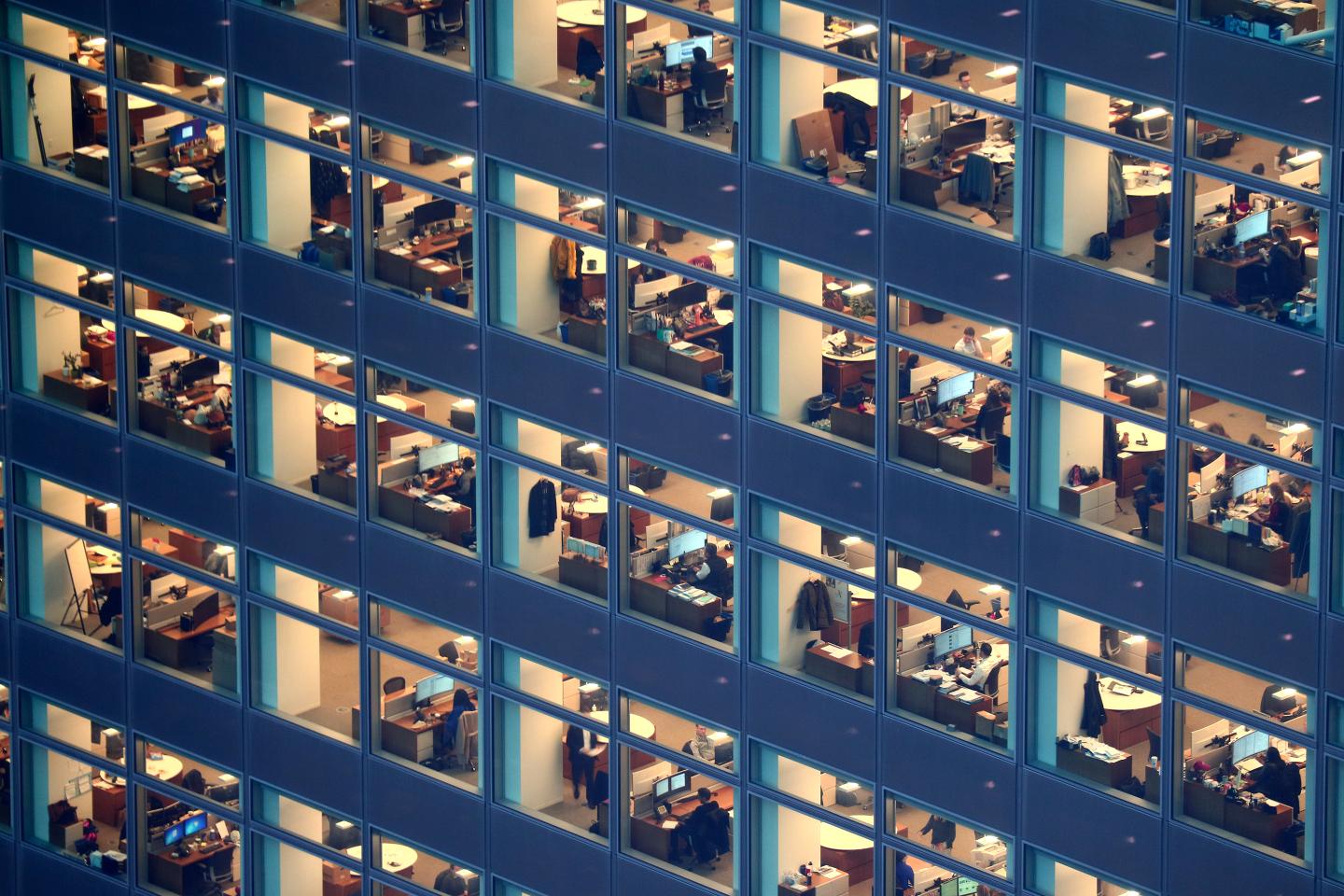
Blue skies. Startups have tried to attract employees with beer taps, ping-pong tables, and unlimited trail mix, but according to a new survey, office workers really just want a view of the outside world. The survey—run by human resources consultancy Future Workplace and View Inc., a manufacturer of tech-enabled glass for buildings—asked 1,600 North American professionals about workplace perks. Over half said they would most value natural light and a view from their desk. A sliver of that corner-office feeling, in exchange for the rec room amenities. [Fast Company]
A new vision. This week, California company Mojo Vision shared a plan to release the first-ever smart contact lens. Mojo is still in its research and development phase, and a working demo contact lens does not yet exist. If it did, the connected silicone disc would respond to the flick of an eye, displaying notifications, calendar events, and other content against the user’s field of vision. Mojo is teasing some form-specific use cases that make the lens more than a discreet smartwatch, such as an app that displays a script for the user. That could prove to be both discomfiting and harmless: You don’t want stage actors reading from a script, but it might make wedding speeches more tolerable. [Wired]
Safe search. Pinterest has a bit of a reputation as the nicest company in Silicon Valley. As if to prove it, CEO Ben Silbermann shared background on a product called “Compassionate Search.” When the photo-pinning platform noticed users searching for sensitive topics like depression, anxiety, and vaccines, it took it upon itself to engineer results to surface accredited, responsible information. Medical experts and clinical psychologists weighed in, a sign that Pinterest rejected moving fast and breaking things in favor of moving deliberately and safely. [Recode]
IN CASE YOU MISSED IT
Understanding the 2020 Election as Brand Marketing by Geoff Colvin
Industry standouts: The companies most admired by the business world by Scott DeCarlo and Matthew Heimer
The certainty of Magic Leap’s augmented-reality future by Aaron Pressman
How Ganni used tech-world tricks to grow from a cult fashion label to a global brand by Nicole Gull McElroy
BlackRock arrives fashionably late to sustainable portfolios by Eamon Barrett
DISCUSSION
There’s a line in Uncanny Valley, the journalist Anna Wiener’s new debut memoir, that’s hard to shake. “It was a strange place for young and moneyed futurists...they engaged with their new home by rating it,” she writes of those who moved to San Francisco in the wake of Facebook’s 2012 IPO, at the height of the Silicon Valley gold rush. It’s hardly the harshest indictment of the era, but it gets at an unnerving shift in human behavior that took hold. The sudden ability to geo-tag and share opinions and personal photos with strangers led quickly to the inability to simply wander in the world and see what you see. In a world of apps and services, spontaneous discovery gave way to an internet-enabled census on what’s “the best.”
No ratings system has proven as powerful as Instagram’s likes. Since launching in 2010, the metric has fundamentally changed the way users interface with their surroundings and how they view success, to the point of launching an entire new form of advertising.
Last fall, the photo-sharing app announced it would experiment with removing public likes, to make the platform less stressful for its users. This week, The New York Times profiled Adam Mosseri, head of Instagram and the man spearheading that effort. Besides surveying Mosseri’s career, the article reveals the complexity of untangling likes from the app:
“[Instagram] is carefully considering how this will happen, for months ‘dog-fooding’ (internal Insta-talk for testing) different variations of the new format. A post’s achievement of ‘thousands of likes’ or ‘tens of thousands of likes’ might still be public. Users might still be able to find others’ likes with a little more digging in the app. But the average teenager under pressure to be popular won’t need to suffer the indignity of only his mom liking his skateboarding post.”
Instagram gets design nips and tucks all the time, but Mosseri is proposing something more radical: a near-total overhaul on a system that, despite its short lifespan, is central to how many people experience being online. Imagine the ripple effect of unlearning the like. Without knowing who is watching (and caring), users may stop regarding personal life as a performance. The pressure could ease up; genuine delight in sharing could return.